


EU law is equally authentic in all 24 official languages, yet this very principle creates a paradox that catches businesses and legal professionals off guard. When a contract clause reads differently in French than in Polish, which version governs? When a regulatory obligation is clearer in German than in Spanish, which interpretation stands? This article examines why multilingual legal support is no longer optional for businesses operating across EU borders, and how getting it right protects you from costly, avoidable mistakes.
Key Takeaways
| Point | Details |
|---|---|
| EU legal certainty demands multilingualism | Every official language version of EU law carries legal authority, requiring careful support. |
| Risk and compliance hinge on precise translation | Misinterpretation or poor translation can lead to regulatory breaches and litigation. |
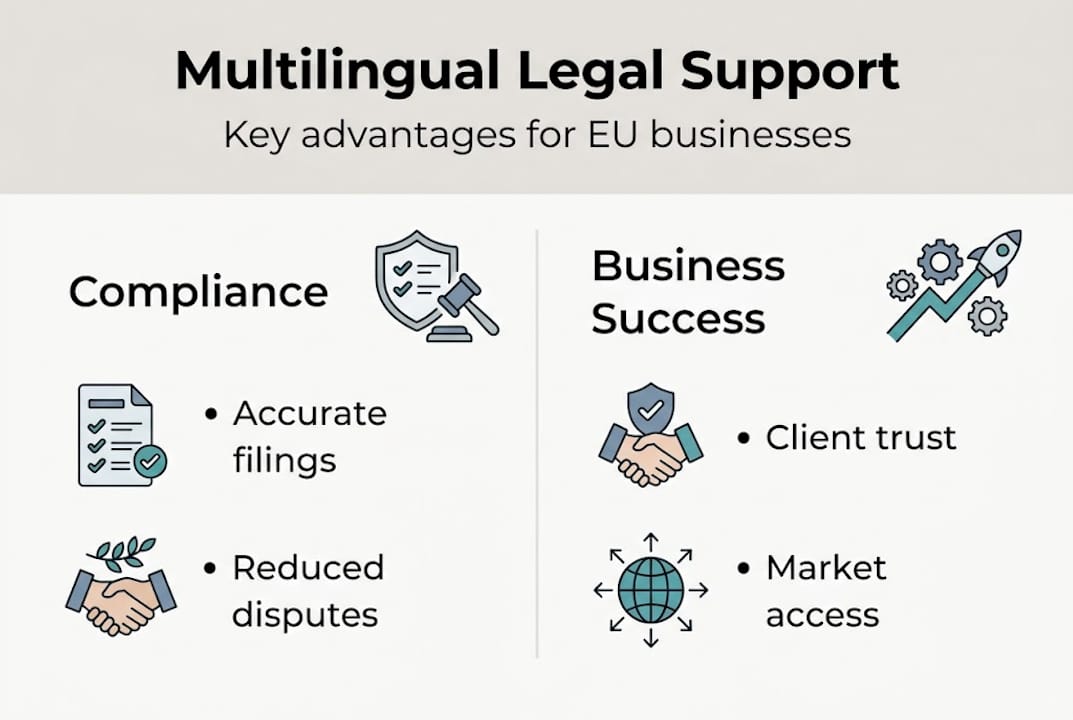
| Multilingual support builds client trust | Clients gain confidence when legal services communicate accurately and culturally appropriately. |
| It’s a strategic business advantage | Effective multilingual legal support opens access to new markets and lifts reputational standing. |
Why linguistic diversity matters in EU law
The EU’s legal framework is built on a commitment that no member state’s language holds superiority over another. All 24 official languages carry equal legal weight, meaning a regulation published in Romanian is as valid as one in English or French. This is a deliberate design choice rooted in equality and democratic legitimacy.
However, EU law authenticity across languages creates genuine complexity in practice. Legal terms do not always translate directly. A word that carries a precise technical meaning in one language may have a broader or narrower equivalent in another. Courts and practitioners must therefore consider multiple language versions simultaneously when resolving ambiguities, rather than defaulting to a single authoritative text.
The consequences of ignoring this are documented and serious. Consider contract disputes where diverging translations of a single clause led to protracted litigation because each party relied on a different language version. Regulatory compliance failures have also arisen when businesses assumed that translating a directive into their home language was sufficient, only to discover that the source version and the translated version imposed subtly different obligations.

According to the EU multilingualism report, linguistic diversity is fundamental to the EU’s democratic values, not merely a bureaucratic requirement. Businesses that treat it as the latter expose themselves to regulatory blind spots.
Working with specialist language service providers and compliance experts helps firms navigate this complexity systematically. Key risks arising from neglecting linguistic diversity include:
- Invalid contracts due to inconsistent terminology across language versions
- Regulatory non-compliance when obligations differ subtly between official translations
- Prolonged litigation caused by ambiguous or contradictory multilingual provisions
- Reputational damage when clients or regulators perceive careless communication
“Multilingualism is not a complication to be managed but a constitutional feature of EU law that demands respect in every legal transaction.”
This is not abstract theory. It is the operating reality for any business that signs contracts, files compliance reports, or navigates EU regulations across more than one member state.
Balancing equality and unity in EU legal interpretation
Recognising that diversity is foundational is only the first step. The deeper challenge is understanding how courts and practitioners achieve unity of law across 24 equally authentic versions.
The European Court of Justice consistently applies a purposive interpretation method. Rather than privileging one language, it looks at all versions to identify a common meaning consistent with the regulation’s purpose. This approach is necessary precisely because, as research shows, uniform interpretation across language versions prioritises EU law unity rather than sole reliance on one text, even where this creates tension with individual language versions.
In practice, this means de facto dominance of major languages such as English, French, and German in drafting and negotiation stages, while formal legal equality is maintained in the published texts. For businesses, this creates a two-tier reality: major language competence offers practical advantages, but legal exposure exists across all 24 languages.
Understanding the difference between translation and interpretation in law is particularly important here. A translated document is static; an interpreted interaction is dynamic. Both require distinct expertise and serve different functions in the compliance chain.
| Scenario | Equality and unity align | Equality and unity clash |
|---|---|---|
| Regulation with consistent terminology | All language versions reach the same outcome | Rare ambiguity, easily resolved |
| Contract clause with no direct equivalent | Purposive method bridges the gap | Litigation risk if only one version consulted |
| Court proceedings with multilingual parties | Certified interpretation ensures fairness | Reliance on informal translation creates unfairness |
| Compliance reporting across member states | Standardised legal glossaries ensure consistency | Inconsistent terminology triggers regulatory queries |
Using a structured localisation workflow for law ensures that your documents are prepared with all language versions in mind from the outset, not corrected reactively after a dispute emerges.
Pro Tip: Always cross-reference the official EU language versions of any regulation or directive that forms the basis of a contract or compliance obligation. A single missed discrepancy can invalidate an otherwise sound legal position.
How multilingual support mitigates risk and ensures compliance
With an understanding of the equality and unity tension, the practical question becomes: how do you protect your business? The answer lies in building multilingual legal support into your operational framework, not treating it as an afterthought when problems arise.
Linguistic diversity as a business asset requires practical embedding in processes, not just policy statements. EU businesses face three primary categories of risk when multilingual support is inadequate:
| Risk category | Example | How multilingual support addresses it |
|---|---|---|
| Contractual invalidity | Inconsistent terms across versions | Legal translators align terminology across all languages |
| Regulatory breach | Misread compliance obligation | Cross-referenced translations catch divergent interpretations |
| Litigation exposure | Ambiguous clause in a second language | Certified interpreters provide accurate oral renditions for hearings |
Building a risk-mitigating legal language strategy requires a structured approach. Follow these steps to establish a robust framework:
- Audit your existing documents. Identify all contracts, compliance filings, and regulatory submissions that exist in more than one language. Flag any that were translated without specialist legal oversight.
- Engage qualified legal translators. Work with translators who hold legal domain expertise, not general linguists. The distinction matters in ensuring translation quality for high-stakes documents.
- Integrate certified interpreters for proceedings. Any court hearing, regulatory interview, or formal negotiation involving multilingual parties should involve certified interpreters for compliance purposes.
- Establish a legal glossary. Standardise key terminology across all languages used in your operations. This prevents inconsistencies from accumulating across document versions.
- Review and update regularly. EU regulations change frequently. A document that was accurately translated in 2023 may no longer reflect the current legal position in 2026.
Pro Tip: Validate every high-stakes legal document with a certified interpreter or legal translator before signing or filing. Machine translation tools can assist with drafts, but they cannot yet reliably handle the nuance that EU legal texts demand.
The impact on client trust, communication, and cross-border success
Beyond risk management, multilingual legal support is a measurable driver of client confidence and business growth. Clients operating across borders need to know that their legal representation understands not just the law, but how it applies in their language and their cultural context.
The accuracy of human translators in legal settings consistently outperforms automated tools because they account for cultural nuance, jurisdictional context, and the intent behind the text. Clients notice this difference. When a client receives a contract in their preferred language that is accurate, culturally appropriate, and legally sound, their trust in the firm rises significantly.
The role of interpreters in court extends beyond mere language conversion. A skilled interpreter conveys register, tone, and legal precision, factors that can influence how testimony is received and how decisions are made.
Businesses and law firms that invest in visible multilingual capabilities gain competitive advantages that are difficult to replicate quickly:
- Expanded client base across multiple EU member states without communication barriers
- Stronger client retention because clients feel genuinely understood, not just served
- Faster cross-border deals where language barriers are proactively managed rather than reactively addressed
- Reduced dispute rates because terms are clear to all parties from the outset
“When our clients know that nothing is lost in translation, they sign with confidence and return with their next matter.”
The capacity to translate legal documents accurately and compliantly is therefore a client-facing capability as much as a compliance function. Firms that present this capability prominently differentiate themselves in competitive markets.
Research consistently shows that trust is the primary driver of long-term client relationships in professional services. Multilingual legal support, delivered to a high standard, is one of the most direct ways to build and sustain that trust across borders.
A crucial but underestimated investment for EU legal success
Too many firms treat multilingual legal support as a line item to be minimised rather than a strategic investment with measurable returns. This is a costly misjudgement. The hidden ROI of genuine multilingual expertise includes avoided litigation costs, retained clients, and accelerated deal timelines.
Relying solely on major languages or machine translation is not a neutral choice; it is an active risk. Every document produced without specialist legal oversight is a potential liability. Reframing multilingual expertise as foundational infrastructure, comparable to IT security or financial compliance, changes how firms allocate resources and how they win mandates.
Language service providers and compliance specialists are partners in legal certainty, not vendors of a commodity. The firms that understand this earliest are the ones building durable cross-border practices in 2026 and beyond.
Start building your multilingual legal edge

Glocco® works with legal professionals and businesses across the EU to deliver tailored translation and interpretation services that meet the precise demands of cross-border legal practice. Whether you need certified interpreters for court proceedings, specialist translators for regulatory filings, or a structured approach to accurate legal document translation, our team is ready to help. Contact Glocco® today to discuss your multilingual legal requirements and discover how the right language partner strengthens your compliance posture and client relationships.
Frequently asked questions
What makes multilingual legal support essential for EU businesses?
All 24 official EU languages carry equal legal validity, meaning compliance and contractual certainty require accurate multilingual support rather than reliance on a single language version.
How does multilingual legal support reduce business risk?
Accurate legal translations and interpretations prevent regulatory breaches, contract disputes, and costly misunderstandings by ensuring that obligations are consistent and clearly understood across all relevant language versions. Linguistic diversity embedded in services is the practical foundation for this protection.
When do law firms need certified interpreters?
Certified interpreters are essential during court proceedings, regulatory hearings, and formal multilingual negotiations where legal precision and accountability are non-negotiable.
Does one translation serve all EU member states?
No. Every official language version of EU law is equally authentic, so all relevant versions must be considered to ensure accuracy and full legal compliance across member states.


