


A single mistranslated legal term can invalidate a contract, trigger costly disputes, or expose your organisation to regulatory penalties across European jurisdictions. Legal document translation demands specialist expertise, rigorous quality assurance, and deep compliance knowledge to ensure every clause holds its intended meaning. This guide delivers practical best practices for achieving precise, legally valid translations that protect your interests in 2026.
Table of Contents
- Introduction To Legal Document Translation
- Prerequisites For Legal Document Translation
- Step-By-Step Translation Process For Legal Documents
- Common Mistakes In Legal Document Translation And How To Avoid Them
- Implementing Modern Translation Technologies
- Expected Timelines And Costs For Legal Document Translation
- Summary And Best Practices For Legal Document Translation
- Explore Professional Legal Translation And Sworn Translation Services With Glocco
- Frequently Asked Questions
Key takeaways
| Point | Details |
|---|---|
| Specialist expertise required | Legal translation demands qualified legal linguists with jurisdictional knowledge and certified credentials. |
| Quality assurance cuts errors | Multi-stage review processes reduce errors to 1% or less through expert proofreading and contextual validation. |
| Certification ensures validity | Certified translations with proper notarisation secure legal acceptance by European courts and authorities. |
| Technology accelerates delivery | AI tools combined with human oversight can speed turnaround while maintaining accuracy and compliance standards. |
| Avoid common pitfalls | Never rely solely on generic machine translation or ignore formatting requirements that affect legal interpretation. |
Introduction to legal document translation
Legal document translation involves converting contracts, court filings, patents, and regulatory documents between languages whilst preserving precise legal meaning and intent. Unlike general translation, this specialised field requires exact terminology that accounts for jurisdictional differences across European legal systems. A mistranslated clause in a commercial agreement can render the contract unenforceable, whilst errors in litigation documents may result in case dismissals or financial penalties.
The European legal landscape presents unique complexity. Each member state maintains distinct legal frameworks, terminology conventions, and procedural requirements. Translators must navigate civil law traditions in France and Germany, common law influences in Ireland, and hybrid systems across other jurisdictions. This demands specialised knowledge beyond linguistic fluency.
Typical risks from poor legal translation include:
- Invalid contracts that courts refuse to enforce due to ambiguous or incorrect terms
- Regulatory non-compliance triggering fines when translated filings fail to meet legal standards
- Prolonged disputes arising from misinterpreted obligations or rights in multilingual agreements
- Financial losses when mistranslated patent claims weaken intellectual property protection
- Reputational damage to law firms and businesses following public translation failures
Rigorous quality assurance processes form the foundation of risk mitigation. Multi-stage reviews with legal expert validation improve accuracy to 99%, dramatically reducing the likelihood of invalid documents. This approach requires coordinated efforts between qualified translators, legal specialists, and quality assurance teams who understand both source and target legal contexts.
Understanding sworn translation essentials proves critical for documents requiring official certification. Professional legal translation accuracy and compliance standards provide frameworks that guide best practices across European jurisdictions.
Prerequisites for legal document translation
Successful legal translation projects begin with establishing proper groundwork before any linguistic work commences. Your first requirement involves securing specialised legal translators who possess both linguistic expertise and legal training. These professionals must demonstrate proven experience with relevant legal systems in both source and target languages. Translators with legal subject matter expertise and jurisdictional understanding deliver substantially higher accuracy than general translators.
Regulatory knowledge forms the second critical prerequisite. Your translation team must understand European legal compliance requirements specific to your document type and target jurisdiction. This includes familiarity with data protection regulations, contract law principles, court filing standards, and industry-specific legal frameworks. Different member states impose varying certification requirements for legal translations.
Certification and notarisation awareness ensures your translated documents achieve legal validity. Many European jurisdictions require sworn translators to certify legal documents before courts or government bodies accept them. Understanding sworn translation requirements early in your project prevents costly delays and rejections.
Technology infrastructure supports quality and security throughout the translation process:
- Secure document management systems that protect confidential legal information during transmission and storage
- Translation memory tools that maintain terminology consistency across large document sets
- Formatting preservation software ensuring translated documents mirror original layouts precisely
- Quality assurance platforms enabling multi-stage review workflows with tracked changes
- Encrypted communication channels safeguarding sensitive client information
Pro Tip: Request documented proof of translator qualifications, including legal credentials, sworn translator licences, and jurisdiction-specific certifications before engaging any legal translation service. Verify their experience with your specific document type and target legal system.
Establishing clear communication protocols between legal teams and translators prevents misunderstandings. Your translators need access to subject matter experts who can clarify ambiguous terms, explain contextual nuances, and validate legal interpretations during the translation process.
Step-by-step translation process for legal documents
Follow this structured workflow to achieve accurate, compliant legal translations that withstand scrutiny.
-
Prepare and organise original documents: Convert all legal documents into editable digital formats such as Word or searchable PDFs. Remove any formatting inconsistencies, verify page numbering, and compile reference materials including relevant legislation, precedents, or glossaries. This preparation reduces errors and accelerates subsequent stages.
-
Assign qualified translators: Match translators to projects based on verified legal expertise aligned with your document’s subject matter and target jurisdiction. Verify their sworn translator status if certification is required. Establish clear deadlines, formatting requirements, and communication protocols upfront.
-
Implement multi-stage quality assurance: Execute rigorous review cycles including initial translation, specialist legal proofreading, and contextual validation by subject matter experts. Multi-stage quality assurance with legal expert review achieves near 99% accuracy, making this stage non-negotiable for legal documents.
-
Obtain required certification: Arrange for sworn translator certification or notarisation as legally mandated in your target jurisdiction. This step ensures courts and authorities accept your translated documents without challenge.
-
Deliver final translations: Transmit completed documents through secure channels whilst maintaining formatting integrity. Provide certification documentation, translator credentials, and any required affidavits or declarations of accuracy.
| Step | Purpose | Key Actions |
|---|---|---|
| Preparation | Reduce errors and establish clear scope | Digitise documents, compile references, verify completeness |
| Assignment | Match expertise to requirements | Verify qualifications, confirm jurisdiction knowledge, set expectations |
| Quality assurance | Eliminate errors and validate legal accuracy | Execute multi-round reviews, engage legal experts, track changes |
| Certification | Secure legal validity | Obtain sworn translator stamps, arrange notarisation, prepare affidavits |
| Delivery | Maintain integrity and confidentiality | Use encrypted transmission, preserve formatting, provide documentation |
Pro Tip: Maintain a detailed audit trail documenting every revision, reviewer comment, and quality check throughout your translation project. This record provides legal defensibility if translation accuracy is later questioned in court proceedings or regulatory audits.
Effective legal translation workflows integrate these steps seamlessly, reducing project timelines whilst maintaining rigorous quality standards. Building buffer time into your schedule accommodates unforeseen clarifications or additional review rounds without compromising deadlines.
Common mistakes in legal document translation and how to avoid them
Recognising frequent translation failures helps you implement safeguards that protect document validity and legal standing.
Literal word-for-word translations represent the most dangerous error. Legal concepts rarely map directly between languages, and literal renderings often miss contextual legal meaning. A contract term that functions perfectly in English may require completely different phrasing in French or German civil law contexts to convey the same legal obligations. Literal translations lacking legal contextual adaptation cause invalid contracts and misinterpreted rights.
Generic machine translation tools create systematic problems when applied to legal documents without expert oversight:
- Mistranslated technical legal terminology that changes substantive meaning
- Inconsistent term usage across long documents that creates ambiguity
- Grammatical errors affecting legal interpretation and enforceability
- Missing cultural and jurisdictional context essential for proper adaptation
- Formatting corruption that disrupts document structure and readability
Jurisdictional terminology mismatches occur when translators fail to account for different legal systems. Common law terms like “consideration” or “estoppel” have no direct equivalents in civil law jurisdictions. Translators must find functional equivalents that preserve legal effect rather than forcing inappropriate direct translations.
“The difference between the right word and the almost right word is the difference between lightning and a lightning bug. In legal translation, that difference can invalidate an entire contract or lose a court case.”
Ignoring certification requirements causes document rejection. Courts and government bodies in many European countries refuse uncertified translations regardless of accuracy. Verify certification needs early and engage appropriately licensed translators.
Formatting errors create serious problems in legal contexts. Incorrect clause numbering, disrupted paragraph structure, or corrupted tables can alter meaning or make documents difficult to reference during legal proceedings. Professional legal translation maintains original formatting precisely.

The solution involves always engaging certified translators with proven legal expertise and implementing mandatory multi-stage review processes. Understanding how language service providers impact compliance helps you select partners who prioritise accuracy over speed.
Implementing modern translation technologies
Combining artificial intelligence with expert human oversight transforms legal translation efficiency without compromising accuracy or compliance.
AI-powered translation platforms offer substantial productivity gains when properly deployed. These systems learn from vast databases of legal terminology, enabling faster initial translations than purely manual approaches. Modern neural machine translation can handle complex sentence structures and maintain contextual awareness across paragraphs. However, AI alone cannot replace human legal expertise for critical documents.
The human-in-the-loop approach maximises technology benefits whilst preserving quality. Qualified legal translators review and refine AI-generated drafts, correcting errors, adapting jurisdictional terminology, and ensuring legal coherence. AI combined with human expert review reduces turnaround times by 70% whilst maintaining accuracy standards required for legal validity.
Specialised legal translation platforms provide essential infrastructure:
- Translation memory systems that ensure consistent terminology across related documents
- Formatting preservation tools maintaining original document structure through the translation process
- Secure cloud environments protecting confidential legal information with encryption and access controls
- Collaborative review interfaces enabling legal experts and translators to work seamlessly
- Quality metrics tracking error rates, consistency scores, and compliance markers
Data security remains paramount when handling sensitive legal documents. Technology solutions must implement end-to-end encryption, role-based access controls, and comprehensive audit logs documenting every interaction with confidential files. Compliance with GDPR and other European data protection regulations is non-negotiable.
Pro Tip: Prioritise translation providers offering integrated platforms that combine secure AI assistance with certified human translators. This hybrid approach delivers optimal speed and accuracy whilst maintaining legal defensibility. Explore AI and machine translation services designed specifically for legal and compliance-sensitive content.
Expected timelines and costs for legal document translation
Understanding realistic delivery expectations and cost factors enables better project planning and budget allocation.
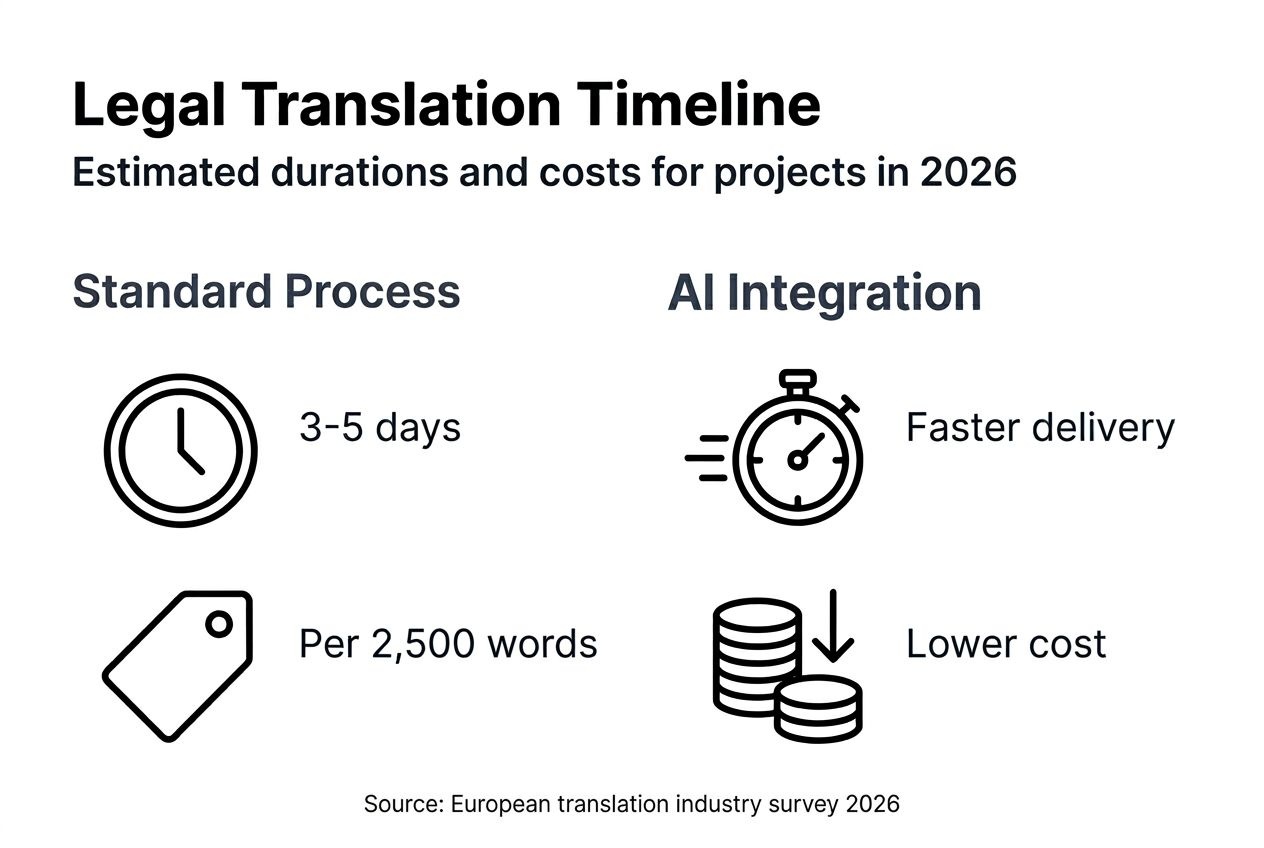
Standard legal documents typically require three to five business days per 2,500 words when using qualified translators with appropriate quality assurance processes. Complex technical contracts, patent applications, or litigation documents may require longer timelines to ensure accuracy. Rush services can compress timelines to 24 hours for urgent matters, though this significantly increases costs and may compromise some quality assurance steps.
Cost benchmarks vary across European markets and document complexity:
| Document Type | Typical Cost Range (per word) | Average Turnaround |
|---|---|---|
| Standard contracts | €0.12 to €0.18 | 3 to 5 business days |
| Court filings | €0.15 to €0.25 | 2 to 4 business days |
| Patents and IP documents | €0.20 to €0.35 | 5 to 10 business days |
| Regulatory compliance documents | €0.15 to €0.22 | 3 to 7 business days |
| Certified translations with notarisation | Additional €30 to €100 per document | Additional 1 to 2 business days |
Several factors influence final pricing and delivery schedules:
- Document complexity and technical terminology density requiring specialist translators
- Target language combinations, with less common pairs commanding premium rates
- Certification and notarisation requirements adding administrative time and fees
- Urgency of delivery, with rush services typically doubling standard rates
- Volume discounts for large projects or ongoing translation programmes
Technology integration reduces both costs and timelines. Providers leveraging AI-assisted workflows with human review can offer 20% to 30% cost reductions compared to purely manual translation whilst delivering faster turnaround. Understanding translation workflows and timelines helps you evaluate provider capabilities objectively.
When negotiating with translation providers, clarify exactly what services are included in quoted prices. Confirm whether costs cover quality assurance rounds, certification fees, formatting preservation, and project management. Request detailed timelines with milestones for multi-document projects to track progress effectively.
Summary and best practices for legal document translation
Implementing these proven practices ensures your legal translations achieve accuracy, compliance, and validity across European jurisdictions.
Your essential checklist for quality legal translation includes:
- Engage certified legal translators with verified expertise in relevant legal systems and subject matter
- Implement mandatory multi-stage quality assurance with legal expert review and proofreading
- Verify certification and notarisation requirements for your target jurisdiction before starting work
- Use secure technology platforms that preserve formatting whilst protecting confidential information
- Maintain detailed audit trails documenting all revisions and quality checks for legal defensibility
- Allow adequate timelines for thorough review rather than rushing projects that compromise accuracy
Certified and notarised translations provide legal validity that courts and authorities recognise without challenge. This extra step proves essential for contracts, court filings, corporate documents, and regulatory submissions across Europe.
Combining modern technology with human expertise delivers optimal results. AI-assisted platforms accelerate initial translation whilst qualified legal experts ensure contextual accuracy and jurisdictional appropriateness. This hybrid approach balances speed with the precision legal documents demand.
Clear communication throughout the translation process prevents misunderstandings and enables efficient clarification of ambiguous terms. Establish direct channels between your legal team and translation specialists to address questions promptly. Transparency about document purpose, target audience, and compliance requirements helps translators make informed decisions about terminology and phrasing.
Adherence to recognised workflows tailored for European legal frameworks provides systematic quality control. Following legal translation best practices established by professional language service providers reduces errors substantially and protects your organisation from costly translation failures.
Explore professional legal translation and sworn translation services with Glocco
Glocco provides certified legal and sworn translation services designed specifically for European legal professionals and businesses requiring accuracy and compliance. Our advanced localisation workflows reduce errors by 60% through rigorous multi-stage quality assurance processes.
We combine qualified legal linguists with AI-enhanced technology platforms to deliver timely, precise translations that maintain formatting integrity and meet jurisdictional requirements. Our services support complete confidentiality and compliance standards across contract translation, litigation support, regulatory filings, and intellectual property documentation.
Discover comprehensive sworn translation guidance for 2026 covering certification requirements across European jurisdictions. Our integrated approach ensures your legal documents achieve validity and defensibility whilst meeting tight deadlines.
Frequently asked questions
What qualifications should legal translators have?
Legal translators require formal qualifications in legal linguistics, demonstrated expertise in relevant jurisdictions, and sworn translator licences where certification is legally required. Many hold law degrees or specialised legal translation certifications from recognised professional bodies. Verify their experience with your specific document type and target legal system before engagement.
How can certification impact the acceptance of translated legal documents?
Certified and notarised translations carry legal validity that courts and government authorities recognise without challenge. Many European jurisdictions mandate sworn translator certification for contracts, court filings, and official documents. Uncertified translations face rejection regardless of accuracy, causing costly delays and potentially invalidating legal proceedings.
Are machine translation tools suitable for legal documents?
Generic machine translation tools produce unacceptably high error rates for legal documents and cannot replace qualified human experts. However, AI-assisted platforms with mandatory human review by legal specialists can improve efficiency without sacrificing accuracy. The key lies in combining technology with expert oversight rather than relying on automated translation alone.
What factors influence the cost and timeline of legal translation projects?
Document complexity, required certifications, delivery urgency, and jurisdiction-specific regulations significantly impact both cost and turnaround times. Technical terminology density, target language combinations, and volume also affect pricing. Rush services and specialised legal expertise command premium rates, whilst technology integration can reduce costs by 20% to 30% compared to purely manual approaches.


