


TL;DR:
- Certification ensures translation accuracy and legal compliance across Europe’s regulated sectors.
- Certified professionals follow structured workflows that reduce errors by over 60%.
- Choosing ISO-compliant providers prevents costly delays and compliance failures.
Across Europe, the assumption that any competent translator will meet legal and regulatory requirements is costing organisations dearly. 70% of EU compliance failures are caused by translation errors, and document rejections are rising as cross-border operations grow more complex. A certified translation professional is not simply a linguist with good language skills; they are a regulated, credentialled expert whose work meets the specific standards required by courts, regulators, and corporate compliance frameworks. This article explains what sets these professionals apart, why certification is non-negotiable for legal and business documentation, and how to choose the right expert for your organisation’s needs.
Key Takeaways
| Point | Details |
|---|---|
| Certification is crucial | Certified professionals are essential for legal and compliance-critical translations across Europe. |
| Non-certified risks high | Translation errors lead to 70% of EU compliance failures and many document rejections. |
| Human oversight required | Regulators reject 90% of machine-only translations, so expert review is mandatory. |
| Choose wisely | Check credentials, sector expertise, and workflows before appointing any translation professional. |
What is a certified translation professional?
A certified translation professional is someone who holds recognised qualifications confirming their competence to produce translations that meet legal, regulatory, or institutional standards. Certification is not a single universal standard. Across Europe, it takes different forms depending on jurisdiction, but in every case it signals that the translator has been independently assessed and is accountable for the accuracy and integrity of their work.
Credentials vary, but they typically include one or more of the following:
- Membership of a national or EU-recognised professional body, such as the Chartered Institute of Linguists (CIOL) in the UK or the Fédération Internationale des Traducteurs
- Formal academic qualifications in translation, linguistics, or a specialist field such as law or medicine
- ISO 17100 certification, the international standard for translation service providers governing processes, resources, and quality management
- Sworn or court-appointed status in jurisdictions where official recognition by a legal authority is required
- Sector-specific training, particularly relevant for legal, medical, and technical documents
Certified professionals perform a distinct range of functions that general translators do not. They translate contracts, court rulings, regulatory submissions, patent applications, and other legally binding documents while ensuring terminological precision and jurisdictional accuracy. They sign and stamp documents to attest to their completeness and fidelity to the source text. They work within documented quality assurance processes, often in peer-reviewed workflows.
“A certified translator does not just convert words. They carry professional and, in many jurisdictions, legal responsibility for the accuracy of the final document.”
This is the crucial distinction from general translators, certified interpreters, and AI-powered services. General translators may produce fluent, readable text, but without certification they cannot attest to legal compliance. AI tools, despite rapid improvement, remain fundamentally unsuitable for official documentation. 90% of regulators reject machine-only translated documents outright. For legal teams and compliance officers, understanding sworn translation in Europe is equally important, as sworn status carries additional legal force that certified translation alone may not fulfil in every context.
Why certification matters for legal and business compliance
Certification is not an administrative formality. It is the mechanism through which organisations manage real legal and financial risk. Courts, public authorities, and regulators across the EU require certified translations for most filings, from contract submissions to immigration documents, merger filings, and product compliance dossiers. A translation rejected on certification grounds can delay proceedings, trigger fines, or invalidate an entire submission.

The financial and operational stakes are significant. Consider the documented impact of translation quality on compliance outcomes:
| Outcome | With certified professionals | Without certified professionals |
|---|---|---|
| Document acceptance rate | High | Significantly lower |
| Error rate | Reduced by up to 60% | Elevated |
| Processing speed | Up to 20% faster | Slower due to resubmissions |
| Regulatory risk | Managed and mitigated | Increased exposure |
| Reputational impact | Protected | Potential long-term damage |
Specialist LSPs and compliance errors research confirms that working with a specialist language service provider (LSP) rather than a generalist delivers 35% fewer errors and 20% faster turnaround times. That is a measurable operational advantage, not just a quality preference.
ISO-certified workflows are particularly important. Organisations that implement ISO-compliant localisation processes see a reduction in translation-related errors of more than 60%, according to published benchmarks. This directly affects translation quality for compliance in regulated sectors such as pharmaceuticals, financial services, and law.
Pro Tip: If your organisation operates across multiple EU member states, request proof of ISO 17100 compliance from any translation provider before engaging them. Non-compliant providers may appear cost-effective upfront but generate expensive resubmissions and delays.
Beyond regulatory consequences, there is reputational damage to consider. A mistranslated clause in a contract or an error in a regulatory submission signals professional negligence to counterparties and authorities. The cost of rebuilding trust far exceeds the cost of getting certified translation right the first time.
How certified professionals improve translation accuracy
Certified professionals do not simply translate more carefully. They operate within structured, documented systems that systematically reduce the risk of error. Understanding how these systems work helps legal and compliance teams set informed expectations and ask the right questions of their providers.
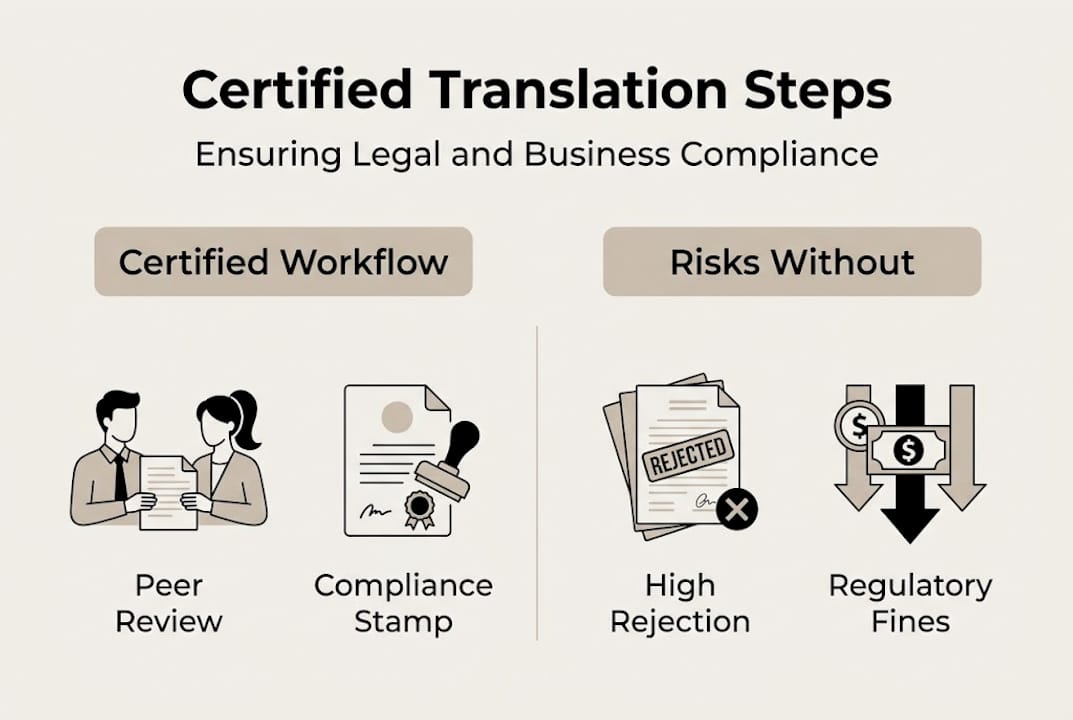
Here are the key stages in a certified professional’s quality assurance process:
- Terminology management: Certified professionals build and maintain specialist glossaries for each client or sector, ensuring that legal and technical terms are rendered consistently across all documents.
- Translation and self-review: The translator produces the initial translation and then reviews it against the source text, checking for completeness, accuracy, and formatting.
- Peer review: A second qualified professional reviews the draft independently, identifying errors the original translator may have missed.
- Compliance checking: Specific compliance checklists verify that terminology, formatting, and attestation requirements meet the target jurisdiction’s standards.
- Final approval and attestation: The certified translator signs, dates, and where required, stamps the document to confirm its accuracy and completeness.
The difference between this and an uncertified or AI-driven workflow is stark:
| Workflow type | Peer review | Compliance checklist | Attestation | Error risk |
|---|---|---|---|---|
| Certified professional | Yes | Yes | Yes | Low |
| General translator | Rarely | No | No | Moderate |
| AI-only | No | No | No | High |
For organisations handling legally binding documents, the case for certified workflows is clear. ISO-certified localisation workflow benchmarks show that ISO-compliant processes cut errors by 60% compared to unstructured approaches. The role of human translators in legal contexts remains irreplaceable, particularly where nuance, intent, and jurisdictional precision are at stake.
Key insight: Organisations that switched to certified, ISO-compliant providers reported not only fewer rejections but faster internal approvals, because compliance teams trusted the documentation from the outset.
Choosing the right certified translation professional
Selecting the right certified translation professional requires more than verifying a credential. It demands a structured assessment that matches the provider’s expertise to your specific regulatory context. The following framework provides a clear starting point.
Credentials to verify:
- Membership of a recognised professional body (CIOL, FIT, or equivalent national body)
- ISO 17100 or ISO 9001 certification for the translation service provider
- Sworn or court-appointed status where required by the target jurisdiction
- Sector-specific experience, whether legal, medical, technical, or financial
- Documented peer review processes and quality assurance workflows
Questions to ask prospective providers:
- How do you manage terminology consistency across a project?
- Who reviews the translation before delivery, and what are their qualifications?
- What is your process for ensuring compliance with the specific regulatory requirements of the target jurisdiction?
- Can you provide references from clients in our sector?
For organisations procuring accurate legal translation at scale, red flags include unusually low pricing, AI-only delivery without human oversight, and an inability to provide proof of peer review. These are not signs of efficiency; they are indicators of risk.
Pro Tip: When evaluating providers for sensitive sectors such as healthcare, always check for experience specifically with medical translation risks. Errors in medical documents carry patient safety implications that go well beyond compliance penalties.
90% of regulators reject machine-translated documents without certified human oversight. This single data point should anchor every procurement decision your organisation makes around translation services. Speed and cost are valid considerations, but they must not come at the expense of regulatory acceptance.
Why most compliance failures are preventable: an expert viewpoint
After working with legal teams, regulators, and corporate compliance officers across Europe, one pattern emerges clearly: most translation-related compliance failures are not caused by ignorance of the rules. They are caused by process shortcuts that people believed would save time.
Organisations often engage general translators for documents that require certified professionals, or rely on machine translation for filings where human attestation is mandatory. The rationalisation is always the same: cost, speed, or a belief that the document is “simple enough” to avoid scrutiny. It rarely is.
70% of EU compliance failures trace back to translation errors. That is a preventable statistic. The knowledge exists, the certified professionals are available, and the ISO-compliant workflows are proven. What is missing in most failures is organisational discipline around translation as a compliance function, not an afterthought.
The organisations that consistently pass regulatory scrutiny treat certified translation with the same rigour as legal review or financial audit. They build it into their compliance calendar, not their contingency budget. The role of human translators in compliance is not supplementary; it is foundational.
Get certified expertise for your documentation
At Glocco®, our certified professionals are equipped to meet the full spectrum of EU legal and business documentation requirements. Whether you need accurate certified translation services for court submissions, regulatory filings, or cross-border contracts, our ISO-compliant workflows ensure your documents are accepted first time. We support clients across legal, financial, medical, and technical sectors with proven accuracy and fast turnaround.
If you are unsure whether you need translation or interpretation support, our guide on translation vs interpretation will help clarify the right service for your situation. And for teams managing ongoing compliance documentation, our human translators for compliance service is designed to integrate seamlessly into your existing processes. Contact us to request a consultation or quote today.
Frequently asked questions
What is the difference between certified and sworn translation?
Certified and sworn translation differ primarily in legal standing: certified translation confirms professional competence and accuracy, while sworn translation is performed by a legally appointed translator and carries official legal authority in specific jurisdictions.
Are machine translations ever acceptable for legal or compliance documents?
No. 90% of regulators reject documents translated by machine alone, and certified human involvement is required for any document intended for official or regulatory use.
How do I verify a translation professional’s certification?
Request proof of membership with a recognised certifying body and ask for documented quality assurance workflows; you can also cross-check certification requirements with national or EU-recognised professional associations.
Why is ISO workflow important in translation?
ISO-certified processes are structured to cut errors by 60% compared to unstructured approaches, making them essential for ensuring consistent compliance and regulatory acceptance of translated documents.


