


Many legal professionals assume modern machine translation tools can handle legal documentation with sufficient accuracy. This misconception puts compliance at risk across European jurisdictions where precise terminology and contextual understanding determine legal validity. Human translators bring irreplaceable expertise in navigating complex legal language, cultural nuances, and jurisdictional requirements that automated systems simply cannot replicate. Understanding why human involvement remains essential protects your practice from costly errors and regulatory failures.
Key takeaways
| Point | Details |
|---|---|
| Precision matters | Human translators ensure accurate interpretation of specialised legal terminology that machines frequently mishandle. |
| Context is critical | Machine translation cannot fully grasp legal context, cultural implications, and jurisdictional variations across Europe. |
| Compliance protection | Professional human translators help maintain compliance with diverse European legal standards, reducing error rates significantly. |
| Risk mitigation | Human oversight lowers the risk of costly legal errors that automated translations often introduce into documentation. |
| Confidentiality assurance | Ethical considerations and sensitive legal matters require trusted human translators who uphold professional confidentiality standards. |
Understanding the complexity of legal translation
Legal language operates in a realm where single word choices carry enormous consequences. A misplaced term in a contract clause can alter obligations, liabilities, and rights in ways that ripple through entire agreements. Unlike general content translation, legal document translation demands deep understanding of both source and target legal systems, not merely linguistic conversion.

European jurisdictions present unique challenges because each country maintains distinct legal frameworks, procedural requirements, and terminology conventions. What constitutes valid contractual language in German civil law differs fundamentally from English common law principles. Human translators apply years of specialised training to navigate these variations, ensuring translations respect both linguistic accuracy and legal validity within specific jurisdictions.
Machine translation tools process words through algorithms that lack contextual awareness of legal implications. They cannot distinguish between ordinary usage and technical legal meanings, leading to dangerous misinterpretations. Consider how “consideration” in contract law carries specific technical meaning beyond its everyday sense, or how “force majeure” requires precise rendering to maintain its legal effect across languages.
Pro Tip: Always engage translators who hold both linguistic qualifications and formal legal training or extensive experience in your specific practice area for optimal accuracy.
Legal translation challenges include:
- Specialised terminology requiring precise equivalents in target languages
- Idiomatic expressions embedded in legal traditions that resist literal translation
- Statutory references that must align with corresponding provisions in different legal systems
- Procedural terms specific to court systems and administrative processes
- Cultural concepts underlying legal principles that vary between jurisdictions
- Formatting requirements for official documents that differ by country
Limitations of automated translation in legal contexts
Automated translation systems have improved remarkably in recent years, yet they consistently fail when confronted with legal documentation complexity. These tools excel at straightforward content but struggle profoundly with the interpretative demands legal texts require. The stakes in legal work mean even small errors can trigger compliance failures, contractual disputes, or regulatory penalties.
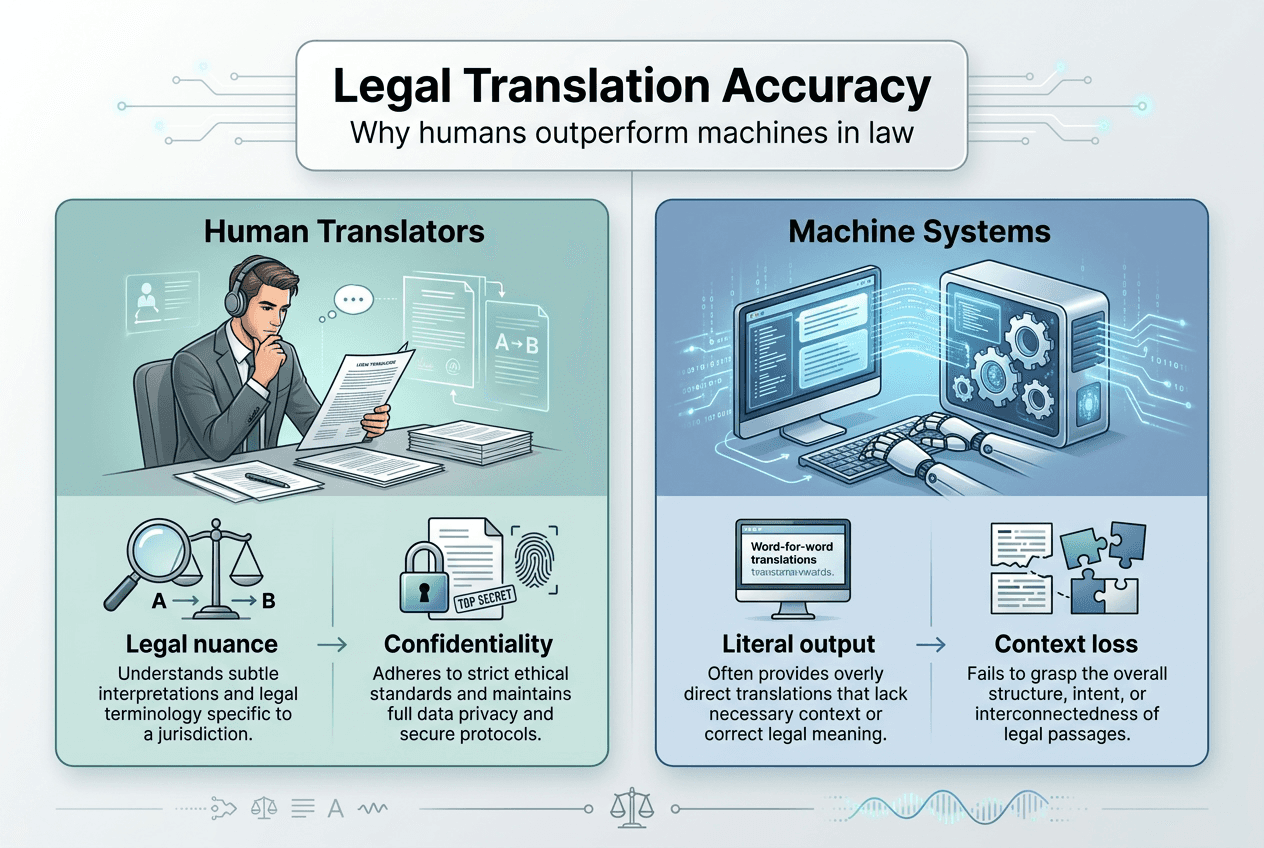
Machine translation algorithms cannot interpret legislative intent, apply precedent, or recognise when statutory language requires adaptation rather than direct translation. They process text linearly without understanding how legal clauses interconnect or how specific terms gain meaning from broader document context. This limitation becomes particularly dangerous in cross-border transactions where multiple legal systems intersect.
Key limitations affecting legal translation quality:
- Inability to recognise and correctly render jurisdiction-specific legal terminology
- Failure to maintain consistent terminology across lengthy documents where precision matters
- Mishandling of conditional clauses and complex sentence structures common in legal drafting
- Omission or alteration of critical qualifiers that change legal meaning substantially
- Lack of awareness regarding formal register requirements in different legal cultures
- Inability to verify accuracy against relevant legal sources and precedents
Consider a contract clause specifying liability limitations. Machine translation might render the words accurately whilst completely missing how those limitations interact with mandatory consumer protection laws in the target jurisdiction. A human translator recognises this conflict and alerts you to potential enforceability issues before they become problems.
Pro Tip: Use machine translation only for preliminary understanding of foreign legal documents, never for official submissions, court filings, or binding agreements without comprehensive human review.
The translation impact on accuracy in regulated fields demonstrates how automated systems introduce errors that human oversight prevents. Legal documentation demands the same rigorous human verification to ensure compliance and protect client interests.
Benefits of professional human translators for legal compliance
Professional human translators deliver measurable compliance advantages that directly protect your practice and clients. Research shows professional translators reduce errors by 35% in EU legal compliance contexts, a margin that can mean the difference between successful transactions and costly litigation.
Human translators understand regulatory frameworks governing legal documentation across European jurisdictions. They recognise when translations must meet certified or sworn translation requirements, ensuring documents gain legal recognition in target countries. This expertise proves invaluable for court submissions, notarised agreements, corporate filings, and immigration documentation where regulatory compliance determines validity.
| Aspect | Human Translation | Machine Translation |
|---|---|---|
| Legal accuracy | Expert interpretation ensures precise terminology and contextual correctness | Frequent errors in specialised terms and legal concepts |
| Confidentiality | Professional ethics and secure processes protect sensitive information | Data processed through third-party servers raises security concerns |
| Legal knowledge | Translators possess understanding of relevant legal systems and requirements | No awareness of legal implications or jurisdictional requirements |
| Compliance risk | Minimal risk with qualified translators familiar with regulatory standards | High risk of non-compliance due to errors and omissions |
| Quality assurance | Multiple review stages and verification against legal sources | No verification or quality control mechanisms |
Confidentiality represents another critical advantage human translators provide. Legal matters involve sensitive client information, trade secrets, and privileged communications that require absolute discretion. Professional translation services implement robust confidentiality protocols, including non-disclosure agreements and secure document handling procedures. The secure multilingual communication case study illustrates how proper security measures protect sensitive information during translation processes.
Pro Tip: Verify that your translation provider maintains ISO certifications for quality management and information security, particularly ISO 17100 for translation services and ISO 27001 for data protection.
Human translators also provide invaluable consultation beyond mere translation. They identify potential legal issues, suggest alternative phrasings that better suit target jurisdictions, and alert you to cultural considerations that might affect document reception or interpretation. This advisory role transforms translation from a mechanical process into strategic legal support.
Applying human translation in legal practice: real-world strategies
Integrating professional human translation into your legal workflows requires systematic approaches that maximise accuracy whilst maintaining efficiency. The process begins with proper document assessment to determine translation requirements, urgency, and specific jurisdictional considerations that will guide translator selection.
Selecting qualified translators demands attention to multiple criteria:
- Professional certifications in translation and relevant legal specialisations
- Demonstrated expertise in your specific legal field (corporate, litigation, intellectual property, etc.)
- Native-level proficiency in target language with deep cultural knowledge
- Understanding of both source and target legal systems
- Membership in professional translation associations with ethical standards
- Proven confidentiality protocols and security measures
- Quality assurance processes including peer review and verification
Implementing effective translation workflows:
- Assess document type, purpose, and jurisdictional requirements to determine translation specifications
- Select translators with appropriate legal expertise and language combinations for your needs
- Provide translators with context, reference materials, and clarification of document purpose
- Review translated drafts collaboratively, addressing questions and ensuring accuracy
- Conduct final verification against source documents and legal requirements
- Obtain certification or sworn translation status where legally required
- Maintain translation records and terminology databases for consistency across future documents
Sworn translation deserves particular attention in legal practice. Many European jurisdictions require sworn translators for official documents submitted to courts, government agencies, or regulatory bodies. These specially certified translators hold legal authority to attest translation accuracy, and their certifications carry official recognition. Understanding when sworn translation becomes necessary prevents delays and ensures your documents meet formal requirements.
Maintaining translation quality over time requires building relationships with trusted translation providers who understand your practice areas and terminology preferences. Consistent collaboration allows translators to develop familiarity with your work, creating efficiency gains whilst preserving accuracy. Many firms establish preferred provider arrangements that streamline processes for recurring translation needs.
The legal document translation process benefits enormously from clear communication between legal professionals and translators. Share background information, explain document purposes, and remain available for questions during translation. This collaborative approach produces superior results compared to treating translation as a simple handoff task.
Explore expert legal translation services for compliance
Navigating the complexities of legal translation across European jurisdictions demands partners who understand both linguistic precision and legal requirements. Glocco specialises in providing professional human translation services tailored specifically for legal professionals who cannot afford errors or compliance failures. Our translators combine legal expertise with linguistic mastery, ensuring your documentation meets the highest standards for accuracy and regulatory compliance.
We recognise that legal work involves sensitive information requiring absolute confidentiality. Our secure processes and professional ethics protect your clients whilst delivering translations you can trust for court submissions, cross-border transactions, and regulatory filings. Whether you need legal document translation for contracts, litigation materials, or corporate documentation, our language service providers bring the specialised knowledge your practice requires.
Explore how professional language services support your global legal work with confidence in accuracy and compliance throughout 2026 and beyond.
Frequently asked questions about human translators in law
What makes human translation essential in legal documents?
Human translation ensures precise interpretation of specialised legal terminology and contextual nuances that automated systems cannot grasp. Legal documents require understanding of both linguistic meaning and legal implications within specific jurisdictions, something only qualified human translators provide. This expertise prevents costly errors that could invalidate agreements or trigger compliance failures.
Can machine translation replace human translators in law?
Machine translation cannot replace human translators for legal work because it lacks contextual awareness, legal knowledge, and interpretative ability. Whilst automated tools may assist with preliminary understanding, they consistently introduce errors in specialised terminology, miss critical nuances, and fail to ensure compliance with jurisdictional requirements. Legal documentation demands the expertise and accountability only human professionals provide.
How do human translators maintain confidentiality in legal cases?
Professional human translators maintain confidentiality through binding non-disclosure agreements, secure document handling protocols, and adherence to professional ethical standards. Reputable translation providers implement information security measures including encrypted communications, restricted access controls, and staff training on confidentiality requirements. These protections ensure sensitive legal information remains protected throughout the translation process.
What is sworn translation and why is it important?
Sworn translation involves officially certified translators authorised by government bodies to attest translation accuracy for legal purposes. Many European jurisdictions require sworn translation for documents submitted to courts, government agencies, or regulatory authorities. These certified translations carry legal recognition and ensure your documents meet formal requirements for official proceedings.
How to choose the best legal translation service for compliance?
Choose legal translation services by evaluating translator qualifications in both language and law, verifying confidentiality protocols and security measures, and confirming experience with your specific legal field and target jurisdictions. Look for providers with relevant certifications, professional association memberships, and proven quality assurance processes. Request references from other legal professionals and assess their understanding of compliance requirements relevant to your work.


