


Terminology harmonization is the intentional process of aligning terms and their concept definitions across systems, disciplines, or languages so that the same concept means the same thing everywhere it appears. That single alignment decision has three immediate consequences: it enables semantic interoperability (systems can exchange data without misreading it), it improves data quality for AI and machine learning pipelines, and it creates the regulatory clarity that compliance teams depend on. In the UK, NHS Digital’s deployment of SNOMED CT is the clearest national example: a single, maintained clinical terminology that lets GP systems, hospital EHRs, and public health dashboards speak the same language without manual reconciliation.
Three benefits worth keeping front of mind:
- Semantic interoperability: shared concept definitions let disparate systems exchange data reliably, cutting the translation overhead that slows cross-system analytics.
- AI and data quality: consistent terms prevent the semantic drift that corrupts training datasets and degrades model performance, particularly in healthcare and legal AI.
- Regulatory clarity: agreed terminology reduces ambiguity in contracts, submissions, and compliance documentation, which matters enormously in regulated UK sectors.
What is terminology harmonization, and which standards define it?
Terminology harmonization sits within the broader discipline of terminology work, which creates agreed expressions for specialist fields and builds common understanding across expert communities. The Cambridge Dictionary offers a useful plain-English anchor: harmonization means making different things suitable for each other. The technical, standards-based version goes further. It requires that each concept has exactly one preferred term, that definitions are written from the concept outward (not from the word inward), and that equivalent concepts across systems are explicitly mapped.
The international framework for this work rests on five ISO standards, each covering a distinct layer of the problem.
| Standard | Scope | Why it matters in practice |
|---|---|---|
| ISO 704:2022 | Principles and methods for preparing terminologies; links objects, concepts, definitions and designations | The conceptual foundation: tells practitioners how to model concepts and write definitions correctly |
| ISO 860 | Harmonisation of concept systems; aligning or merging terminologies from different domains | The go-to standard when two or more concept systems must be reconciled |
| ISO 1087 | Vocabulary of terminology work; defines the meta-terms used across all other standards | Keeps practitioners speaking the same language about terminology itself |
| ISO 15188:2001 | Project management guidelines for terminology standardisation projects | Provides planning, resourcing and governance scaffolding for real projects |
| — | International terminology standards: preparation and layout | Governs how standardised term entries are structured and published |
These standards interconnect in practice: ISO 704 and ISO 860 together supply both the conceptual foundations and the harmonisation strategies, while ISO 15188 wraps the project management layer around them. Structural standards such as IEC 61355 and DIN supplements sit alongside these when domain-specific document classification is involved.
In the UK, two bodies translate these international standards into operational practice. The British Standards Institution (BSI) publishes and maintains the UK adoption of ISO standards and provides national guidance channels for terminology-related work. NHS Digital (now operating under NHS England) distributes the UK edition of SNOMED CT, the clinical terminology that underpins electronic health records across the NHS. SNOMED CT’s UK release is maintained on a regular cycle, with concept additions, retirements, and mapping updates published through the NHS Digital terminology server.
The principles that govern good terminology work follow directly from these standards. Term-formation rules require linguistic correctness, concision, the capacity to derive related forms, and one term per concept to prevent ambiguity. Beyond formation, practitioners also apply concept orientation (define the concept, then assign a term), multilingual equivalence (map concepts across languages, not words), and maintainability (build governance in from day one so the terminology stays current).
How do harmonization methods and artefacts actually work?
A harmonization project is not a single activity. It is a sequence of connected tasks, each producing an artefact that feeds the next stage.
Inventory and term discovery comes first. Teams collect existing terms from source documents, databases, legacy glossaries, and subject-matter expert (SME) interviews. The output is a raw term list, often with duplicates, synonyms, and conflicting definitions already visible.
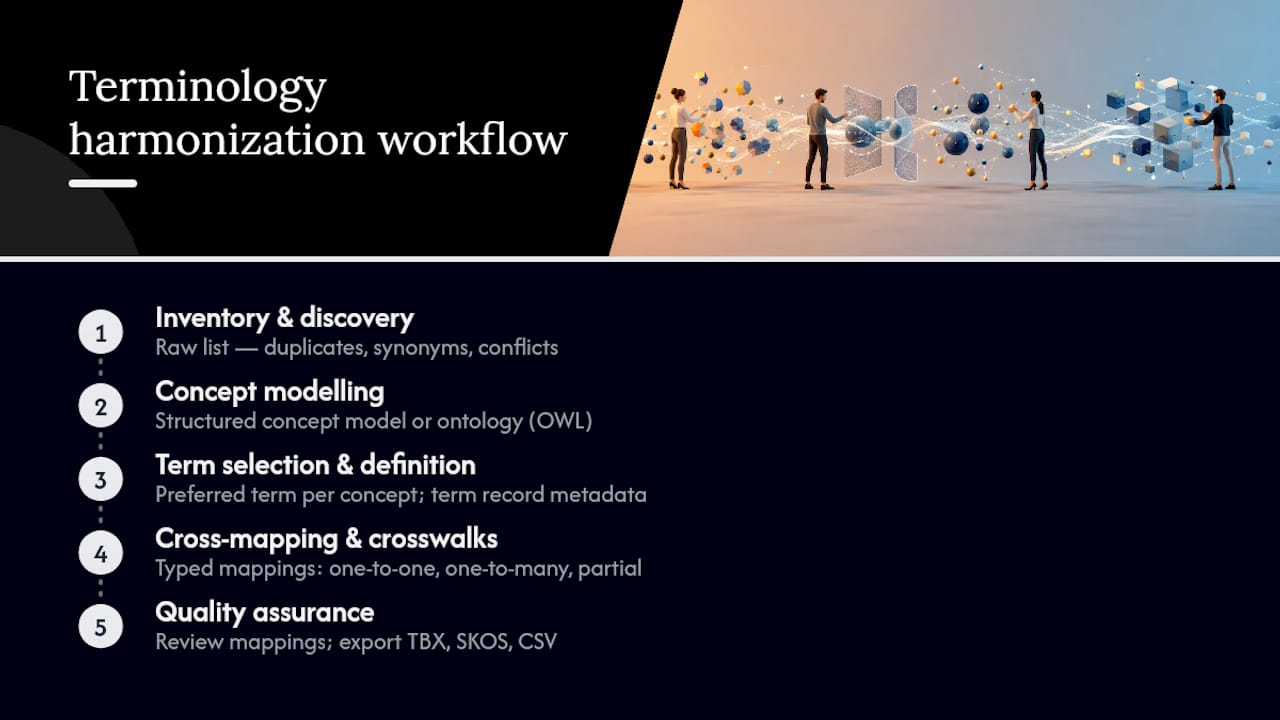
Concept modelling turns that raw list into a structured concept system. Practitioners group terms by the concepts they represent, draw hierarchical and associative relationships, and identify where two terms from different sources actually describe the same concept. The artefact here is a concept model or ontology, sometimes serialised in OWL for machine-readable use.

Term selection and definition writing applies the ISO 704 principles: one preferred term per concept, a definition written from the concept’s characteristics rather than from the word’s etymology, and a set of permitted synonyms or deprecated terms flagged accordingly. Each entry becomes a term record, carrying metadata such as source, status, domain, and language.
Cross-mapping and crosswalk creation is where harmonization becomes visible. A crosswalk table maps concepts from System A to their equivalents in System B. Mappings are typed: one-to-one (exact equivalence), one-to-many (one source concept maps to several target concepts), or partial equivalence (the concepts overlap but are not identical). A short example: the SNOMED CT concept Type 2 diabetes mellitus maps one-to-one to ICD-10 code E11, but maps one-to-many when aligned to a legacy local coding scheme that splits the concept by treatment type. That distinction matters for data aggregation and for AI training sets.
Quality assurance closes the loop. Reviewers check definition consistency, mapping accuracy, and term-formation compliance before export. Final deliverables typically include TBX (TermBase eXchange) files for translation memory systems, SKOS (Simple Knowledge Organisation System) exports for linked-data environments, and CSV mapping tables for data engineering teams.
Pro Tip: When building crosswalks, document the mapping rationale in a dedicated notes field for every partial-equivalence entry. Partial maps are where semantic drift begins: six months later, no one remembers why the mapping was flagged as approximate, and the approximation quietly becomes treated as exact.
A practical checklist for starting your own harmonization project
Getting started does not require a full enterprise rollout. A scoped pilot covering one domain or one data exchange interface is enough to prove value and build internal momentum. Here is a numbered sequence that follows the ISO 15188 project management guidance, with realistic timing and resource notes.
-
Scope and discovery (2–6 weeks). Define the domain boundary, identify source systems, and collect existing term lists. Assign a terminologist and at least two SMEs. Hidden cost to watch: SME time is rarely budgeted and often the biggest constraint.
-
Concept modelling and gap analysis (3–6 weeks). Build a concept model for the scoped domain. Identify gaps (concepts with no agreed term), conflicts (same term, different meanings), and redundancies (different terms, same concept). A data engineer is useful here if source systems need querying.
-
Pilot mapping (1–3 months, depending on scope). Produce a crosswalk between the two highest-priority systems. Use typed mappings. Validate a sample with SMEs before committing the full set. Tooling cost enters here: terminology management systems, mapping utilities, and version control for term sets all carry licensing or setup overhead.
-
Governance setup (2–4 weeks, runs in parallel with step 3). Establish a terminology board with named stewards, an editor, and a change-request process. Define release cadence and versioning rules. This step is frequently skipped in pilots and almost always regretted.
-
Validation and rollout (4–8 weeks). Run a structured validation exercise with downstream users (analysts, clinicians, legal teams). Capture pre/post error rates. Publish the approved term set via your chosen format (TBX, SKOS, API). Schedule the first maintenance review.
Resource roles: a terminologist (lead), two to four SMEs, one data engineer for system queries and exports, and a project manager. For a single-domain pilot, expect part-time involvement from most roles rather than dedicated headcount.
Cost categories to plan for: terminologist and SME time (usually the largest line item), terminology management system licensing, mapping utility setup, stakeholder workshop facilitation, and ongoing maintenance effort post-launch. Hidden costs that surprise teams include legacy data cleaning before mapping can begin, and the iterative SME review cycles that extend timelines when concept boundaries are genuinely contested.
A language services checklist can help teams audit their readiness before committing to a full pilot scope.
Where does harmonization deliver real value? Three concrete examples
Abstract methods only become convincing when you can point to a domain where they changed something measurable. Here are three.
-
Healthcare and NHS interoperability. SNOMED CT, LOINC, and ICD serve different interoperability needs within the NHS ecosystem. Cross-mapping between them supports EHR data exchange, laboratory result interpretation, and AI-readiness for clinical decision support. LOINC–SNOMED CT collaborations are actively expanding the coverage of these maps, which reduces the manual reconciliation burden on NHS data teams. Coordinated terminological activities in biomedical fields have been shown to improve patient safety and interoperability by ensuring that clinical concepts translate consistently across systems and languages.
-
Exposure science. A Nature paper on exposure-science glossary harmonization illustrates what happens when researchers across disciplines use the same word to mean subtly different things. The paper describes how a harmonised glossary reduces ambiguity and improves comparability of study results across research groups. Without it, a meta-analysis aggregating studies from different institutions risks combining data that is not actually measuring the same exposure concept.
-
AI and localisation. Inconsistent terms in training data cause semantic drift: a model trained on documents where “adverse event” and “side effect” are used interchangeably learns a blurred concept boundary that degrades classification accuracy. Cross-mapping to a canonical vocabulary, or enforcing a controlled vocabulary at data ingestion, fixes this before it corrupts the model. For multilingual localisation, the same principle applies: a term that maps cleanly to one concept in English may split into two distinct concepts in another language, and a harmonized concept model surfaces that split before a translator makes an arbitrary choice.
What challenges do teams run into, and how do you avoid them?
Harmonization projects fail in predictable ways. Knowing the failure modes in advance is half the defence.
-
Semantic drift during mapping. Terms shift meaning as they travel between systems or over time. Mitigation: typed mappings with mandatory rationale notes, and a sample-based validation cycle before each release.
-
Ambiguous source terms. Legacy glossaries frequently contain terms that were never formally defined. Mitigation: treat undefined terms as gaps, not inputs. Write a new definition from the concept model rather than inheriting an ambiguous one.
-
Legacy system constraints. Older systems may use flat code lists with no concept hierarchy, making structured mapping difficult. Mitigation: map to an intermediate canonical vocabulary first, then derive system-specific codes from that, rather than mapping directly between two legacy schemes.
-
Stakeholder disagreement on concept boundaries. Two clinical specialties may genuinely disagree on whether two conditions are one concept or two. Mitigation: an adjudication workflow with a named decision-maker and a documented rationale. Consensus is the goal, but a governance process that can reach a decision without consensus is what keeps projects moving.
-
Multilingual nuance. A concept that has one preferred term in English may have no direct equivalent in another language, or may map to a term that carries different connotations. Mitigation: involve native-speaker terminologists and apply multilingual equivalence principles from ISO 704 rather than relying on direct translation.
Ad-hoc glossaries assembled without governance almost always fail at scale. They accumulate synonyms, lose provenance, and become inconsistent faster than they can be maintained. A regulatory terminology framework with version control and a named steward is the only durable alternative.
How do you govern terminology work and know it is succeeding?
Governance is what separates a one-off harmonization exercise from a programme that stays accurate over time.
Roles to assign from day one:
- Terminology steward: owns the term set, approves changes, and is accountable for quality.
- Editor: implements approved changes and maintains the term records.
- Subject-matter experts: review concept definitions and validate mappings within their domain.
- Data custodian: manages the technical infrastructure (terminology server, version control, export pipelines).
- Terminology board: a small group (steward, editor, one or two SMEs) that meets on a defined cadence to handle change requests and release decisions.
Operational rules to establish early: a formal change-request process (who can submit, who approves, what evidence is required), a release cadence (quarterly is common for active domains), versioning with provenance capture (every term record shows when it was created, by whom, and what changed), and a deprecation policy (retired terms are flagged, not deleted, so historical data remains interpretable).
Success metrics worth tracking:
- Mapping coverage: percentage of source concepts with an approved mapping to the target vocabulary.
- Term reuse rate: how often downstream systems draw from the canonical term set rather than local variants.
- Reduction in ambiguous codes: pre/post comparison of flagged ambiguities in data quality reports.
- Time-to-find correct term: a proxy for usability, measurable via user surveys or support ticket volume.
- Reported errors pre/post harmonization: the most direct indicator of downstream data quality improvement.
Setting up a governance forum does not require a large team. A monthly meeting with three to five participants, a shared term record repository, and a documented change log is enough to start. The key is consistency: governance that meets irregularly and has no decision authority quickly becomes ceremonial.
Which UK tools and registries should you use?
Practitioners in the UK have access to a set of well-maintained registries and technical formats that cover most harmonization scenarios.
| Resource / Format | Type | Access and licensing notes |
|---|---|---|
| NHS Digital SNOMED CT UK | Clinical terminology registry | Free to NHS and affiliated organisations; commercial use requires a SNOMED International licence |
| BSI (British Standards Institution) | National standards body | Standards available for purchase via BSI Shop; some ISO adoptions available via institutional subscriptions |
| TBX (TermBase eXchange) | File format for term records | Open standard; supported by most terminology management systems |
| SKOS (Simple Knowledge Organisation System) | Linked-data vocabulary format | W3C open standard; used for publishing concept schemes as linked open data |
| OWL (Web Ontology Language) | Ontology serialisation | W3C open standard; used for formal ontologies and reasoning-capable systems |
| NHS Terminology Server | API-based terminology access | Available to NHS-connected systems; provides FHIR-compliant concept lookup and mapping queries |
For terminology management systems, the choice depends on scale and integration needs. Entry-level options handle term records and simple exports; enterprise platforms add workflow management, API connectivity, and multi-user governance. Version control for term sets is best handled in a dedicated terminology management system rather than a generic document repository, because term records have structured metadata that flat files cannot track reliably.
When accessing SNOMED CT for a UK project, the NHS Digital distribution is the correct starting point. It includes UK-specific extensions (such as the UK Clinical extension and the UK Drug extension) that are not present in the international release. BSI guidance is the appropriate channel for non-clinical domains where a national standard adoption exists.
Pro Tip: For AI and data annotation projects, export your canonical vocabulary as SKOS and load it into your annotation pipeline as a controlled vocabulary. This prevents annotators from introducing ad-hoc synonyms that later corrupt your training labels, and it makes the vocabulary version-trackable alongside your model versions.
How glocco® approaches a terminology harmonization project
glocco®’s workflow for terminology harmonization follows five structured steps, each producing a concrete deliverable that feeds the next phase.
-
Scoping and discovery. glocco® works with the client to define the domain boundary, identify source systems, and collect existing term assets. Deliverable: a scoped term inventory with source provenance and an initial gap analysis.
-
Concept modelling. The team builds a concept model for the scoped domain, grouping terms by concept and identifying conflicts, gaps, and redundancies. Deliverable: a concept model document and a prioritised list of concepts requiring new or revised definitions.
-
Pilot mapping. glocco® produces a typed crosswalk between the two highest-priority systems, applying one-to-one, one-to-many, and partial-equivalence mapping types. Deliverable: a pilot mapping table with rationale notes for every partial-equivalence entry.
-
Validation and QA. A structured review with the client’s SMEs checks definition accuracy, mapping correctness, and term-formation compliance. Deliverable: a validated term set with a QA report documenting resolved and outstanding issues.
-
Rollout and maintenance. glocco® exports the approved term set in the client’s required formats (TBX, SKOS, CSV, OWL) and supports the governance setup. Deliverable: a published term set, a governance charter, and a scheduled first maintenance review.
In a typical UK pilot covering a single clinical or regulatory domain, this workflow projects a 60% reduction in downstream terminology errors compared to unmanaged legacy glossaries, based on glocco®’s localisation workflow benchmarks. The legal terminology workflow follows the same five-step structure and is directly adaptable for compliance-sensitive environments.
Why terminology harmonization genuinely excites us
Here is something we do not say enough: the moment a harmonization project clicks into place is genuinely satisfying. Not in a dry, technical way. In a “we just fixed something that was quietly causing problems for years” way.
The disputes that used to eat up meeting time, the analyst who kept flagging inconsistent codes, the translator who had to make an arbitrary call because two source terms pointed at the same concept — all of that gets quieter. The analytics get cleaner. The onboarding of new systems gets faster because there is a canonical vocabulary to map to, rather than a fresh negotiation every time.
The benefit that surprises clients most? AI model reuse. When your training data is built on a harmonised vocabulary, you can retrain or fine-tune a model on a new domain without rebuilding your annotation scheme from scratch. The vocabulary is already there. That is not a small saving.
We will be honest: harmonization is not glamorous work. It involves a lot of careful definition-writing and a fair number of meetings where people disagree about concept boundaries. But the downstream payoff, in data quality, in translation consistency, in regulatory confidence, is real and measurable. That is why we keep doing it.
Ready to start your terminology harmonization project?
glocco® offers terminology harmonization as a structured, end-to-end service for UK organisations in regulated and international sectors. The engagement typically works in three stages: a scoping audit to assess your current term assets and identify the highest-priority gaps, a pilot mapping project to prove value on a defined domain, and a scale-up phase that extends the harmonised vocabulary across systems and languages.
If you are working in healthcare, legal, fintech, or any sector where data quality and regulatory clarity matter, a well-governed term set is one of the highest-return investments you can make in your data infrastructure. glocco® brings terminologists, SMEs, and AI-assisted translation tools to every project, covering 76 languages and all major export formats.
To scope a pilot or request an estimate, contact glocco® directly via Glocco.
Sources
The following references are the canonical starting points for anyone planning or governing a terminology harmonization project in the UK.
- ISO 704:2022 – Terminology work — Principles and methods
- How to use: meaning, term and terminology standardization (Welsh Government / BydTermCymru)
- ISO 15188:2001 – Project management guidelines for terminology standardization
- International unification of concepts and terms (ISO committee overview referencing ISO 860)
- Terminology and standards: practical overview (FlashTerm)
- Terminology work and what it is needed for (Sanastokeskus / Finnish terminology centre)


