


A manual is not a brochure. If a sentence in it is wrong, a person ends up with a damaged machine, a failed audit or a product that can’t legally be sold. So translating technical manuals for Slovakia comes down to three things: Slovak that an operator actually understands, terminology that stays identical from page one to page 300, and a process that keeps every language version current. glocco® has been doing language work since 2014, across 76 languages and sectors such as legal, medical, defence, fintech and software. Here is how we’d approach it, and what you need to have in place first.
What counts as a technical manual?
More than the thick binder that ships with a machine. For most product teams the translation scope includes:
- operating and installation instructions
- maintenance and service manuals
- safety notices and warning labels
- software user guides and in-app help
- datasheets, specifications and parts lists
- declarations and compliance documents that travel with the product
They share one trait: they are full of fragments, such as part names, values, warnings and menu labels, rather than flowing prose. That makes consistency harder than elegance, and it is why a generic translator working sentence by sentence tends to struggle.
Which rules decide the language?
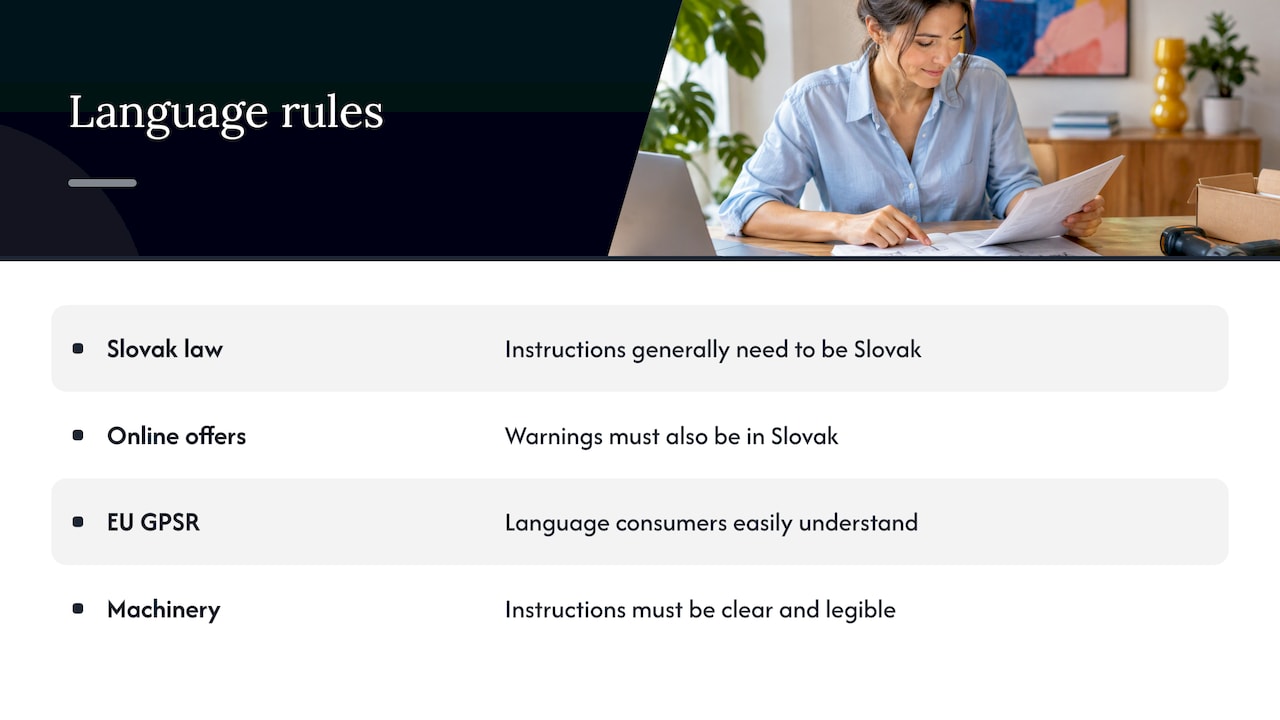
Short answer: if the product is made available in Slovakia, the instructions generally need to be in Slovak. Here is where that comes from.
Slovak law. Slovakia’s Product Safety Act No. 83/2025, promulgated on 24 April 2025, generally requires a trader to supply instructions and safety directions in Slovak. Other languages, symbols and pictograms may sit alongside. For online offers aimed at Slovak consumers, the relevant warnings and safety directions in the offer itself must also be in Slovak.
EU product safety. The General Product Safety Regulation, Regulation (EU) 2023/988, has applied since 13 December 2024. Products that need instructions or safety information must carry them in a language consumers can easily understand, as decided by the Member State where the product is sold. The Commission’s 2025 guidance adds that instructions aren’t mandatory where a product can be used safely without them, and that products placed on the market before that date under the old regime may continue to be sold.
Machinery. Under Regulation (EU) 2023/1230, instructions for use must be in a language users can easily understand, and clear and legible. Under the earlier regime, a Slovak testing body notes that a translated original must accompany the original instructions.
The details differ by product type: CE-marked goods, medical devices, export-controlled items. We’ve written up the language side of several of them: CE marking language requirements, MDR translation requirements and translating product safety notices into Slovak. For your specific product, your compliance lead or legal adviser confirms which rules bite.
Prepare before you send anything
Half of translation quality is decided before a linguist opens the file. Guidance on writing usable operating manuals recommends defining target markets and their legal implications, avoiding needlessly complex sentences and unexplained jargon, and keeping a glossary of product terms. In practice, that gives you this checklist:
- Send editable source files. Original DTP, XML or word-processor files beat PDFs. Layout then survives the trip.
- Freeze the English (or German) source. Translating a moving target is the most expensive mistake there is.
- Build a glossary. Product names, part names, UI strings, units. Decide which terms stay untranslated.
- Include reference material. Earlier manuals, approved Slovak terms, standards you cite, screenshots.
- Flag the market. Slovak only, or Czech and Hungarian too? It affects text length and layout.
- Mark safety-critical text. Warnings deserve a separate review pass.
On the second item: the same paper recommends organisational controls so translators always work from the latest source version, and so translated manuals are revised whenever the source changes. Easy to say. Harder at version 14 with five languages in flight!
How the translation itself should run
Here is the routine, and where it usually goes wrong.
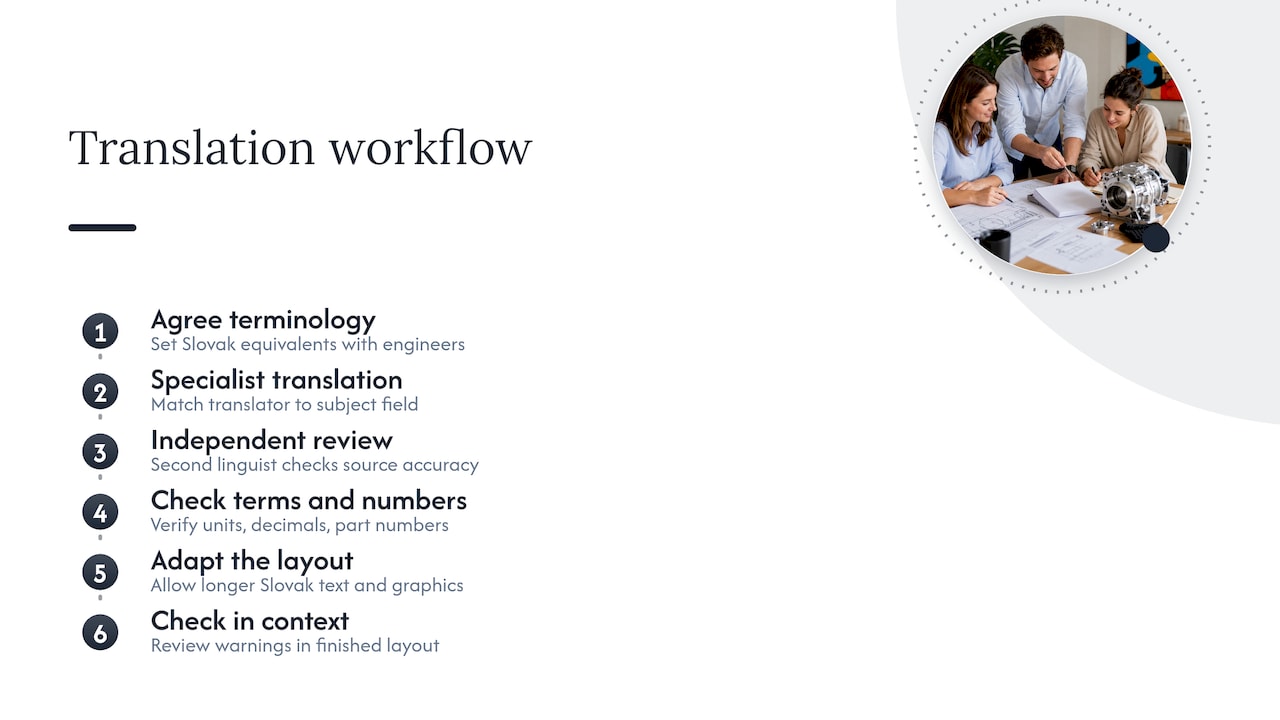
Step 1: terminology first. Extract the key terms, agree Slovak equivalents with your engineers, then translate. Where it goes wrong: each translator invents their own word for “clamping ring”.
Step 2: translation by a subject specialist. Someone who knows the field, not just the language. A hydraulics manual and a software guide need different people. glocco® works with specialist teams across industries, and our HumanPro service is the place to start for technical content.
Step 3: independent review. A second linguist checks accuracy against the source. Where it goes wrong: skipping this because the deadline is tight.
Step 4: terminology and number check. Units, decimals (Slovak uses a decimal comma), part numbers, cross-references. Differences in measures are exactly the kind of thing the technical-writing guidance asks you to plan for.
Step 5: layout. Slovak text is usually longer than English, so tables, callouts and labels overflow. Plan for expansion, and for graphics with embedded text that needs re-creating.
Step 6: final check in context. Read the finished layout, not a text extract. Warnings sitting on the wrong page are a safety problem, not a cosmetic one.
Translation alone doesn’t always guarantee comprehension either: the same guidance points out that localisation may need to reflect local customs. Think of the voice used for instructions, the way dates are written and the standards people in Slovakia expect to see referenced.
Standards worth knowing
If your team writes manuals, you will meet STN EN IEC/IEEE 82079-1:2020, the standard on principles and general requirements for preparing product information for use. The Slovak Office of Standards, Metrology and Testing records that the 2013 Slovak edition was withdrawn on 3 April 2023. Check that your source documents follow the current edition before you translate them, so the Slovak version isn’t built on an outdated structure.
Digital manuals and long-term access
More and more instructions live online. For machinery in scope of the Machinery Regulation, digital instructions are allowed under conditions: users must be able to print and download them, and they must stay accessible online during the product’s expected lifetime and for at least 10 years after it is placed on the market. That means every Slovak version has to be archived and retrievable too. A handover documentation checklist is a handy model for deciding what travels with a product, and our piece on the 10-year archive risk when localising manuals covers the language side.
Managing updates across language versions
The first translation is the easy part. Then a firmware update lands, a warning changes, a part is replaced. Four habits keep you out of trouble:
- Keep a translation memory, so unchanged sentences aren’t retranslated or reworded.
- Version every source file and tag each translation with the source version it matches.
- Update all languages together when a safety text changes, not one by one.
- Name one owner for the glossary.
Our view: a manual is part of the product
We start from a simple idea: a translated manual is part of the product, so it deserves the same discipline as the product.
That’s why we pair specialist linguists with technology rather than choosing one or the other. Modern tools keep terminology and updates under control. Experienced people make sure the Slovak reads like something an engineer would actually write. We work with clients in legal, medical, defence, IT, e-commerce and finance, so we know that precision matters more than speed of delivery.
Our advice? Bring us in before the source is final. A glossary agreed early saves more time than any rush service.
glocco®
Need Slovak manuals that hold up?
glocco® translates technical, legal, medical and software content for companies in regulated and international sectors. For manuals, HumanPro is the natural start, and HumanPlus is there for content that needs extra attention. Pricing is project-based or retainer-based, so tell us about your documentation and we’ll scope it with you.
FAQ
Do technical manuals have to be in Slovak?
Generally yes, when the product is supplied to Slovakia. Act No. 83/2025 requires instructions and safety directions in Slovak, and other languages may appear in parallel. Exceptions exist, for example where a product can be used safely without instructions, so confirm the rule for your product with your compliance adviser.
Can we send a PDF for translation?
Yes, but editable files are better. A PDF means someone must rebuild the layout, which adds time and risk of errors. Send the original DTP or XML files if you have them.
How do we keep terminology consistent across many manuals?
Agree a glossary before translation starts and keep a translation memory. Every new manual then reuses approved terms, and one named person on your side signs off any additions.
Is a digital manual enough?
For machinery in scope of the Machinery Regulation, digital instructions are permitted if users can print and download them and they stay available for at least 10 years after the product is placed on the market. Check the exact conditions for your product category.
Sources
- Product Safety Act No. 83/2025 (Zbierka zákonov)
- Regulation (EU) 2023/988, General Product Safety Regulation
- European Commission GPSR guidance, 2025
- Regulation (EU) 2023/1230, Machinery Regulation
- Technická inšpekcia: documentation of machinery
- Usable and safe operating manuals for consumer goods
- STN EN IEC/IEEE 82079-1:2020 catalogue entry
- Handover documentation checklist


