


Short answer: if your product reaches Slovak buyers, its safety warnings, instructions and any recall notice need to be in Slovak. Not “close enough”. Not English with a Slovak cover sheet. Proper, legally safe Slovak, written by someone who knows what the notice must achieve.
Want to know where companies trip up? Let’s go through it, notice type by notice type. (Spoiler: it’s rarely the grammar.)
Why a safety notice is not a marketing text
A brochure can be playful. A safety notice cannot. It is a legal instrument, and EU market surveillance work keeps pointing at the same weakness: safety information that is incomplete, unclear or missing. In the Commission’s 2025 testing of children’s activity toys, shortcomings included difficulties in assembling products, which is exactly where clear instructions matter.
So the translator’s job is not to make the text sound nice. It is to make sure a Slovak reader does the safe thing, immediately, without guessing.
What the law expects in Slovakia
Three regimes cover most of what our B2B clients ask about.
General consumer products: the GPSR
The EU General Product Safety Regulation has applied since December 2024, and it covers online shops as well as physical retail. Under Regulation (EU) 2023/988, the product’s presentation, labelling, warnings and instructions for safe use all count when assessing whether a product is safe. Safety information has to be in a language consumers can easily understand, as set by the Member State where the product is sold. For Slovakia, read that as Slovak.
Chemicals: REACH and CLP
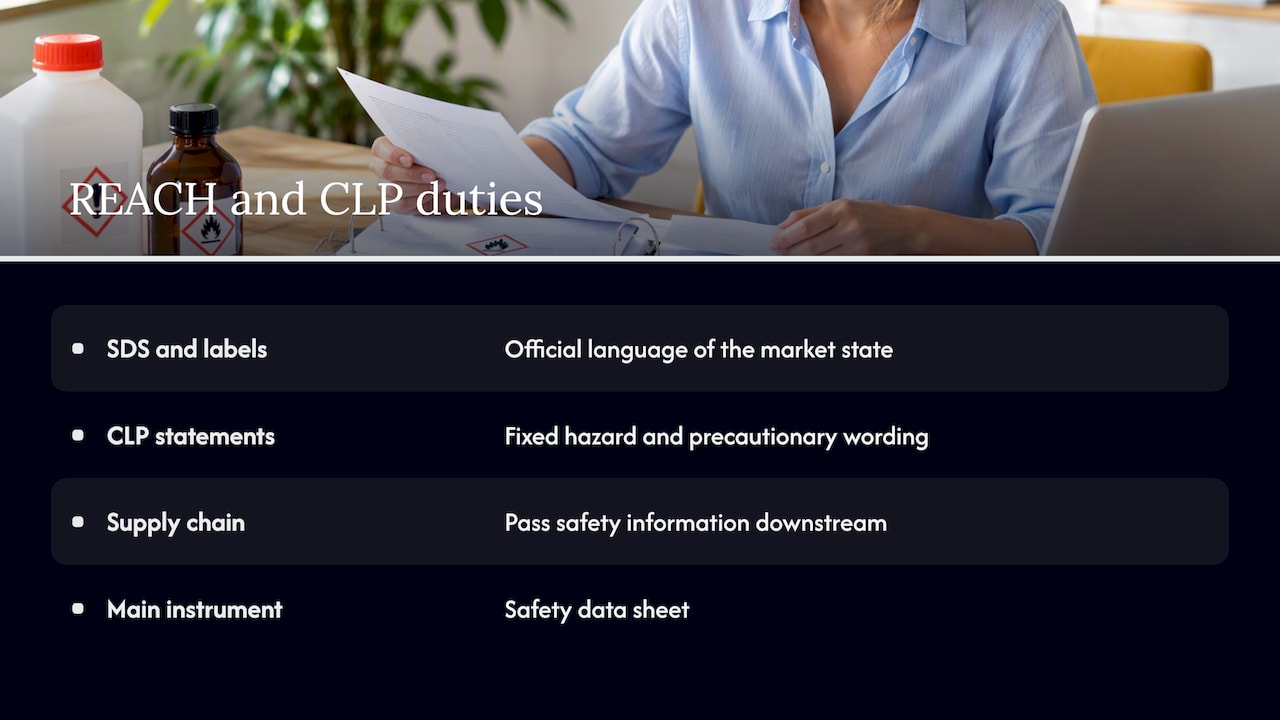
Here the rules get stricter. Safety data sheets and labels must be provided in the official language of the Member State where the substance or mixture is placed on the market, and CLP hazard and precautionary statements use fixed wording. As ECHA’s guidance for distributors explains, you pass safety information down the supply chain, with the safety data sheet as the main instrument. Free translation of H and P statements is a classic way to end up non-compliant. Use the official Slovak versions, word for word.
Procurement teams buying SDS translation should read our checklist on REACH SDS translation and Annex II before they brief anyone.
Recalls and safety notices to customers
When a product is recalled, the notice must be available in the language(s) of the Member State(s) where it was sold. The Commission’s Q&A on the GPSR implementing rules says Implementing Regulation (EU) 2024/1435 sets the template for a recall notice. It also says the notice should offer a free number or an interactive online service in an official EU language, so customers can get help.
Tone matters here as much as language. The same guidance steers away from softening words such as “voluntary” or “in rare situations”, which can downplay the risk. Your Slovak version must be just as direct as the English original. If the source text hedges, a good translator flags it and does not carry it over.
Which documents count as safety notices?
People search for this under many names, including production and technical documentation. In practice, the set usually looks like this:
- Warnings and symbols printed on the product and packaging
- User manuals and installation instructions, including safe-use and disposal sections
- Safety data sheets for chemical products
- Product safety recall notices and customer letters
- Online listings with safety information, if you sell through e-shops
- Internal technical files and risk assessments, where an authority or distributor requests Slovak versions
Not every item has the same legal weight, so a first step is sorting them. The consumer-facing ones need the most care. For general background on how business documents differ in legal status, our guide to document translation for EU businesses is a good start.
Where translations of safety notices go wrong
We see the same handful of problems again and again.
- Translating the words, not the duty. “Keep away from children” can be accurate and still weaker than the original warning.
- Paraphrasing fixed phrases. CLP statements are not creative writing.
- Inconsistent terminology. The manual says one thing, the label says another, the web listing says a third. Readers wonder which one applies.
- Units and conditions lost. Operating temperature, voltage and load limits must survive the trip. A sloppy decimal separator is a safety bug.
- Layout breakage. Slovak text often runs longer than English. If the warning gets cut off on the label, it is not a warning anymore.
- Machine output shipped unchecked. Fast, yes. Defensible when something goes wrong? No.
How to brief a translator for safety content
Give the translator the same things a good regulator would ask for.
- The source files in editable form, plus the product itself or photos of the label. Context prevents mistakes.
- The legal basis: GPSR, REACH, CLP or a sector rule. This tells the linguist which wording is fixed.
- Approved terminology and previous translations. Reuse is a safety feature.
- The audience: consumers, professionals or both. A Slovak consumer text and a technician’s manual do not share a register.
- Review steps: a second linguist, and ideally a subject expert or your own compliance person for the final read.
- Space limits for labels and screens, agreed before translation, not after.
If the notice also touches personal data (a recall form, for instance), our piece on GDPR translation and clear notices shows how to brief a supplier for that part. For medicines and healthcare products, the rules differ again: see our package leaflet translation checklist.
Do you need a lawyer as well?
A translator checks that the Slovak says what your source says. They do not decide whether your source meets the law. If you are unsure which obligations apply to your product, or who counts as the responsible economic operator, take that to counsel who handles product compliance, such as a business law practice with regulatory and product compliance experience. Then hand the settled text to the language team.
Building parts or components? Material rules matter too. For example, there is an overview of REACH and RoHS duties for 3D-printed components, which shows how far these obligations reach into manufacturing.
Our view: treat the notice as part of the product
Here is what we have learned working with regulated sectors across Europe: companies that handle safety translation well treat it as part of product development, not as a last-minute chore before shipping.
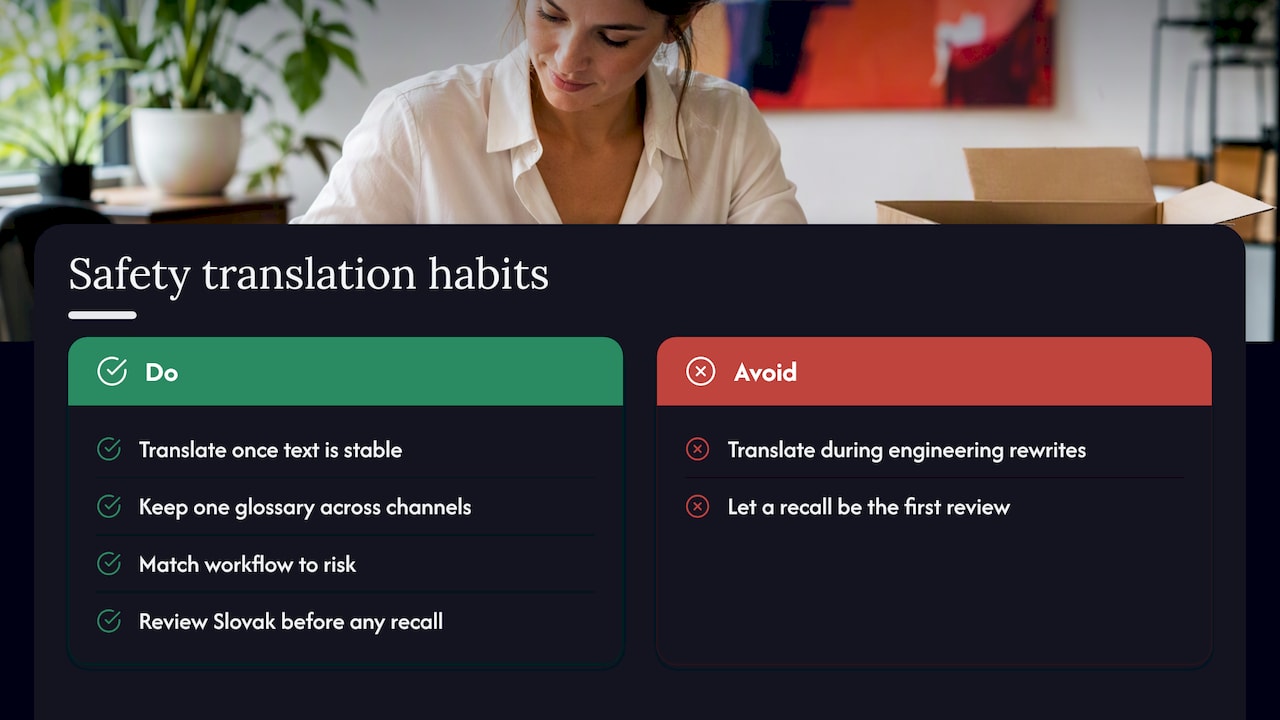
That means a few habits. Translate when the text is stable, not while engineers are still rewriting it. Keep one glossary for manual, label and web. Choose the workflow by risk: a warning label deserves a human specialist and a second reviewer, while a long internal technical file may benefit from machine translation with human post-editing. And never let a recall notice be the first time your Slovak text gets reviewed. Recalls are stressful enough!
Slovak is a small market with a loud regulator. Getting it right once is cheaper than getting it fixed in public.
— glocco®
How glocco® can help
We handle translation for compliance-sensitive content, including technical, legal and medical material, across 76 languages. For safety notices, the legal-grade route is HumanLegal, and HumanPro suits technical manuals and product documentation. If you have a large manual set and want to speed things up while keeping people in charge, ask us about HumanPlus. Send us your documents and tell us the product and the market. We will tell you which workflow fits. Start at glocco.com.
FAQ
Can we send English-only safety instructions to Slovakia?
Not safely. Under the GPSR, safety information has to be in a language consumers can easily understand, as set by the Member State, which for Slovakia means Slovak. English-only material risks the product being treated as non-compliant. Check your exact obligations with a compliance adviser.
Can we translate CLP hazard statements ourselves?
You should not rephrase them. CLP statements use official wording, and ECHA expects suppliers to use the specified versions in the target language. Take the official Slovak text, and have a specialist check the rest of the safety data sheet.
What must a recall notice include?
The Commission’s guidance points to a clear heading, a plain description of the hazard, and an instruction to stop using the product. It should also give customers a free contact route in an official EU language. A template exists under Implementing Regulation (EU) 2024/1435.
Is machine translation acceptable for safety notices?
It can be a first draft, but a person must check it before anything reaches consumers. Warnings, labels and recall notices carry legal weight, so mistakes cost more than the time saved. Lower-risk internal documents are a better fit for machine translation with human post-editing.
Sources
- Regulation (EU) 2023/988, consolidated version (EUR-Lex)
- ECHA: Distributor guidance
- European Commission: Q&A on GPSR implementing and delegated regulations
- European Commission: EU testing of children’s activity toys
- Grandus: Nové nariadenie o bezpečnosti výrobkov (GPSR) a jeho dopad na e-shopy


