


Here is a surprise: half of the people who search for “STANAG translation” don’t need a translation at all. They need a language exam. The other half need something much trickier than a translation: terminology that matches NATO’s own, delivered by people who may have to handle classified material. Let’s sort out which camp you’re in, and what to ask before you sign anything.
Two things that share a name: STANAG 6001 and translated STANAGs
A STANAG is a NATO Standardization Agreement. It is a document in which member nations agree to implement a common standard. There are thousands of them, from medical procedures to logistics and data formats. Slovakia’s Office for Defence Standardization, Codification and State Quality Assurance (ÚOŠKŠOK) publishes the list of STANAG and STANREC documents and gives contacts for up-to-date information.
STANAG 6001 is one particular agreement, and it is not about documents. It sets out levels of language proficiency for people, first drafted in 1973. Job adverts at NATO headquarters ask for English at a standard language profile of 3333%20-%20NATO%202030.pdf): listening, speaking, reading and writing, each scored separately.
So, quickly:
- You need to prove a person’s English level? That’s an exam from an accredited testing centre. It’s not what we do.
- You need a STANAG, AAP, ATP or ALP document in Slovak (or from Slovak)? That’s a specialist translation project. Read on.
- You’re both? Keep the two streams apart in your tender paperwork and contracts. Mixing them is a classic way to confuse evaluators.
NATO training centres make the split obvious. One invitation letter for a course says translation from other languages will not be provided and lists the English proficiency attendees must already have.
Why a STANAG is not a normal technical translation
We love a good technical text. But NATO documents have three quirks that catch out generalist agencies.
1. Terminology is not up for debate
NATO keeps an official terminology database, NATOTerm. Slovakia’s defence standard SOŠ 3680 implements STANAG 3680 and the AAP-6 glossary, which is the reference for terms and definitions. If your translator picks a “nice” Slovak word where an established term exists, the text may read fine and still be wrong for its purpose.
That’s the trap with raw machine output. An engine trained on general web text doesn’t know that a term has an approved Slovak equivalent. It guesses, confidently.
2. Translating is not the same as standardising
A translated STANAG is not automatically a Slovak defence standard. The ÚOŠKŠOK publishes a formal Slovak defence standard (SOŠ) when the NATO document is officially implemented. Your translation may support that process, but the legal status comes from the decision, not from the translator. Check with the standardisation office which situation you’re in before you brief anyone.
3. Security comes before price
NATO documents carry markings: NATO Unclassified, Restricted, Confidential, Secret. Anything above unclassified brings national security rules into play. In Slovakia, firms and people who handle classified information need clearance from the National Security Authority (NBÚ), whose published forms distinguish first-degree clearance for Restricted material, second-degree for Confidential and so on. If a provider can’t show it, their linguistic skills won’t matter. Ask about it on the first call, and ask for the evidence in writing.
Our own guides on what secure translation means and on a confidentiality process for defence linguists are a good checklist for that conversation.
What a real Slovak tender asks for
Public buyers are specific. A Slovak procurement record describes a functional specification for translating NATO standardisation documents from English into Slovak, specifying specialist text with military terminology. An earlier contract on the government’s electronic marketplace covered 130 pages of an Allied Logistic Publication, with technical, schematic and graphic elements all to be delivered as PDF.
That last detail matters. Diagrams, tables and labelled figures are where layout work eats time. Budget for it, and ask whether the provider returns the file in the same layout as the source.
If you’re a supplier bidding in NATO programmes, note two more things:
- Slovak firms taking part in NATO Security Investment Programme tenders must be on the national NSIP database kept by the Ministry of Defence.
- Suppliers also need an NCAGE code, the identifier of the NATO codification system. It has nothing to do with language services, so don’t expect your translation partner to sort it out.
Perspective: how we’d approach a STANAG project
We’ll be straight with you: a STANAG is a project where “fast and cheap” is the wrong brief. Here is how we think about it at glocco®.
Start with the source and the marking. Before a single word is translated, we want to know the classification, the edition of the document, and who will see the result. That decides who can touch it.
Build a glossary first. NATOTerm and the existing Slovak standards are the backbone. Every approved term goes into a termbase, and a second linguist checks the final text against it. Humans decide, tools assist. Our HumanPro workflow is built around that principle: expert translation plus independent review.
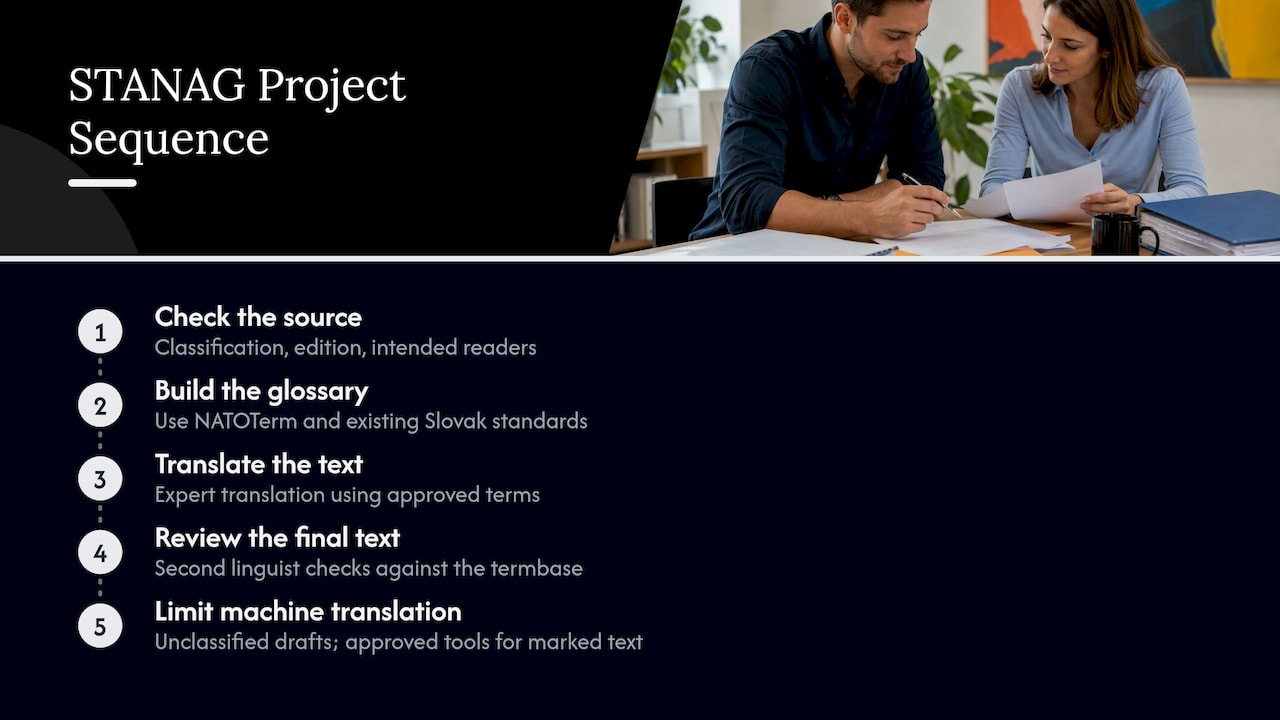
Keep the AI on a short lead. Machine translation can speed up an unclassified draft, but the output is only as good as the human who edits it and the termbase behind them. For marked material, the question is not “can software do it?” but “is it allowed to?”
Talk about the boring bits. File formats, diagrams, version control, delivery channel. These sink more projects than grammar does.
Defence work also lives inside a wider multilingual picture, which we explore in why language diversity helps defence teams. If your STANAG sits inside software, see our security-first playbook for defence software localisation.
— glocco®
Questions to ask any provider before you sign
Print this out if you like:
- Which classification levels can you handle, and what proof can you show?
- How do you align terminology with NATOTerm and existing Slovak defence standards?
- Who reviews the translation, and what are their qualifications in the subject area?
- Where are files stored, and who has access?
- Can you reproduce diagrams, tables and numbering exactly as in the source?
- Do you use machine translation, and under what conditions?
If the answers are vague, that tells you what you need to know. If your documents are heavy on legal references, such as national implementing acts, our guide to what is legally valid when translating laws in Slovakia helps with the legal side.
One more idea for tender teams: when you’re drowning in large volumes of scanned specifications, AI document processing and data extraction can help you sort and index material before the linguists start. Just keep classified files out of any tool that hasn’t been approved for them.
How glocco® can help
We provide translation, interpretation and AI services to private, public and third-sector clients, covering 76 languages. For defence-adjacent technical and legal documents, our HumanLegal and HumanPro services are the natural starting points. Tell us the document type, the language pair and the marking, and we’ll tell you honestly whether and how we can take it on. Start at glocco.com.
FAQ
Is a STANAG 6001 certificate the same as a certified translation?
No. STANAG 6001 describes proficiency levels for individual people, scored from 0 to 5 in four skills. A translation is a document produced for a client. They are different business streams and should be separate lines in any contract.
Can I use a generalist translation engine for a STANAG?
We wouldn’t. Terms should map to NATOTerm and the existing Slovak defence standards, and generic engines don’t know them. Use machine output only as a draft, with a specialist reviewer, and never for marked documents unless the rules allow it.
Does a Slovak translation of a STANAG become a Slovak defence standard?
Not by itself. A Slovak defence standard (SOŠ) is issued by the ÚOŠKŠOK once the NATO document is formally implemented. Contact its standardisation department to confirm the status of your document.
Do I need a security clearance to have a NATO document translated?
For NATO Unclassified material, the rules are lighter. For Restricted and above, the people and the organisation handling it need the appropriate national clearance. Ask the NBÚ, or the ÚOŠKŠOK for the standardisation side, what applies to your case.
Sources
- Štandardizačné dohody NATO, ÚOŠKŠOK
- NATO STANAG 6001 first draft, NATO Archives
- NATO civilian post notification, JFC Brunssum%20-%20NATO%202030.pdf)
- NMIOTC invitation letter for Course 7000
- SOŠ 3680 AAP-6, ÚOŠKŠOK
- NBÚ clearance request, NATO employees
- Jazykové preklady, public procurement result
- Public contract Z201612945, EKS portal
- Standard procedure for international tenders, Ministry of Defence SR
- NCAGE, ÚOŠKŠOK


