


Short answer: for Slovakia, your label and instructions for use (IFU) must be in Slovak. English is only an option in a narrow case. Technical files are a different story, because the notified body decides the language there.
Sounds simple? It isn’t, quite. Each EU country sets its own language rules under the MDR, so one “EU-ready” file can still fail at the Slovak border. Let’s sort out what goes where.
The two language questions the MDR actually asks
People say “MDR translation” as if it were one job. It’s really two:
- Information for the user: label, IFU and other things that travel with the device. Member States set the language.
- Documentation for authorities and notified bodies: technical file, clinical evaluation, certificates. The reviewing body sets the language.
Mix them up and you either over-translate (money down the drain) or under-translate (launch delayed). The European Commission publishes a table of national language requirements under the MDR. Revision 3 is dated August 2025. Bookmark it, and recheck before every shipment.
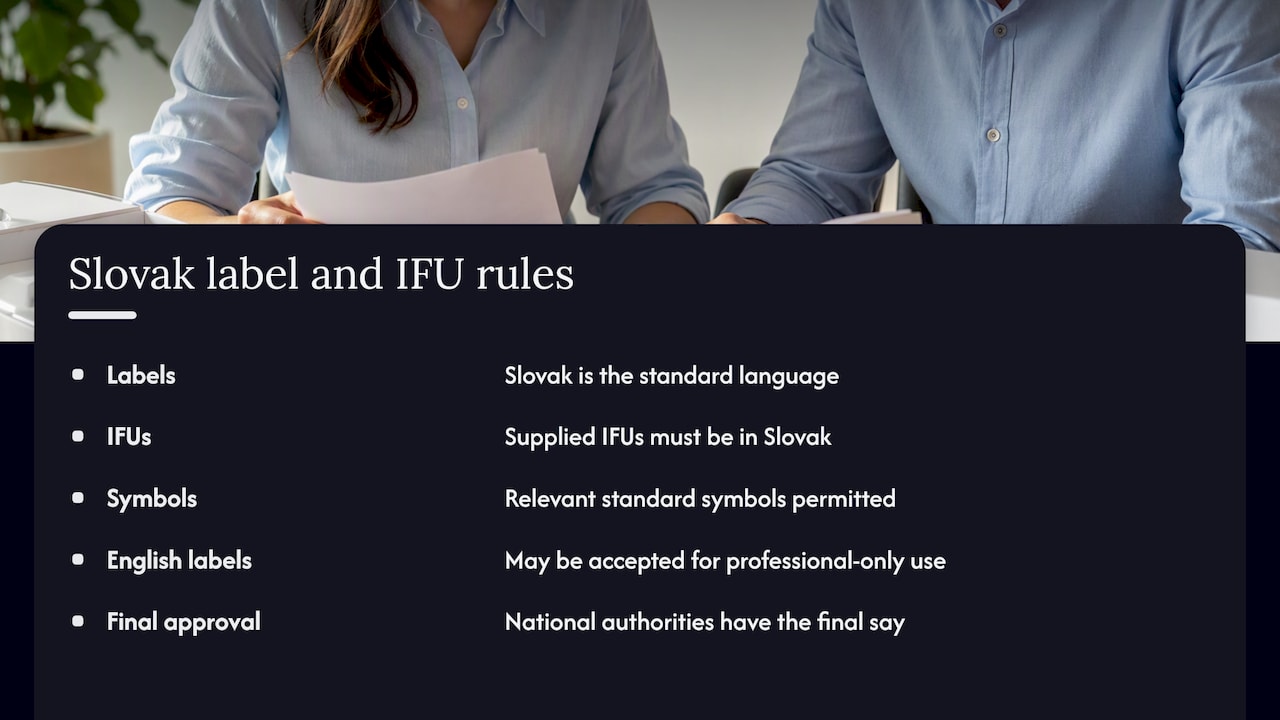
What Slovakia expects on labels and IFUs
According to that Commission table, as of August 2025 Slovak is the standard language for labels and IFUs in Slovakia. The legal basis is Act No. 362/2011 Coll. on drugs and medical devices, together with Act No. 270/1995 Coll. on the official language. English labels may be accepted if the device is intended exclusively for professional use.
The Slovak regulator ŠÚKL says much the same on its page about manufacturer notification of medical devices. Devices must be labelled in Slovak, or with the symbols from the relevant standards, and an IFU supplied with the device must also be in Slovak. That page cites older standard numbers, so treat the Commission table as your up-to-date reference.
Don’t bank on English for professional devices. It’s a popular assumption that “professional use” always means English is fine. The regulation leaves the final say to national authorities, so confirm the Slovak position for your exact product before you print anything. Printed packs are expensive to scrap!
Technical documentation and conformity assessment
Here the audience is a notified body, not a patient or a nurse. The language must be one the notified body accepts. The Czech Metrology Institute, a notified body, describes its conformity assessment preparation. Our research shows that for Slovak and Czech submissions, Czech, Slovak and English are typically accepted. Anything else needs a professional translation, and the timeline stretches by however long that translation takes.
Practical takeaway: pick your notified body early and ask in writing which languages it accepts for each document type. Then translate only what you must, and translate it once.
Quick reference: who reads what
| Document | Who reads it | Language question |
|---|---|---|
| Label | Users, inspectors | Slovak in Slovakia; English possible only for professional-use-only devices |
| IFU | Users, inspectors | Slovak; same professional-use nuance, so verify |
| Technical file | Notified body | Whatever the body accepts (often CZ, SK, EN) |
| Other items (implant card, declaration of conformity, field safety notices) | Patients, authorities | Check the Commission table row by row |
The last row is deliberate. The Commission’s tables cover more than label and IFU, as this overview of the tables explains. Don’t assume.
The sneaky one: relabelling and parallel trade
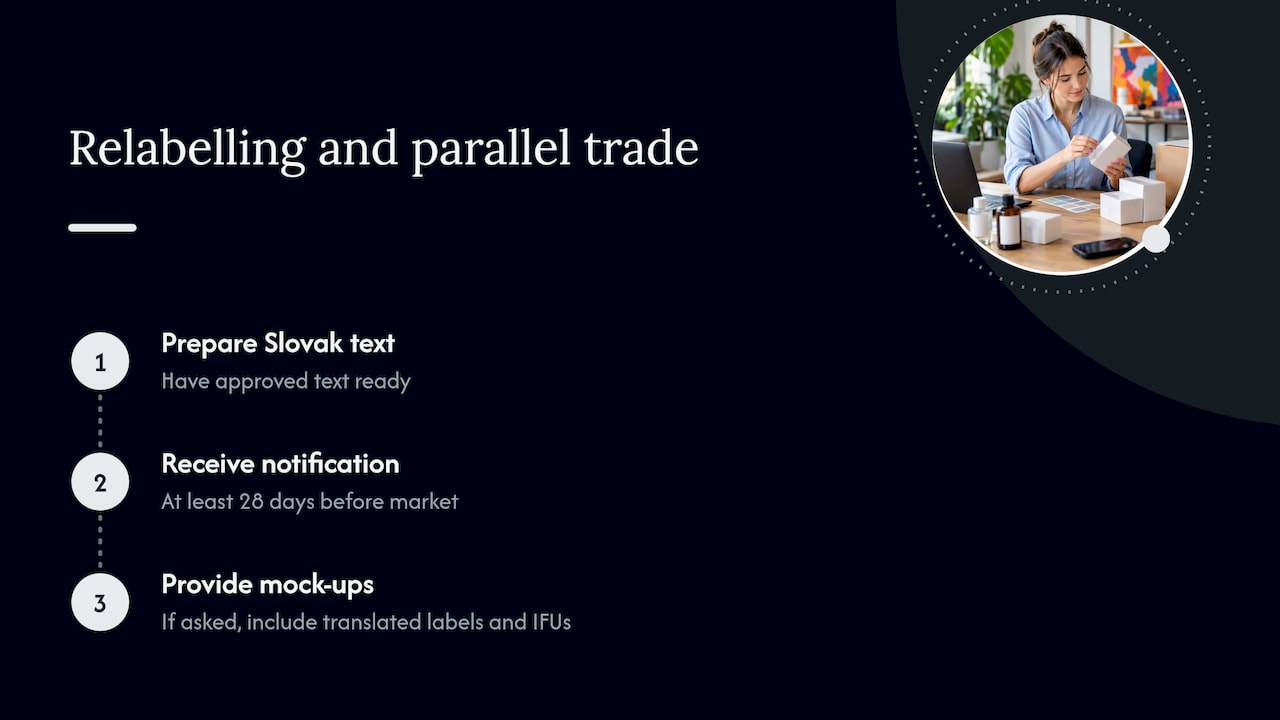
If an importer or distributor relabels or repackages your device, they must notify you at least 28 days before it goes on the market. According to MDCG 2021-26, you may then be asked for sample mock-ups, including translated labels and IFUs. Have approved Slovak text ready, and the 28 days won’t feel so short.
A workflow that keeps audits boring
Boring is the goal. Here’s the order we’d follow:
- Map the documents. List everything that ships with or supports the device, and tag each by audience.
- Confirm languages. Check the Commission table for Slovakia and ask your notified body in writing.
- Build a glossary first. Fix terms like “intended purpose”, “adverse event” and device names before translation begins.
- Translate with medical-device specialists. Not a generalist, not raw machine output.
- Independent review. A second linguist checks against the source, and a subject expert checks the units, warnings and contraindications.
- Lock and reuse. Store approved segments, so the next revision costs a fraction of the first.
We go deeper on step by step IFU handling in our guide to IFU translation requirements and audit readiness. If your device also has a patient-facing leaflet, our package leaflet checklist covers the neighbouring rules. Running clinical investigations too? See clinical study translation.
Our view: why translation belongs in the regulatory plan
We’re a language services provider that has worked since 2014 with clients in regulated sectors, medical among them. Here’s what we’d say to a regulatory manager over coffee.
Translation is usually the last line in the project plan. It’s also the one that quietly decides your launch date. A warning that reads slightly off in Slovak is not a style problem. It’s a safety and compliance problem, and an auditor will treat it as one.
So we treat MDR text as a controlled process: specialist linguists, terminology agreed up front, a human check on every file. Technology helps us move faster, but people are accountable for the result. Start the language work when the source text is nearly frozen, not after the printing order is placed.
— glocco®
Where glocco® can help
For MDR content we’d usually combine HumanPro for specialist translation with independent review. Prices depend on volume and document type, so tell us what you have and we’ll scope it with you. Want to start the conversation? Head to glocco.com and send us your document list.
FAQ
Does the MDR require translation into Slovak?
The MDR itself leaves language to Member States. In Slovakia, labels and IFUs must be in Slovak, according to the Commission’s August 2025 table. English is only accepted for devices intended exclusively for professional use.
Can I submit my technical file to a notified body in English?
Often yes, but it is the notified body’s decision. For Slovak and Czech submissions, Czech, Slovak and English are typically accepted. Ask for the accepted languages in writing before you commission any translation.
Where do I find the current language rules for each country?
Use the European Commission’s MDR language requirements table, which is updated in revisions. Check the revision date every time, because national rules can change.
What happens if my documents arrive in the wrong language?
You will need a professional translation, and the assessment timeline grows by the time it takes. That is why we suggest settling languages before submission, not after.
Sources
- European Commission: language requirements for manufacturers under the MDR (Rev. 3, August 2025)
- ŠÚKL: notification of medical devices
- Czech Metrology Institute: preparation for conformity assessment
- MDCG 2021-26: Article 16(2) to (4) questions and answers
- Casus Consulting: overview of the Commission’s translation tables


