


A compliant translation of a medicine package leaflet is not just word for word translation. It is a regulated, multi-stage process that must follow EMA QRD templates and national language rules, and it must include a mock up and pharmaceutical proofreading. Get any of those pieces wrong and you are looking at rejection letters, not approvals.
What the regulation and QRD templates actually require
Here is the bit nobody tells you until you are halfway through a submission: translating a package leaflet is as much a legal exercise as a linguistic one. Directive 2001/83/EC sets the baseline. Article 63 says the leaflet must be clearly legible in the official language, or languages, of the Member State where the medicine is sold, and it has to be written and designed so ordinary people can actually understand it. Not translators. Not pharmacists. Patients.
That single requirement, patient readability, drives almost every other rule that follows.
EMA’s QRD templates give structure to the whole thing. They define the section order, the headings, the phrasing conventions. Skip the template and your translation might be linguistically perfect and still get bounced back. The templates are not static, either. EMA has been working on a QRD v11 revision aimed squarely at making patient information friendlier to read and easier to scan, grouping content so patients find what matters faster.
On top of the EU layer sits national guidance. SÚKL, the national medicines authority, expects translations that meet real quality standards, not quick machine output. Its methodological guidance on submitting quality translations explicitly rules out raw machine translation and calls for native speakers with pharmaceutical subject knowledge. It also draws a line most people miss: the SmPC can keep its technical terms, but the PIL has to speak plain language.
Formatting matters just as much as wording. National rules typically expect:
- A specified font and size (commonly Times New Roman, 11pt) for consistency and legibility.
- Correct page numbering and layout matching the approved mock up.
- Braille information provided where the rules require it.
- Submission through the designated national channel, not an informal route.
Miss one of these and you are not dealing with a typo fix. You are dealing with a resubmission.
The regulated translation workflow: step by step
Right, so how does this actually happen in practice? Here is the order that keeps projects out of the rejection pile.
- Lock the source SmPC and common text. Nothing moves until the Summary of Product Characteristics is final and agreed. Translating against a moving target wastes everyone’s time.
- Assign a translator with pharmaceutical experience. General translators, however skilled, miss the nuances of dosage language and warning phrasing.
- Align terminology. INN names and MedDRA terms need to match exactly across SmPC, PIL and labelling. No creative synonyms.
- Run pharmaceutical proofreading. This is where someone checks that the PIL has shifted into lay language while the SmPC keeps its technical precision, exactly the distinction SÚKL’s guidance draws.
- Build the mock up. DTP specialists lay out the translated text exactly as it will appear on the physical pack or leaflet insert.
- Submit to the national authority and follow up. Then you wait, and sometimes you answer queries, following the verified process to translate and notarize documents as required for official acceptance.
The most common failure point? Mock up mismatch. Text that reads fine in a Word document suddenly does not fit the approved pack dimensions, or a translator reorders a “blue box” safety statement that must stay untouched. SÚKL’s mock up methodological guidance sets out exactly what has to appear on a mock up and the review windows that follow, and getting this wrong is one of the surest ways to add weeks to your timeline.
Pro Tip: Bundle translation, pharmaceutical proofreading and mock up DTP into one managed project. Running them as separate, sequential jobs is where most of the rework creeps in.
Your commissioning checklist for ordering a PIL translation
Ordering a package leaflet translation without a proper brief is like ordering coffee without saying what size you want. You will get something, just maybe not what you needed. Here is what to put in your request.
Ask for these deliverables:
- The translated PIL in full QRD section order, not a loose rearrangement.
- Aligned SmPC excerpts so terminology matches across documents.
- Mock up files for every pack size and strength you sell.
- Editable DTP source files, not flattened PDFs.
- A proofreader’s report showing what changed and why.
- A written list of differences versus the English source text.
- Confirmation of native speaker competence for every translator involved.
On the people side, insist on a native target language translator with genuine PIL experience, a pharmaceutical reviewer, a DTP operator who actually knows QRD layout conventions, and ideally access to a patient readability tester for anything going to a wide audience.
Administratively, get your pack sizes, marketing authorisation holder details, Braille text requirements, submission route and deadlines all written down before work starts. It saves a lot of back and forth later.
Your acceptance test is simple: no safety information added or dropped, lay language used throughout the PIL, QRD headings followed to the letter, and mock ups where the approved text fits without being squeezed or truncated.
Timeline and costs: what to budget for
Nobody loves a Gantt chart, but you will want one here. Rough stage estimates look like this:
- SmPC alignment: 1 to 3 days.
- Specialist translation: 3 to 10 days, depending on length.
- Pharmaceutical proofreading: 1 to 3 days.
- DTP and mock up work, per pack size: 1 to 5 days.
- National authority review: varies by change type, with some categories carrying statutory 30 to 90 day windows under SÚKL’s mock up guidance.
Mock up rework is one of the most frequently cited causes of delayed approvals in SÚKL’s own guidance. That alone should tell you where to focus your quality checks.
Cost drivers include specialist translator rates, the number of pack sizes and strengths you are translating for, DTP complexity, whether patient readability testing is required, and any expedited service fees. Build in at least one full regulator review cycle as a buffer before you commit to a launch date.
Cultural adaptation considerations for different markets
Translating accurately is only half the job. A PIL also has to make sense to the people reading it in their own cultural context, not just their own language.
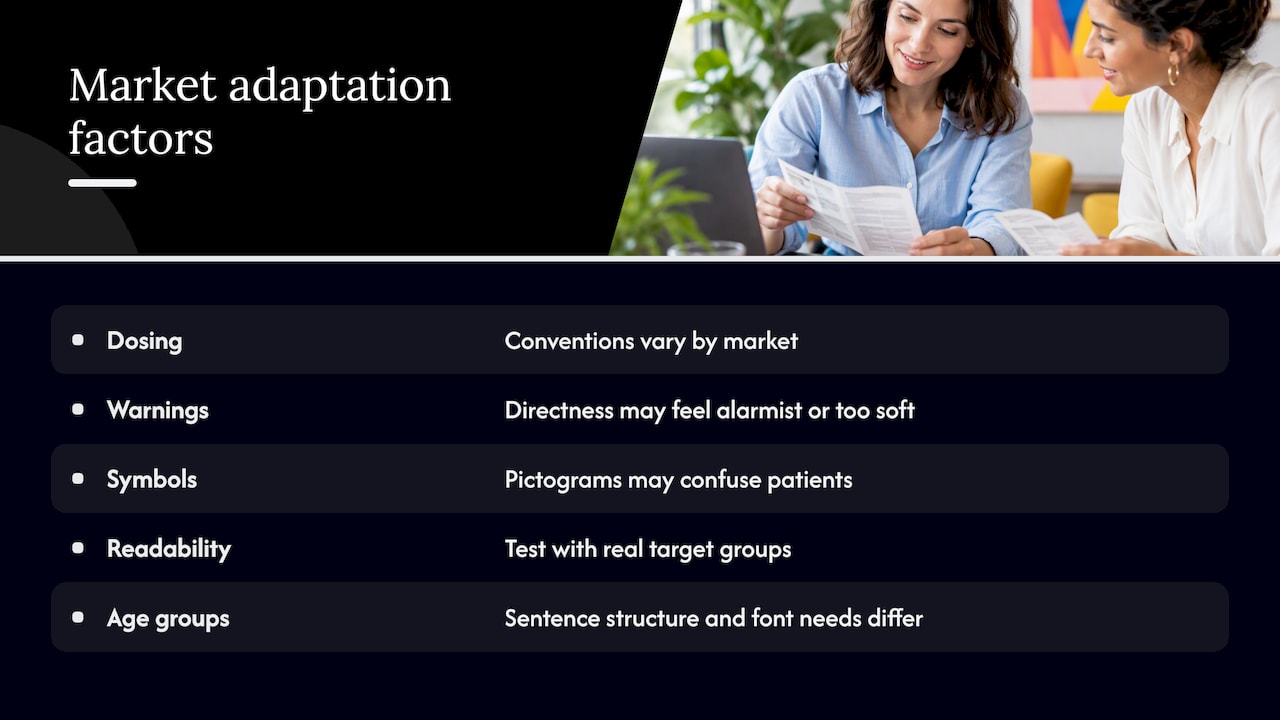
Dosing conventions, measurement habits and even how directness is perceived vary by market. A warning that reads as appropriately firm in one language can feel alarmist, or worse, too soft, in another. Symbols and pictograms used on packaging are not universally understood either, so a mock up that works in one country might confuse patients somewhere else.
Health literacy levels also differ across patient populations, which is exactly why the EU’s own guideline on leaflet readability calls for testing with real target groups rather than assuming a single translation style fits everyone. Age groups matter too: a leaflet aimed at an ageing population needs different sentence structure and font sizing considerations than one for a younger demographic.
None of this means rewriting the science. The clinical content stays fixed by the approved SmPC. What shifts is how that content gets framed, phrased and laid out so it actually lands with the reader holding the box.
Quality assurance built for leaflets, not general text
Generic proofreading does not cut it here. Package leaflet translation needs its own quality layer, and for good reason.
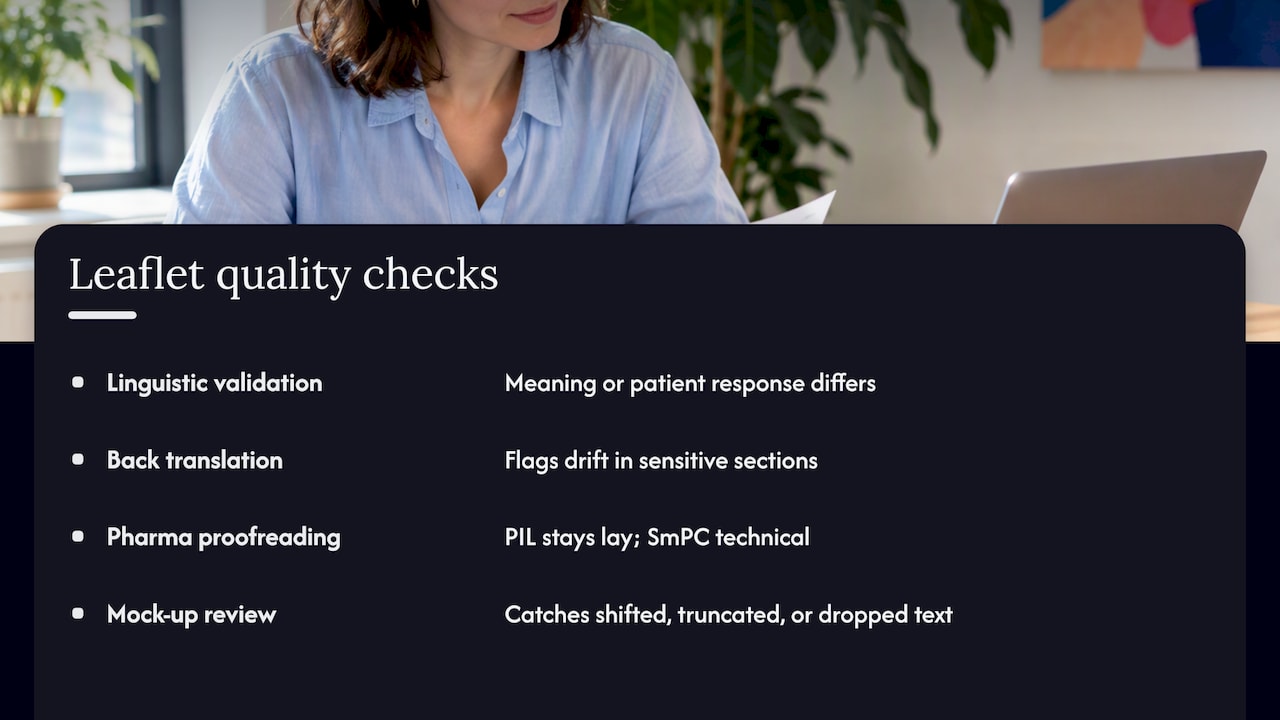
Linguistic validation checks that the translated text produces the same meaning and the same patient response as the source, not just a grammatically correct version of it. Back translation, translating the finished text back into the original language by a separate translator, is a useful sense check for particularly sensitive sections like dosage instructions or contraindications, flagging drift before it reaches a regulator.
Then there is the proofreading step we mentioned earlier: a pharmaceutical reviewer checking that PIL language stays lay friendly while SmPC language keeps its technical precision, per SÚKL’s own distinction. A final visual check against the mock up closes the loop, confirming nothing shifted, truncated or dropped during layout.
Skip any one of these checks and the risk is not just a clumsy sentence. It is a leaflet that tells a patient the wrong thing.
The technology that keeps leaflets consistent
Translation memory tools matter a lot here, probably more than in most other document types. Package leaflets reuse huge amounts of boilerplate text, warnings, storage instructions, standard phrasing, across different products and strengths. A well maintained translation memory keeps that language consistent every single time it appears, which matters when a regulator is comparing your submission against a previous one.
Terminology management systems do similar heavy lifting for drug names, INN terms and MedDRA vocabulary, making sure a term translated one way in the SmPC does not quietly become something else in the PIL. QRD compliant templates built into the translation workflow also help catch structural slips before a human reviewer even sees the document.
None of this replaces the pharmaceutical reviewer or the native translator. It just means fewer avoidable errors reach them in the first place.
Why translators and pharmaceutical experts need to work together
A brilliant translator without pharmaceutical context can still get a leaflet wrong, not through sloppiness, but because some judgement calls need subject expertise. Deciding how much detail a lay patient needs about a drug interaction, for instance, is a clinical judgement as much as a linguistic one.
That is why the better workflows pair a native language specialist with a pharmaceutical or regulatory reviewer at the proofreading stage, exactly the kind of check SÚKL’s guidance points towards. The translator handles tone, clarity and readability. The reviewer confirms nothing clinical got lost, softened or overstated along the way. Treated as separate silos, these two roles miss things. Treated as one collaborative step, they catch each other’s blind spots.
Common challenges, and how to actually solve them
A few problems show up again and again in package leaflet translation. Knowing them in advance saves a lot of grief.
Overly literal translation is the big one. A PIL translated word for word often fails the readability test even when every word is technically correct, which is exactly why SÚKL’s guidance stresses faithful rather than literal translation.
Mock up mismatches are the other repeat offender: translated text that simply does not fit the approved layout, forcing font shrinkage or truncated warnings. The fix is treating DTP and translation as one connected task from day one, not a layout job bolted on afterwards.
Inconsistent terminology between SmPC and PIL trips up plenty of submissions too, usually solved with proper terminology management from the start. And raw machine translation output submitted without expert review remains a fast route to rejection, something SÚKL explicitly rules out.
Author perspective: our view on best practice
We have been doing this since 2014, and here is what we have learned: treating translation and mock up layout as two separate jobs is where most delays start. Running them as one connected project, with pharmaceutical reviewers involved from the start, saves rework and gets leaflets through review faster.
— glocco®
How glocco® can help with your package leaflet translation
Getting a PIL translation right first time means involving skilled translators, pharmaceutical reviewers, and DTP specialists familiar with QRD layout rules from the start. That is exactly how we structure work through HumanPro, our workflow for high accuracy, compliance sensitive text, alongside HumanLegal where regulatory wording precision is the whole point.
We manage translation, pharmaceutical proofreading and mock up delivery as a connected process to reduce rework and speed up approval. This approach aims to minimize queries from regulators and rounds of rework, helping to speed up the route to market. Fancy getting your next PIL project moving? Get in touch for a project brief and quote through HumanPro.
This article is general information, not a substitute for advice from a qualified doctor. Consult a qualified healthcare professional about your own circumstances before acting on anything here.
FAQ
Can machine translation be used for a package leaflet?
No, national guidance explicitly rules out raw machine translation for medicine package leaflets. A native speaking translator with pharmaceutical experience, followed by expert proofreading, is required instead.
Who needs to sign off on the translated leaflet?
A pharmaceutical reviewer should check the translation against the approved SmPC before submission, confirming that PIL sections use plain language while technical terms are preserved where required. Final approval then rests with the national medicines authority reviewing your submission.
What font and formatting rules apply to package leaflets?
National templates typically specify a particular font and size, commonly Times New Roman at 11pt, along with consistent page numbering matching the approved mock up. Braille text may also be required depending on the product and market.
How is a translated leaflet submitted for approval?
Translated leaflets, together with mock up files showing the final layout for each pack size, are submitted through the national authority’s designated channel. Review periods vary by change type, with some categories subject to statutory windows of 30 to 90 days under SÚKL’s mock up guidance.
What usually causes a package leaflet translation to be rejected?
Mock up mismatches, where translated text does not fit the approved layout, are among the most common causes of delay according to SÚKL’s own guidance. Overly literal translation and inconsistent terminology between the SmPC and PIL are also frequent culprits.
Sources
- For human use authorised by the Union — labelling and package leaflet (EU documents)
- Product‑information (QRD) templates — European Medicines Agency (EMA)
- Metodický pokyn na predkladanie kvalitných prekladov informácie o lieku — SÚKL
- Metodický pokyn na predkladanie návrhu obalu lieku – mock‑up — SÚKL


