


Most ordinary translations usually land in your inbox within a few working days, depending on length and subject matter. Certified or sworn documents usually take a bit longer, and large or highly specialised projects need weeks, not days. The safest move? Confirm the exact turnaround in your quote, and talk to a project manager early if your deadline is tight.
Typical delivery times by document size and service
Your timeline really depends on what you’re sending and how much of it there is—tools like the Slovak AI Content Generator can help automate and streamline preparation for Slovak-language projects. Here’s the honest breakdown:
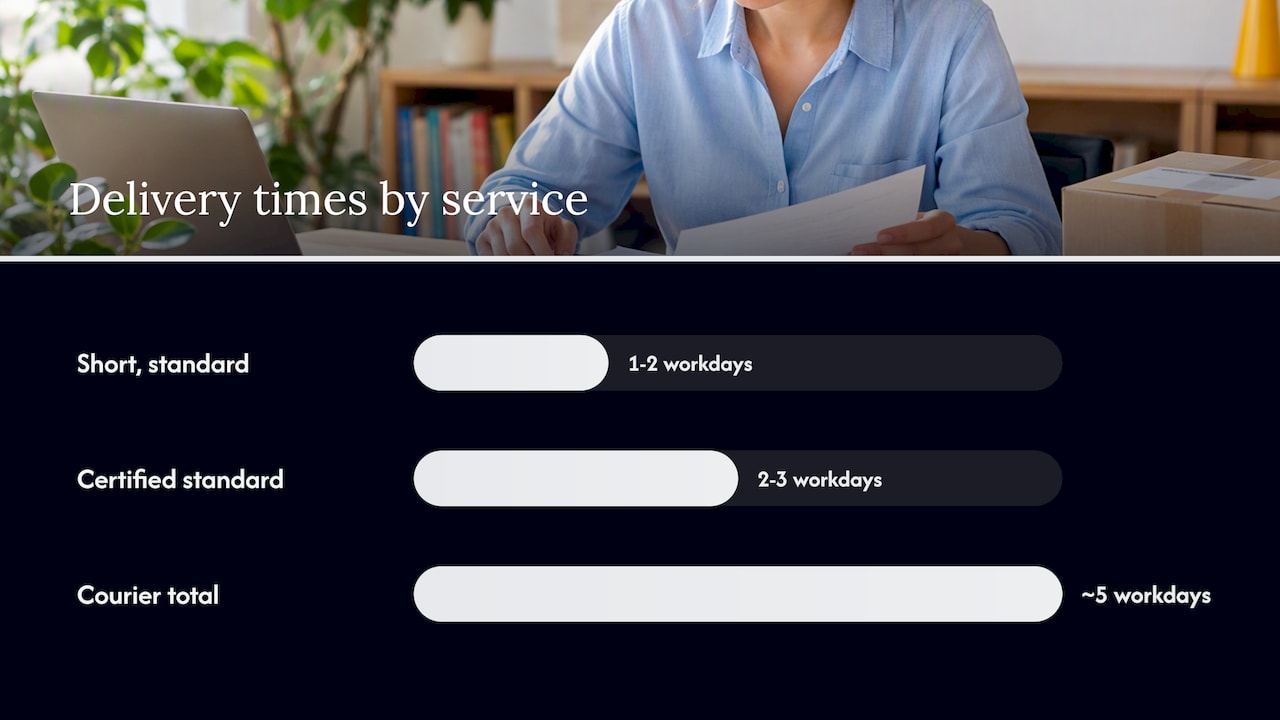
- A short document (a page or two) usually comes back in 1 to 2 working days on a standard service, or same day or next day if express is available.
- A medium job (several pages) typically takes a few working days, with larger batches scaling up from there.
- A big or ongoing project? Think weeks, not days, with milestones agreed upfront rather than one single deadline.
- Legal, medical or technical texts often need extra time for research and a second set of expert eyes, and express options get thinner the more specialised the content gets.
Pro Tip: Always ask whether your word count or page count changes the standard delivery window before you commit to a deadline.
For certified translations specifically, Legalization Center publishes a standard delivery window of 2 to 3 working days, with express turnaround available on request. If physical documents need to be posted or couriered, add time on top of that, sometimes stretching the total closer to 5 working days.
What actually changes your delivery window
A quote isn’t a guess, it’s based on real variables. Here’s what pushes your timeline up or down:
- Editable files (Word, Excel, InDesign source) move faster than scanned PDFs or photos, which need extra prep work first.
- Layout-heavy documents, like brochures, slide decks or invoices, add time for formatting checks alongside the translation itself.
- Specialist terminology (legal, medical, technical) means a linguist with the right background, plus an extra review pass.
- Volume scales pretty linearly: double the words, roughly double the time, so ask your provider what their daily throughput looks like.
- Feedback cycles add days fast. Every round of “just one more change” resets part of the clock.
Pro Tip: Bundle all your feedback into one consolidated round instead of sending edits in three separate emails. It saves more time than you’d think.
Zelenka’s guidance on preparing projects backs this up: allowing enough lead time improves quality precisely because of the checks, proofreading and formatting steps built into a proper workflow.
Your pre-order checklist: cut delivery time before you even ask for a quote
Want a faster turnaround? Most of the work happens before you hit “send”. Try this:
- Unify your source text first. Remove duplicate sections and lock in the final version, not a draft you’re still editing.
- Send editable files wherever possible, and include fonts or source assets if there’s layout work involved.
- Share glossaries, past translations or a translation memory if you’ve got one. It speeds things up and keeps terms consistent.
- Tell your provider your absolute deadline and any hard constraints at the quoting stage, not halfway through the job.
- If you need a certified or sworn translation, ask whether electronic delivery is accepted, so you’re not waiting on a courier.
Pro Tip: A translation memory doesn’t just save time, it keeps your terminology consistent across every future project too.
Zelenka’s own blog recommends exactly this: unify your texts, agree on a translation memory upfront, and decide early whether price, speed or quality matters most to you, because you rarely get all three maxed out at once.
Certified translations: why the extra steps take extra time
Certified or sworn translations carry legal weight, so there’s more process involved. Here’s what to expect:
- Many receiving authorities want original or notarised documents, which means courier or postal time gets added to your total.
- Legalization Center lists a standard delivery window of 2 to 3 working days for certified translations, calculated per standard page (1,800 characters including spaces, or roughly 250 words).
- Courier transit can add extra time, stretching the total delivery to about a week once you factor in physical delivery.
- Before you commit to posting anything, ask the receiving authority whether it accepts electronic sworn translations or a qualified electronic signature. It can save you days.
Worth checking out too: our piece on certified translation professionals if you want to understand what compliance actually looks like in practice.
How we estimate timelines and manage your deadline
We don’t just guess and hope. Every project runs through our five-stage SmPC workflow internally: intake, terminology and translation-memory check, translation, review, and final formatting and quality assurance. Each stage has its own time allocation, which means fewer surprises and less rework later.
Here’s what that looks like from your side:
- A project manager confirms your absolute deadline and hard constraints right at the quoting stage, then allocates linguists accordingly.
- Resource availability and document complexity shape the estimate, not a one-size-fits-all promise.
- For legal translation specifically, Slovak-market pricing typically runs £20 to £30 per 1,800-character page, a useful reference point when you’re budgeting both time and cost together.
If your project involves regulatory deadlines, it’s also worth reading how pharmacovigilance document translation timing works, since those windows are often tighter than people expect.
Why most turnaround advice misses the point
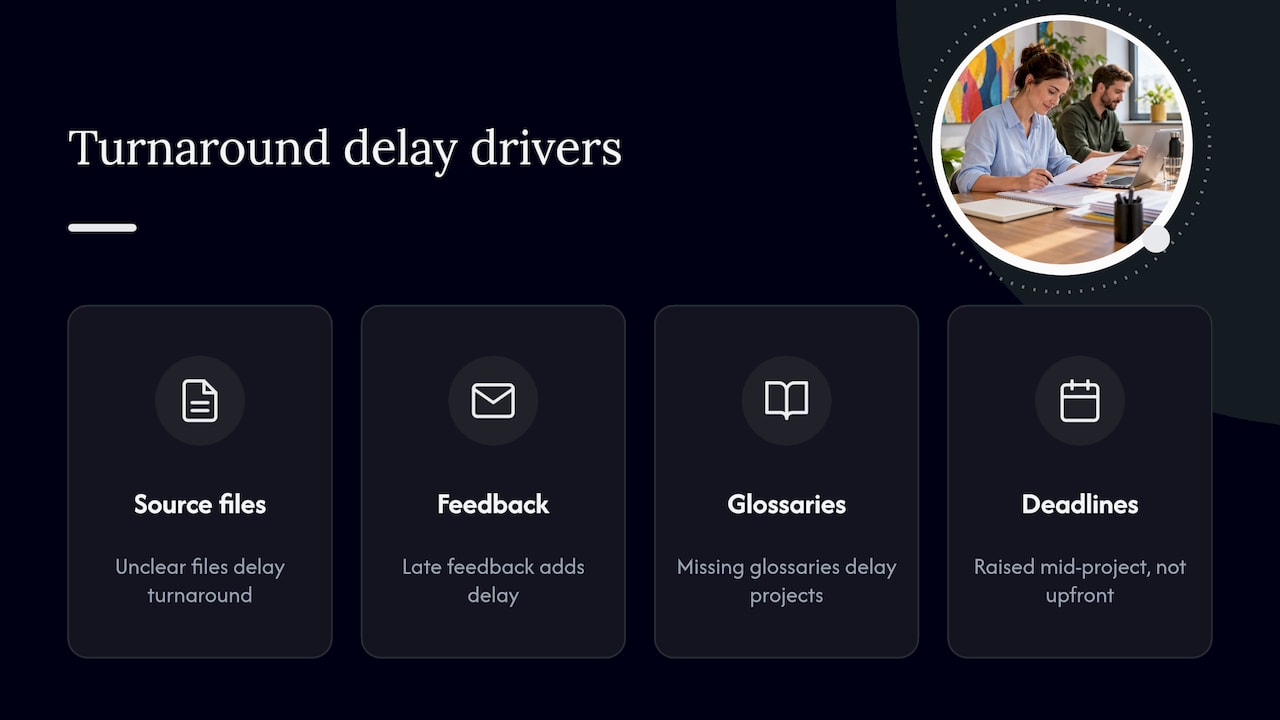
Most turnaround guides focus on averages: “translations typically take X days”. That’s not wrong, but it’s the wrong question. The real driver of delay isn’t the translation itself, it’s everything that happens before and after it: unclear source files, late feedback, missing glossaries, and deadlines mentioned halfway through a project instead of at the start.
Here’s our take: the biggest lever you control isn’t picking the fastest service tier, it’s handing over a clean, final, well-prepared file and naming your real deadline upfront. A tight express turnaround on a messy, half-finished document will always underperform a standard turnaround on a clean one.
If we’re being blunt, express options get oversold for complex content. They work brilliantly for short, simple texts. For legal or medical material, rushing rarely saves the time you think it will, because the review step simply can’t be skipped.
— glocco®
How glocco® can help you hit your deadline
Got a deadline breathing down your neck? We get it, and we’ve built our process around exactly that pressure. Whether you need HumanLegal for compliance-sensitive documents, HumanPro for technical or specialist content, or an express option for something shorter, our project managers coordinate availability the moment your file lands with us.
Upload a scan or send us your document, and we’ll come back with a quote and a realistic turnaround estimate, no guesswork involved. Got hard constraints or a fixed deadline? Tell us at quoting stage and we’ll build your delivery plan around it, not the other way round.
Ready to see your timeline? Get a quote from our HumanPro team and find out exactly when your translation lands.
FAQ
How long does a standard translation usually take?
A standard translation of a page or two typically takes 1 to 2 working days, while several pages usually take 2 to 3 working days. Larger or more technical projects take longer, so it’s worth confirming the exact window in your quote.
How long does a certified or sworn translation take?
Legalization Center lists a standard delivery window of 2 to 3 working days for certified translations, priced per standard page of 1,800 characters including spaces. If originals need posting or couriering, total delivery can stretch closer to 5 working days.
What’s a standard page for translation pricing?
A standard page is defined as 1,800 characters including spaces, which works out to roughly 250 words, according to Legalization Center. Pricing and turnaround estimates are usually calculated using this unit.
What can I do to speed up my translation?
Send a clean, final source file in an editable format, share any glossary or translation memory you have, and state your absolute deadline at the quoting stage. These steps remove the back-and-forth that usually adds the most delay.
Does file format affect delivery time?
Yes, editable files like Word or InDesign source documents move faster than scanned PDFs or images, which need extra preparation work first. Layout-heavy documents also take longer because of formatting checks on top of the translation itself.
Sources
- Certified Court Translations Bratislava with Sworn Stamp | Legalization Center
- Co je vhodné udělat před objednáním překladu (ZELENKA blog excerpt)


