


Yes, if you’re targeting speakers of another language, you need to give them GDPR transparency information in that language, and it has to be accurate, plain and genuinely usable. That’s the whole game. A technically correct translation that confuses people still fails the test. So the real job isn’t just preklad GDPR dokumentácie, it’s making sure what lands in front of your reader actually makes sense to them.
What makes a GDPR translation legally fit?
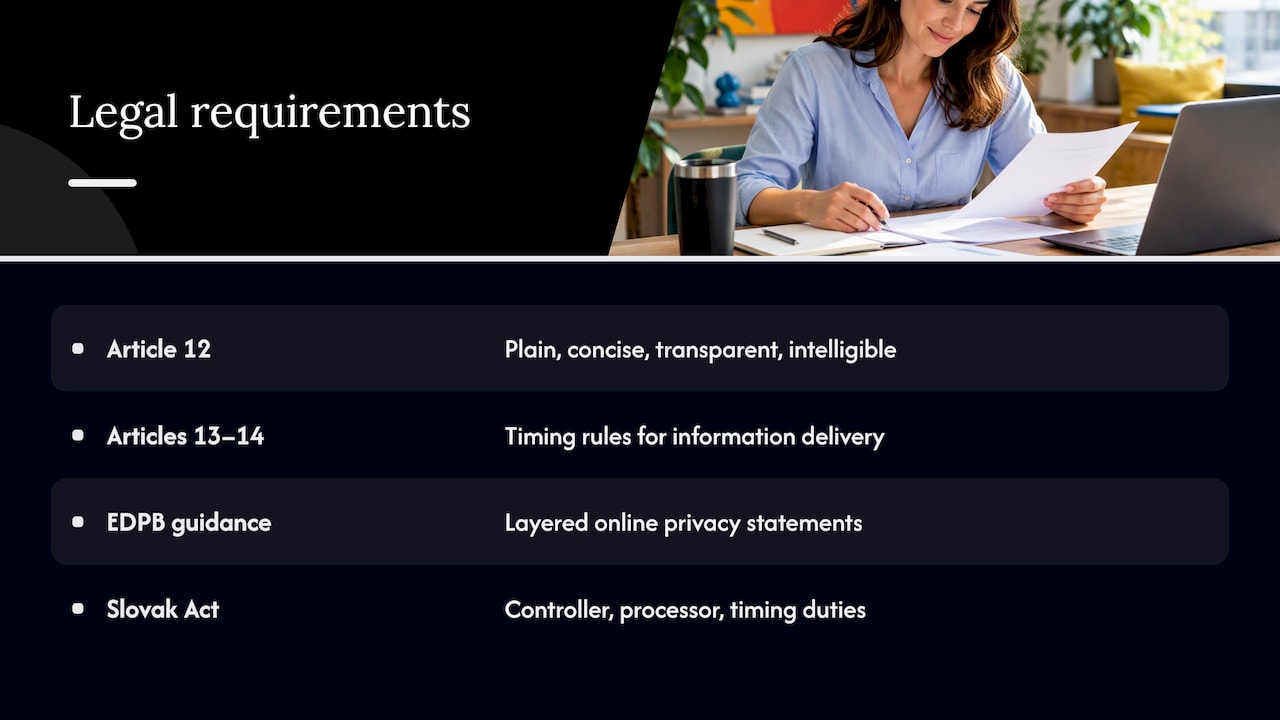
Article 12 of GDPR sets the bar: information has to be concise, transparent, intelligible and written in clear, plain language. Not “legally accurate but reads like a tax form”. Intelligible. There are also timing rules under Articles 13 and 14 about when that information has to reach people, so a translation that arrives late doesn’t help you either.
The EDPB’s transparency guidance spells this out in more detail: where you have an online presence, layered privacy statements are the recommended way to keep things accessible without burying people in legal text. And here’s the part people miss: this guidance applies to how you present privacy information to people. If your customers read Slovak, German or Hungarian, a privacy notice in English doesn’t satisfy “clear and plain language”, no matter how well it’s written in English.
Slovak businesses also have national law to check against. The Slovak Act on personal data protection sets out controller obligations, timing for providing information, and duties for processors and controllers that sit alongside GDPR’s own requirements. It’s worth reading both together rather than assuming the EU regulation covers every detail on its own. A literal, word-for-word translation can tick the “translated” box while completely missing the “intelligible” one, and that gap is exactly where complaints start.
Practical checklist: step-by-step for translating GDPR documents
Right, let’s get practical. Here’s how we’d actually approach this if it landed on our desk tomorrow.
Start with scope. Not every document needs the same treatment, but most organisations end up translating:
- Privacy notices and policies
- Consent forms and cookie banners
- Summaries of data processing agreements
- Executive summaries of data protection impact assessments
Then work through the process:
- Gather source text, build or reuse a glossary of key terms, and set up a translation memory so future updates stay consistent.
- Assign a human legal reviewer who understands both the source and target language context, not just the vocabulary.
- Run bilingual QA: someone checks the translation against the original for meaning, not just grammar.
- Get final legal sign-off before anything goes live.
- Publish, with a timestamp or audit trail showing when the translated version went public.
On plain language: demand active voice and short sentences from whoever’s doing the translating. “Your data may be processed by us” beats “Processing of your data may be undertaken” every single time. Adapt examples and timelines too, not just vocabulary, because a translated example that doesn’t match local context confuses more than it clarifies.
On evidence: keep your bilingual review notes. Keep your publication timestamps. If a regulator ever asks “when did this version go live, and who checked it”, you want an answer ready, not a scramble.
On logistics: cost and timeline depend mostly on word count, how specialist the terminology is, and whether you need certified copies for any formal process. A straightforward privacy notice moves faster than a consent form wrapped in sector-specific jargon.
Pro Tip: Build your glossary before you request quotes. It can speed up later stages and help keep terminology consistent across your documents.
For a deeper walkthrough, our 7-step GDPR translation checklist breaks this down further with QA suggestions for each stage.
Formatting and presentation: layered notices and readability
Translating the words is only half the job. How the information is laid out matters just as much, maybe more, when it comes to Article 12 compliance in an online context.
Layered notices (a short summary with a link through to the full text) help enormously here. People get the headline fast, and anyone who wants detail can dig deeper. The EDPB recommends this approach alongside tables and simple visuals like pictograms, because complex legal concepts land better with structure than with dense paragraphs.
When localising, go beyond the text itself:
- Rewrite in active voice, short paragraphs, clear headings
- Localise tables and icons, not just the surrounding copy
- Adjust vocabulary when any part of your audience includes minors
- Add direct links or QR codes straight to privacy information, especially in apps and sign-up flows
One point worth remembering: an EDPB decision highlights that privacy information should be directly accessible during user interactions, such as account creation, and that inaccessible or unsuitable-language information can breach transparency obligations. Testing your translated copy with real readers from your target audience, and keeping a record of what you found, builds exactly the kind of evidence trail you want if anyone ever questions your approach.
Who should translate your documents, and how do you brief them?
Not every translator is right for this job. You want someone who’s handled GDPR texts before, understands legal nuance in both languages, and treats your source files like the sensitive material they are.
Before you pick a provider, check for:
- Native legal translators with GDPR-specific experience
- Secure handling protocols for personal data during the project
- A proper revision workflow, not a single pass
- Bilingual reviewers available for final QA, separate from the original translator
When you brief someone, hand over:
- Source files and the target audience you’re writing for
- Intended use (public-facing notice versus internal processor agreement, for example)
- Any certification requirements
- Your glossary and style guide
- Turnaround expectations and acceptance criteria, including a bilingual QA report
Questions worth asking upfront: Do you provide a translation memory we can reuse? Will we get a QA report and change log? Can you issue a statement of accuracy if we need one for a specific use case?
Machine translation with human post-editing may suit some low-risk, informational copy. For consent forms and contracts, where an ambiguous phrase could shift legal meaning, consider human legal translation and careful review. There’s no shortcut that holds up here.
Pro Tip: Ask for a short sample translation before committing to the full project. It tells you more about a provider’s grasp of legal nuance than any portfolio page will.
Our piece on the role of translation in legal compliance goes further into how legal teams and translators should actually work together.
Keeping data confidential while it’s being translated
Here’s something people forget: the documents you’re sending for translation often contain personal data themselves. Consent forms, DPIA summaries, even sample privacy notices with real customer examples baked in. That means confidentiality during the translation process isn’t a nice-to-have, it’s part of your GDPR obligations.
Work with providers who have secure file transfer in place, not email attachments bouncing around inboxes. Confirm who on their end actually sees the files, and whether translators sign confidentiality agreements as standard. Ask how long source files are retained after delivery and whether they’re deleted or anonymised once the project closes.
If your documents include real personal data rather than placeholder examples, consider redacting names and identifiers before sending files out. There’s rarely a reason a translator needs a genuine customer’s name to translate a consent clause accurately. Treat the translation vendor the same way you’d treat any other processor: due diligence first, contract second, and a clear understanding of how your data moves and where it rests along the way.
For more on this side of things, our guide on what secure translation actually means covers the practical safeguards worth building into any vendor relationship.
Post-translation checks: how do you know it’s still working?
Publishing the translated version isn’t the finish line. Laws change, your business changes, and a notice that was accurate last year might be out of date now.
Set a review cycle, every six to twelve months is reasonable for most organisations, and check that your translated documents still match the current source version. Updates to processing activities, new vendors, or changed retention periods all need to flow through to every language version, not just the original.
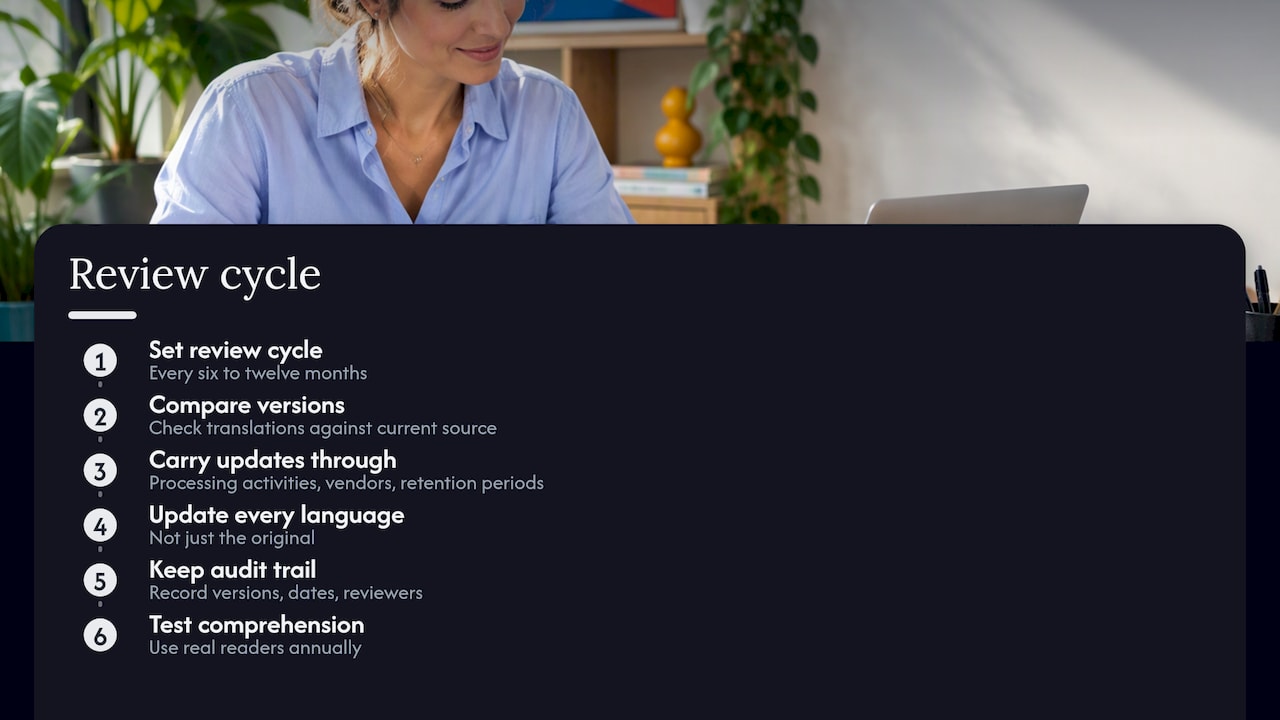
Build a simple audit trail: version numbers, publication dates, who reviewed what. If a regulator or a curious customer ever asks “is this still accurate”, you want a one-minute answer, not an afternoon of digging through old files.
It’s also worth occasionally testing comprehension again with real readers, the same way you did at launch. Language drifts, expectations shift, and what felt clear before might read as dated or confusing today. A quick annual check costs very little compared to discovering a problem after a complaint lands.
Do GDPR translations need certification?
Short answer: usually no, not in the way a birth certificate translation does. GDPR itself doesn’t demand a “sworn” or “certified” translation for privacy notices or consent forms. What it demands is accuracy and intelligibility, which is a different standard.
That said, some situations call for a statement of accuracy, particularly where a translation might be scrutinised in a dispute, an audit, or a formal regulatory enquiry. In those cases, having your provider issue a signed statement confirming the translation is a true and accurate rendering of the source gives you something concrete to point to.
Legal validation, where a qualified lawyer reviews the final translated text, is a sensible extra step for higher-risk documents like data processing agreements or anything that creates contractual obligations. It’s not a legal requirement everywhere, but it’s good practice, and it’s the kind of thing that’s far cheaper to arrange upfront than to wish you’d done after the fact.
A language-provider perspective: why specialised localisation matters
We’ll be straight with you: a lot of GDPR translation problems aren’t translation problems, they’re clarity problems wearing a translation disguise. Human and AI workflows, used together properly, speed up delivery without sacrificing legal precision, as long as a specialist is steering the process rather than just approving whatever comes out the other end.
Clear, readable translations do more than tick a compliance box. They cut down on confused customer queries and show regulators you took transparency seriously, not just literally.
— glocco®
How glocco® can help with GDPR translation
We’ve built our legal localisation workflows around exactly this problem: getting GDPR documents translated in a way that’s accurate, properly reviewed and actually readable in the target language. Our HumanLegal service can help translate your privacy notices and consent forms so they’re clear and readable in the target language.
Here’s how to get started:
- Request a quote with your document scope and target languages
- Share your source files with our team
- Discuss your project with our team before committing
- Discuss your project’s requirements with our team
If your project mixes creative copy with compliance-heavy sections, our HumanPlus package blends both. Get in touch and we’ll scope the right approach for your documents.
FAQ
Do I need to translate my GDPR privacy notice?
Yes, if you’re targeting people who speak a different language, GDPR’s transparency principle and EDPB guidance require information in a language they understand. Skipping this can mean your notice fails the “clear and plain language” test even if the content itself is accurate.
What documents are most commonly translated for GDPR compliance?
Privacy policies, consent forms, cookie banners, data processing agreement summaries and DPIA executive summaries top the list. Our consent translation guide covers the consent-form side in more detail.
Can I use machine translation for GDPR documents?
Machine translation with human post-editing can work for low-risk, informational text, but consent forms and contracts need human-only legal translation. A single ambiguous phrase in a consent clause can change its legal meaning entirely.
Does a GDPR translation need to be certified?
Not usually. GDPR requires accuracy and intelligibility rather than formal certification, though a signed statement of accuracy is useful for documents likely to face regulatory or legal scrutiny.
How often should translated GDPR documents be reviewed?
A review every six to twelve months is reasonable for most organisations, checking that translated versions still match your current source documents and processing activities. Keeping version numbers and review dates on file gives you a ready answer if anyone asks whether a document is current.
Sources
For further reading, we’d point you to the EDPB’s transparency guidance, the consolidated GDPR text, the Slovak Act on personal data protection, and the EDPB consent guidelines. For wider regulatory terminology, taxmanagement.eu’s GDPR reference is a useful companion.
- ARTICLE 29 DATA PROTECTION WORKING PARTY
- on personal data protection and amending and supplementing certain Acts


