


Yes, you almost certainly need to translate some of your GDPR materials, and no, you don’t need a sworn translation for most of them. The rule is simple: privacy notices and other customer-facing texts must be understandable in the language your audience actually speaks. Official or sworn translation only kicks in when a court, authority or contract partner specifically asks for it. Start by listing which texts face your customers, then pick your target languages and a translator who knows the territory.
Which GDPR texts organisations commonly need translated
Not every document needs the same treatment, but a handful of texts come up again and again. If you’re targeting an audience, these are the usual suspects:
- Privacy notices covering what you collect and why, under Articles 13 and 14 of the GDPR
- Cookie banners and consent checkboxes, including the exact wording someone ticks to agree
- Templates for responding to data-subject requests under Articles 15 to 22
- Breach notifications required under Article 34
- Multi-language processor contracts
- Public-facing forms where someone submits personal data
Many organisations now use layered privacy statements: a short, plain-language summary up front, with a fuller legal version underneath. Both layers deserve translation attention, not just the short one. A mistranslated consent checkbox (“by continuing you agree” versus “you may choose to agree”) can quietly change what someone actually consented to, so even small UI strings deserve the same scrutiny as the long-form policy.
When you actually need a sworn or official translation
Most of what you’ve just read doesn’t need a sworn translation. Slovak law 382/2004 Z. z. sets up a registry of authorised translators who attach a doložka, a formal statement and stamp, to translations used in legal or administrative acts. Our guide on legally valid translations in Slovakia walks through how that registry works in practice.
Your website’s privacy policy almost never needs this treatment. Court filings, submissions to a public registry, or documents demanded by a regulator during an investigation usually do. Before you order anything official, check with the receiving authority what format they actually want.
- Court and administrative filings typically require the translator’s stamp and signed statement
- Some receiving bodies also want an apostille or specific binding format
- Sworn translations typically require more time and may have higher costs compared to ordinary commercial work
Pro Tip: Ask the requesting authority exactly what they need before you order a sworn translation. You’ll avoid paying for a stamp nobody asked for.
For a fuller rundown of formats and when authorities expect them, our guide to sworn translation across Europe is worth a look.
What makes a GDPR translation actually fit for purpose?
Here’s the bit a lot of businesses miss: a technically correct translation can still fail GDPR’s transparency test. The EDPB’s guidelines on transparency are blunt about this. Translations need to be accurate and read naturally, not like something a machine spat out that the reader then has to decode themselves. The real question isn’t “is this a literal translation?” It’s “would an ordinary person reading this actually understand what happens to their data?”
One of the clearest markers of a weak translation is when readers need to mentally retranslate it back into the source language to understand it, which EDPB guidance on transparency treats as a sign that it has failed the plain-language test.
So what should you ask for?
- A translator brief that specifies plain language, not literal word-for-word rendering
- A glossary so “processing”, “controller” and “legitimate interest” mean the same thing every time they appear
- Bilingual quality assurance, where someone checks the translation against the source and against readability
- Legal or DPO review wherever genuinely legal terms show up
Our piece on ensuring legal translation quality goes deeper into glossary and QA workflows if you want to build this into a standing process rather than a one-off job.
How to document and prove you did this properly
Accountability is baked into GDPR. EU guidance on data protection stresses that you need to demonstrate compliance, not just achieve it quietly in the background. For translations, that means a paper trail.
- Keep the source text version alongside the translation, dated and labelled.
- Save the translator brief and any glossary used for the project.
- Record who did the translation, whether an individual, agency or in-house team.
- Store the legal or DPO sign-off confirming the translation was reviewed.
- Log the publication timestamp and archive a snapshot of the published version.
- Keep the confidentiality or data-processing agreement with your supplier on file.
Map each translated version to the effective date of the original policy. If your English privacy notice changes in March, your Slovak version needs a record showing when it caught up. A patchwork of versions with no dates is the kind of gap a regulator notices quickly.
Practical ordering checklist for your next translation brief
When you brief a translation supplier, vague instructions produce vague results. Here’s what actually belongs in that brief:
- State the purpose: website publication, an official filing, or an internal compliance document.
- List every target language and audience.
- Specify the delivery format and whether you need an editable source file.
- Hand over your glossary, or ask the supplier to build one.
- Flag whether legal or DPO review is required before publication.
- Set a realistic deadline, especially if a sworn translation is involved.
- Confirm security measures: encryption in transit, access controls, and a signed non-disclosure or data-processing agreement.
Pro Tip: Ask for version history and an editable deliverable as standard. If a regulator ever asks how your privacy notice evolved, you’ll want that trail ready in minutes, not days.
Our guide to translation quality assurance covers back-translation and version control if you want that as a formal step rather than an optional extra. If you’re also restructuring how consent requests get captured across languages, tools like SoftEXIT’s CRM intake forms can help standardise multilingual data capture at the point of collection.
Handling data-subject requests across languages
When someone files a data-subject request in their own language, the practical question is how you respond without creating confusion or delay. EDPB guidance on access rights points out that responses need to be clear, and where someone asks for data electronically, in a commonly used machine-readable format.
- Reply in the language the requester used wherever that’s feasible.
- Provide a readable export, and explain any coded or raw fields rather than leaving them unexplained.
- For portability requests, supply the machine-readable file plus a short human-readable summary where the data itself is hard to interpret.
- Verify identity before sending anything, speed matters, but not at the cost of sending someone else’s data to the wrong person.
How a specialised language partner fits into your GDPR workflow
We know businesses need different levels of rigour depending on what’s being translated. That’s why we built separate workflows rather than one-size-fits-all.
We offer tailored services for different translation needs, including those for legal documents, polished customer-facing text, and high-volume content with a human-plus-AI workflow.
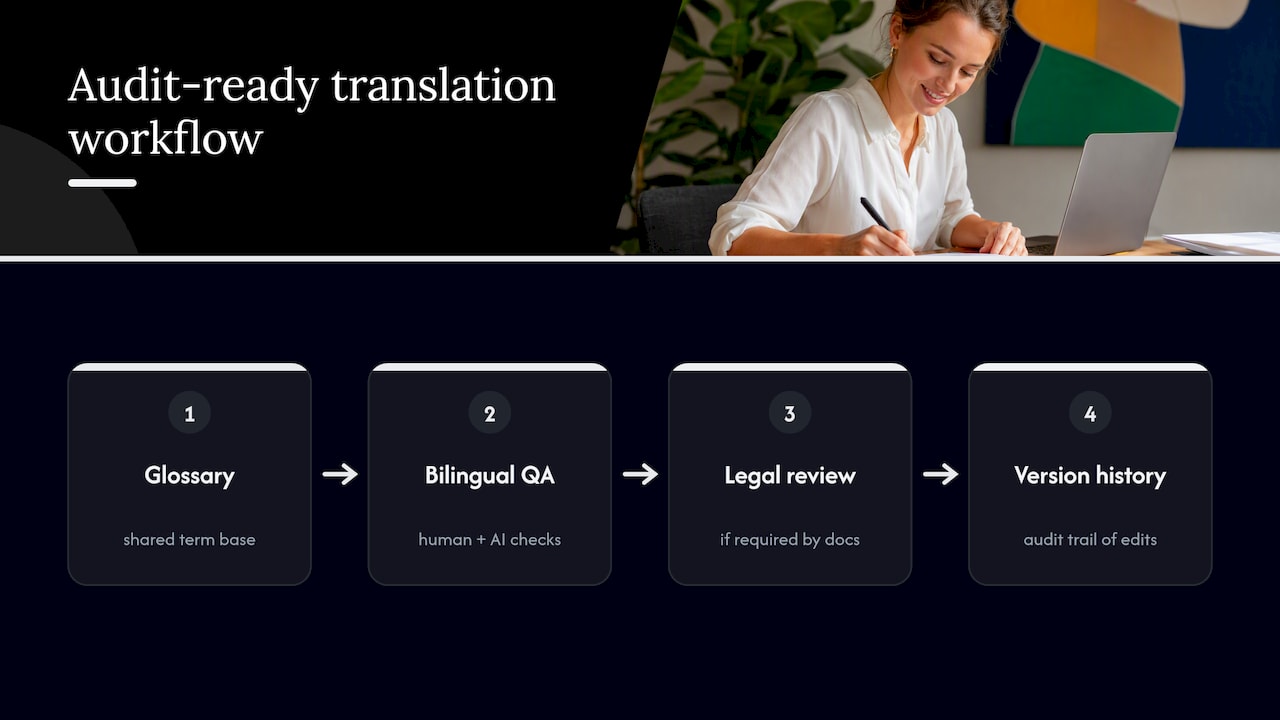
Our projects incorporate a glossary, bilingual quality assurance, legal review when needed, and version history to support compliance. We also built a GDPR-ready cost template for data annotation procurement that shows how we structure audit-friendly deliverables from the start, not bolted on afterwards.
Common mistakes and quick wins
The biggest mistake we see? Treating translation as an afterthought, bolted onto a policy update the week before launch. Raw machine translation with no human check, no version log, and no DPO involved until it’s too late.
The fix is almost boring in its simplicity: build a short glossary, run a native readability check, keep layered notices, and slot translation into your policy update calendar as a fixed step, not a scramble.
— glocco®
How glocco® can help you get this right
We’ll be honest: GDPR translation isn’t glamorous work, but getting it wrong is expensive. If you’re staring at a privacy notice that needs updating in four languages by next month, here’s where we’d point you.
- HumanLegal for privacy policies, contracts and DSAR templates that need legal precision.
- HumanPro for consent screens, cookie banners and anything your users read directly.
- HumanAI when you’re translating high volumes and need speed without losing accuracy.
When you reach out, tell us the purpose (publication or an official filing), your target languages, and your deadline. We’ll scope the glossary and QA steps from there. Start with our HumanLegal service page and send us your brief.
This article is general information, not a substitute for advice from a qualified lawyer. Consult a qualified legal professional about your own circumstances before acting on anything here.
FAQ
Do I need to translate my privacy policy into every EU language?
Only into languages your actual audience understands, not every EU language by default. The GDPR’s transparency requirement is about intelligibility for the people you’re targeting, not blanket coverage.
Is a sworn translation required for a website privacy notice?
Generally, no. Sworn translations under Slovak law 382/2004 Z. z. apply to court filings, registry submissions and formal administrative proceedings, not routine website content.
What counts as a ‘natural’ translation under EDPB guidance?
It means a translation a reader understands without mentally retranslating it back to the original. EDPB transparency guidance treats literal, machine-style phrasing as failing this test.
What records should I keep to prove a translation is compliant?
Keep the source text, translator brief, glossary, legal or DPO sign-off and a timestamped archive of the published version. EU data protection guidance frames this as part of general accountability.
Can glocco® provide legal sign-off on translations?
We coordinate with your legal or DPO team during review, but the legal sign-off itself comes from your organisation. Our HumanLegal service builds that review step into the workflow.
Sources
- EDPB guidelines on transparency
- Regulation (EU) 2016/679 (GDPR) — EUR-Lex
- Your Europe — GDPR and data protection (EU guidance)
- Collection of laws (Slovakia) — law 382/2004 Z. z.


