


Translation quality assurance (TQA) is the governance system that prevents, detects, and validates translation errors across linguistic, functional, visual, and cultural dimensions — from the moment a brief is created to the moment content is signed off. If you’re running a multi-market content programme, handling compliance-sensitive material, or managing high-volume localisation across multiple language pairs, TQA isn’t optional. It’s the operational layer that makes consistent quality possible at scale.
Here’s when you need it:
- Multi-market programmes: any content touching more than one locale, where inconsistency compounds fast
- High-risk or compliance content: legal, medical, financial, or regulatory material where an error carries real consequences (see translation and legal compliance)
- High-volume localisation workflows: where individual reviewer effort alone cannot guarantee consistency across translators, projects, and language pairs
glocco® applies TQA governance across all 76+ languages it works in, aligning workflows with ISO 17100, the international standard for translation services. Whether you’re building a programme from scratch or auditing an existing one, the framework below gives you everything you need.
What does translation quality assurance actually cover?
TQA is not just a spell-check. A complete TQA framework covers four distinct dimensions, and addressing all four is what separates a reliable programme from one that quietly accumulates errors.
- Linguistic: accuracy, fluency, grammar, register, and tone. A legal contract translated into formal German but rendered in casual register is linguistically broken, even if every word is technically correct. Linguistic Quality Assurance (LQA) focuses specifically on this dimension: semantic precision, adherence to approved glossaries, and consistency with the client’s style guide.
- Functional: placeholder integrity, tag structure, variable formatting, and character limits. A mobile UI string with a broken
{username}placeholder will crash the interface. Functional checks catch these before deployment. - Visual: layout, text expansion, font rendering, and UI overflow. A French translation of an English button label can run significantly longer. Without visual QA, buttons clip, menus break, and PDFs reflow incorrectly.
- Cultural: local regulations, colour symbolism, date and number formats, and culturally loaded references. A campaign image that works in the UK may carry unintended meaning in the Middle East or East Asia.
LQA sits within the linguistic dimension and is the layer most relevant to regulated sectors. Broader localisation QA encompasses all four dimensions and is essential for software, e-commerce, and any content that renders in a live environment.
Why TQA matters: the risks of getting it wrong
The business case for TQA is straightforward. A structured programme delivers brand consistency across markets, reduces costly rework, mitigates legal and regulatory exposure, and improves user experience. The ELIA Association specifically highlights LQA as critical for accuracy and compliance in legal, medical, and financial settings.
The risks of weak or absent QA are equally concrete:
- Brand embarrassment: a mistranslated marketing headline or culturally tone-deaf campaign can go viral for the wrong reasons
- Broken UI: missing or malformed placeholders cause interface failures that damage user trust and generate support costs
- Compliance breaches: inaccurate translation of regulatory disclosures, product warnings, or contract terms can trigger legal liability
- Lost revenue: a checkout flow with confusing translated copy directly reduces conversion rates in target markets
Consider two contrasting scenarios. A software company launching in five European markets without a QA programme discovers, post-launch, that date format errors in its billing module are causing payment failures in Germany and France. Fixing it post-release costs multiples of what a pre-launch functional QA cycle would have. Contrast that with a pharmaceutical company that embeds LQA into its regulatory submission workflow: every translated patient information leaflet passes a structured linguistic review against a locked glossary before submission, and the approval process runs without delays. The difference is process, not talent.

How a TQA workflow runs from brief to sign-off
TQA works as a three-layer system: prevention, detection, and validation. Each layer catches a different category of problem, and earlier detection is always cheaper to fix. Here’s a typical cycle with role assignments and time estimates.
-
Source content lock and brief (Prevention — Project Manager): Finalise the source text, define scope, confirm target locales, and prepare the translation brief. Attach the approved style guide, glossary, and translation memory ™. Small project: 1–2 hours. Medium: half a day. Large: 1–2 days.
-
Translator matching and onboarding (Prevention — Project Manager): Assign translators with verified domain expertise and brief them on project-specific requirements. Small: 30 minutes. Medium/Large: 1–2 hours.
-
Translation with in-line automated QA (Detection — Translator + CAT/TMS tool): Translation proceeds inside a CAT tool (such as memoQ) with real-time QA checks running: terminology flags, tag errors, number mismatches, and TM leverage warnings. Small (up to 2,000 words): 1–2 days. Medium (2,000–10,000 words): 3–5 days. Large (10,000+ words): 1–3 weeks.
-
Independent linguistic review (Detection — Editor/Reviewer): A second specialist reviews the translation for fluency, register, brand voice, and contextual accuracy. This is the human layer that catches what automated tools cannot. Estimate: roughly 1,500–2,000 words per hour for an experienced reviewer.
-
Automated batch QA run (Detection — QA Engineer/PM): Run a full QA report in the TMS or a standalone tool. Review error lists, resolve flagged issues, and update TM and glossary entries where needed. Small: 1–2 hours. Medium: half a day. Large: 1 day.
-
DTP and visual QA (Validation — DTP Specialist): Apply translated content to the target layout. Check for text overflow, font rendering, image text, and visual consistency. Varies significantly by format; allow 20–30% of translation time for complex layouts.
-
Final proofread and accuracy check (Validation — Senior Reviewer): Standard QA stages include a final proofread against the source. Verify terminology compliance, formatting, and any locale-specific requirements (date formats, currency, legal disclaimers). Small: 1–2 hours. Medium: half a day. Large: 1 day.
-
Client sign-off (Validation — Project Manager + Client): Deliver with a QA report summary. Capture any client feedback as TM and glossary updates for future projects. Allow 1–3 days for client review cycles.
Automated quality control vs linguistic quality assurance: what’s the difference?
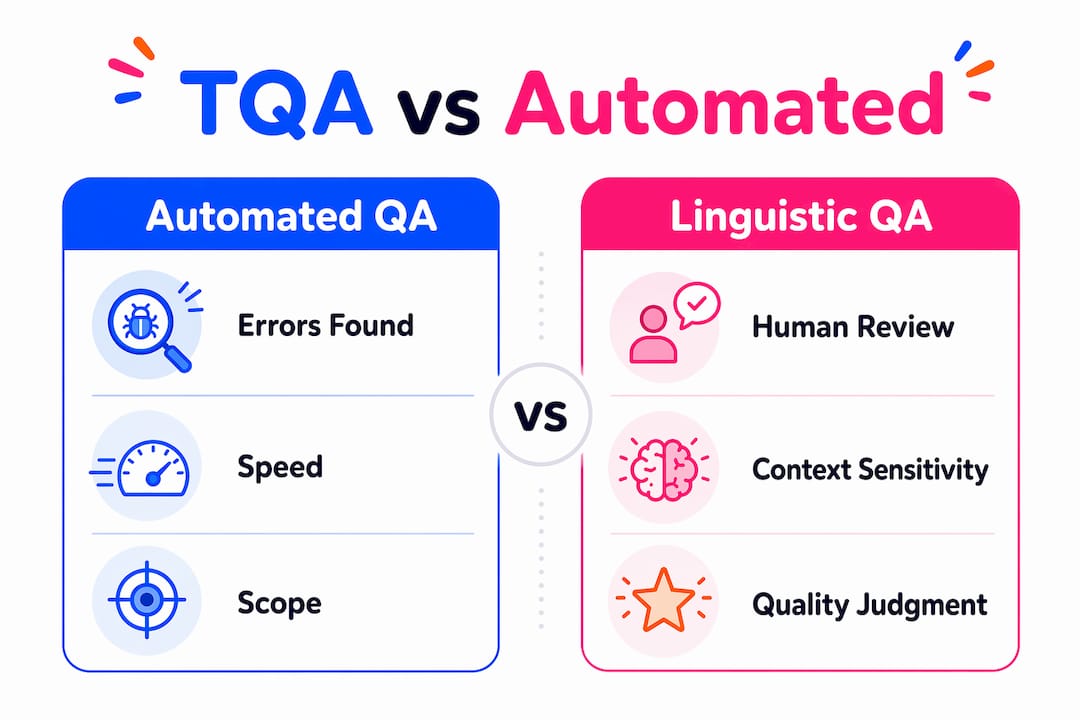
These two terms are often conflated, but they do different jobs. Automated QA tools catch machine-detectable errors; human LQA captures what algorithms cannot judge. You need both.
| Dimension | Automated quality control (AQC) | Linguistic quality assurance (LQA) |
|---|---|---|
| What it detects | Placeholders, tags, number mismatches, punctuation patterns, orthography, forbidden terms, TM inconsistencies | Register, tone, fluency, idiom, cultural fit, brand voice, nuance, contextual accuracy |
| When it runs | In-line during translation and as a post-translation batch check | Post-translation, as an independent human review stage |
| Automation level | Rule-based and regex checks; some ML-assisted suggestions | Human judgement; may be supported by QE scoring for triage |
| Best use case | High-volume content, software strings, e-commerce product data | Legal, medical, marketing, compliance, and any content where tone and nuance carry risk |
| Reporting output | Error lists with category and severity, TM compliance rates, pass/fail flags | LQA score sheets, annotated error reports, style guide deviation logs |
A practical routing approach: run AQC on everything, then use quality estimation (QE) scores to triage. Content scoring above a confidence threshold passes to a lighter human review; content below threshold goes to full LQA. This approach means expert reviewer time is concentrated on the content that genuinely needs it, typically the 10–20% requiring real judgement rather than the full volume.
Which QA tools should you use and when?
The right tool depends on your workflow, content type, and volume. Here’s how the main categories break down.
-
memoQ: A leading CAT and TMS platform with an integrated QA module. memoQ’s QA tooling runs checks on tags, numbers, terminology, punctuation, and consistency directly within the translation environment. It supports customisable QA profiles, so you can configure stricter rules for legal content and lighter profiles for marketing copy. Best for teams that want QA embedded in the translation workflow rather than bolted on afterwards.
-
POEditor: A cloud-based localisation management platform with in-line QA checks suited to software and app localisation. Its QA features flag missing variables, inconsistent translations, and formatting issues within the platform. Best for development teams managing software strings at scale.
-
Standalone QA tools (e.g. Xbench, Verifika): Purpose-built for batch QA runs across multiple file formats and language pairs. Useful when your translators work outside a single TMS or when you need to audit third-party translations.
-
Visual and functional testing tools: Pseudo-localisation tools, screenshot-based review platforms, and browser/device testing environments catch UI overflow, font rendering failures, and layout breaks. Essential for software, web, and app localisation.
-
Quality estimation (QE) tools: QE models score translation output in real time and can route content for human review based on confidence thresholds. QE-based triage reduces the volume of content requiring expert review, which directly cuts cost and turnaround time. Particularly useful for high-volume MT post-editing workflows.
Pro Tip: Don’t build your QA stack around tools first. Define your error taxonomy and severity thresholds first, then select tools that can report against those categories. A tool that generates reports you can’t act on is just noise.
For teams exploring AI-assisted translation tools, QE integration is increasingly standard and worth prioritising in any new tool evaluation.
How to measure translation quality: error types, scoring, and reporting
Measurement starts with a shared error taxonomy. The Multidimensional Quality Metrics (MQM) framework is the most widely adopted standard for structured translation quality evaluation, offering a customisable hierarchy of error categories that can be mapped to your specific content type and risk profile.

Common error categories and severity levels
| Error category | Examples | Typical severity |
|---|---|---|
| Terminology | Wrong term from approved glossary, brand name error | Major |
| Mistranslation | Incorrect meaning transferred from source | Critical |
| Omission | Segment or phrase missing from target | Critical |
| Addition | Content added with no source basis | Major |
| Punctuation | Missing full stop, incorrect quotation marks | Minor |
| Placeholder/tag error | {name} missing, broken HTML tag |
Critical (functional) |
| UI break | Text overflow, truncated label, clipped button | Major (visual) |
| Register/tone | Formal source rendered informally, or vice versa | Major |
| Spelling/grammar | Typo, agreement error | Minor to Major |
Illustrative LQA scoring approach
A simple weighted scoring model assigns penalty points by severity: critical errors score higher than major, which score higher than minor. The total penalty is divided by the word count of the reviewed sample to produce a normalised error rate. A threshold is then set (for example, a score below a defined limit = pass; above = requires revision). This approach, used in frameworks such as the American Translators Association’s certification grading system, allows consistent comparison across projects and language pairs.
Note: the specific thresholds you set should reflect your content type, risk level, and client requirements. There is no universal pass mark.
Useful reporting outputs
- Error trend charts: track error rates by language pair, translator, or content type over time to identify systemic issues
- TM compliance rates: measure how consistently translators leverage approved TM matches, which directly affects terminology consistency
- Revision round counts: a high number of revision rounds signals a prevention-layer failure, not just a detection issue
For teams working on localisation workflows, feeding QA report data back into process design is what turns a one-off audit into a continuous improvement cycle.
Best practices for TQA governance and continuous improvement
Good TQA governance is about building a system that gets better over time, not just catching errors in the current project.
Pro Tip: Embed QA requirements in the brief, not the review stage. A brief that specifies the approved glossary, style guide version, target register, and any locale-specific restrictions gives translators what they need to get it right first time. Catching a register error in the final proofread is expensive; preventing it at the brief stage costs nothing.
Pro Tip: Centralise your translation memory and glossary updates. Every QA cycle should produce a short list of approved corrections that feed back into the TM and glossary. If a reviewer corrects a terminology error in project 12, that correction should be locked in before project 13 starts. Consistency across markets depends on this loop.
Pro Tip: Use quality estimation to triage, not to replace human review. QE scores are useful for routing decisions — flagging which segments need expert attention — but they are not a substitute for linguistic judgement on high-risk content.
Brand voice consistency across languages is a governance challenge as much as a linguistic one. Style guides, approved tone descriptors, and example translations for each locale give reviewers a concrete reference point rather than a subjective impression.
The governance cycle looks like this: QA findings feed into TM and glossary updates, which improve future translation quality, which reduces the volume of errors in the next QA cycle. Over time, a well-governed programme produces fewer errors, faster turnaround, and lower review costs. That’s the compounding return on a governance-first approach.
Your pre-sign-off TQA checklist
Run this before any translation is handed over for final approval.
Tags and placeholders
- [ ] All source placeholders (
{name},%s,{{variable}}) present and correctly formatted in target - [ ] No broken or missing HTML/XML tags
- [ ] No extra spaces introduced around tags
Numbers, dates, and formats
- [ ] Numbers match source (no transposition errors)
- [ ] Date formats follow target locale convention (DD/MM/YYYY for UK; varies by market)
- [ ] Currency symbols and decimal separators correct for target locale
Terminology and consistency
- [ ] All terms match the approved glossary
- [ ] Product names, brand names, and proper nouns correctly handled (translated or retained per brief)
- [ ] Consistent terminology across all segments (check TM compliance report)
Punctuation and typography
- [ ] Quotation mark style correct for target language (e.g. « » for French, „ “ for German)
- [ ] No double spaces, stray characters, or encoding artefacts
- [ ] Sentence-final punctuation consistent with source intent
UI and visual rendering
- [ ] No text overflow in buttons, labels, or menus
- [ ] No truncated strings in UI elements
- [ ] Images containing text updated or flagged for DTP (see localisation testing checklist)
Cultural and regulatory checks
- [ ] No culturally inappropriate references, images, or idioms for target market
- [ ] Legal disclaimers, warnings, and regulatory text reviewed by a domain specialist
- [ ] Local date, address, and phone number formats applied
Final validation
- [ ] Back-translation or accuracy spot-check completed for critical segments
- [ ] QA report reviewed and all critical/major errors resolved
- [ ] Client or stakeholder sign-off obtained and documented
What does a TQA cycle actually cost and how long does it take?
Time and cost vary by project size, content type, and the number of QA layers required. Here are realistic estimates for a standard TQA cycle.
Time estimates by project size
- Small (up to a few thousand words, one or two languages): Prevention and brief: a few hours. Translation: a couple of days. Linguistic review: several hours. Automated QA batch: about an hour. DTP/visual: a few hours. Final proofread: a couple of hours. Total elapsed time: several working days.
- Medium (a few thousand to up to around ten thousand words, two to several languages): Prevention: several hours. Translation: multiple days. Linguistic review: one to two days. Automated QA: a few hours. DTP/visual: one or two days. Final proofread: several hours. Total: a few weeks.
- Large (over ten thousand words, five or more languages): Prevention: a couple of days. Translation: multiple weeks. Linguistic review: several days. Automated QA: about a day. DTP/visual: several days. Final proofread: a couple of days. Total: multiple weeks.
Primary cost drivers
- Volume: more words and more language pairs multiply every stage
- Language difficulty: less-resourced language pairs (e.g. Arabic, Japanese, Thai) typically command higher rates and require more specialist review time
- Domain expertise: legal, medical, and technical content requires certified or highly specialised reviewers, which increases per-word cost
- UI and visual testing: functional and visual QA for software or web content adds significant effort, especially across multiple devices and screen sizes
- Number of revision rounds: each additional round adds cost; prevention-layer investment reduces rounds
- Legal or compliance review: regulated content may require a qualified professional (solicitor, pharmacist, or certified translator) to sign off on specific segments
Automation reduces cost primarily at the detection layer. Running AQC and QE triage before human review means reviewers spend time on genuinely ambiguous or high-risk content rather than fixing tag errors and number mismatches that a tool catches in seconds.
Who performs TQA tasks and what qualifications should you look for?
| Role | Primary TQA tasks | Relevant qualifications / bodies |
|---|---|---|
| Translator | Translation with in-line QA tool use; self-review against brief and glossary | Degree in translation or linguistics; CIOL membership; ITI membership; ISO 17100 compliance |
| Editor / Reviser | Independent linguistic review; LQA scoring; style guide adherence | Senior translator with domain expertise; CIOL Qualified Member (MCIL); ITI Fellow |
| QA Engineer / Reviewer | Automated QA batch runs; error categorisation; TM and glossary updates | TMS/CAT tool certification (e.g. memoQ certified); project management background |
| DTP Specialist | Visual QA; layout adaptation; text expansion management | Desktop publishing qualifications; experience with InDesign, Figma, or platform-specific tools |
| Project Manager | Brief preparation; translator matching; QA report review; client sign-off | CIOL or ITI membership; PMP or PRINCE2 for larger programmes; ISO 17100 project management competency |
In the UK, the Chartered Institute of Linguists (CIOL) and the Institute of Translation and Interpreting (ITI) are the primary professional bodies for qualified translators and reviewers. ISO 17100 sets the competency requirements for translation service providers, including minimum qualifications for translators and revisers working on professional projects.
For in-house teams, the decision between internal and vendor QA resources usually comes down to volume and specialisation. Internal reviewers work well for ongoing, high-volume content in a single domain. Vendor QA is more practical for specialist content (legal, medical, technical), new language pairs, or projects requiring certified translators under ISO 17100.
glocco®’s perspective on TQA: governance first, always
Here’s our honest view: most TQA failures aren’t caused by bad translators. They’re caused by bad systems. A talented linguist working without a locked glossary, a clear style guide, or a structured review process will produce inconsistent output. Not because they lack skill, but because the governance infrastructure isn’t there to support them.
At glocco®, we treat TQA as a continuous process, not a final checkpoint. QA is built into the brief stage, runs through translation and review, and feeds back into our TM and glossary governance after every project. That loop is what makes quality compound over time rather than plateau.
We’ve seen the difference this makes across sectors. Clients in fintech and legal who invest in prevention-layer governance — locked source content, approved terminology, clear register requirements — consistently see fewer revision rounds and faster sign-off cycles. The upfront investment in process pays back quickly.
If you’d like to see how this works in practice, we’re happy to run a sample audit on a current project or walk through a discovery call on your existing workflow. No pressure, just a conversation.
Ready to put TQA governance to work?
glocco® offers end-to-end TQA programme support: from LQA and localisation testing to TM and glossary governance, across 76+ languages and sectors including legal, medical, fintech, and e-commerce. Whether you need a one-off audit of an existing workflow or a fully structured QA programme built from scratch, the team brings ISO 17100-aligned processes and genuine domain expertise to every project.
For compliance-sensitive content, our back translation and validation service adds an extra verification layer for high-stakes material. For document-heavy workflows, our document translation services cover the full cycle from brief to signed-off delivery.
Get in touch to request a sample audit or book a short discovery call. We’ll show you exactly where your current programme is strong and where it’s leaving risk on the table.
Useful sources and further reading
-
ISO 17100: Translation services requirements — The international standard for translation service providers. Defines minimum competency requirements for translators and revisers, and sets out process requirements for professional translation projects. Essential reference for any TQA programme.
-
ISO 5060:2024: Evaluation of translation output — Provides guidance on evaluating human and machine translation output using an analytic approach based on error types and penalty points. Useful for teams building or auditing a scoring framework.
-
Multidimensional Quality Metrics (MQM) framework — A customisable, hierarchical error taxonomy for translation quality evaluation. Widely used in professional and academic settings; available as a free resource. The go-to reference for building an error categorisation system.
-
ELIA: The crucial role of linguistic quality assurance — The European Language Industry Association’s overview of LQA in professional settings, with particular focus on regulated sectors. Useful for teams in legal, medical, or financial localisation.
-
Kent State MCLS: Translation quality assurance — Academic programme summary covering standard QA workflow stages (translation, editing, DTP, final proofread). Good grounding for teams new to structured QA processes.
-
memoQ: Translation quality assurance tooling — Product documentation and overview of memoQ’s integrated QA module. Reference for teams evaluating CAT/TMS platforms with built-in QA capabilities.
-
POEditor: Localisation platform with in-line QA — Platform documentation for POEditor’s QA features, covering variable checks, consistency flags, and formatting validation for software localisation workflows.
-
Contentoo: What is translation quality assurance — Practical explainer covering the prevention/detection/validation framework and the distinction between QA and QC. Useful for programme managers building or reviewing a TQA system.
-
Lokalise: Translation QA best practices — Covers the four TQA dimensions, quality estimation, and TM/glossary governance. Practical guidance for teams managing multi-language content programmes.


