


Short answer: the CE mark itself speaks no language. Everything that travels with it does. Manuals, safety warnings and the declaration of conformity must be in a language the user understands, and in Slovakia that generally means Slovak.
Sounds simple? Almost. The trouble is in the details: which documents, which law, and what counts as “translated”. Let’s walk through it.
The mark is language-free, the paperwork is not
The CE mark is a symbol. The European Commission says it must be visible, legible and indelible, with a minimum height of 5 mm, unless specific product rules say otherwise. No words, no translation.
But the mark is a promise by the manufacturer that the product meets the rules. That promise is backed by documents, and users and inspectors read those documents. This is where language bites.
The EU treats language as a safety matter. According to the EU summary on language use in consumer information, these provisions can be very strict, especially for potentially dangerous products. The goal is that people actually understand the product, not that a box gets ticked.
Which documents need a Slovak version?
There is no single list for every product. The applicable directive or regulation decides. Still, a typical set looks like this:
- Instructions for use and installation: the core of it. Think assembly, operation, maintenance.
- Safety information and warnings: on the product, packaging and in the manual.
- EU declaration of conformity: often needed in the destination language.
- Labels and packaging text: anything a consumer relies on to use the product safely.
- On-screen text: menus, error messages and alerts for products with a display or an app.
Technical files for authorities are a separate question. Some of them can be accepted in another language on request, so check the specific regime before you commission anything.
Instructions: “easily understood” means Slovak
EU product laws, such as Directive 2014/35/EU on low-voltage electrical equipment, set duties for manufacturers, importers and distributors. Language details are often left to each Member State. That’s the catch.
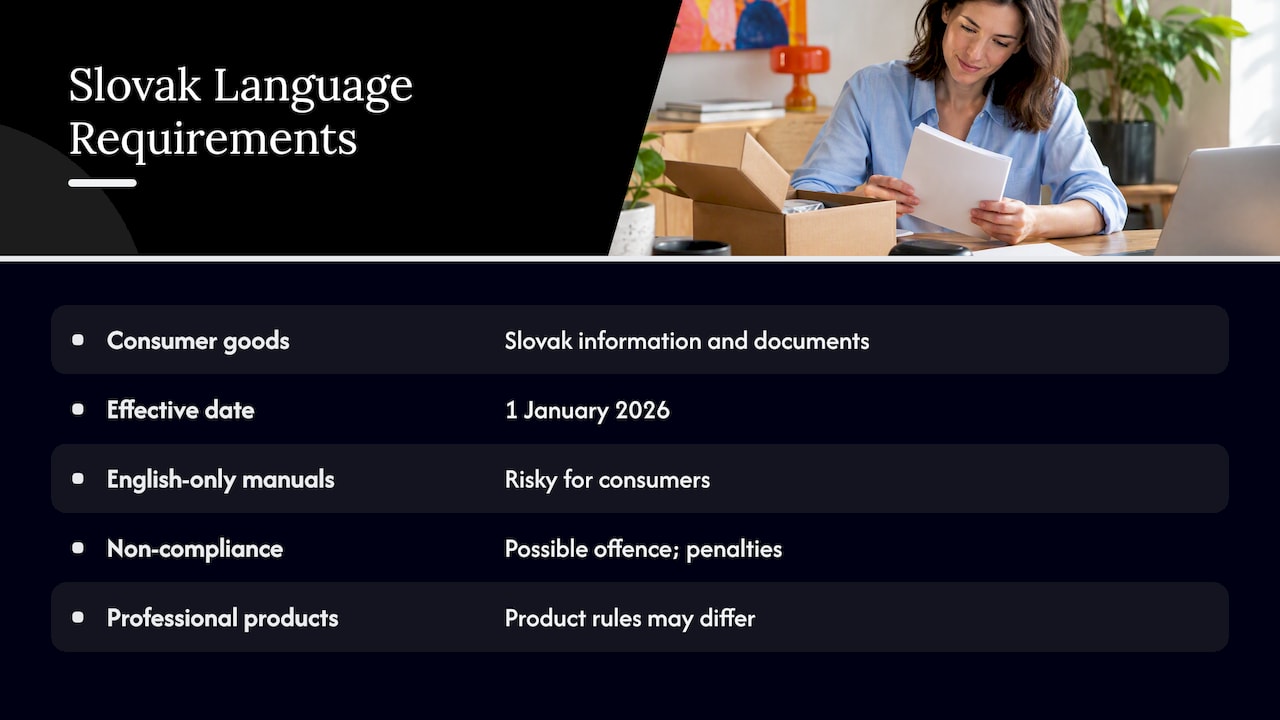
Slovakia’s consumer protection law, Act No. 108/2024 Z.z., effective from 1 January 2026, requires the trader to give information and documents in the state language. Translation: if you sell to Slovak consumers, plan on Slovak. English-only manuals for consumer goods are a risky bet. The same law treats non-compliance as a possible administrative offence with penalties.
For professional-only products the picture can differ, and the product rules decide. When in doubt, ask the market surveillance authority or your legal adviser before you print 10,000 manuals.
The declaration of conformity: easy to forget
The manufacturer draws up the declaration. Many teams assume it is an internal form that never needs translating. Not always!
Take machinery. Annex II of the Machinery Directive 2006/42/EC says the declaration and its translations must be produced under the same conditions as the instructions for use. So if your manual needs a Slovak version, the declaration needs one too.
A good declaration also carries a precise set of details: the manufacturer’s name and address, the product identification and the standards applied. Your Europe has a guide to what goes into the declaration. Translators must handle model numbers, standard references and legal wording exactly, not creatively.
Original versus translated: the label trap
Here is a mistake that makes auditors smile and manufacturers sweat. Several directives expect the original instructions to accompany the translation, with each version clearly marked. As F2 Tech Notes explains, your obligations go beyond the mark, and translation duties depend on the directives that apply to your equipment.
So: label the source document as the original, label the Slovak one as a translation, and keep the two aligned. Even a flawless translation can be flagged if the labelling is missing. Silly? Yes. Avoidable? Also yes.
Sector notes: medical, chemicals, software
Some sectors add their own language rules on top of the general ones:
- Medical devices: MDR and IVDR bring specific expectations for IFUs, labelling and registration data. We cover them in MDR translation requirements in Slovakia and in a guide to five-stage IFU translation for audits. For EUDAMED, check the current official guidance on languages for each type of data, because requirements and system modules change over time.
- Chemicals: safety data sheets follow their own structure, see REACH SDS translation checks.
- Consumer goods with warnings: our practical guide to translating product safety notices into Slovak goes through the wording that matters most.
- Connected products and software: the interface is part of the safety information. If your product has an app, effective app localisation keeps menus, alerts and instructions consistent across markets.
A simple workflow that avoids nasty surprises
- Map the rules. List every directive or regulation that applies to the product, and the countries you sell in.
- List the documents. Manual, warnings, labels, declaration, on-screen text, packaging.
- Freeze the source. Translate a final, approved original, not a draft that will change next week.
- Translate with subject experts. A translator who knows electrical, machinery or medical terms beats a generalist.
- Review and check against the source. A second linguist, ideally with a technical eye.
- Label and archive. Mark original and translated versions and keep both on file. Our piece on localising manuals and the 10-year archive explains why.
- Plan updates. When the product changes, the translations change too. A repeatable localisation workflow saves headaches.
Our view: translation is part of safety, not an add-on
We see the same pattern again and again. A team finishes testing, signs the declaration, orders the labels, and only then remembers the manuals need Slovak, German and Polish. Deadline panic follows.
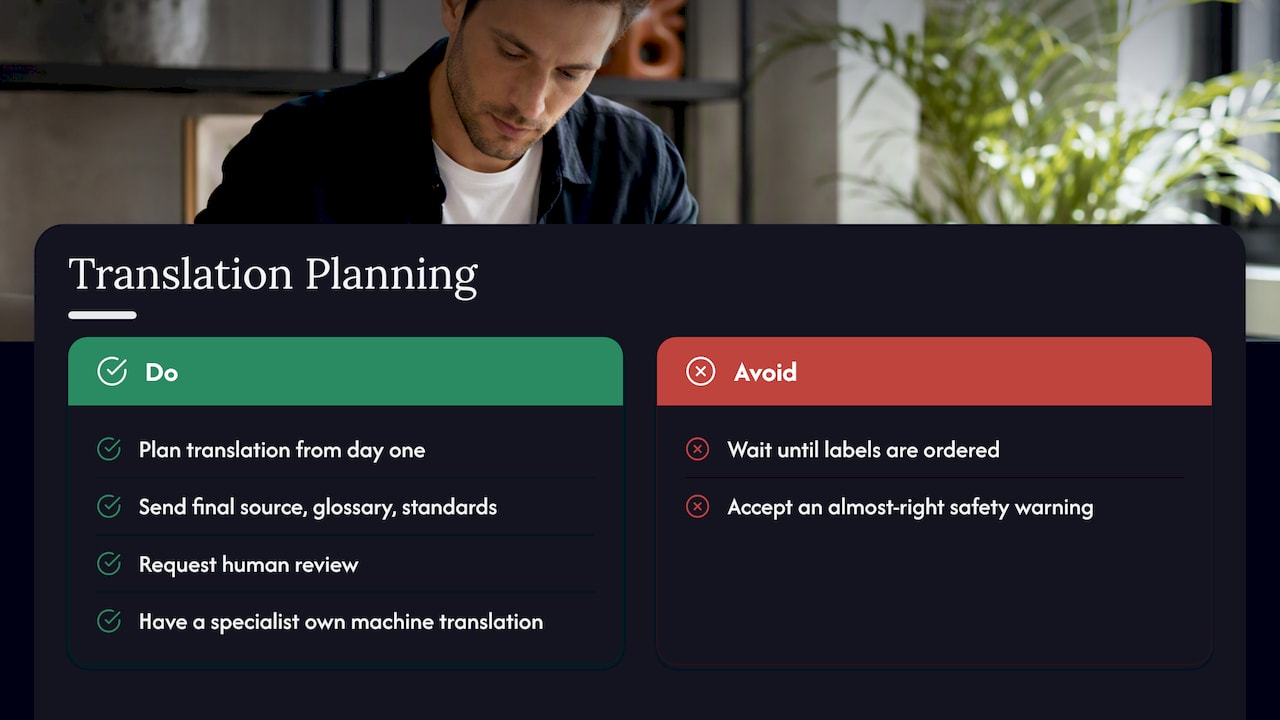
Our advice is boring and it works: put translation in the compliance plan from day one. Give linguists the final source, the glossary and the relevant standard references. Ask for a human review, because a safety warning that is “almost right” is wrong. If you use machine translation for speed, keep a specialist in the loop who owns the final text.
The EU’s own framing helps here. The aim is that the user understands the product. If your Slovak reader would hesitate over a warning, that is the sentence to rework, not the one a checker would notice.
— glocco®
Need a hand with CE documentation?
glocco® translates technical, legal and regulated content for businesses across Europe, in 76 languages. For declarations of conformity and legal wording, our HumanLegal service is built for exactly that kind of precision. For the full range, from manuals to video instructions, start at glocco.com. Send us the document list and we will tell you what is needed.
FAQ
Does the CE mark itself need to be translated?
No. It is a symbol with set proportions, and the Commission’s guidance sets a minimum height of 5 mm unless product rules say otherwise. What needs translating is the documentation that goes with the product.
Do I need a Slovak declaration of conformity?
Often, yes. For machinery, the directive requires the declaration and its translations to be produced under the same conditions as the instructions. Check the rules for your product category, and when you sell in Slovakia, plan for a Slovak version.
Is an English manual enough for Slovakia?
For consumer products, usually not. Slovak law requires traders to provide information and documents in the state language, and non-compliance can be an administrative offence. For professional-only equipment, check the product rules and ask the authority if unsure.
Should I label the original and the translation?
Yes. Several directives expect the original instructions to accompany the translation, and missing labels can be cited in an audit. Mark each version clearly and keep them in sync.
Sources
- Manufacturers, CE marking | European Commission
- Language use in consumer information | EUR-Lex
- Electrical safety: low-voltage electrical equipment | EUR-Lex
- Act No. 108/2024 Z.z. on consumer protection | Slov-lex
- Machinery Directive 2006/42/EC, Annex II | EUR-Lex
- Signing the declaration of conformity | Your Europe
- CE marking and the Requirement for Native Language Translations | F2 Tech Notes


