


Get this wrong and someone gets hurt, or your product gets pulled from shelves. Localisation of user manuals means adapting instructions, safety warnings, graphics and units for a specific market, not just swapping words. The safest, fastest route is specialist localisation with proper terminology management and regulatory QA baked in from day one.
What does localisation of user manuals actually involve?
Translating a manual word for word is how you end up with a torque spec that’s technically correct but practically useless, or a safety icon nobody in the target country recognises. Real localisation of user manuals covers a lot more ground than swapping English for Slovak.
Here’s what’s actually in scope:
- Linguistic translation of every instruction, warning and label
- Cultural adaptation of examples, tone and even colour associations (red doesn’t mean “stop” everywhere)
- Conversion of units, date formats and measurement systems
- Redrawing or relabelling diagrams, icons and callouts
- Plain-language checks so instructions are genuinely usable, not just grammatically correct
That last point matters more than most manufacturers realise. ISO 24495‑1:2023 sets out plain-language principles built around relevance, findability, clarity and usability, and it applies squarely to technical documents. A manual can be perfectly translated and still fail every one of those tests if nobody checked whether a real user could find and act on the safety information inside three seconds.
What do EU rules require for manual language and format?
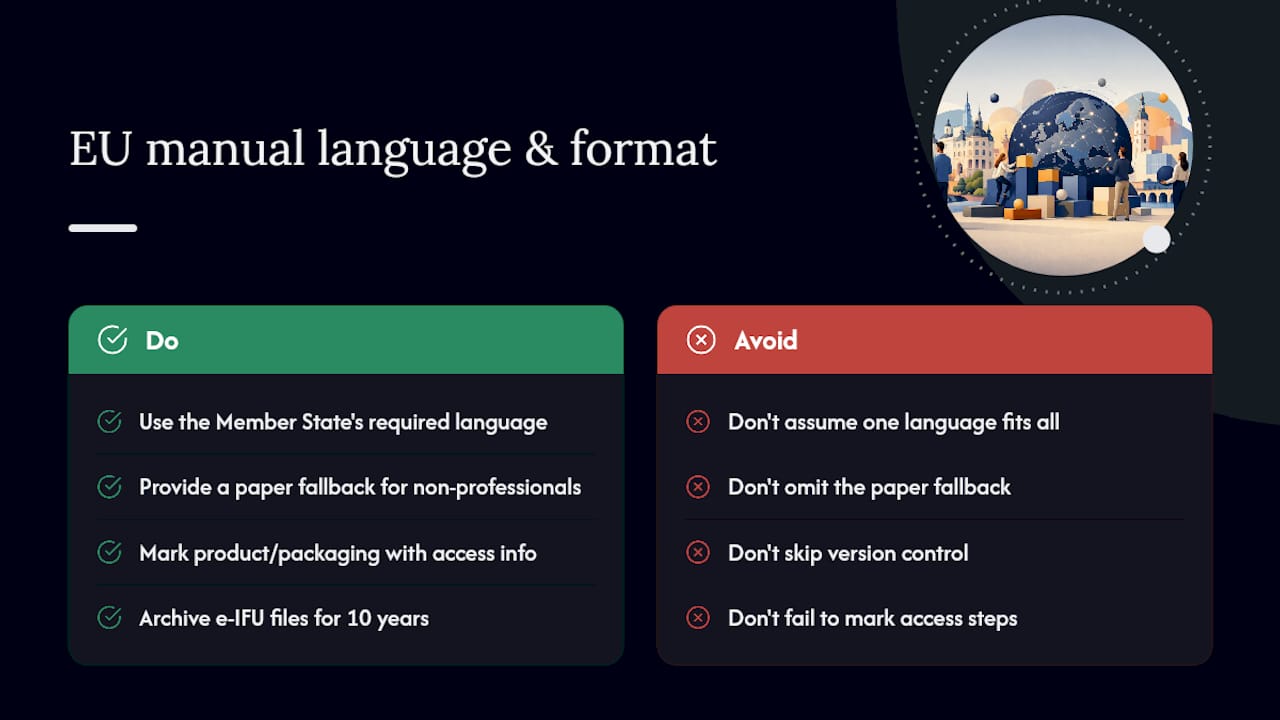
Manufacturers can’t just pick their favourite language and hope for the best. Regulation (EU) 2023/1230 requires instructions for use to be clear, understandable and written in a language “easily understood,” with each Member State deciding what that means for its own market. Ignore that and you’re not just risking a bad review, you’re risking a compliance breach.
Digital instructions (e‑IFU) are allowed, but not as a free pass. Implementing Regulation 2021/2226 sets the conditions for when e‑IFU is acceptable, and it requires a paper fallback for non‑professional users. Manufacturers also have to mark the product or packaging with clear instructions on how to access the digital version, and keep those e‑IFU files available for at least 10 years after the product hits the market.
That’s a decade of archiving obligation resting on files your localisation partner produced. Get the version control wrong at project stage, and you’re the one explaining it to an auditor later.
How does the manual type change the localisation approach?
Not every manual needs the same treatment, and treating them identically is how budgets balloon and deadlines slip. The audience dictates the deliverable.
- Safety and installation manuals for professional installers can lean on technical vocabulary, but every warning still needs plain-language checks under ISO 24495 principles.
- Consumer-facing manuals for non-professional users need simpler phrasing, bigger safety callouts, and almost always a printable version on request.
- Maintenance and service manuals demand tight terminology consistency across every revision, since technicians rely on exact matches between the manual and the machine’s own labelling.
- Software and in-device strings need character-limited, UI-constrained translation that still has to line up with the printed manual describing the same screen.
- Patient information leaflets for medical devices carry the strictest regulatory scrutiny and usually need in-country clinical or regulatory sign-off before release.
Mixing up these categories at the briefing stage is a classic way projects go sideways.
What’s the step-by-step localisation workflow for a manual?
A manual localisation project that skips steps doesn’t save time, it just moves the delay to after launch, when fixing it costs far more.
- Brief and asset collection. Gather source files, existing glossaries, diagrams, and any regulatory context (device class, target markets, applicable standards).
- Terminology extraction and style guide. Build or update a glossary before translation starts, not during it, so every translator uses the same term for the same part.
- Translation with HumanAI support. Combine human subject-matter translators with AI-assisted tools for speed on repetitive technical content, keeping a human reviewer on every safety-critical sentence.
- In-context review and DTP. Check translated text sits correctly in diagrams, callouts, and page layouts, not just in a spreadsheet.
- Usability and in-country review. Test whether a real target-market reader can actually follow the steps, then get local regulatory or legal sign-off.
- Version control and archiving. Lock the final files, log the version history, and store everything against the retention period your regulation demands.
Glocco’s own language localisation workflow integrates this pipeline directly into a product’s CI process, so software strings and printed manuals never drift out of sync.
Pro Tip: Never let translation and DTP happen as separate, disconnected phases. A word that fits perfectly in English can wreck a diagram’s layout in German or Finnish, and you only find out if someone checks the actual page, not just the text file.
What quality checks actually catch manual errors?
Most manual errors aren’t spelling mistakes, they’re the invisible kind: a symbol that means something different locally, a line break that hides half a warning, or a unit conversion that’s off by a decimal point.
Here’s what proper QA covers:
- Terminology consistency checks against the approved glossary
- Optional back-translation for safety-critical warnings, translating the target text back to source to catch drift
- DTP verification of diagrams, callouts, icons and page breaks in the finished layout
- Accessibility checks for e‑IFU, including confirming the file prints cleanly if a user requests a paper copy
- A final QA artefact pack: glossary, style guide, DTP proof, and sign-off record, all handed over, not just filed away
Pro Tip: Ask for the QA artefacts as standard deliverables, not an extra. If a vendor can’t hand you the glossary and DTP proof at project close, you’ve got no paper trail if a regulator ever asks how a warning was translated.
How long does manual localisation take, and what drives the cost?
Turnaround depends heavily on volume and complexity, but a mid-sized technical manual with DTP and one or two target languages typically moves faster than a multi-language rollout with medical or legal sign-off layered on top. Rush options exist, but they usually mean parallel review streams rather than skipped steps, so budget for that if your deadline’s tight.
Cost drivers worth knowing before you request a quote:
- Word count and repetition rate (repeated content costs less per word)
- DTP complexity, especially diagram-heavy or icon-dense manuals
- Number of target languages and whether legal or regulatory review is required per market
- Ongoing update frequency, which usually shifts pricing from per-project to a retainer model
Per-word pricing suits one-off projects; a retainer makes more sense if your manuals get revised every product cycle.
How do you choose the right localisation partner?
The wrong vendor choice shows up months later, usually as a support call or a regulatory query you can’t answer cleanly. A few concrete checks up front save that headache.
- Ask for subject-matter specialists, not generalist translators, especially for medical, engineering or legal content.
- Confirm DTP capability in-house, so diagrams don’t get outsourced to a third party you never vetted.
- Request a regulatory track record, ideally with examples covering your specific device or machinery category.
- Check version control practices, particularly how they handle e‑IFU updates against the 10-year retention window.
- Ask for a sample translation of a genuinely tricky page, not the easiest paragraph in the manual.
Glocco’s own localisation checklist covers the procurement side of this in more depth, including the update SLA question most buyers forget to ask until it’s too late. If discoverability of the finished documentation matters too, it’s worth looking at how multilingual content gets structured for search, since a well-localised manual that nobody can find online isn’t doing its job either.
Why “good enough” translation isn’t good enough for manuals
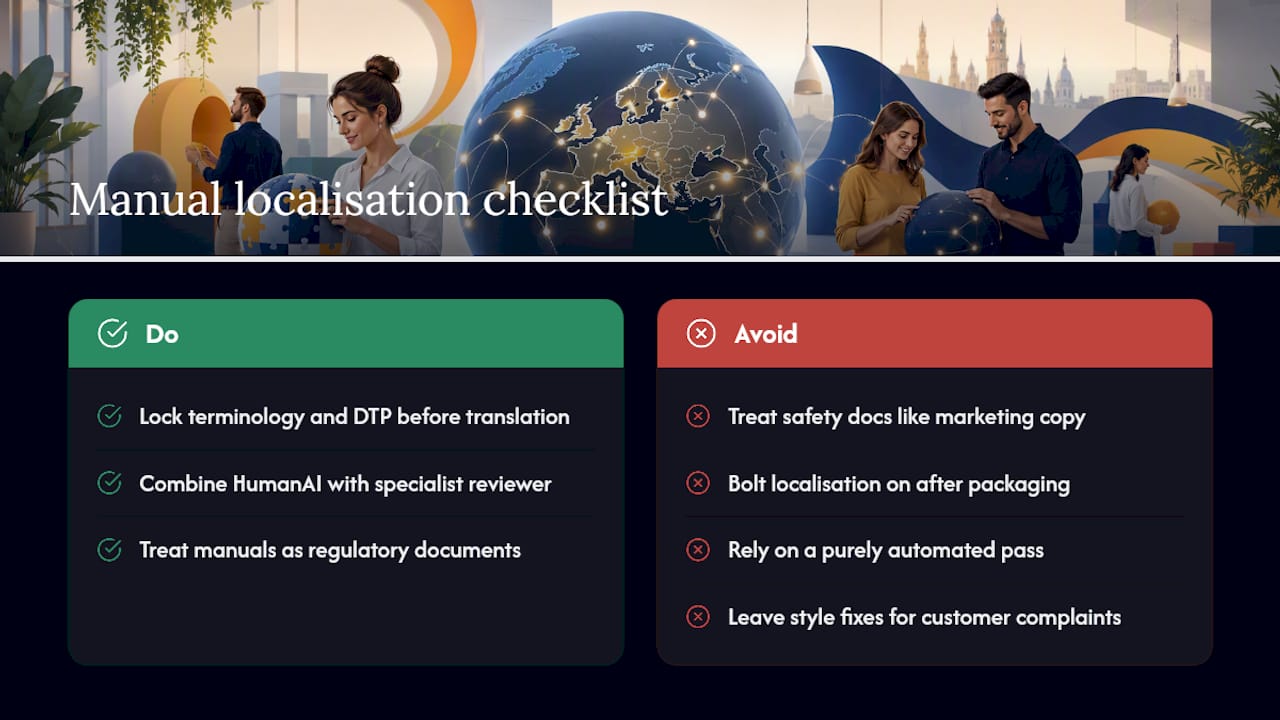
Here’s an uncomfortable truth: most manual translation problems don’t come from bad translators. They come from treating a safety document like marketing copy, something you can polish later if a customer complains. Manuals don’t get that luxury. A missed unit conversion or a warning that reads awkwardly in the target language isn’t a style issue, it’s a liability sitting quietly inside your product box.
What we’ve found working across software, medical, engineering and ecommerce clients is that the projects that go smoothly are the ones where terminology and DTP get locked in before translation even starts, not bolted on afterwards. Combining HumanAI speed with a specialist reviewer on every safety-critical line catches the errors a purely automated pass misses and the delays a fully manual process creates. Manufacturers who treat their manual as a regulatory document from the start, not an afterthought bundled with packaging, tend to avoid the expensive rework later.
— glocco®
Get your manual localisation project started properly
Choosing the right localisation provider is the practical alternative to juggling a freelance translator for the words and a separate DTP shop for the layout, because you get specialist translation, plain-language QA and layout checks handled as one connected process. That matters most for manuals, where a mismatch between the translated text and the diagram it sits beside is exactly the kind of error that slips through when two vendors never talk to each other.
If you’re staring down a manual that needs to hit multiple markets, or an e‑IFU deadline with a paper fallback requirement attached, HumanPro is built for exactly this kind of compliance-sensitive technical documentation. Send over a sample page and get a feel for how the terminology and DTP process actually works before you commit to the full project.
Sources
- ISO 24495-1:2023 – Plain language — Part 1: Governing principles and guidelines
- Regulation (EU) 2023/1230 — EUR-Lex
FAQ
Does an EU manual have to be translated into every local language?
Not automatically, but each Member State sets its own rule on what counts as a language “easily understood” by users, under Regulation (EU) 2023/1230. In practice, this usually means the official language of wherever the product is sold.
Can a manual be digital only, with no paper version?
Sometimes, but Implementing Regulation 2021/2226 generally requires a paper fallback for non-professional users, and manufacturers must mark the product with how to access the digital version. Paper copies typically have to be available on request, free of charge.
How long should e‑IFU files be kept available?
Digital instructions for use need to stay accessible for at least 10 years after the product is placed on the market. That is a long archiving commitment, so version control at the localisation stage really matters.
What’s the difference between literal translation and proper localisation?
Literal translation swaps words; localisation adapts units, icons, cultural references and phrasing so the instructions are genuinely usable in the target market. ISO 24495‑1:2023 frames this as a usability requirement, not just a linguistic one.
How much does manual localisation cost?
Pricing depends on word count, DTP complexity, number of languages and whether legal review is needed, so there’s no single flat rate. Current pricing for services like HumanPro is available directly on the Glocco site.


