


Here’s the surprise: a good translation of your terms and conditions is the easy part. The hard part is that Slovak law decides which language your terms must be in, what must be inside them and how a doubtful sentence gets read. If you sell to Slovak consumers, your terms need to be in Slovak. If you sell to Slovak companies, they need to be clear, agreed and consistent in both languages. Either way, a legal translator who knows the contract type should do the work. That is exactly what our HumanLegal service is built for, and below is the routine behind it.
Why a literal translation of T&Cs is risky
Terms and conditions are not marketing copy. They are a contract, and a single mistranslated clause can change who carries the risk.
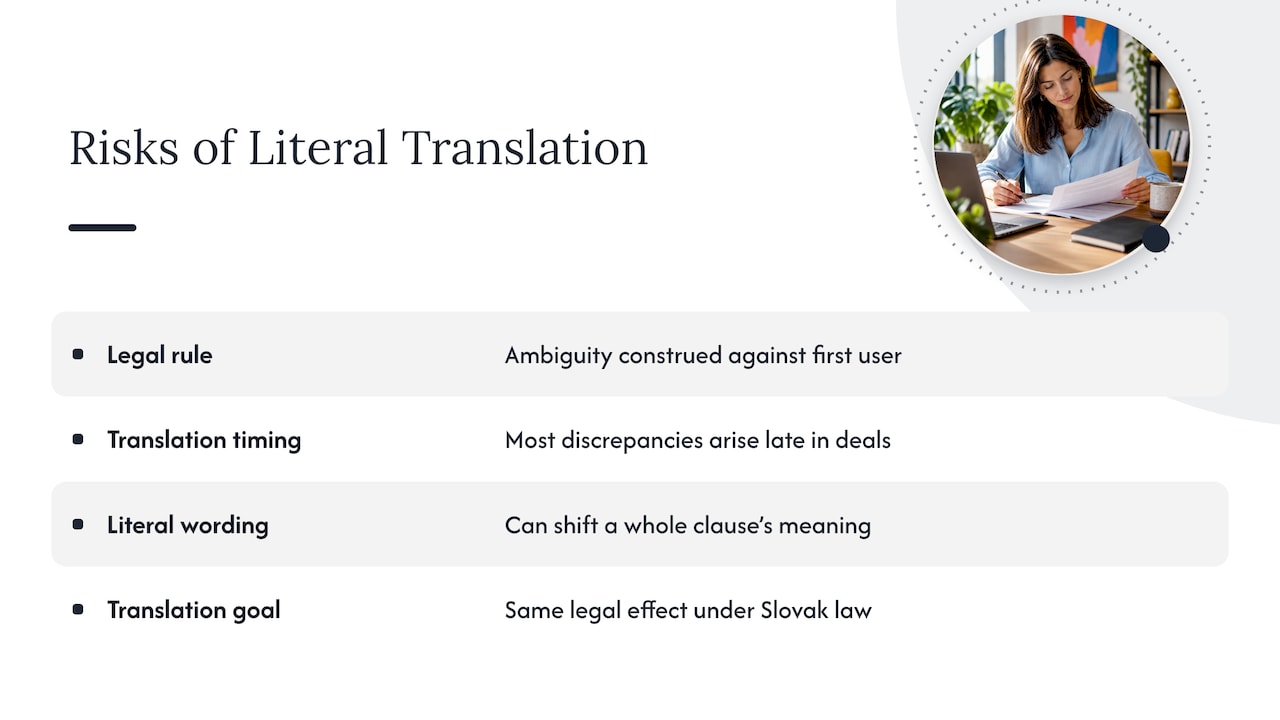
Slovak commercial law has a nasty rule for this. Under Section 266(4) of the Commercial Code, a term open to several readings is, in case of doubt, construed against the party that first used it. If your wording came from a sloppy translation, guess who that party is. You.
Lawyers who work with bilingual contracts see the same pattern. Most discrepancies come from translations rushed at the end of a deal, not from bad intent. Legal concepts in two languages rarely line up perfectly, so a word-for-word rendering can shift the meaning of a whole clause.
So the goal is not “the same words in Slovak”. The goal is “the same legal effect under Slovak law”.
When your terms must be in Slovak
This depends on who you sell to.
Consumers (B2C)
The EU leaves language rules to each country. The Consumer Rights Directive expressly lets Member States keep or introduce language requirements for contract information and terms. Slovakia uses that option.
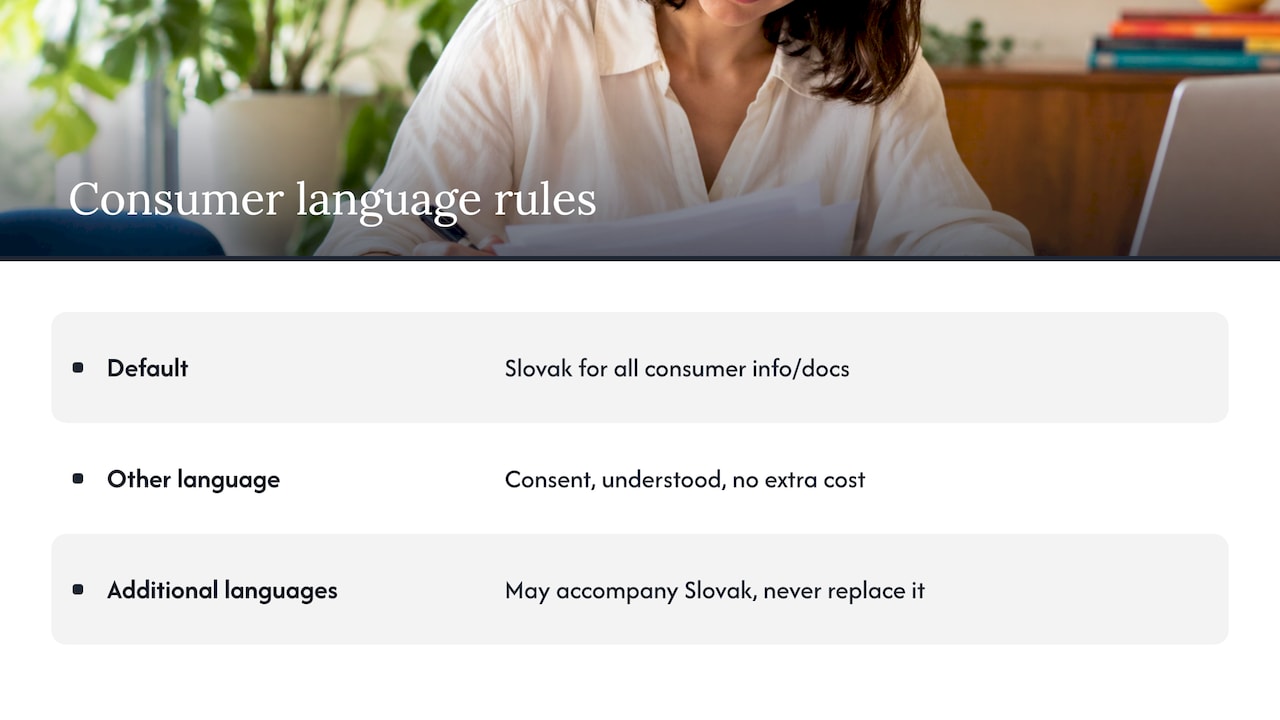
Under § 4(1)(g) of Act No. 108/2024 Coll., a trader must give consumers all information and documents in Slovak. With the consumer’s consent, another language the consumer understands is possible, and it must come at no extra cost. Other languages may appear alongside Slovak, not instead of it.
The stakes are real. Consumer-law guidance for EU businesses states that information in the wrong language is treated as if it was not provided at all. One legal guide to Slovak online shops adds that the Slovak Trade Inspection (SOI) treats a foreign-language document as a breach of information duties.
Act No. 108/2024 took effect on 1 July 2024 and replaced Acts 250/2007, 102/2014 and 299/2019. So if your Slovak terms were translated years ago, they probably still cite the old acts. Time for a refresh!
Businesses (B2B)
Between companies there is more freedom, but also more traps:
- The parties must actually agree to your terms. A mention on an invoice or in an email is not enough, and the main contract wins over the T&Cs if they conflict.
- Your own terms must be known to the other side or attached to the draft contract. Letting them inspect the terms before signing is not enough, and you carry the burden of proof in court.
- In a bilingual deal under Slovak law, one firm recommends giving priority to the Slovak version, because the Slovak text applies in case of inconsistency in proceedings before the authorities named in the State Language Act.
What a Slovak consumer T&C has to contain
A translator should know this list before touching a word. Guidance on Slovak online shops names these typical building blocks:
- seller identity: company, registered office, IČO/DIČ, contact details;
- ordering rules and the moment the contract is concluded;
- prices including VAT, payment methods and terms;
- delivery methods, costs and time frames;
- the 14-day right of withdrawal with a model form;
- a complaints procedure;
- the alternative dispute resolution (ARS) body and a link to the EU ODR platform;
- a reference to the privacy policy.
The EU’s own page on information you must give before a purchase adds, for distance sales, the trader’s e-mail, after-sales service and commercial register number, plus written confirmation on paper or a durable medium.
Two more details from Act 108/2024: § 4(2) bans unfair terms in consumer contracts, and § 5(3) says ARS information belongs mainly in your general terms and on your website. Under EU rules, unfair terms do not bind the consumer, and any ambiguity is read in the consumer’s favour. For a quick overview of how clear T&Cs protect client relationships, see this piece on protecting client relationships with clear T&Cs.
Notice what this means: if your source terms were written for another country, the Slovak version may need new clauses, not just new words. A Czech law firm puts it bluntly: Slovak T&Cs are an adaptation, not a translation, because arrangements that work in one country can be invalid or debatable in the other.
Terms to keep consistent
Consistency is where translations quietly fall apart. The same concept must have one Slovak rendering, everywhere.
A few classics:
| English concept | Typical Slovak rendering |
|---|---|
| force majeure | vyššia moc |
| liability limitation | obmedzenie zodpovednosti |
| intellectual property | duševné vlastníctvo |
| arbitration | rozhodcovské konanie |
| general terms | všeobecné obchodné podmienky |
And mind the vocabulary of the new Civil Code. The terminology table for the new Civil Code shows that “general business terms” become “standard terms” (všeobecné zmluvné podmienky), “breach of contract” becomes “non-performance” (nesplnenie), and premlčacia doba becomes premlčacia lehota. Check which regime your contract actually falls under before choosing the term.
A practical routine that works:
- Fix the source terms first. Stabilise them early and translate them first, so the glossary does not shift mid-project.
- Define key terms in one place and use them the same way throughout. Lawyers also advise stating the calculation base and period for penalties and caps.
- Decide what stays untranslated, such as brand and product names.
- Keep a termbase entry per concept, so one source word with two meanings gets two Slovak equivalents.
How to prepare and review your translation
Here is the order we would follow with you.
- Check the source. Remove old versions and harmonise clauses across your templates. A translation of a messy original is a messy translation.
- Decide the legal frame. Consumers or businesses? Slovak law or another? Which version prevails? This choice shapes the translation brief.
- Translate with a specialist. HumanLegal is our service for legal content, and glocco® works across 76 languages. If you also deal with confidentiality terms, our guide to NDA translation in Slovakia covers that side.
- Read both versions side by side before anything goes live. Lawyers recommend exactly this for final bilingual texts, ideally with a lawyer who knows the contract type in both languages.
- Publish and link properly. Link the T&C URL in every order and state that the order is governed by the terms at that URL, as Slovak law firms suggest.
- Keep records. Document in writing which version applied to which customer and when.
For more on how quality is assured in legal projects, see our piece on ensuring legal translation quality in the EU. If budget is on your mind, there is a page on legal translation pricing in Slovakia.
Our perspective
Many companies ask us for “just a translation” of their T&Cs. We get it: it sounds simple, and a deadline is usually breathing down your neck.
But your terms are a contract. We treat them like one. That means a specialist legal team, a locked glossary and a side-by-side check of the finished text, so the Slovak version does the same job as the original.
The best moment to call us is before launch, not after the first complaint. Send us your source terms, tell us who you sell to, and we will build the Slovak version around that.
glocco®
Ready to get your terms into Slovak?
glocco® has provided translation, interpretation and AI services since 2014 to clients in e-commerce, fintech, legal, pharma, IT and other sectors. Whether you run a web shop, a SaaS platform or a law firm, our HumanLegal team can take your terms from source text to a Slovak version you can publish with confidence. Prefer to talk first? Start from glocco.com.
FAQ
Do I need Slovak T&Cs if I sell online to Slovak consumers?
Yes. Under Act 108/2024, information and documents for consumers must be given in Slovak, or with the consumer’s consent in another language they understand. Other languages can appear alongside Slovak.
Does Slovak T&C translation need a lawyer?
For consumer terms, the legal content (withdrawal, complaints, ARS) must match Slovak rules, so legal review matters. A legal translator who knows the contract type handles the language, and your lawyer confirms the legal frame.
Which version wins in a bilingual B2B contract?
The contract should say so explicitly. Under Slovak law and a Slovak court, the Slovak version is recommended as the prevailing one, since it applies in case of inconsistency before the authorities in the State Language Act.
Can I just reference my T&Cs on the invoice?
No. In B2B dealings the parties must explicitly agree to the terms, and the main contract takes precedence over them. Link the terms in every order instead.
Sources
- Act No. 108/2024 Coll. on Consumer Protection
- Directive 2011/83/EU, Consumer Rights Directive
- Your Europe: information you should receive when shopping
- Your Europe: unfair contract terms
- Consumer Law Ready: practice questions and answers
- Online shop terms and conditions for Slovakia
- Obchodné podmienky a ochrana spotrebiteľa od 1.7.2024
- Setting Slovak T&Cs for Czech companies
- Ambiguous wording in your own contract template
- Bilingual agreements and the prevailing language version
- General terms and conditions in Slovak law
- Changes in terminology, New Slovak Civil Code
- Slovak legal glossary
- Manage terminology, Microsoft Learn
- Protecting client relationships with clear T&Cs


