


Translating your onboarding pack into Slovak is not localising it. Your new starter in Bratislava or Košice can read every word and still not know whether to say ty or vy to the team lead, which form to sign on day one, or why the leave policy talks about a country they don’t work in. Real localisation covers language, legal content, tone and format. Get those four right and new colleagues feel at home in week one. Get them wrong and the pack just looks like a translated afterthought.
This guide is for EU businesses in law, pharma, defence, tech, e-commerce and finance that hire or manage people in Slovakia. Let’s go through what to adapt, what the law expects and how to keep it all up to date.
Translation moves words, localisation moves the experience
Quick definition, because the two get mixed up all the time. Translation transfers text from one language into another. Localisation adapts the whole learning experience to the audience’s cultural, linguistic and social expectations, including tone, references and visuals.
For onboarding, that means checking things like:
- dates, currency and measurement units (a salary example in dollars is a small but real signal that the pack was not made for your reader);
- cultural references, such as an American holiday used as a scheduling example;
- terminology, so that “line manager”, “probation” or “PTO” match what Slovak HR actually says;
- layout and navigation, because Slovak text often runs longer than English and can break a tidy slide or button.
If you want the bigger picture first, our guide on what language localisation is covers the basics, and the language localisation checklist gives you a reusable list.
What to adapt in the Slovak onboarding journey
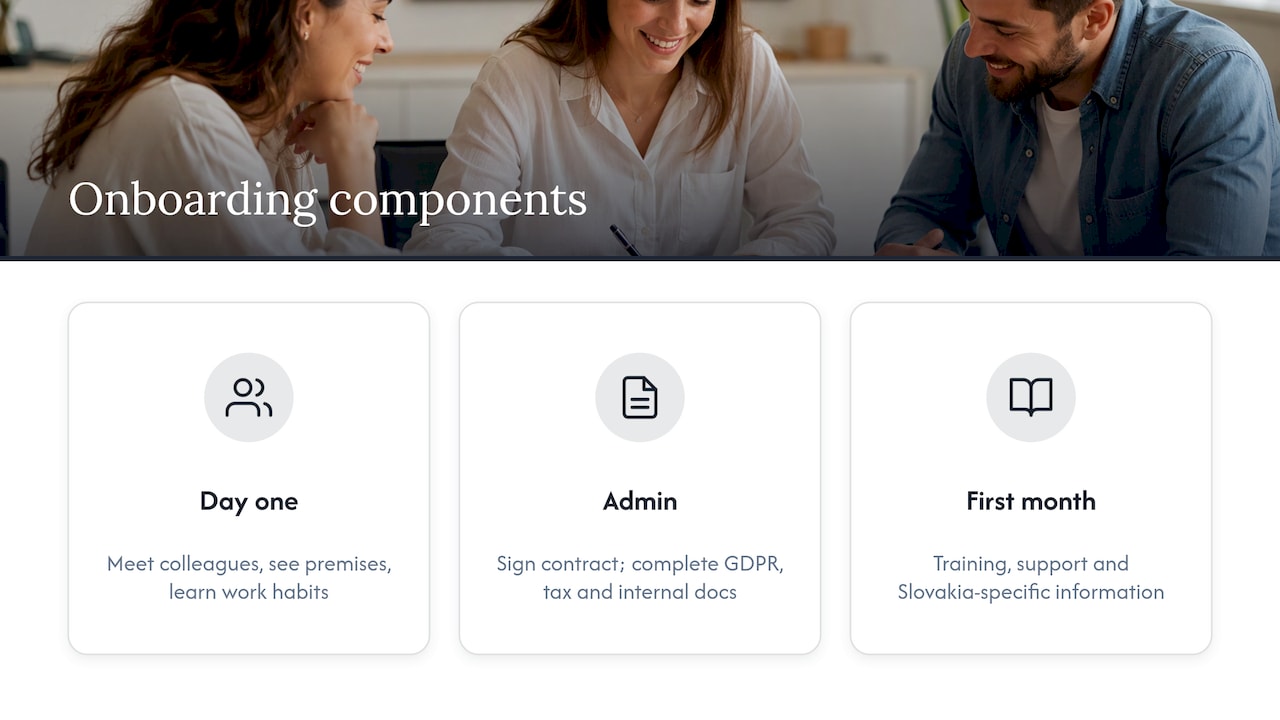
A good starting point is to look at how Slovak employers structure their own. The Slovak Academy of Sciences’ new-employee handbook describes day one as meeting colleagues, seeing the premises and learning basic work habits, alongside administration: signing the employment contract and completing GDPR, tax and internal documents. It then moves to first-month training and support, plus Slovakia-specific information on working time, telework, sickness, medical visits, paid leave, wages and ethics.
That gives you a practical map. Go through your global onboarding and sort each item into one of three buckets.
Keep as it is, but translate well
Company values, code of conduct, product knowledge, brand story. Global onboarding works best when it balances standard company values with local adaptation in areas like communication style and local legal requirements. Here the job is faithful, consistent terminology.
Adapt to Slovak reality
- Working-time, leave, sickness and telework information.
- Payroll dates, benefits, meal arrangements and who to call for what.
- Communication norms: meeting culture, feedback, how formal emails are. A Slovak management school article lists cultural norms, tools and compliance among the things inclusive onboarding should cover, with equal quality for remote and onsite staff.
- Everyday guidance: addressing colleagues formally or informally is a classic Slovak workplace question, and a short note saves awkward first weeks.
Replace completely
Anything that describes another country’s law: statutory leave, probation rules, data-subject processes written for a different regime. These need a local rewrite, not a translation.
One warning about stereotypes. The IOM’s Migration Information Centre stresses an individual approach over nationality-based assumptions when managing diverse teams. So write for clarity and clear expectations, not for a cartoon version of “the Slovak employee”.
The legal layer you cannot translate away
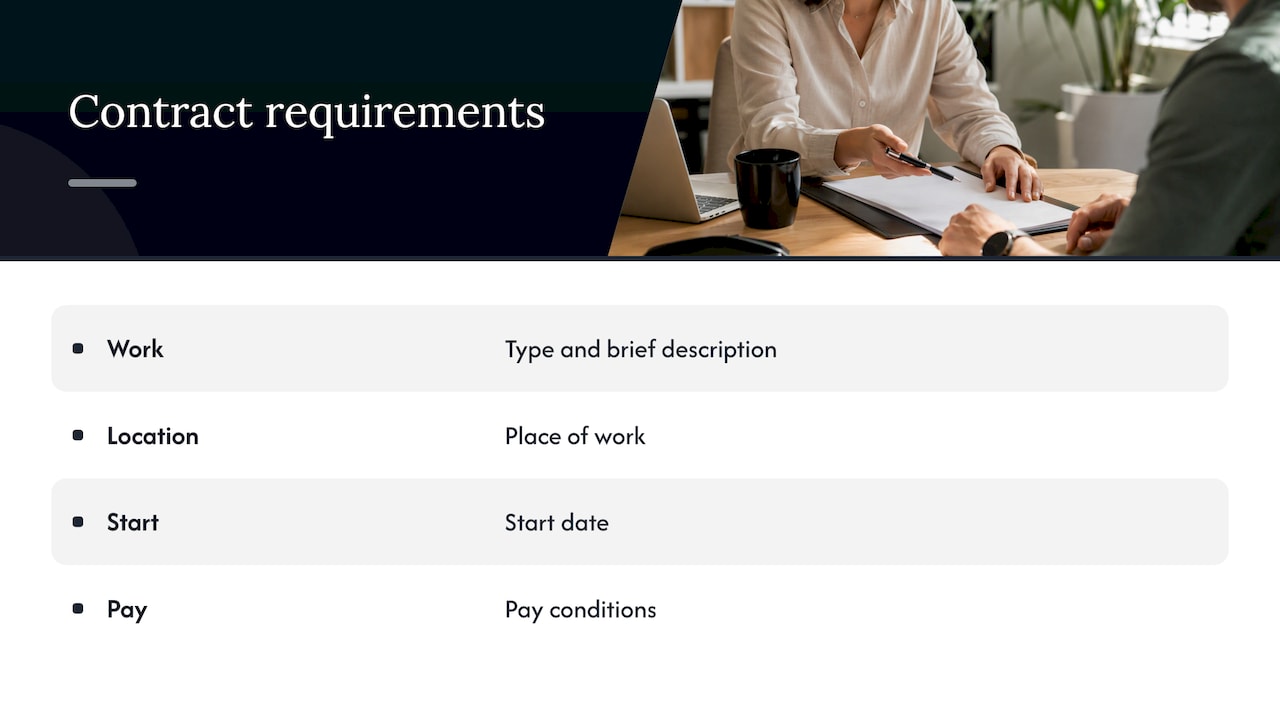
This is where regulated sectors feel the pressure. Under the Slovak Labour Code (Act No. 311/2001 Coll.), an employment contract must be in writing and include the type of work and its brief description, the place of work, the start date and the pay conditions. On the language side, the Global Employment Compass for Slovakia states that the contract must be in Slovak, while an additional translation into another language is permitted. Handy: your English-speaking starter can have a parallel version, but the Slovak text is the one that counts.
There is more than the contract. When employment begins, the employer must inform the employee about workplace regulations, collective agreements, applicable legal rules, occupational health and safety and equal treatment. That is onboarding content, so it must exist in a clear, accurate Slovak version.
Hiring from abroad? The Ministry of Labour says employers must notify the Labour Office in writing of the start and end of employment of EU citizens, their family members and third-country nationals within seven working days. For third-country hires, vacancy notification deadlines of 5, 10, 15 or 20 working days apply before certain residence or work-permit applications. Check the ministry page for the case that fits, and talk to your Slovak employment lawyer for anything specific to a contract.
Because legal wording carries consequences, this is the place for specialist legal translators rather than a quick machine pass. Our HumanLegal service exists for exactly that kind of text, and our article on sector-specific localisation and compliance shows how requirements differ by industry.
Global policies: addendum or rewrite?
Most groups have a global code of conduct, an anti-bribery policy and an IT-use policy. According to a Slovak advisory firm, corporate policies can be localised by keeping the global wording and adding a local addendum, or by rewriting them for local conditions. The same source notes there is no universal rule: you review the global text against local legislation and against how work is actually done in Slovakia.
A simple way to decide:
| Situation | Usual approach |
|---|---|
| Policy is principle-based and law-neutral (values, ethics) | Faithful translation |
| Policy mostly fits but a few clauses clash with Slovak rules | Translation plus local addendum |
| Policy is built on another country’s legal framework | Local rewrite, then translate back for group review |
The last row is where back translation earns its keep: it lets group legal read what the Slovak text actually says.
Build a process, not a one-off project
Onboarding content changes: new tools, new policies, new benefits. If you localise it once and forget it, the Slovak version drifts away from the English one within a year. Here is a routine that holds up.
- Inventory everything. Handbook, welcome emails, forms, slide decks, e-learning, videos, intranet pages, checklists. People always forget the auto-generated emails.
- Stabilise the source. Fix unclear English first. Idioms and jokes that work in London rarely survive in Bratislava.
- Sort by risk. Legal and safety content goes to subject-matter specialists. Culture and welcome content needs a native, tone-aware adaptation.
- Build a glossary. Agree the Slovak term for every recurring concept once, and reuse it everywhere.
- Review in the final format. Read the Slovak in the real slide, page or video, not in a spreadsheet. That is where truncated buttons and mismatched subtitles show up.
- Update on a schedule. Tie localisation to your policy-review calendar so changes flow to Slovak at the same time as to English.
Video is a big part of modern onboarding. If your welcome or compliance training is on screen, subtitling and video translation are part of the job, and our guide to subtitles for compliance training explains how to keep them accurate.
How to tell whether it works
A localised pack is not finished when it is delivered. It is finished when a new starter uses it without confusion. Some simple checks:
- Frequent check-ins. EURES recommends meetings with a manager or team at least twice a week to prevent isolation and track progress, especially for remote new hires. Use those conversations to ask what was unclear.
- Ask about specific documents. “Which form did you have to ask about?” gives better answers than “how was onboarding?”.
- Track repeat questions. If HR keeps answering the same question, the pack has a gap.
- Watch the 6 to 12 month picture. Slovak management educators describe onboarding as a lifecycle phase of roughly 6 to 12 months, not a first-day paperwork exercise.
Our perspective
We think the best onboarding pack is the one nobody notices. The new starter reads it, understands it and gets on with the job. No raised eyebrows, no “was this machine translated?” moment.
That is why we treat localisation as teamwork between language specialists and your HR, legal and compliance people. Legal wording goes to legal specialists. Welcome messages get a culturally nuanced, human touch. Video gets proper subtitling. And all of it is built on consistent terminology so the next update is quicker than the first.
Our work spans translation, localisation, interpretation, video subtitling and AI services in 76 languages, for companies in regulated and international sectors. Our formula is designed to combine modern technology with proven localisation practice. Onboarding is a perfect place to use it: small text, big first impression.
glocco®
Where glocco® fits in
Need the Slovak version of your handbook, policies and welcome materials? We offer text services at several levels, including HumanPro for professional human translation and HumanLegal for legal content, plus video subtitling and translation for training films. Tell us what is in your onboarding pack on glocco.com and we will point you to the right mix.
FAQ
Is localising onboarding the same as translating the handbook?
No. Translation converts the text. Localisation also adapts terminology, examples, dates, currency, tone and legal content to Slovak conditions. A translated handbook that still describes another country’s leave rules is a risk, not a help.
Does a Slovak employment contract have to be in Slovak?
Yes. According to the Global Employment Compass for Slovakia, the contract must use Slovak, and an additional translation into another language is permitted. Have your Slovak employment lawyer confirm how this applies to your contracts.
Which onboarding parts need the most care?
Content with legal consequences: the contract, workplace regulations, occupational health and safety information, data protection documents and compliance policies. Slovak law expects the employer to inform employees about workplace rules and OHS at the start of employment, so these should be accurate and clear.
How often should localised onboarding materials be reviewed?
Whenever the source policy changes, and on a fixed schedule at least once a year. Linking localisation to your policy-review calendar keeps Slovak and English versions aligned.
Sources
- Translation vs. Localization: What’s the Difference?
- Príručka nového zamestnanca (Slovak Academy of Sciences)
- Essential Documents And Steps For Onboarding International Employees
- Integračný proces: Adaptácia nových zamestnancov a onboarding
- IOM Migration Information Centre: training for HR
- Labour Code, Act No. 311/2001 Coll. (Slov-lex)
- Global Employment Compass Slovakia
- Employer information duties (Ministry of Labour, Slovakia)
- Povinnosti pri zamestnávaní cudzincov (MPSVR SR)
- How to localise corporate compliance policies so they work in Slovakia
- Top tips for onboarding new international employees (EURES)


