


Most annotation budgets fail for one boring reason: they price the labels and forget everything that makes the labels usable. Review, tooling, rework and compliance arrive later, uninvited, and send the invoice. At glocco® we run data annotation for regulated and international sectors, so here is the budget routine we would hand to a colleague, built for EU teams in law, pharma, defence, tech, e-commerce and finance.
What a data annotation budget actually covers
Think of it as a dataset budget, not a labelling budget. The per-label price is the visible part. Around it sit the lines that decide whether the data trains a model or gets thrown away.
A complete budget has these blocks:
- Labelling: the human work of tagging text, images, audio or video.
- Quality assurance: second reviewers, adjudication of disagreements, and sampling checks.
- Guidelines and schema: the label taxonomy, the instructions, the pilot round.
- Tooling and security: the annotation platform, integrations, access control.
- Rework: relabelling after the first quality results come in.
- Compliance: data protection work before anyone sees the data.
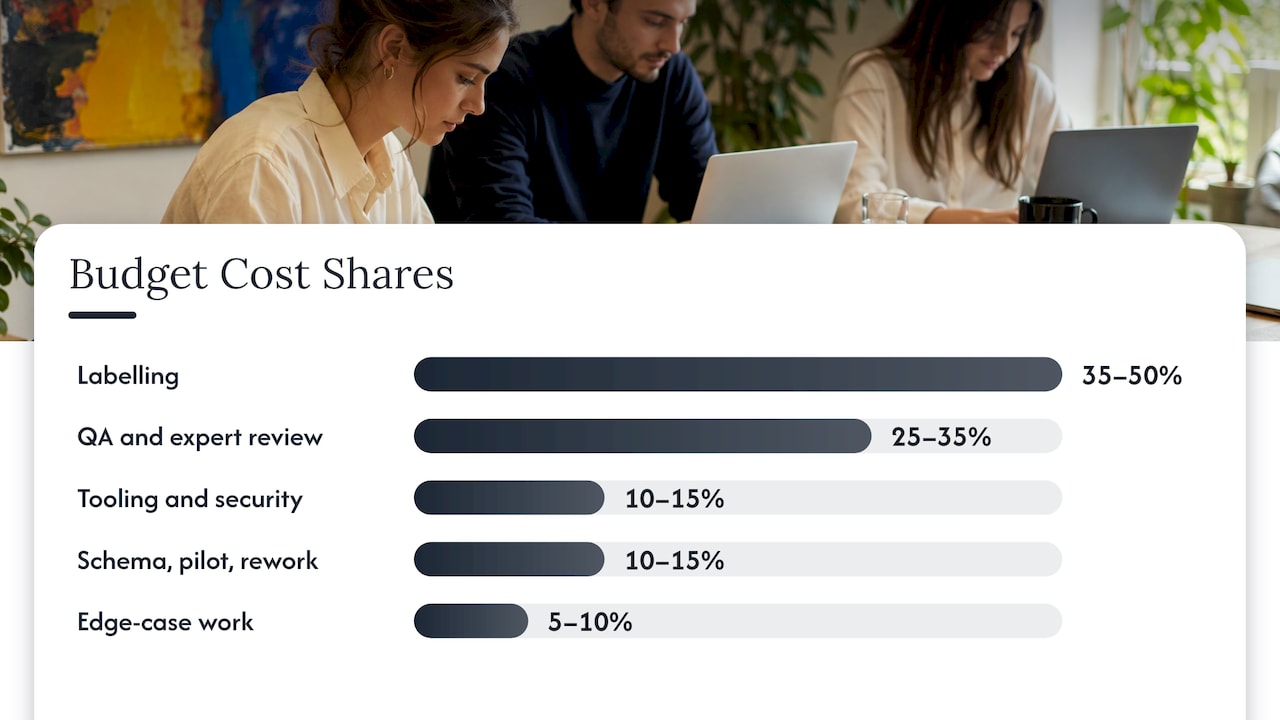
PCCVDI Research’s 2026 cost benchmarks give a useful starting split: labelling at 35–50% of the total, QA and expert review at 25–35%, tooling and security at 10–15%, schema design, pilot and rework at 10–15%, and edge-case work at 5–10%. Notice that labelling alone is under half. A quote that only shows labels is showing you perhaps a third to a half of the real bill.
How annotation work is priced
Expect three common shapes, and the choice changes who carries the risk.
- Per label or per item. Easy to compare, easy to forecast when the task is stable. Works well for repeatable classification.
- Per hour or per day. Better when guidelines are still moving, for example in a pilot. You carry the productivity risk.
- Project or retainer. A fixed scope for a defined dataset, or a monthly arrangement for continuous flows. This is the usual fit for ongoing programmes.
We go through how these compare, with a GDPR-ready template for procurement, in our guide to data annotation pricing models. Use it to line up quotes on the same basis before you compare totals.
What pushes the price up or down
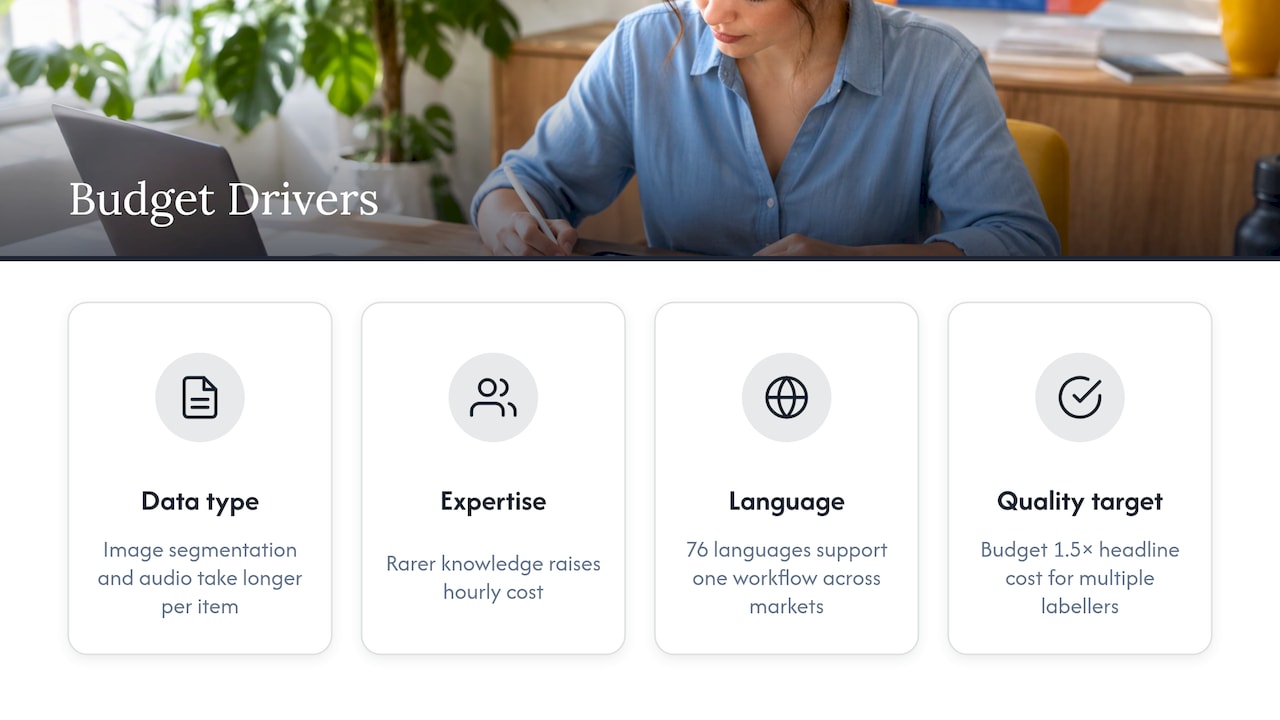
Four things move the number more than anything else.
Data type. Short text classification is quick. Segmenting images or transcribing audio takes far longer per item, so the same volume costs far more.
Expertise. A contract clause, a clinical note and a product title need different people. The rarer the knowledge, the higher the hourly cost. Our guides for legal, medical and fintech data show what each domain needs from annotators.
Language. Slovak, Czech or Hungarian text in a legal domain is a smaller pool of qualified reviewers than English e-commerce text. That is where a provider covering 76 languages helps you keep one workflow across markets.
Quality target. Asking for two or three independent labels per item, with senior adjudication, multiplies the labour on purpose. PCCVDI advises budgeting at least 1.5 times the headline labelling cost to get a usable dataset when you use multiple labellers and agreement scoring.
A formula you can run in ten minutes
Start with the labour estimate that ONES describes: annotation volume, divided by productive units per hour, multiplied by the loaded hourly cost. Then add the direct costs (review, adjudication, taxonomy, platform) and the indirect ones (administration, training, maintenance).
Two traps hide in that sentence:
- Loaded cost, not wage. Include supervision, recruiting, workspace and administration.
- Productive hours, not paid hours. Meetings, guideline questions and quality checks eat time. Use realistic throughput.
A worked example (illustrative numbers)
Say you need 100,000 support tickets classified for a fintech chatbot. These figures are invented to show the arithmetic, not a price list.
| Step | Assumption | Result |
|---|---|---|
| Headline labelling quote | 100,000 items at €0.10 | €10,000 |
| Floor for a usable dataset | headline × 1.5 | €15,000 |
| Contingency | 10% on the floor, your choice | €1,500 |
| Working budget | €16,500 |
Now run it three ways: optimistic, expected, pessimistic. ONES recommends testing several scenarios and writing down your labelling assumptions. If the pilot shows annotators agree less than expected, you will already know which line grows.
What regulated sectors should add
Lawyers, pharma, defence and finance teams carry extra lines that a start-up scraping public images never sees.
- Anonymisation before annotation. If the data contains personal details, strip or pseudonymise them first. Our GDPR playbook on anonymising personal data covers the routine.
- Access and security. Restricted environments, named annotators, audit trails. Budget for them in the tooling and security block, not as an afterthought.
- Tool hygiene. Staff pasting sensitive samples into random AI tools is a budget risk of its own. Read up on AI data leakage risks and decide your rules before the project starts.
- AI Act scoping. Work out which risk category your system falls into before you price compliance, since the duties differ by category. The European Commission’s AI Act page is the place to start.
Put a named line in the budget for each of these. A line with a number can be discussed. A hidden cost cannot.
Keeping costs under control without hurting accuracy
Cutting QA is the tempting move and the wrong one. PCCVDI’s warning is blunt: a budget that funds only labelling and treats QA, tooling and rework as overhead is the budget most likely to blow up. Better levers:
- Run a pilot first. A few hundred items expose unclear guidelines while fixing them is still cheap.
- Write tight guidelines with examples. Every ambiguous rule is paid for twice: once in disagreement, once in rework.
- Spend reviewers where it counts. Use sampling on easy classes and double review on the hard ones.
- Audit as you go. A regular check catches drift early. Here is how to run an annotation quality audit.
- Keep one team across batches. Annotators who know your domain get faster and more consistent.
See? Saving money and keeping accuracy are not enemies. Bad guidelines are the enemy.
How glocco® fits in
Our data annotation service sits alongside data collection and data validation, so the labelling, the checks and the data work can be planned as one scope. We serve legal, medical, fintech, e-commerce and other sector-specific content across 76 languages. Pricing is project-based or retainer-based, so send us your data type, volume and quality target and we will scope it with you.
Our view: budget the dataset, not the label
The cheapest label is rarely the cheapest dataset. We have built glocco® around the idea that proven localisation practice and modern technology should work together, and annotation is no different.
So we start with a conversation about the outcome: what the model must do, which languages it must handle, how sensitive the data is. Then we shape the team and the quality checks around that, rather than the other way round.
Our advice to procurement teams is simple. Ask for a scope that shows labelling, review and rework as separate lines. Then the budget is something you can steer, not something that happens to you.
glocco®
FAQ
How much should I budget for QA on top of labelling?
PCCVDI’s 2026 benchmarks suggest 25–35% of the total for QA, adjudication and expert review. Specialist domains such as legal or medical data usually sit at the higher end because reviewers are scarcer.
Is a per-label price enough to compare quotes?
No. Two quotes at the same per-label price can differ hugely once review layers, tooling and rework are counted. Ask each provider to show those lines separately, then compare totals.
Should I budget a contingency?
Yes. Pilots almost always reveal guideline gaps, and fixing them costs time. Add a percentage you are comfortable with and revisit it after the pilot.
Does GDPR change the budget?
It adds work before annotation starts, mainly anonymisation, access control and documentation. Plan these as their own lines, and involve your data protection officer or legal counsel early for sensitive datasets.
Sources
- What does AI training data actually cost in 2026? (PCCVDI)
- How to Estimate a Data Quality and Annotation Project Budget (ONES)
- AI Act regulatory framework (European Commission)


