


Short answer: if a submission or piece of evidence reaches a Slovak court in a foreign language, it needs a Slovak translation. Ideally that translation comes from a translator listed with the Ministry of Justice, and it should arrive before the court starts chasing you for it. Miss that, and the court can set you a deadline, arrange the translation itself or simply not work with the document. Let’s walk through how it all fits together.
What counts as a court submission translation?
Three different things hide behind one search phrase, and mixing them up is the classic way to lose a week.
- The submission itself. Your claim, response, appeal or motion. It has to be actionable in front of the judge, so it must be in Slovak.
- Supporting documents. Contracts, extracts, emails, expert reports. These are evidence, and the court needs to read them in the state language.
- Translations coming from the court. Under the Civil Dispute Code (Act No. 160/2015 Coll.), every person has the right to act in their native language or one they understand, and the court has to ensure equal opportunities for the parties. That is about your procedural rights, not a free translation service for your paperwork.
If you want to see where translation ends and interpreting begins, our piece on legal translation vs interpretation draws the line clearly. Hearings are a different job from documents.
When must you translate, and into which language?
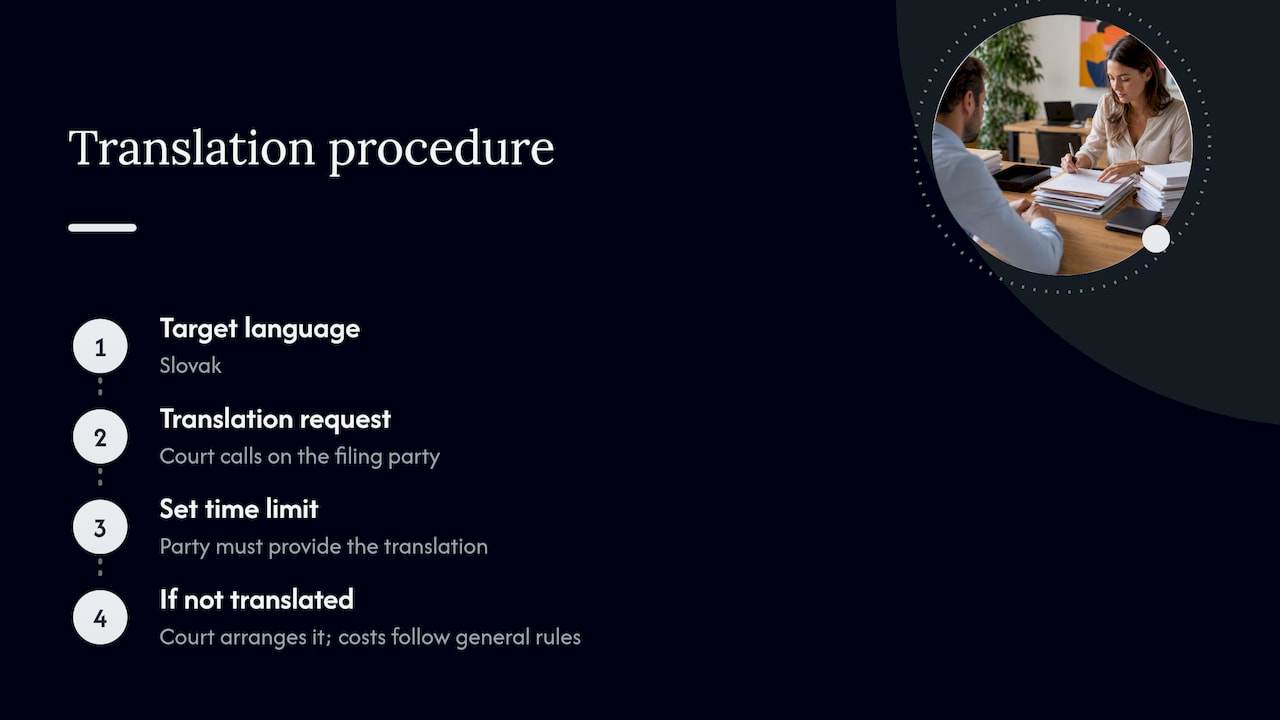
The target language is Slovak. Under the same Civil Dispute Code, when a submission or evidence is not in the state language, the court calls on the party who filed it to provide a translation within a set time limit. If the party does not, the court arranges it itself.
Sounds relaxed? Not quite. According to the explanatory report to the Civil Dispute Code, parties arrange translations of their submissions and evidence themselves, or the state arranges them and costs follow the general rules on costs. So a court-ordered translation can land in the cost assessment. Doing it yourself, early, keeps control of quality, timing and budget.
Civil, criminal, administrative, cross-border
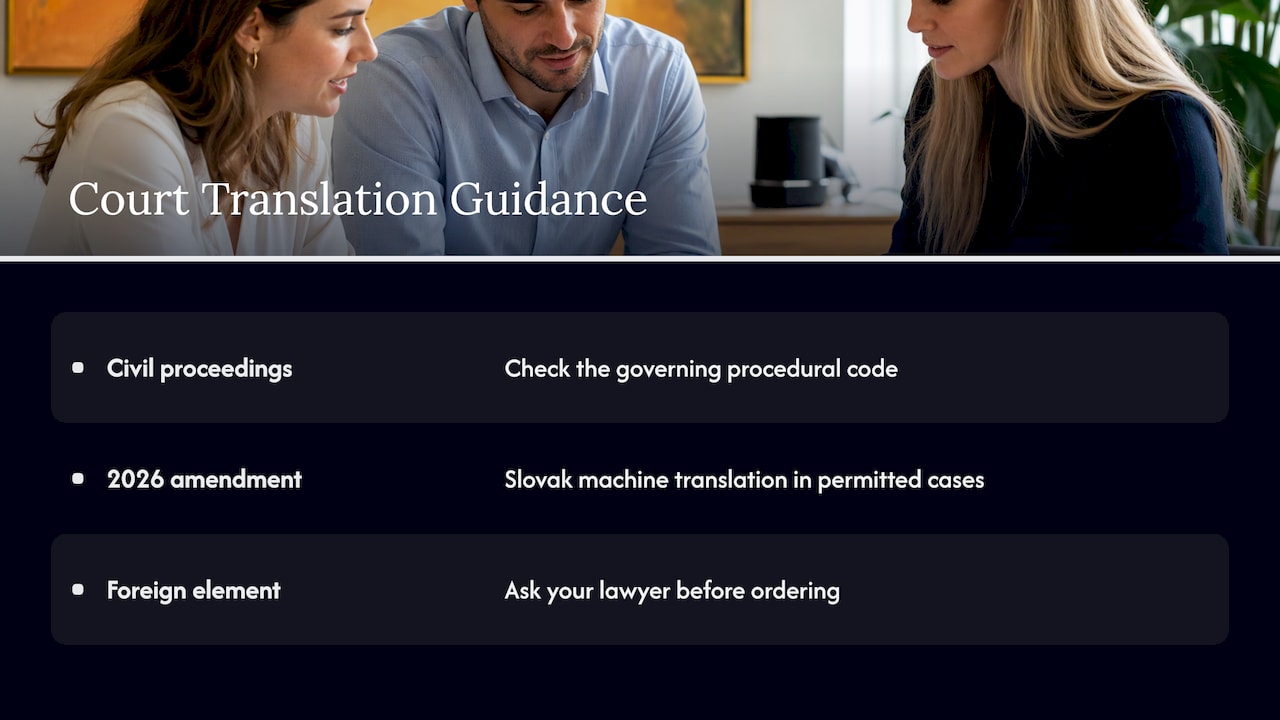
The research we rely on here covers civil proceedings in detail, so check the procedural code that governs your case before you assume the same rules apply. One 2026 change is worth knowing: an amendment allows machine translation into Slovak for certain foreign-language requests and documents in specified cross-border judicial procedures, where a regulation permits it. That is narrow. It does not turn machine output into a safe default for your own filings.
If your matter has a foreign element, for example cross-border divorce proceedings, the question of which documents travel and in which language comes up very early. Ask your lawyer before you order anything.
Who may provide a legally recognised translation?
In Slovakia a translator in the legal sense is a natural person. According to the Ministry of Justice, this is someone authorised by the state and listed by the ministry, or appointed ad hoc. A company cannot sign for itself, which surprises many procurement teams!
To get on the list, applicants must meet requirements including full legal capacity, integrity, education in the field, at least 30 hours of professional training and a passed examination.
How to check a translator in two minutes
- Open the register of translators on the Ministry of Justice site.
- Search by name and check the language combination is listed.
- Confirm the translator will use their seal on the translation clause.
- Ask the agency which listed translator signs your file, and get the name before work starts.
We go deeper on the verification routine in 3 steps to audit-ready court interpreting. It is written for hearings, but the verify-brief-file logic works for documents too.
Format, seal and supporting documents
The Ministry explains that a listed translator uses their official seal on the translation clause, and that the translation is in paper form or, by mutual agreement, electronic form. Practical consequences:
- Send the translator a clean, complete copy of the source. Missing pages mean a clause that cannot cover the whole document.
- For a document that is itself an original or a certified copy, tell the translator, so the clause references it correctly.
- Keep the translation with its source, in the same order you will file them.
- Agree on electronic or paper delivery before the order, not after.
Filing: eŽaloby and the 10-day rule
Many civil and administrative filings now go through eŽaloby. The Ministry notes that for specified filings, an unauthorised filing on the merits or for interim or protective relief must be resubmitted on paper or in authorised electronic form within 10 days, or it is disregarded. Translation delays and this clock can collide, so plan the translation before the filing date, not after.
Also useful: an original attached to an electronic filing may be replaced by guaranteed paper-to-electronic conversion by a public authority, lawyer, notary, qualifying postal operator or, unless it is a public document, a patent attorney. Your lawyer will know which route suits your case.
What if the translation is missing or wrong?
The court will typically call on you to supply a translation by a deadline. If you do not, the court may disregard the document or arrange the translation itself, which can affect the assessment of costs. A defective translation can mean delays or the evidence being rejected.
The cheapest fix is prevention:
- Get a second linguist to review legal terminology before sealing.
- Keep party names, case numbers, dates and amounts consistent across every document.
- Use one terminology list for the whole file, not one per translator.
More on this in top ways to ensure legal translation quality in the EU.
What does it cost?
Prices depend on language pair, length, subject and deadline. We publish a guide with typical ranges for Slovakia in our legal translation price breakdown, and we quote each project individually.
Our perspective
Here is the thing we see again and again: the translation is rarely the problem. The timing is!
A court deadline does not care that a foreign-language contract arrived on Friday afternoon. So we treat court material as a workflow, not a one-off order: intake, terminology, translation by a qualified linguist, a second human check, then delivery in the form your lawyer needs.
We built glocco® around that idea. Technology speeds up the groundwork, and trained legal specialists make the decisions that matter, like how a Slovak procedural term maps to your source. Our legal service, HumanLegal, is designed for exactly this kind of compliance-sensitive content.
Our advice? Send us the whole file early, tell us the filing date, and let us plan backwards from it. Your lawyer gets to focus on the case. Everyone wins (and nobody panics).
glocco®
How glocco® can help
If your legal team or law firm needs submissions and evidence in Slovak, our HumanLegal service pairs specialist legal translators with a human review step. Want to know more about how we work with certified professionals? Read about certified translation professionals and compliance, or tell us your deadline and we will come back with a plan.
FAQ
Do I have to translate every document I attach to a submission?
If a document is in a foreign language and you rely on it as evidence, expect the court to require a Slovak translation. If you do not provide it, the court calls on you to do so by a deadline. Your lawyer can tell you whether a short extract is enough in your case.
Can any translator do it, or must they be on the ministry list?
For a legally recognised translation, the translator should be listed with the Ministry of Justice or appointed ad hoc. You can check the register online. A company name alone does not carry that authority; a named, listed individual does.
Can I send the translation electronically?
The Ministry states that a translation is in paper form or, by mutual agreement, in electronic form. Agree the format with your translator at the start. For eŽaloby filings, watch the 10-day resubmission rule.
Can machine translation be used for court filings?
A 2026 amendment allows it only for certain foreign-language requests and documents in specified cross-border judicial procedures, where a regulation permits it. For ordinary filings, rely on a qualified human translator and check with your lawyer.
Sources
- Act No. 160/2015 Coll., Civil Dispute Code, consolidated text effective 15 July 2026
- Act 2026/148, amendment on machine translation in cross-border procedures
- Explanatory report to Act No. 87/2017 Coll.
- Ministry of Justice: information for the public on interpreters and translators
- Ministry of Justice: conditions for entry in the list
- Ministry of Justice: register of translators and interpreters
- Ministry of Justice: filing submissions and related documents


