Many legal professionals across Europe assume all certified translations hold equal legal weight. That belief can derail court filings, immigration applications, and regulatory approvals. Sworn translation carries unique legal authority unmatched by standard or certified options. This guide clarifies what sworn translation means, which documents require it, how European jurisdictions regulate it, and the practical steps to secure valid sworn translations for your compliance needs.
Table of Contents
- Introduction To Sworn Translation And Its Legal Importance
- Who Are Sworn Translators? Accreditation And Legal Authorisation
- Documents That Require Sworn Translation In Europe
- How Sworn Translation Differs From Certified And Notarised Translations
- Common Misconceptions About Sworn Translations
- Practical Guidance: When And How To Obtain Sworn Translations
- Country-Specific Sworn Translation Frameworks In Europe
- Potential Legal Risks Of Uncertified Translations
- Explore Sworn Translation And Multilingual Services With Glocco
- Frequently Asked Questions
Key takeaways
| Point | Details |
|---|---|
| Legal authority | Sworn translation is a legally binding process requiring an authorised translator’s oath, making documents valid for official use. |
| Jurisdictional variation | Different European countries have distinct accreditation and certification systems for sworn translators. |
| Document requirements | Official certificates, court rulings, contracts, and powers of attorney typically require sworn translation for legal acceptance. |
| Compliance risks | Using uncertified translations can lead to document rejection, legal delays, and financial penalties. |
| Verification necessity | Always verify translator accreditation and understand jurisdictional rules before commissioning translations. |
Introduction to sworn translation and its legal importance
Sworn translation stands as the legally recognised bridge between languages in official contexts. Unlike standard translation services, sworn translation is the process where an officially authorised translator legally certifies accuracy and faithfulness to the original document. This certification makes the translation valid for official legal use across courts, government agencies, and regulatory bodies.
The critical difference lies in the translator’s legal standing. Sworn translators undergo official appointment through judicial or governmental authorities. They take a formal oath to provide accurate, faithful translations. This oath binds them legally, creating accountability that standard translators do not carry.
Every sworn translation includes three essential elements:
- The translator’s official signature
- A government-issued stamp or seal proving accreditation
- A declaration under oath confirming translation accuracy
These elements transform a document from a simple language conversion into a legally admissible piece of evidence. Courts, immigration authorities, and corporate registries across Europe demand this level of certification for official acceptance.
The stakes are considerable. Submit an unofficial translation for a marriage certificate in Spain, and the registry will reject it outright. Use a non-sworn translator for court evidence in Germany, and the judge may dismiss your submission. Understanding sworn translation is not academic knowledge but operational necessity for legal professionals navigating European compliance landscapes.
“Sworn translation provides the legal guarantee that translated documents accurately represent original content, ensuring acceptance by official bodies and preventing costly procedural delays.”
Immigration proceedings, university admissions, business incorporations, and litigation all depend on sworn translations. The translator’s legal authority gives these documents the same evidentiary weight as originals. For legal and compliance professionals, this understanding forms the foundation for cross-border work.
Who are sworn translators? Accreditation and legal authorisation
Sworn translators are not simply skilled linguists. They hold official legal appointments that grant their translations binding authority. The process to become a sworn translator generally includes higher education, translation experience, passing official exams on legal language, and formal registration by judicial or governmental authorities.

The journey begins with rigorous academic preparation. Most countries require a university degree in translation, languages, or law. Candidates then accumulate practical translation experience, typically two to five years depending on jurisdiction. This experience builds the specialised knowledge needed for legal terminology and document conventions.
Official examinations test both language mastery and legal understanding. These exams assess candidates on:
- Legal terminology in both source and target languages
- Document formatting requirements and conventions
- Understanding of legal systems and procedural rules
- Ethical standards and confidentiality obligations
- Technical accuracy in rendering complex legal concepts
Successful candidates then take their oath before a judicial authority or government ministry. This ceremony marks the legal transformation from translator to sworn officer. The oath binds the translator to accuracy, impartiality, and legal responsibility for every certified document.
Accreditation systems vary significantly across Europe. Spain registers sworn translators through the Ministry of Foreign Affairs. Germany relies on court certification at the regional level. Italy requires translators to swear their oath before local courts. The Netherlands maintains a national register of sworn interpreters and translators. France uses a system of expert translators appointed by courts of appeal.
Official registration creates a public record. Government or court registries list authorised sworn translators by language pair and jurisdiction. This transparency allows clients to verify credentials before engaging services. The translator’s official seal, issued upon registration, becomes their signature legal instrument.
Pro Tip: Always request proof of official registration before contracting a sworn translator. Check the relevant government or court registry to confirm the translator’s seal number and authorised language pairs. This simple verification prevents invalid translations that authorities will reject.
For multilingual communication needs beyond document translation, services like over-the-phone interpreting complement sworn translation work by providing immediate language support for consultations and negotiations.
Documents that require sworn translation in Europe
Certain document categories trigger mandatory sworn translation requirements across European jurisdictions. Understanding which documents demand this certification prevents procedural rejections and compliance failures.
Civil status documents top the list. Birth certificates, marriage certificates, death certificates, divorce decrees, and adoption papers require sworn translation for virtually all official purposes. Immigration authorities, civil registries, and family courts will not accept these documents without proper sworn certification.
Legal and judicial documents demand sworn translation without exception. Court rulings, judicial decisions, legal contracts, powers of attorney, and notarial acts require sworn certification to carry legal effect across borders. A Spanish court will not recognise a UK judgment without sworn translation into Spanish by an authorised translator.
Academic credentials need sworn translation for official recognition. University degrees, school certificates, academic transcripts, and professional qualifications must carry sworn certification when submitted for:
- University admissions in another country
- Professional licence applications
- Credential recognition by government agencies
- Employment verification for regulated professions
Corporate and business documents often require sworn translation. Articles of incorporation, shareholder agreements, financial statements, and regulatory filings need sworn certification when submitted to company registries, tax authorities, or regulatory bodies. For Spanish student visa documentation, sworn translations of financial records and sponsor letters form essential parts of the application package.
Property and financial documents involving legal transactions require sworn translation. Property deeds, mortgage agreements, bank statements for visa applications, and tax documents need sworn certification for legal validity.
The legal reason behind these requirements centres on authenticity and legal certainty. Sworn translations carry legal presumption of accuracy. Courts and government agencies can rely on sworn translations without independent verification. The translator’s legal accountability eliminates the need for each agency to assess translation quality independently.
Requirements vary by country and purpose. Some jurisdictions accept certified translations for academic purposes but demand sworn translations for court proceedings. Others require sworn translations for all official documents regardless of context. This variation makes jurisdictional research essential before commissioning translations.
Submitting non-sworn translations where sworn versions are required triggers automatic rejection. The document has no legal effect. Resubmission requires obtaining proper sworn translation, paying additional fees, and accepting procedural delays that can extend weeks or months.
How sworn translation differs from certified and notarised translations
The terminology around legal translations confuses many professionals. Sworn, certified, and notarised translations appear similar but carry distinct legal statuses and practical implications.
Sworn translation differs from certified and notarised translations primarily in legal authority. Sworn translations are legally recognised and admissible in courts because the translator has sworn an oath. Certified translations provide accuracy declarations without official legal status. Notarised translations verify document authenticity but not translation accuracy.
| Translation Type | Legal Authority | Court Admissibility | Typical Usage |
|---|---|---|---|
| Sworn | High (legally binding oath) | Automatic in appointing jurisdiction | Court proceedings, government filings, civil registries across continental Europe |
| Certified | Medium (professional declaration) | Varies by jurisdiction | UK immigration, US academic admissions, some business filings |
| Notarised | Low for translation (verifies signature only) | Generally not accepted alone | Document authentication, supplementary to certified translations |
Sworn translation involves a legally appointed translator who has taken an official oath. This oath creates legal accountability. The translator’s signature and official seal on the translation carry the same legal weight as a notary’s certification of an original document. Courts and government agencies accept sworn translations without additional verification.
Certified translation involves a professional translator providing a signed statement declaring the translation’s accuracy. The translator certifies their qualifications and the translation’s completeness. However, no official oath binds the translator, and no government authority has appointed them. Certified translations work well in jurisdictions that do not require sworn translation, particularly the UK and US.
Notarised translation adds a notary’s verification to a translation document. The notary confirms the translator’s identity and signature but makes no assessment of translation quality or accuracy. A notarised translation without underlying sworn or certified status offers limited legal value. Many European authorities will not accept notarised translations alone.
Country-specific requirements determine which translation type you need:
- Spain, France, Italy, and Germany require sworn translations for official documents
- The UK accepts certified translations for most purposes including immigration
- The US generally accepts certified translations for academic and immigration contexts
- Netherlands and Belgium require sworn translations for court and government submissions
Pro Tip: When working across multiple jurisdictions, consult local legal requirements early in the process. Some countries accept certified translations initially but require sworn translation for final approval. Understanding these nuances prevents costly re-translation and procedural delays.
The cost differences reflect the legal authority involved. Sworn translations typically cost 20-40% more than certified translations due to the sworn translator’s legal liability and official status. Notarised translations add notary fees but do not replace the need for proper sworn or certified translation.
Common misconceptions about sworn translations
Several persistent myths about sworn translation create unnecessary confusion and compliance risks for legal professionals.
Sworn translation is not simply higher quality translation. The distinction is legal, not linguistic. A highly skilled translator without sworn status produces accurate work, but that work lacks legal recognition for official purposes. The sworn translator’s oath and official appointment create the legal authority, not superior language skills. Both sworn and non-sworn translators may possess equal linguistic ability, but only sworn translations carry legal weight.
Not all documents require sworn translation in every context. The requirement depends on jurisdiction, document type, and intended use. Academic transcripts may need sworn translation for Spanish university admission but only certified translation for UK universities. Business contracts between private parties may not require sworn translation unless one party demands it or local law mandates it for registration.
Sworn translators do not enjoy unlimited authority. Their accreditation applies only in the jurisdiction that appointed them. A sworn translator authorised by Madrid courts cannot produce legally valid sworn translations for German courts without corresponding German accreditation. Cross-border work often requires multiple sworn translators or acceptance of foreign sworn translations under bilateral treaties.
“The legal accountability inherent in sworn translation separates it from other translation services. Sworn translators face professional sanctions, legal liability, and potential criminal penalties for inaccurate or fraudulent translations, creating strong incentives for precision.”
Many professionals assume sworn translation is optional if they provide original documents alongside translations. This assumption fails in most European contexts. Officials often cannot read the original language and rely entirely on sworn translation. The original document proves authenticity, but the sworn translation enables legal processing.
Some believe any translator can become sworn quickly. The reality involves years of preparation, rigorous examinations, and formal legal appointment. The process protects document integrity by ensuring only qualified professionals receive sworn status.
Another misconception treats sworn translation as interchangeable with certified or notarised translation. As explained in the previous section, these are legally distinct. Using certified translation where sworn translation is required guarantees rejection. The reverse also creates problems: requesting expensive sworn translation when certified translation suffices wastes resources.
The risks from these misconceptions are tangible. Rejected immigration applications, dismissed court evidence, invalidated business registrations, and compliance penalties all result from misunderstanding sworn translation requirements. Legal professionals must separate fact from assumption when dealing with multilingual documentation.
Practical guidance: when and how to obtain sworn translations
Securing valid sworn translations requires systematic procedures that ensure legal compliance and document acceptance.
Follow this step-by-step process:
- Identify document requirements by researching the receiving authority’s specific rules. Contact the court, government agency, or institution to confirm whether sworn translation is mandatory, which languages are accepted, and whether they recognise foreign sworn translators.
- Verify translator accreditation through official registries. Search the relevant government or court database for sworn translators authorised in your required language pair. Confirm their registration number, authorised languages, and jurisdiction.
- Request formal quotation including timeline, cost, and delivery format. Specify whether you need paper originals with official stamps, digital copies, or both. Clarify the number of certified copies required.
- Provide clean, legible copies of original documents. Poor quality scans or faded photocopies slow translation and risk errors. Include any relevant context about document purpose to help the translator understand technical requirements.
- Review the completed sworn translation for formatting and completeness. Verify that the translator’s signature, official seal, and oath declaration appear clearly. Check that the translation includes all pages and annexes from the original.
- Submit the sworn translation with original documents as required. Some authorities need both original and sworn translation. Others accept sworn translation alone. Follow submission instructions precisely to avoid rejection.
Verifying credentials protects against fraud. Check these elements:
- Official seal matches the pattern shown in government registries
- Registration number appears on both seal and translator’s declaration
- Translator’s name and registration match official records exactly
- Language pair authorization covers your specific language combination
- Jurisdiction of appointment aligns with receiving authority’s requirements
Sworn translation provides international recognition of documents for immigration, legal proceedings, university admissions, and business compliance, making cross-border legal processes more efficient. Understanding these recognition principles helps you navigate complex requirements.
Legal consequences of submitting uncertified translations include immediate document rejection, case dismissal in court proceedings, visa application denial, and potential fraud allegations if deception is suspected. The time and cost of correcting these errors far exceed the investment in proper sworn translation initially.
Confidentiality and ethics matter significantly when handling sensitive legal documents. Sworn translators operate under professional secrecy obligations similar to lawyers. Discuss confidentiality protections explicitly with your translator, especially for proprietary business information, personal data, or privileged legal communications.
Pro Tip: Maintain comprehensive records of every sworn translation. File copies of translator credentials, registration certificates, and correspondence. These records prove due diligence during audits and provide evidence if translation validity is later questioned. Digital backups ensure you can produce documentation years after the original transaction.
Country-specific sworn translation frameworks in Europe
European countries maintain distinct regulatory frameworks for sworn translation, reflecting different legal traditions and administrative structures. Understanding these variations prevents compliance failures when working across borders.
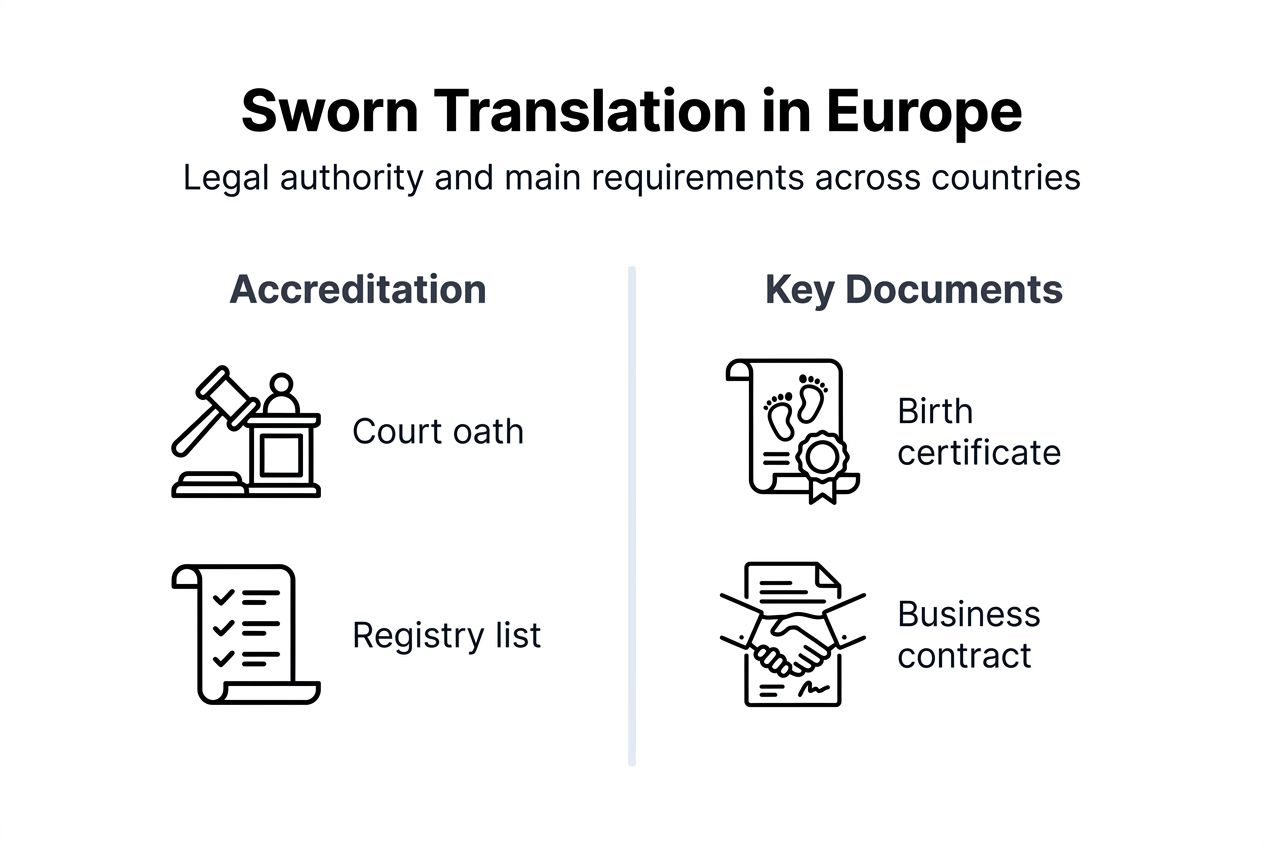
Each European country has specific rules on who can be a sworn translator and how sworn translation is certified. Spain’s Ministry of Foreign Affairs certifies sworn translators. Germany uses court certification. Italy requires oath before court.
| Country | Accreditation Authority | Appointment Process | Legal Basis | Cross-Border Recognition |
|---|---|---|---|---|
| Spain | Ministry of Foreign Affairs | National exam, formal appointment | Law 2/2014 | Bilateral treaties |
| Germany | Regional courts | Court examination, oath before judge | Court Interpreters Act | EU member state acceptance |
| Italy | Local courts | Professional qualifications, court oath | Presidential Decree 115/2002 | Limited automatic recognition |
| France | Courts of Appeal | Expert list registration, professional exam | Code of Civil Procedure | Bilateral agreements |
| Netherlands | Bureau Sworn Interpreters and Translators | Registration, professional standards | Law on Sworn Interpreters | EU directive compliance |
Spain operates a centralised system through the Ministry of Foreign Affairs. Candidates pass rigorous national examinations testing legal terminology, translation accuracy, and procedural knowledge. Successful candidates receive official appointment valid throughout Spain. The ministry maintains public registry of all sworn translators with language pair authorisations.
Germany decentralises sworn translator appointment to regional courts. Each court examines and appoints translators for its jurisdiction. This creates variation in standards and recognition across German states. Translators sworn by Munich courts may need additional certification for Berlin court submissions, though reciprocal recognition generally applies.
Italy requires sworn translators to appear before local courts and take their oath publicly. The court registers translators in official lists maintained by tribunal presidents. Italian sworn translators often specialise in specific document types, with separate registers for legal, commercial, and technical translations.
France uses the expert translator system. Courts of Appeal maintain lists of expert translators who have demonstrated professional competence through examination. These experts provide sworn translations recognised throughout France. The system emphasises professional experience over academic qualifications.
The Netherlands operates a national Bureau that registers sworn interpreters and translators. Registration requires proof of language competency, translation training, and understanding of Dutch legal procedures. The Bureau issues official identification cards that sworn translators present when providing services.
Cross-border implications create complexity. EU directives facilitate mutual recognition of professional qualifications, but sworn translator appointment remains national competence. A document with sworn translation from Spain may require re-translation by German sworn translator for German court proceedings, despite both countries being EU members.
Bilateral treaties between some countries allow direct recognition of sworn translations without re-certification. These agreements typically cover civil status documents and commercial papers. Check whether treaty coverage applies to your specific document type before assuming automatic recognition.
Potential legal risks of uncertified translations
Using non-sworn or uncertified translations where sworn translations are required creates significant legal exposure for professionals and their clients.
Incorrect or non-sworn translations can cause legal delays, document rejection, and liability risks, especially in immigration, court proceedings, and corporate regulatory filings. The consequences extend beyond mere inconvenience into material legal and financial harm.
Primary risks include:
- Automatic document rejection by courts, immigration authorities, or regulatory bodies
- Case dismissal or adverse rulings due to inadmissible evidence
- Immigration application denial requiring complete resubmission with proper documentation
- Corporate registration refusal causing business formation delays and lost opportunities
- Compliance breaches triggering regulatory sanctions and financial penalties
- Professional liability exposure for lawyers or consultants who advised using improper translations
- Reputational damage from procedural failures and missed deadlines
Court proceedings face particular vulnerability. Judges may exclude evidence submitted without proper sworn translation. This exclusion can determine case outcomes. A critical contract clause lost to translation inadequacy may cost a client millions. The lawyer who failed to obtain sworn translation faces malpractice claims.
Immigration contexts impose severe consequences. Visa applications submitted with uncertified translations face automatic rejection. Processing times extend months beyond original timelines. Applicants miss employment start dates, academic term beginnings, or family reunification opportunities. Some jurisdictions impose reapplication bans after multiple rejections, compounding the harm.
Business regulatory filings require sworn translation in most European jurisdictions. Company registries will not process incorporation documents, shareholder resolutions, or annual accounts without proper sworn certification. The resulting delays prevent contract execution, financing arrangements, and commercial operations. Financial losses accumulate daily while waiting for correct documentation.
“The false economy of avoiding sworn translation costs far exceeds any initial savings. Document rejection triggers expensive re-translation, resubmission fees, procedural delays, and potential legal sanctions that dwarf the original sworn translation expense.”
Legal liability extends to professionals who recommend or accept uncertified translations. Lawyers, immigration consultants, and compliance officers owe duties of competence to clients. Failing to understand sworn translation requirements breaches these duties. Malpractice insurers increasingly scrutinise cross-border documentation procedures after claim trends showed translation-related failures.
Financial penalties arise from compliance violations. Tax authorities may assess penalties for filing corporate documents with inadequate translations. Regulatory agencies fine companies for submitting non-compliant documentation. These penalties often exceed the cost of proper sworn translation by factors of ten or more.
Reputational damage affects professional standing. Clients lose confidence in lawyers or consultants who cause procedural failures through translation errors. Referral sources hesitate to recommend professionals with reputations for documentary mistakes. The competitive disadvantage persists far beyond individual case outcomes.
Explore sworn translation and multilingual services with Glocco
Navigating sworn translation requirements across multiple European jurisdictions demands expertise in legal procedures, language capabilities, and regulatory compliance. Glocco provides comprehensive language solutions designed specifically for legal and compliance professionals operating across borders. Our sworn translation services connect you with properly accredited translators holding official appointments in the jurisdictions you need. We verify credentials, manage documentation requirements, and ensure your translations meet the precise legal standards for acceptance by courts, government agencies, and regulatory bodies. Beyond sworn translation, Glocco offers integrated language support including over-the-phone interpreting for client consultations and video translation services for multimedia legal presentations. Contact Glocco to discuss your multilingual compliance needs and access professional language services that function as your global language department.
Frequently asked questions
What is sworn translation and why is it necessary?
Sworn translation is a legally certified translation produced by an officially authorised translator who has taken a formal oath before judicial or governmental authorities. This certification makes the translation legally valid for official purposes including court proceedings, immigration applications, civil registry submissions, and regulatory compliance. Unlike standard translations, sworn translations carry legal presumption of accuracy and admissibility. Authorities accept sworn translations without independent verification because the translator’s legal accountability guarantees faithful rendering of original content.
How do I verify a sworn translator’s credentials?
Check official government or court registries where sworn translators must register. Most countries maintain searchable databases listing authorised translators by name, registration number, and language pairs. Examine the translator’s official seal and signature on completed work, ensuring the seal number matches registry records. Request proof of current registration status directly from the translator, including copies of their official appointment certificate. Confirm that the translator’s jurisdiction of appointment aligns with where you will submit the translated documents, as accreditation is typically jurisdiction-specific.
Which documents require sworn translation in Europe?
Civil status documents including birth certificates, marriage certificates, death certificates, and divorce decrees universally require sworn translation for official use. Court rulings, legal contracts, powers of attorney, and judicial decisions need sworn certification for cross-border legal validity. Academic credentials such as university degrees, school certificates, and professional qualifications require sworn translation for admissions and credential recognition. Corporate documents including articles of incorporation, shareholder agreements, and regulatory filings typically demand sworn translation for company registry submissions. Requirements vary by country and specific purpose, so always verify with the receiving authority.
Can I use certified or notarised translations instead of sworn translations?
Certified translations are often accepted in the UK, US, and some other common law jurisdictions, particularly for academic and immigration purposes. Notarised translations verify document authenticity and translator identity but do not certify translation accuracy, offering limited legal value. Most continental European countries require sworn translations for legal and official documents regardless of certification or notarisation. The translator’s legal appointment and oath create the legal authority that certified and notarised translations lack. Always check jurisdiction-specific requirements before deciding which translation type to commission, as using the wrong type guarantees rejection and necessitates costly resubmission with proper sworn translation.