


TL;DR:
- Content localisation involves adapting various elements beyond translation to fit cultural and market expectations.
- Ensuring quality and consistency in localisation prevents trust erosion and improves conversion rates.
- Ongoing localisation efforts, based on performance data and feedback, drive sustained growth in European e-commerce.
Translation gets your words into another language. Content localisation gets your brand into another world. Many European e-commerce businesses invest in translation, launch their multilingual sites, and then wonder why conversion rates in target markets remain flat. The reason is almost always the same: customers can read the content, but it does not feel local. It feels like a foreign brand that learned their language. This guide explains what content localisation really means, how it differs from translation, which content areas demand your attention first, and how to measure whether your localisation efforts are actually working.
Key Takeaways
| Point | Details |
|---|---|
| Localisation is holistic | True content localisation adapts messaging, visuals, and structure for each market, not just the language. |
| Quality impacts results | Poor translation leads to errors, confusion, and lost sales, so quality control is essential. |
| Continuous improvement | Review, test, and update localised content regularly to ensure ongoing international success. |
| Strategic advantage | Brands that prioritise localisation gain more trust and higher conversions in international markets. |
Defining content localisation: beyond translation
Content localisation is the process of adapting your content so that it resonates naturally with a specific regional audience. It goes far beyond swapping words from one language to another. It means adjusting context, tone, imagery, formats, calls to action, and even the underlying assumptions your content makes about the reader.
Think of translation as changing the soundtrack of a film and localisation as reshooting the scenes to fit a different culture entirely. The story may be the same, but everything around it is tailored to feel native.
For e-commerce brands, localisation covers far more than translated text. It includes your user interface, product content, currency displays, images, and SEO metadata. Each of these touchpoints shapes how a customer experiences your brand before they ever reach the checkout.
Here is a clear comparison to illustrate the difference:
| Dimension | Translation | Localisation |
|---|---|---|
| Role | Language conversion | Cultural and contextual adaptation |
| Scope | Text only | Text, images, UI, formats, SEO, legal |
| Business impact | Readable content | Trusted, conversion-ready content |
| E-commerce example | Product name in French | Price in euros, local size chart, French SEO keywords |
The content types you can localise for e-commerce include:
- Product descriptions adapted for local terminology and buying habits
- Legal notices rewritten to meet regional regulatory requirements
- UI microcopy such as button labels, error messages, and form fields
- Images and visual assets featuring locally relevant models, settings, or cultural references
- Currencies and number formats displayed in the convention local customers expect
- SEO elements including meta titles, descriptions, and keyword strategies per market
For a structured starting point, the website localisation overview from Glocco® provides a practical framework for e-commerce teams. Getting localisation right matters because European markets are diverse in ways that go far beyond language. A German shopper and a Spanish shopper may both understand English, but their expectations around trust signals, payment methods, and content tone are genuinely different.
Key elements of content localisation for e-commerce
With a clear understanding of what content localisation is, it is time to explore which content areas matter most for e-commerce success.
E-commerce localisation covers marketing copy, product details, legal text, UI microcopy, images, currencies, local formats, and SEO. The table below maps each area to the specific adaptations that make the biggest difference.

| Content type | Key local adaptations |
|---|---|
| Product descriptions | Local terminology, units of measure, regional benefits |
| Marketing copy | Tone, cultural references, seasonal campaigns |
| Legal and compliance | GDPR notices, returns policy language, consumer rights |
| UI microcopy | Button text, checkout labels, error messages |
| Visuals and images | Locally relevant photography, colour associations |
| SEO elements | Local keyword research, hreflang tags, meta content |
| Customer service | Local contact options, response language, operating hours |
Here is a practical roadmap for prioritising your localisation effort:
- Audit your existing content to identify which assets require localisation before entering a new market.
- Prioritise product pages and checkout flows as these directly affect conversion rates.
- Localise legal and compliance content to meet regional regulatory requirements from day one.
- Adapt your SEO strategy with local keyword research rather than simply translating existing terms.
- Review visuals and imagery to ensure they reflect the cultural context of your target audience.
- Localise customer service touchpoints including email templates, chatbot scripts, and FAQs.
Use the localisation checklist to ensure nothing is missed across each content type. Content localisation affects the entire customer journey, from the moment a buyer finds your product in a local search result to the confirmation email they receive after purchase. Gaps anywhere along that journey create friction, and friction kills conversions. For further guidance on optimising localisation processes, Glocco® offers targeted resources for e-commerce teams.
Quality, consistency, and common pitfalls
Understanding what to localise is only half the challenge. Ensuring quality and consistent results is where many brands struggle.
Literal translation is one of the most common and costly mistakes in e-commerce localisation. When content is translated word for word without regard for cultural context or natural phrasing, the result can feel awkward, confusing, or even offensive. Beyond embarrassment, it erodes trust.
Poor translation quality can introduce errors and reduce customer trust, even in content that sits outside your core marketing materials.
Common e-commerce localisation mistakes include:
- Word-for-word translation that ignores idiomatic expressions and natural phrasing in the target language
- Neglecting UI microcopy such as error messages, which customers encounter at the most frustrating moments
- Missing legal elements specific to a market, which can create compliance risk and erode credibility
- Using culturally inappropriate images that may seem neutral in one market but carry negative connotations in another
- Inconsistent terminology across product pages, emails, and customer service, which undermines brand coherence
- Ignoring ongoing updates so localised content becomes stale as products, regulations, and campaigns evolve
Pro Tip: Build quality control into your localisation workflow best practices at every stage, not just at launch. Assign native-speaking reviewers to sign off on content before it goes live, and schedule regular audits to catch drift over time.
The link between localisation quality and commercial performance is direct. Customers who encounter confusing content, mistranslated product names, or legally non-compliant notices will abandon their session. Localisation testing is the mechanism that catches these issues before they reach real buyers.
Content localisation in action: strategy and metrics
Finally, let us bridge theory and practice by examining what effective content localisation looks like in the real world and how to measure its impact.
A localisation strategy for a European e-commerce brand typically involves several stages: a discovery phase to assess market requirements, a production phase where content is adapted and reviewed, a launch phase with testing across devices and markets, and an optimisation phase driven by performance data.
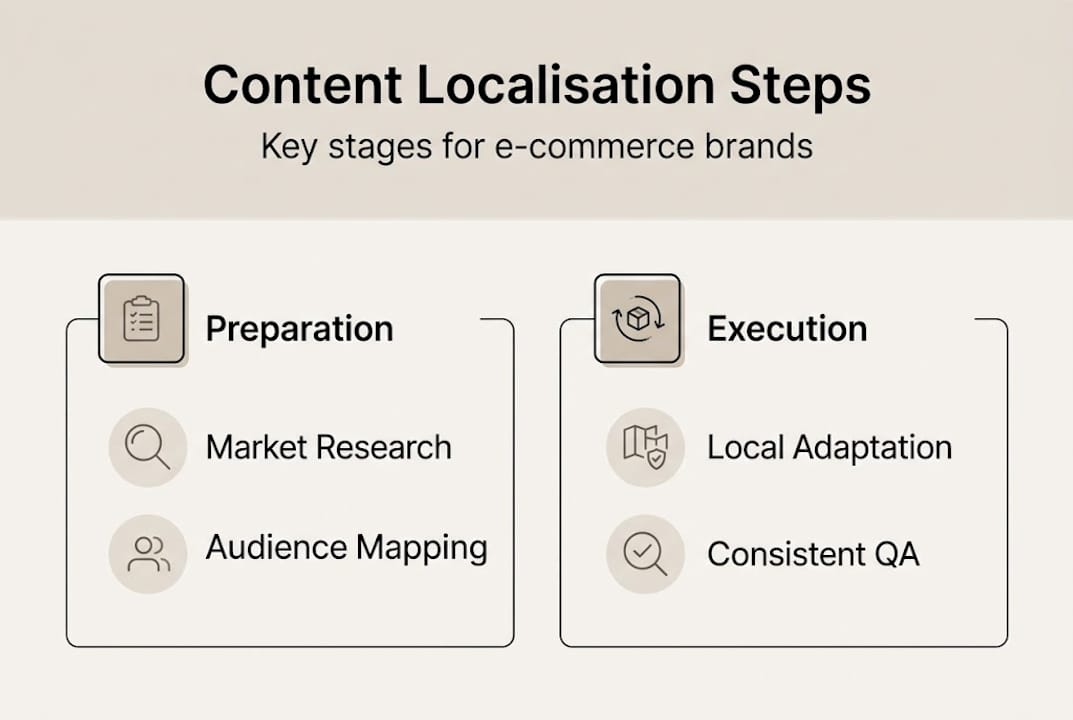
Effective localisation means adapting the entire customer experience, measuring performance per market, and updating content continuously rather than treating it as a one-off project.
Here is a numbered process for implementing and measuring localisation effectively:
- Conduct a localisation audit of your current site to identify gaps by market and content type.
- Select pilot markets where localisation investment is likely to deliver the strongest returns.
- Localise and launch in pilot markets with full quality review before going live.
- Run A/B tests on key pages, comparing localised content against direct translation where possible.
- Gather qualitative feedback from local customers through surveys, reviews, and support interactions.
- Iterate based on data and expand the process to additional markets as confidence grows.
Pro Tip: Track conversion rates, cart abandonment rates, and local customer reviews as your primary indicators of localisation performance. These metrics reveal whether your content is resonating or creating friction at critical points in the purchase journey.
Real-world European e-commerce adaptations often look like this: a fashion retailer adjusting its homepage hero image to feature locally recognisable settings for each country site; a software brand rewriting its CTA button text from a direct English equivalent to a phrase that carries stronger urgency in German; or a health brand adapting its compliance disclaimers for France versus the Netherlands. Explore EU localisation success stories to see how brands have achieved measurable results, and review the localisation benefits for business to quantify the commercial case.
Why content localisation is the real growth engine for European e-commerce
Conventional wisdom still treats localisation as a technical afterthought, something you add after the real work of building a product or campaign is done. That framing is costing brands significant revenue across European markets.
From working with e-commerce clients across multiple regions, the pattern is consistent. The biggest gains do not come from translating more words faster. They come from adapting the brand narrative, adjusting the visual language, and building feedback loops that keep localised content current. Customers buy from brands that speak their world, not just their language. That distinction is subtle but commercially decisive.
The uncomfortable truth is that most brands invest in translation once, at launch, and then leave localised content largely untouched. Markets evolve. Slang shifts. Regulations change. Competitors adapt. A static localised site degrades in quality and relevance over time.
Read the language localisation guide to understand localisation as an ongoing business system rather than a project milestone. Because that is precisely what it is: a growth system, built on continuous market understanding, not a checkbox you tick before moving on.
Accelerate your localisation journey with the right tools
![cta_image]
If you are ready to transform how your business connects with customers globally, here is where to start. Glocco® provides dedicated website localisation resources designed specifically for e-commerce teams navigating multi-market expansion. Whether you are entering your first European market or refining an existing strategy, our team supports you at every stage, from audit to ongoing optimisation. Download the complete localisation checklist to map your content against best practice standards and identify your highest-priority localisation gaps before your next market launch.
Frequently asked questions
What is the difference between content localisation and translation?
Translation changes the language of content, while localisation adapts content to fit cultural, legal, and user expectations in each specific market. Localisation includes formatting, images, and product details that translation alone does not address.
Which types of content should e-commerce brands localise first?
Start with product information, checkout UI, key marketing materials, and legal copy. Shopify identifies product text, legal notices, UI, images, and SEO as the highest-priority content types for localisation.
How does poor translation impact e-commerce performance?
It leads to errors, customer confusion, and lower conversion rates. Poor translation quality reduces trust and can introduce inaccuracies even in content that sits outside your primary marketing materials.
What metrics show localisation is working?
Look for improved conversion rates, reduced cart abandonment, and positive local customer feedback. Successful localisation is measured through market-level performance data and refined through continuous updates.


