


TL;DR:
- Poor localisation leads to lost revenue and damages customer trust globally.
- Effective localisation involves thorough preparation, cultural adaptation, and continuous measurement.
- Treat localisation as a strategic brand driver, not just a technical task, for optimal growth.
Poor localisation costs businesses more than they realise. When content feels foreign, trust evaporates. 76% of consumers prefer purchasing in their native language, and 40% never buy from sites that don’t speak to them directly. For marketing managers in e-commerce, fintech, gaming, and healthcare, these numbers translate directly into lost revenue, stalled market entry, and weakened brand credibility. This article walks you through a clear, sector-aware localisation process, from audit through execution to measurement, so you can build a strategy that converts and competes on a global scale.
Key Takeaways
| Point | Details |
|---|---|
| Localisation drives revenue | Adapting content for local markets significantly boosts conversions and customer trust. |
| Sector-specific planning | Different industries have unique localisation requirements and regulatory risks. |
| Process and measurement matter | Successful localisation depends on structured workflow and tracking key metrics in every market. |
| Technical preparation saves cost | Preparing design and content for localisation from the start cuts errors and future expenses. |
| Strategic advantage | Approaching localisation as a core brand function gives businesses a lasting edge. |
Understand the business impact of localisation
Localisation is not a support function. It is a growth engine. When your content resonates with a market, conversion rates climb, customer trust deepens, and lifetime value increases. When it doesn’t, the damage is measurable and swift.
The commercial case is strong. Localised websites deliver 1.5x higher conversions, and poor localisation can cost businesses up to 20% in lost revenue. These are not theoretical figures. They represent real revenue being left on the table every time a checkout page feels culturally misaligned or a product description reads like it was written for a different country entirely.
The stakes differ by sector, and understanding that difference is essential to prioritising your investment in localisation business benefits:
- E-commerce: Localised UX, currency formats, and culturally relevant imagery directly influence purchase decisions.
- Fintech: KYC flows, payment terminology, and regulatory language must reflect local rules and expectations precisely.
- Healthcare: Clinical accuracy and legal compliance are non-negotiable. A mistranslated dosage instruction carries real risk.
- Gaming: Cultural storytelling, character naming, and humour all need adaptation to avoid alienating local audiences.
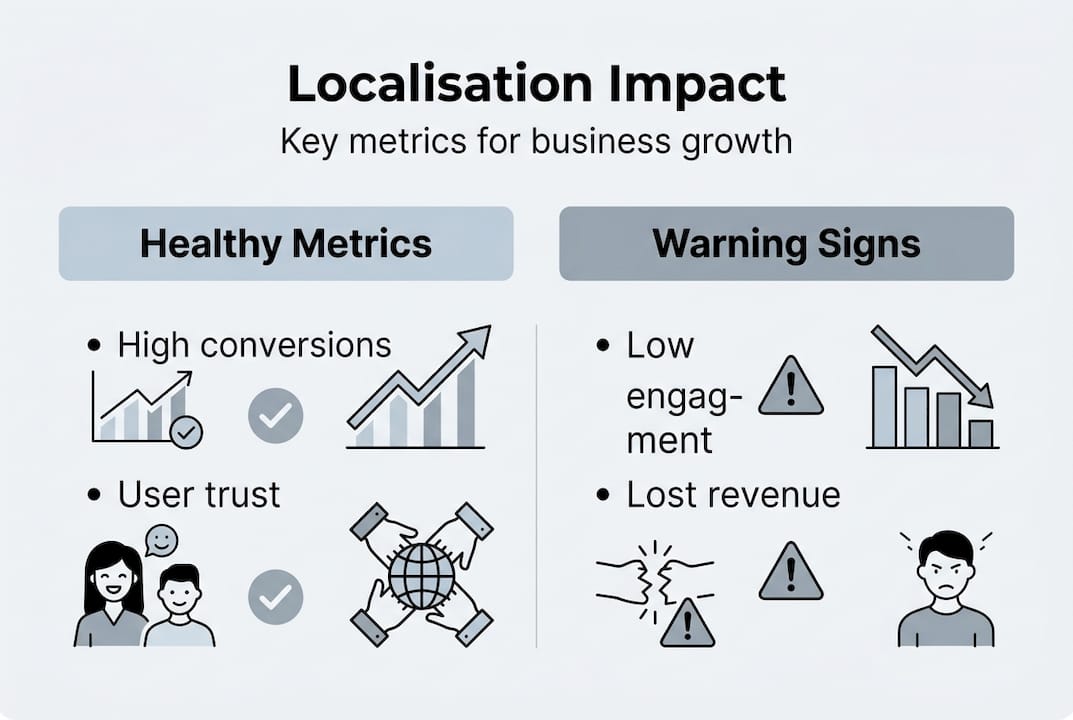
To understand the localisation impact in your own business, audit your per-locale metrics before making strategic decisions.
| Metric | Healthy benchmark | Warning signal |
|---|---|---|
| Per-locale conversion rate | Above market average | Falling below global average |
| Net Promoter Score by region | Consistent across locales | Significantly lower in specific markets |
| Support ticket volume | Low post-launch | Spike after regional release |
| Revenue per locale | Growing quarter on quarter | Stagnant despite traffic growth |
When you treat localisation as a cost to be minimised, you are effectively capping your growth ceiling. The most ambitious global brands frame it differently: localisation is what turns reach into revenue.
Prepare your content and systems for localisation
Recognising localisation’s business value makes proper setup imperative. The quality of your output depends heavily on the quality of your preparation. Rushing this stage is where most localisation projects go wrong.

Start with your source text. Write in a neutral, clear style that avoids idioms, colloquialisms, and culturally specific references. Build a robust glossary and style guide before any translation begins. These documents become the reference point for every linguist and reviewer working on your content, ensuring consistency across markets.
On the technical side, your content architecture matters enormously. Text expansion in German alone can reach 30 to 40%, and failing to account for this in your UI design causes layout breaks, truncated labels, and frustrated users. Set up your systems with this in mind from the start.
Key preparation steps include:
- Modular content design: Break content into discrete, manageable components that can be translated and updated independently.
- No hardcoded strings: All user-facing text should be stored externally in resource files, not embedded in code.
- Right-to-left readiness: If you are targeting Arabic, Hebrew, or Farsi speakers, your design must support RTL layouts natively.
- Regulatory mapping: Identify which compliance frameworks apply per market: GDPR in the EU, HIPAA for US healthcare data, PCI DSS for payment processing.
Exploring a solid localisation workflow guide will help you structure these steps into a repeatable, audit-ready process. For digital products and apps, reviewing software localisation strategies will address platform-specific challenges. And for regulated industries, engaging with professional regulatory compliance support early in the process is strongly advised.
Pro Tip: Involve your compliance team at the content design stage, not after translation is complete. Retrofitting regulatory requirements into localised content is expensive, slow, and error-prone.
| Prepared content | Unprepared content |
|---|---|
| Neutral, glossary-aligned source text | Idioms, slang, and ambiguous phrasing |
| Modular, externalised strings | Hardcoded text in design files or code |
| UI designed with text expansion in mind | Fixed-width layouts with no flexibility |
| Compliance requirements mapped by market | Regulatory review left to post-launch |
| RTL layout support built in | Single-direction design only |
Execute the localisation process: step-by-step
With everything prepared, it’s time to put an effective process into action. A structured, phased approach reduces errors, keeps timelines on track, and ensures every market receives content that feels genuinely local.
- Content analysis: Audit all assets for localisation complexity. Identify high-risk content, such as legal disclaimers, medical instructions, or payment terms, that requires specialist linguists.
- Cultural and linguistic adaptation: Work with in-country experts who understand the cultural nuances of your target market. Translation alone is not sufficient. Content must be adapted to local norms, not just converted word for word.
- Linguistic quality assurance: Run structured QA reviews covering accuracy, consistency with the style guide, terminology alignment, and tone. This is a distinct phase, not an afterthought.
- Stakeholder review: Involve local marketing teams, regional compliance officers, or clinical reviewers depending on your sector. Their input catches what linguists may miss.
- Launch and monitoring: Release to the target market and monitor closely during the first 48 hours. Track support tickets, user behaviour, and any flagged content issues immediately.
Sector-specific cautions are worth highlighting here. In fintech, payment format errors or incorrect legal terminology can trigger regulatory scrutiny. In gaming, a character name that carries negative connotations in a local language can damage brand perception overnight. In healthcare, terminology precision is a patient safety issue, not just a quality metric.
‘Skimping on localisation is like refusing to open the door to new markets.’
Therabody reduced localisation costs by 60% through systematic process improvements, demonstrating that discipline in execution pays off commercially. Use a proven localisation checklist to standardise each phase, and draw on EU localisation strategies for region-specific guidance.
Pro Tip: Build iteration cycles into your launch plan. Share localised content with a small group of local users or team members before full release. Their feedback often catches cultural nuances that in-house review misses.
Measure results and troubleshoot common localisation pitfalls
After a successful launch, your focus shifts to results and iterative improvement. Many businesses treat localisation as done once content is live. The highest-performing teams treat it as an ongoing investment in market fit.
Measuring per-locale conversions, NPS, and traffic is key for demonstrating ROI to stakeholders and identifying where further adaptation is needed. Without granular, locale-level data, you are managing a global strategy blind.
Common pitfalls to watch for include:
- Missed compliance updates: Regulations change. Content that passed review at launch may become non-compliant within months.
- Untranslated strings: Dynamic content, error messages, and system notifications are frequently overlooked and appear in the source language, breaking the user experience.
- Cultural insensitivity: Imagery, colour associations, and idiomatic expressions that seem neutral can carry unintended meaning in specific markets.
- Inconsistent terminology: Without a maintained glossary, different translators introduce variant terms that confuse users and undermine brand credibility.
For troubleshooting by sector: fintech and healthcare teams should prioritise compliance audits at each content update cycle. E-commerce managers should focus on usability testing in-locale, particularly around checkout and product discovery. Gaming teams should monitor community forums and player feedback for early signals of cultural friction.
Visit our website localisation guide for a detailed breakdown of post-launch optimisation steps.
| KPI | Target | Troubleshooting action |
|---|---|---|
| Per-locale conversion rate | Above regional benchmark | Review UX and cultural adaptation |
| NPS by market | Within 10 points of global average | Conduct in-locale user interviews |
| Support ticket volume post-launch | Minimal and declining | Audit untranslated or unclear strings |
| Compliance audit pass rate | 100% per market | Assign regional compliance reviewer |
What most guides miss: why localisation is your global brand’s strategic engine
Stepping back, there is a deeper mindset shift that separates brands who win globally from those who merely expand. Most guides treat localisation as a technical process, a series of files to convert and boxes to tick. That framing misses the point entirely.
Localisation is where your brand either earns trust in a new market or loses it. A healthcare platform that speaks to patients in their own cultural frame becomes a trusted provider. A fintech app that handles local payment norms without friction becomes the default choice. An e-commerce brand that reflects local aesthetics and values builds loyalty that generic competitors cannot replicate.
At Glocco®, we have seen consistently that the brands achieving the strongest international results are those who treat localisation as a core pillar of brand strategy, not a downstream task. They invest in it early, involve local voices throughout, and measure it with the same rigour as any other growth channel.
The uncomfortable truth is that treating localisation as regulatory paperwork guarantees mediocre results. Read our language localisation guide for a strategic framing that challenges that assumption directly. When localisation and brand strategy operate as one, customer trust and lifetime value follow naturally.
Take your localisation process to the next level
If you are ready to move beyond ad hoc translation and build a localisation process that delivers measurable commercial results, Glocco® provides the expertise and infrastructure to make it happen. Our specialist teams support e-commerce, fintech, gaming, and healthcare businesses with tailored language services that combine linguistic quality, cultural insight, and regulatory precision. Explore the full range of enterprise language services built for global operations, or review the proven see business impact data to understand what targeted localisation delivers in your sector. The next stage of your global growth starts with the right language partner.
Frequently asked questions
What is the difference between localisation and translation?
Translation converts text from one language to another, while localisation adapts the full content experience for a specific region, accounting for design, culture, idioms, and regulatory requirements. Localisation includes translation but goes significantly further.
Which content should businesses localise first?
Prioritise content that directly influences conversions or carries legal obligations. Localised sites deliver 1.5x higher conversions, so checkout flows, product descriptions, and compliance-critical documentation should come first.
How do I measure the ROI of localisation?
Track performance at the locale level: monitor per-locale traffic, conversions, NPS, and support volumes over time. Comparing these metrics before and after localisation investment provides a clear picture of commercial return.
What are common mistakes in content localisation?
The most frequent errors include failing to account for text expansion of 30 to 40% in languages like German, missing regulatory checks for specific markets, and overlooking non-text elements such as images, icons, and date formats.


