


TL;DR:
- Effective localisation involves more than translation, adapting visuals, formats, and cultural nuances.
- It increases trust, conversions, and legal compliance across diverse EU markets.
- Ongoing localisation provides strategic insights and maintains competitiveness over time.
Many EU businesses assume that a competent translation is enough to win over customers in a new market. It is not. A product description that reads perfectly in German can still confuse, offend, or simply fail to convert in Austria or Switzerland, where cultural expectations, legal requirements, and consumer habits differ meaningfully. Localisation goes beyond translation and is essential for connecting with EU audiences in a way that builds genuine trust and drives measurable growth. This article explains what localisation really means, why it matters for your business, and how to apply it strategically across European markets.
Key Takeaways
| Point | Details |
|---|---|
| Localisation vs. translation | Localisation adapts both content and context for each target market, beyond language alone. |
| Business impact | Investing in localisation increases customer trust, compliance, and business growth. |
| Compliance essential | Accurate localisation reduces legal and brand risks in Europe’s complex market. |
| Ongoing strategy | Localisation should be seen as a continuous business commitment, not a one-off project. |
| Start with expert help | Professional localisation ensures the right approach for each EU market you enter. |
What is localisation and how does it differ from translation?
Translation and localisation are often used interchangeably, but they are fundamentally different disciplines. Translation converts text from one language to another. Localisation adapts the entire user experience, including language, for a specific locale, culture, and context. Understanding this distinction is the foundation of any successful international strategy.

Here is a clear comparison:
| Aspect | Translation | Localisation |
|---|---|---|
| Scope | Text only | Text, visuals, UX, formats |
| Goal | Linguistic accuracy | Cultural and contextual fit |
| Output | Translated document | Fully adapted product or content |
| Audience awareness | Language-level | Cultural and behavioural |
As language localisation explained in detail, localisation adapts more than language; it covers cultural nuances, formats, and audience expectations. That means adjusting date formats (DD/MM/YYYY in France versus MM/DD/YYYY in the US), currency symbols, measurement units, colour associations, imagery, and even humour.
Consider what full localisation actually covers:
- Language and tone: Adapting formality levels and regional vocabulary
- Visual content: Replacing images and icons that carry different cultural meanings
- Legal and regulatory text: Reflecting local laws, disclaimers, and compliance requirements
- User interface (UI) elements: Adjusting layouts to accommodate text expansion in languages like Finnish or Polish
- Payment and date formats: Matching local conventions to reduce friction at checkout
- Customer support content: Localising FAQs, chatbots, and help documentation
“Localisation is not simply about speaking someone’s language. It is about thinking in their context.”
This is why businesses that invest in proper localisation consistently outperform those that rely on translation alone. Customers notice when content feels native. They trust it more, engage with it more, and convert at higher rates. The difference is not subtle; it is measurable.
The business case: Key benefits of localisation in the EU
The EU is not a single market in any practical sense. It comprises 27 member states, 24 official languages, and dozens of distinct cultural identities. A business entering France, Poland, and the Netherlands simultaneously is, in effect, entering three separate markets with three different sets of expectations.
The localisation business gains are well documented. Effective localisation can increase market share and build trust with local customers in ways that generic translation simply cannot replicate.
Here are the key business benefits, ranked by impact:
- Higher conversion rates: Customers are significantly more likely to purchase when content is presented in their native language and cultural context. Research consistently shows that most online shoppers prefer to buy in their own language, even when they speak English.
- Increased customer trust and loyalty: Localised content signals respect and commitment to a market. It tells customers you have invested in understanding them, not just reaching them.
- Regulatory compliance: EU regulations vary by country and sector. Localisation ensures your product labels, terms of service, and marketing materials meet local legal standards.
- Reduced customer support costs: Clear, culturally appropriate instructions and documentation reduce confusion and the volume of support queries.
- Stronger brand positioning: A brand that communicates fluently in a local context is perceived as more credible and established.
| Business area | Impact of localisation |
|---|---|
| E-commerce product pages | Higher add-to-cart and purchase rates |
| Software UI | Lower churn, better user retention |
| Marketing campaigns | Improved engagement and brand recall |
| Product packaging | Regulatory compliance and consumer confidence |
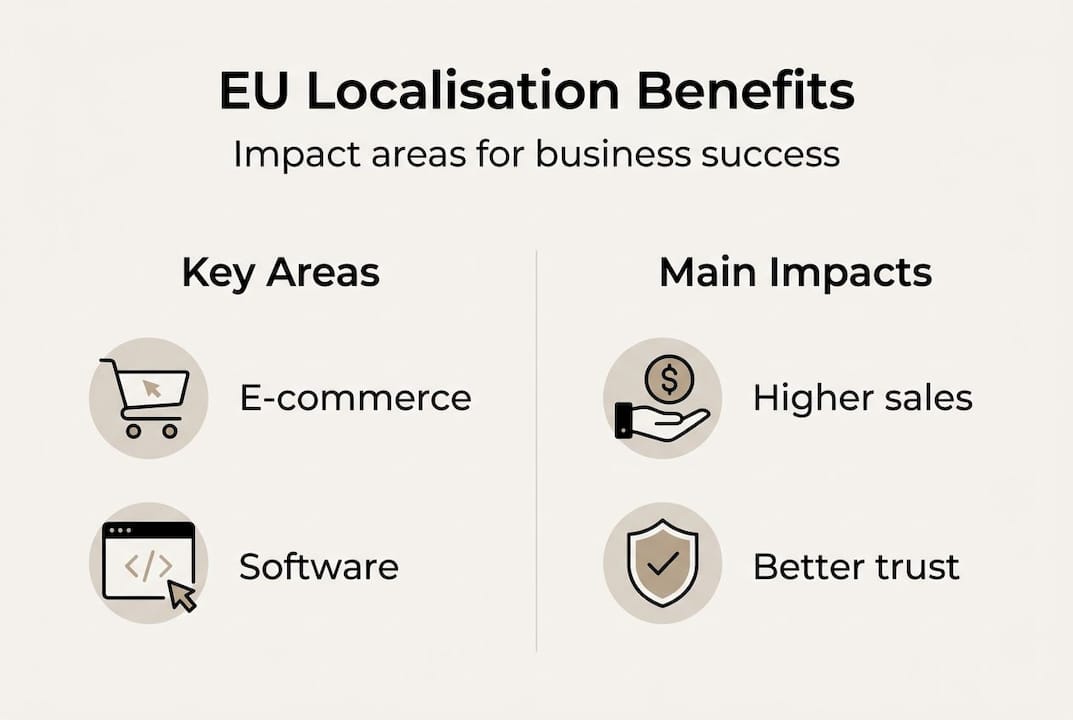
Using a language localisation checklist before entering a new EU market ensures no critical element is overlooked, from legal disclaimers to visual content. The businesses that treat localisation as a strategic investment, rather than a cost, consistently see faster market penetration and stronger long-term performance.
Why effective localisation is critical for EU compliance and reputation
The EU’s regulatory environment is one of the most demanding in the world. From the General Data Protection Regulation (GDPR) to sector-specific directives covering medical devices, financial services, and food labelling, accuracy in communication is not optional. It is a legal obligation.
EU regulations demand accuracy and cultural adaptation beyond literal translation. A mistranslated warning label on a medical device or an inaccurate privacy notice can result in regulatory fines, product recalls, or reputational damage that takes years to repair.
The compliance risks associated with poor localisation include:
- Incorrect legal terminology: Using terms that have different legal meanings in different EU jurisdictions
- Missing mandatory disclosures: Failing to include country-specific legal notices or consumer rights information
- Non-compliant marketing claims: Advertising standards differ across EU member states; what is permitted in one country may be prohibited in another
- Inaccessible content: Some EU member states have specific accessibility requirements for digital content
- Data protection language: GDPR consent language must be precise, unambiguous, and locally appropriate
A structured localisation workflow for compliance can reduce errors by up to 60% in regulated sectors, according to industry data. That is a significant risk reduction for any business operating across multiple EU markets.
Beyond compliance, reputation is at stake. A poorly localised campaign can inadvertently use imagery or phrasing that is offensive or simply tone-deaf in a specific cultural context. These mistakes attract negative attention quickly, particularly on social media.
Pro Tip: Before launching in any new EU market, review all legal disclaimers, user instructions, and consent language with a qualified language compliance in the EU specialist. Do not rely on automated tools alone for regulated content.
Localisation in practice: Real-world examples and best approaches
Knowing why localisation matters is one thing. Knowing how to do it well is another. Structured localisation strategies can shorten time-to-market and reduce costly errors when applied systematically.
Here is a practical step-by-step process for entering a new EU market:
- Conduct a locale analysis: Research your target market’s language variants, cultural norms, regulatory requirements, and competitor landscape before writing a single word.
- Build a glossary and style guide: Define key terminology, preferred tone, and brand voice for each locale. This ensures consistency across all content and all contributors.
- Localise core assets first: Prioritise your website, product UI, legal documents, and customer-facing support content. These have the highest impact on trust and compliance.
- Adapt visuals and symbols: An image that works in one culture may carry entirely different connotations in another. Localise photography, icons, colour schemes, and layout where needed.
- Test with native speakers: Quality assurance by native-speaking reviewers catches errors that automated tools and non-native translators miss.
- Iterate based on performance data: Monitor conversion rates, support queries, and user feedback by locale. Use this data to refine and improve your localised content continuously.
Well-known localisation failures serve as instructive examples. A major food brand once launched a product in a European market with a name that carried an unintended and embarrassing meaning in the local language. The product was quietly withdrawn. A software company released a UI update that broke entirely in right-to-left languages because the layout had not been tested. These are avoidable errors.
Pro Tip: Localise visuals and symbols as well as text. A thumbs-up icon is positive in most Western cultures but can be offensive in parts of the Middle East. If your EU audience includes diverse cultural backgrounds, audit every visual element. Explore effective localisation strategies and master localisation strategies to build a repeatable, scalable approach.
Our take: What most businesses overlook about localisation success
Most businesses treat localisation as a project. They enter a new market, localise their website, tick the box, and move on. This is precisely where long-term value is lost.
Localisation is not a destination. It is an ongoing capability. Markets evolve. Regulations change. Consumer expectations shift. A localised website that was accurate and culturally relevant in 2023 may already be out of step with what customers expect in 2026. Businesses that build localisation into their operational rhythm, rather than treating it as a one-off initiative, consistently outperform those that do not.
There is also a deeper strategic dimension that is frequently missed. Ongoing localisation generates insight. When you are continuously adapting content for specific locales, you are also learning how different audiences think, what language they respond to, and what problems they are trying to solve. That intelligence feeds back into product development, marketing strategy, and customer experience design.
This is particularly relevant for software localisation strategy, where user behaviour data from localised interfaces can reveal feature priorities and UX improvements that would never surface from a single-market perspective. The businesses winning in the EU are not simply the ones that translated their content. They are the ones that built localisation into their culture.
How Glocco supports your localisation journey
At Glocco®, we have been helping businesses navigate the complexity of EU localisation since 2014. We understand that every market is different, every sector has its own compliance demands, and every brand has a voice worth protecting. Our team of specialist linguists, cultural consultants, and localisation engineers works across e-commerce, fintech, legal, medical, and technology sectors to deliver results that are accurate, compliant, and genuinely effective.
Whether you are exploring business growth through localisation for the first time or scaling an existing multilingual operation, we can help you build a strategy that works. Browse examples of EU localisation success or discover the full range of language services for EU business available through Glocco®. Get in touch with our team to discuss your next market entry.
Frequently asked questions
What is the main difference between localisation and translation?
Localisation adapts content for cultural, legal, and audience expectations, while translation only converts text from one language to another. A localised approach includes visuals, formats, tone, and regulatory requirements alongside language.
How does localisation impact EU market access?
Effective localisation helps meet local regulations, build consumer trust, and improve conversion rates when entering EU markets. EU compliance demands go well beyond language accuracy and require cultural adaptation to be met reliably.
Can poor localisation harm my brand’s reputation?
Yes. Cultural missteps and inaccurate messaging can damage credibility quickly, particularly in markets where consumers have strong expectations of local brands. Accurate localisation protects your brand’s standing across EU territories.
What are some examples of content that should be localised?
Websites, legal documents, marketing materials, customer support content, software interfaces, and product packaging should all be localised for each target market. Localisation business gains are most significant when these high-impact assets are adapted thoroughly.
Is localisation a one-time task?
No. Markets, regulations, and audience expectations evolve continuously, so localisation must be an ongoing process. Ongoing localisation ensures your business remains relevant, compliant, and competitive as conditions change.


