


Localisation errors cost businesses millions annually, yet many still confuse it with simple translation. Effective localisation integrates translation, interpretation, and AI services to adapt content culturally and linguistically for global markets. This comprehensive guide explains how to optimise your localisation strategy in 2026, covering compliance requirements across Europe, North America, and Asia, comparing human and AI powered methods, and providing actionable frameworks for e-commerce, fintech, and technology sectors. You’ll learn to reduce errors, enhance user engagement, and build sustainable localisation workflows that drive international growth.
Key takeaways
| Point | Details |
|---|---|
| Robust localisation integrates multiple services | Successful localisation combines translation, interpretation, and AI services rather than relying on translation alone. |
| Compliance drives market entry success | Understanding regional legal requirements and cultural nuance prevents costly errors and builds trust in diverse markets. |
| Structured workflows reduce errors significantly | Adopting proven localisation workflows cuts errors by 60% across EU sectors. |
| Human AI collaboration optimises outcomes | Hybrid approaches balance speed, cost, and accuracy better than either method alone. |
| Industry specific strategies improve engagement | Tailored localisation approaches for e-commerce, fintech, and technology sectors deliver measurable results. |
Understanding localisation: beyond translation
Many businesses mistakenly treat localisation as a straightforward translation exercise. True localisation includes translation, cultural adaptation, interpretation, and AI integration across all business communications. This distinction matters because cultural context, regional preferences, and communication styles vary dramatically across markets.
Translation converts text from one language to another whilst maintaining meaning. Localisation goes further by adapting content to resonate with local audiences, considering currency formats, date conventions, measurement units, imagery, colour symbolism, and cultural references. A product description that works brilliantly in London might confuse or offend customers in Tokyo without proper localisation.
Interpretation services play an equally vital role in live communication scenarios. Whether conducting virtual meetings with international partners, hosting multilingual webinars, or providing customer support across time zones, professional interpretation ensures clear understanding. Remote simultaneous interpretation technology now enables real time multilingual communication for global teams without geographic limitations.
AI and machine translation have emerged as powerful tools within modern localisation workflows. Neural machine translation engines can process vast volumes of content rapidly, making them ideal for time sensitive projects or initial draft creation. However, AI lacks the cultural intelligence and contextual understanding that human linguists bring.
The most effective approach combines human expertise with AI efficiency. Human linguists review and refine machine translated content, ensuring accuracy whilst maintaining natural flow and cultural appropriateness. This hybrid model delivers speed and cost efficiency without compromising quality, making it suitable for businesses scaling their global presence.
Pro Tip: Start your language localisation workflow by identifying content that requires human expertise versus content suitable for AI assisted translation. Legal documents, marketing materials, and customer facing content typically need human oversight, whilst internal documentation or technical specifications may work well with AI assisted approaches.
Consider these core localisation components:
- Linguistic accuracy ensuring correct grammar, syntax, and terminology
- Cultural adaptation reflecting local customs, values, and communication styles
- Technical formatting including currency, dates, measurements, and address formats
- Visual localisation adapting images, colours, and design elements for cultural relevance
- Regulatory compliance meeting local legal and industry specific requirements
Understanding these elements helps you build a website localisation strategy that genuinely connects with international audiences rather than simply translating words.
The role of compliance and cultural nuance in localisation
Regulatory compliance represents one of the most challenging aspects of international business expansion. Each region maintains distinct legal requirements for product labelling, privacy policies, terms of service, and marketing claims. Language service providers reduce compliance errors by 35% in EU localisation projects by ensuring content meets regional standards.
The European Union enforces strict regulations around data protection through GDPR, requiring precise language in privacy notices and consent forms. Mistranslations or cultural misunderstandings in these documents can result in substantial fines. North American markets have varying state and provincial regulations, particularly in financial services and healthcare sectors. Asian markets often require government approvals for translated materials before publication.
Cultural conventions significantly impact how audiences perceive your brand. Colours carry different meanings across cultures: white symbolises purity in Western markets but represents mourning in many Asian countries. Numbers hold cultural significance too, with four considered unlucky in Chinese and Japanese cultures due to its pronunciation similarity to death.
Brand trust develops when businesses demonstrate cultural awareness and respect. This extends beyond avoiding offensive content to actively embracing local preferences. Payment methods, customer service expectations, communication formality levels, and purchasing behaviours all vary by region.
| Region | Primary Compliance Focus | Cultural Consideration | Localisation Priority |
|---|---|---|---|
| European Union | GDPR data protection, CE marking, accessibility standards | Formal communication, privacy emphasis | Legal accuracy, multilingual support |
| North America | State specific regulations, ADA compliance, financial disclosures | Direct communication, convenience focus | Clear messaging, regional variations |
| Asia Pacific | Government content approval, local partnerships, censorship | Hierarchical respect, relationship building | Cultural adaptation, visual localisation |
Successful localisation drives measurable improvements in user experience and engagement. When content feels native rather than translated, users spend more time on your platform, complete more transactions, and recommend your services to others. Enhanced user experience through localisation directly correlates with improved conversion rates and customer lifetime value.
Consider these compliance and cultural factors:
- Legal terminology requiring precise translation by subject matter experts
- Industry specific regulations varying by sector and geography
- Cultural taboos and sensitive topics that differ across markets
- Local business practices affecting communication expectations
- Regional quality standards and certification requirements
Pro Tip: Involve regional cultural consultants early in your localisation planning. Their insights prevent costly revisions and ensure your content resonates authentically. Native speakers who understand both language and local business culture provide invaluable guidance that generic translation services cannot match.
Partnering with experienced language service providers for EU compliance helps navigate complex regulatory landscapes whilst maintaining cultural sensitivity. This proactive approach prevents compliance issues before they arise.
Comparing human and AI powered localisation services
Choosing the right localisation method requires understanding the strengths and limitations of available approaches. Human translation, AI translation, and hybrid models each serve different business needs and project requirements.
| Approach | Best For | Key Strength | Primary Limitation | Typical Cost |
|---|---|---|---|---|
| Human Translation | Marketing, legal, creative content | Cultural nuance, context awareness | Slower turnaround, higher cost | High |
| AI Translation | Technical docs, internal content, high volume | Speed, consistency, scalability | Lacks cultural intelligence | Low |
| Hybrid Human AI | Most business content, websites, apps | Balanced quality, speed, cost | Requires workflow coordination | Medium |
Human translators bring irreplaceable expertise in cultural adaptation and contextual understanding. They recognise idioms, adapt humour, and ensure tone matches your brand voice across languages. Professional linguists specialise in specific industries, understanding technical terminology and regulatory requirements that generic translation tools miss.

AI translation excels at processing large volumes quickly and maintaining consistent terminology across documents. Modern neural machine translation produces increasingly natural sounding output, particularly for straightforward informational content. AI tools work continuously without fatigue, making them ideal for urgent projects or ongoing content updates.
Human AI translation services combine both approaches strategically. AI handles initial translation, then human linguists review and refine the output. This workflow delivers speed and cost efficiency whilst maintaining quality standards. The human review catches cultural missteps, corrects contextual errors, and ensures natural language flow.
Follow these steps to choose your localisation method:
- Assess content type and identify materials requiring cultural sensitivity versus straightforward information
- Evaluate project timeline and determine whether speed or perfection takes priority for this deliverable
- Consider budget constraints and calculate cost per word for different approaches
- Review quality requirements and establish minimum acceptable standards for your audience
- Test different methods and run pilot projects comparing outcomes before committing to one approach
E-commerce businesses often use hybrid approaches for product descriptions, allowing rapid catalogue expansion whilst maintaining brand voice. Fintech companies typically require human translation for regulatory documents but may use AI for internal communications. Technology firms frequently leverage AI and machine translation services for documentation whilst relying on human expertise for user interfaces and marketing.
Pro Tip: Create a content classification system that automatically routes materials to appropriate localisation methods. High value customer facing content gets human translation, technical documentation uses AI assisted approaches, and everything in between receives hybrid treatment. This systematic approach optimises both quality and efficiency.
The localisation landscape continues evolving as AI capabilities improve. However, human expertise remains essential for content requiring emotional connection, persuasive messaging, or cultural sensitivity. The most successful businesses recognise when each approach fits best.
Implementing effective localisation strategies across industries
Developing a robust localisation strategy requires industry specific considerations and systematic implementation. Strategic localisation workflows reduce errors by 60% across multiple EU sectors by following proven frameworks.
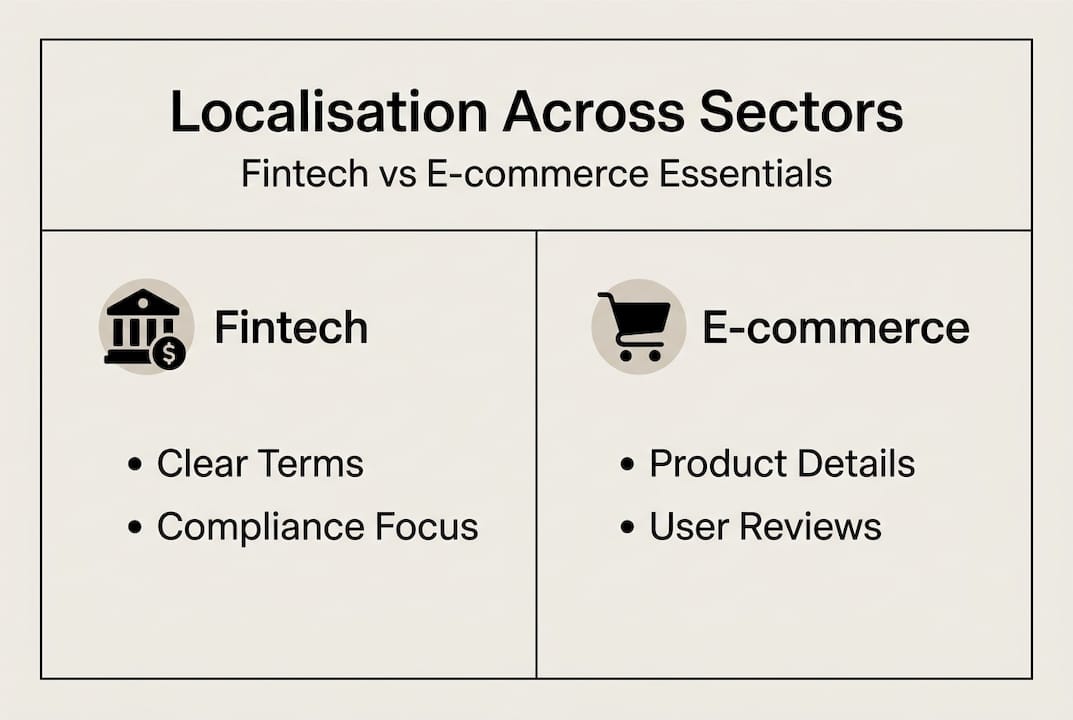
E-commerce businesses face unique localisation challenges with product catalogues, customer reviews, checkout processes, and customer service communications. Success requires translating thousands of product descriptions whilst maintaining SEO value, adapting payment options to regional preferences, and providing multilingual support across channels. Seasonal campaigns and promotional messaging need rapid turnaround without sacrificing quality.
Fintech companies must navigate complex regulatory environments whilst building trust through clear communication. Financial terminology requires precise translation by specialists who understand banking regulations, investment products, and compliance requirements. Privacy policies, terms of service, and risk disclosures carry legal weight, making accuracy non negotiable. Customer education materials explaining financial concepts must be culturally appropriate and easily understood.
Technology firms localise software interfaces, documentation, help centres, and marketing materials. Technical accuracy matters enormously as mistranslated error messages or unclear instructions frustrate users. Consistency across platforms, maintaining terminology databases, and coordinating releases across markets present ongoing challenges. Developer documentation and API references need clarity for international technical audiences.
Implement your localisation strategy with these steps:
- Conduct market research to identify priority languages and regions based on growth potential and existing demand
- Build a terminology database capturing approved translations for key terms, product names, and brand specific language
- Establish quality assurance processes including linguistic review, functional testing, and cultural validation before launch
- Create style guides defining tone, formality level, and communication preferences for each target market
- Develop content management workflows that integrate localisation into your production cycle rather than treating it as an afterthought
- Select language services partners who understand your industry and can scale with your growth
- Train internal teams on localisation best practices so they create content with translation in mind from the start
When selecting language services, evaluate providers based on industry expertise, technology capabilities, quality assurance processes, and scalability. Interpretation support becomes crucial for businesses conducting international meetings, training sessions, or customer consultations. Look for providers offering both translation and interpretation services for consistent quality across communication channels.
Leveraging AI tools within your localisation workflow requires careful integration. Translation memory systems store previously translated segments, ensuring consistency and reducing costs for repetitive content. Machine translation can accelerate first drafts, but always include human review for customer facing materials. Automated quality checks catch formatting errors, broken links, and terminology inconsistencies.
Measuring localisation effectiveness helps optimise your approach over time. Track metrics including conversion rates by language, customer satisfaction scores across markets, support ticket volume in different languages, and time to market for localised content. Compare engagement metrics between localised and non localised content to quantify impact.
Building continual improvement loops ensures your localisation strategy evolves with your business. Gather feedback from regional teams, analyse performance data, review customer comments, and stay current with market trends. Regular audits of existing localised content identify outdated information or opportunities for enhancement.
Successful language services for global business require ongoing commitment rather than one time projects. As your product evolves, markets shift, and regulations change, your localisation strategy must adapt accordingly.
Enhance your business localisation with Glocco services
Navigating the complexities of international expansion requires expert guidance and proven solutions. Glocco offers advanced language localisation workflows that reduce errors and accelerate your global success across Europe, North America, and Asia. Our integrated approach combines translation, interpretation, and AI services tailored to your industry requirements.
Explore comprehensive website localisation suited for diverse markets, ensuring your digital presence resonates with local audiences whilst maintaining brand consistency. Take advantage of cutting edge human AI translation services that deliver speed and accuracy for scaling businesses. Whether you operate in e-commerce, fintech, technology, or other sectors, Glocco provides the expertise and technology to support your international growth ambitions.
Frequently asked questions about localisation in business
What industries benefit most from localisation services?
E-commerce, fintech, technology, gaming, legal, and healthcare sectors gain substantial advantages from professional localisation. These industries serve global audiences, require regulatory compliance across markets, and depend on clear communication to build trust. Any business expanding internationally benefits from localisation, but those with complex products or strict compliance requirements see the most dramatic impact on market success.
How does AI enhance but not replace human translators?
AI accelerates initial translation and maintains consistency across large volumes of content. However, AI lacks cultural intelligence, contextual understanding, and creative adaptation abilities that human translators provide. The ideal approach combines AI efficiency with human expertise, using machine translation for speed and human review for quality. This hybrid model delivers optimal results for most business content.
What are common localisation compliance pitfalls?
Businesses frequently underestimate regional legal requirements, leading to non compliant privacy policies, product labels, or marketing claims. Mistranslated regulatory terminology, overlooked local certification requirements, and inadequate cultural adaptation create compliance risks. Working with experienced language service providers familiar with EU compliance prevents these costly errors. Always involve legal experts and native speakers during localisation planning.
How to measure localisation success effectively?
Track conversion rates, engagement metrics, and customer satisfaction scores by language and region. Compare performance between localised and non localised content to quantify impact. Monitor support ticket volume, time on site, bounce rates, and revenue per market. Gather qualitative feedback from regional teams and customers about content quality and cultural appropriateness. Regular analysis of these metrics guides optimisation and demonstrates ROI.
When should businesses start planning localisation?
Begin localisation planning before entering new markets rather than after launch. Early planning prevents costly redesigns and ensures your website localisation strategy supports international growth from the start. Ideally, consider localisation during product development so you build flexible systems that accommodate multiple languages and cultural variations. This proactive approach reduces time to market and improves outcomes across all target regions.


