


TL;DR:
- Professional interpreters are essential for accurate, culturally nuanced communication at high-stakes events.
- Choosing the correct interpreting mode depends on event size, content, and language needs.
- Thorough briefing, technical testing, and strategic planning ensure seamless multilingual event delivery.
Running a multilingual event without professional interpreters is a gamble most organisers cannot afford. Many assume bilingual staff or AI tools will cover the gap, but the reality is far more complex. The interpreting profession is under significant pressure: ELIS 2025 data shows the share of interpreters who can live solely off freelancing has dropped from 80% to 65%, signalling a market in flux. This guide walks you through why interpreters remain essential, how to choose the right interpreting mode, how to brief your team for success, and how to navigate the growing role of AI without sacrificing quality.
Key Takeaways
| Point | Details |
|---|---|
| Interpreters are key | Professional interpreters ensure true communication and enhance audience engagement at multilingual events. |
| Match mode to context | Choose interpreting modes based on your event’s size, format, and privacy requirements. |
| Preparation boosts quality | Early briefing and material sharing greatly improve interpreting accuracy and attendee experience. |
| AI is not a panacea | AI tools assist but cannot fully replace human interpreters’ adaptability and cultural awareness. |
| Best practice pays off | A systematic, proactive approach ensures seamless multilingual delivery and event success. |
Why interpreters are essential for successful events
One of the most persistent myths in event planning is that a bilingual colleague can step in as an interpreter. Bilingualism and interpreting are not the same skill. A fluent speaker may struggle under the cognitive load of real-time interpretation, miss technical terminology, or fail to convey the cultural weight behind a speaker’s words. The result is a diluted message that can confuse, mislead, or even offend your audience.
Professional interpreters bring far more than language switching. They carry cultural nuance, manage the flow of communication, and ensure compliance with the speaker’s intended meaning. At legal hearings, medical conferences, or high-stakes negotiations, this precision is not optional. It is the difference between a successful outcome and a costly misunderstanding.
The current market tells a revealing story. ELIS 2025 findings confirm that AI integration is rising, yet 65% of professional interpreters report a negative impact from these tools on their work. This does not mean AI is useless. It means quality is at risk when technology replaces rather than supports human expertise.
Event type matters enormously when selecting interpreters:
- Large international conferences: Require simultaneous interpreting with booth setups and relay teams
- Legal and compliance hearings: Demand certified interpreters with subject-matter expertise
- Technical workshops: Benefit from interpreters briefed on specialist vocabulary
- Social or networking events: May suit whispered or consecutive interpreting
“The interpreter is not simply a language conduit. They are the voice of the speaker in another language, carrying tone, intent, and authority.”
For consistent quality across European events, AIIC professional guidelines strongly recommend working with certified or AIIC-compliant providers. Pair this with thoughtful types of interpreting services selection and you set the foundation for a truly successful event. Well-planned corporate event logistics extend beyond transport and catering. Communication quality belongs on that list too.
Understanding interpreting modes and matching them to your event
Choosing the wrong interpreting mode is one of the most avoidable mistakes event organisers make. Each mode serves a distinct purpose, and selecting the right one depends on your audience size, language combinations, and the nature of the content being delivered.
Here is a quick overview of the main modes:
- Simultaneous interpreting: The interpreter works in real time, usually from a soundproof booth, delivering the message almost instantly. Used at large conferences and EU institutions.
- Consecutive interpreting: The speaker pauses to allow the interpreter to relay the message. Suited to smaller meetings, press conferences, or legal settings.
- Relay interpreting: One interpreter translates into a pivot language, and others translate from that pivot. Ideal when many languages are required.
- Whispered interpreting (chuchotage): The interpreter whispers directly to one or two listeners. Works for small groups within larger events.
- Sight translation: The interpreter reads a written document aloud in another language. Common for legal or technical documents during proceedings.
| Interpreting mode | Best suited for | Group size | Key consideration |
|---|---|---|---|
| Simultaneous | International conferences, EU summits | Large | Requires booth and equipment |
| Consecutive | Legal hearings, interviews | Small to medium | Adds time to proceedings |
| Relay | Multi-language events | Large | Needs a reliable pivot interpreter |
| Whispered | Bilateral meetings within events | 1 to 2 listeners | Discreet but limited reach |
| Sight translation | Document-heavy sessions | Any | Interpreter needs advance access to docs |
The anticipation technique is central to fluent simultaneous interpreting. Skilled interpreters predict sentence endings based on context and grammatical structure, which is why briefing and preparation matter so much. EU institutions rely almost exclusively on simultaneous interpreting for this reason.
Pro Tip: For events spanning five or more languages, relay interpreting offers the most practical solution. Rather than sourcing a direct interpreter for every language pair, a strong pivot interpreter reduces complexity and cost without compromising accuracy. Always discuss this option when reviewing types of interpretation with your provider.
How to plan and brief interpreters for maximum impact
Even the most talented interpreter will underperform without proper preparation. Briefing is not a courtesy. It is a professional requirement that directly affects the quality of communication your audience receives.
Follow these steps to set your interpreters up for success:
- Engage early. Book interpreters at least four to six weeks before the event. Last-minute bookings limit your choice and reduce preparation time.
- Share all materials. Provide presentations, speaker notes, agendas, and any technical documents as soon as they are available.
- Build a glossary. Work with your interpreters to create a bilingual glossary of key terms, acronyms, and proper nouns specific to your event.
- Provide cultural context. Brief interpreters on the audience’s background, sensitivities, and any culturally specific references speakers may use.
- Schedule a pre-event Q&A. Allow interpreters to ask questions about content, speaker style, and expected terminology before the event begins.
- Run a full technical test. For hybrid or remote events, test all audio channels, booths, and platforms at least 24 hours in advance.
“Preparation is the invisible work that makes interpretation look effortless. The more context interpreters receive, the more accurately they can serve your audience.”
AIIC guidelines are clear: prepare glossaries and briefings weeks ahead, and ensure RSI (remote simultaneous interpreting) technology is tested and ready for hybrid formats. This is not optional for professional-grade delivery.
The investment in thorough briefing pays off immediately. Interpreters who understand the content make fewer errors, maintain better flow, and handle unexpected terminology with confidence. Learn more about supporting interpreters effectively and how to work with certified interpreters for compliance-sensitive events.

Pro Tip: Insist on a pre-event briefing session even when time is tight. A 30-minute call with your interpreter team can prevent hours of confusion during the event itself.
Balancing human interpreters and AI: what organisers need to know
AI-powered interpreting tools have improved dramatically. They process multiple languages simultaneously, reduce costs, and can handle high-volume, straightforward content with reasonable accuracy. For some scenarios, they offer genuine value.
But the data tells a more cautious story. ELIS 2025 research shows that 65% of professional interpreters report a negative impact from AI on their professional lives, citing quality concerns, reduced work opportunities, and client confusion about what AI can actually deliver.
Here is where AI and human interpreters each perform best:
| Scenario | AI interpreting | Human interpreting |
|---|---|---|
| High-volume, repetitive content | Strong | Overkill |
| Idiomatic expressions and humour | Weak | Strong |
| Sensitive negotiations | Not suitable | Essential |
| Technical jargon (briefed) | Moderate | Strong |
| Real-time audience response | Very weak | Strong |
| Cost-sensitive internal meetings | Viable | Higher cost |
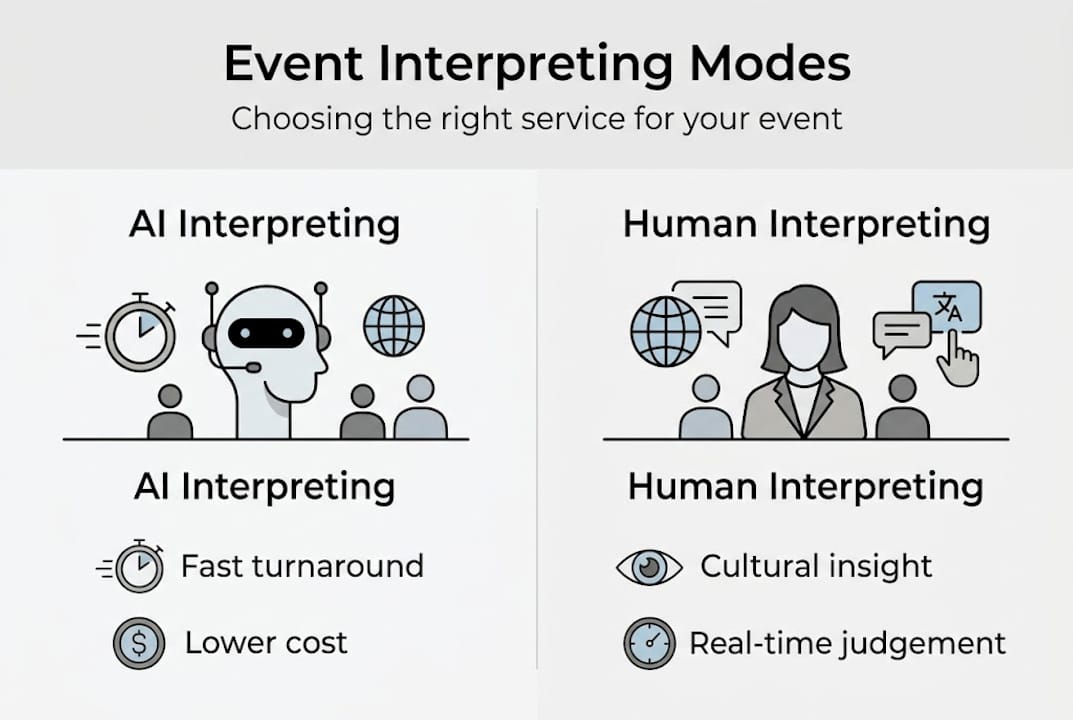
The risk of over-relying on AI is real. Idioms, cultural references, and audience dynamics require human judgement that no current tool reliably replicates. A poorly interpreted punchline or a mistranslated legal term can derail an entire session.
The smartest approach is a hybrid one. Use AI tools for translation to handle pre-event document preparation, post-event transcription, or internal communications. Reserve human interpreters for live, high-stakes moments where nuance, adaptability, and trust are non-negotiable.
- Use AI for pre-event document summaries and glossary building
- Deploy human interpreters for plenary sessions, Q&As, and negotiations
- Combine both for hybrid events where live and recorded content coexist
Best practices for delivering seamless multilingual events
Execution is where all your planning either holds together or falls apart. Even with the right interpreters and the right mode selected, poor on-the-day management can undermine the entire effort.
Here is a practical checklist for smooth delivery:
- Conduct a full technical rehearsal at least one day before the event, including all audio channels, interpreter booths, and remote platforms.
- Assign a dedicated language coordinator who liaises between speakers, interpreters, and technical staff throughout the event.
- Test all receiver equipment for audience members, including headsets and mobile apps used for RSI delivery.
- Prepare a backup plan for technical failures. Know which interpreter can switch mode if the booth system fails.
- Brief speakers on interpreter-friendly delivery. Encourage clear speech, reasonable pace, and advance notice of any slides or documents they will reference.
- Monitor delivery in real time. Have a coordinator listen to interpreter feeds periodically to catch any quality issues early.
- Collect post-event feedback from both interpreters and audience members to improve future events.
AIIC guidelines emphasise that RSI technology for hybrid events must be tested and confirmed well in advance. A solid remote interpreting workflow is just as important as the on-site setup. For large-scale events, partnering with a provider who offers simultaneous interpreting services with full technical support removes significant risk from your shoulders.
Pro Tip: Always arrange on-site or remote technical support specifically for your interpreters. A dedicated technician who understands interpreting equipment is worth every penny when something goes wrong mid-session.
What most event organisers still miss about interpreters
After years of working with event teams across Europe, one pattern stands out. Organisers who treat interpreters as a logistical line item consistently get worse results than those who treat them as strategic partners.
Interpreting is a performance art. It happens in real time, under pressure, with no opportunity to pause and reconsider. The interpreter must process meaning, cultural context, tone, and technical content simultaneously, then reproduce it faithfully in another language within seconds. That is not a task any checklist fully captures.
The events that go wrong are rarely those with poor speakers or weak content. They are events where communication broke down because someone assumed the language problem was already solved. A missed cultural reference, an ambiguous term left unbriefed, or a technical failure with no backup plan can cost far more than the fee of a second interpreter.
View your interpreters as you would a keynote speaker. Give them the information they need, the time to prepare, and the respect their expertise deserves. The impact interpreters have on global reach is measurable, and it starts with how you integrate them into your event from day one.
Technology will continue to evolve. But adaptability, cultural intelligence, and real-time human judgement remain firmly in the human domain.
Take your event further with expert interpretation
Putting this guide into practice starts with finding the right language partner. At Glocco®, we provide tailored interpretation solutions for events across Europe and beyond, from large international conferences to specialist technical workshops. Our interpreters are certified, culturally fluent, and fully briefed to deliver with precision.
Whether you need support selecting the right mode, building a multilingual event plan, or sourcing certified interpreters at short notice, our team is ready to help. Explore interpreting services tailored to your event format, or learn more about our simultaneous interpreting capabilities for large-scale multilingual events. Reach out today and let us help you deliver an event your entire audience will understand and remember.
Frequently asked questions
How much notice do interpreters need for an event?
Ideally, provide at least 2 to 4 weeks’ notice so interpreters can prepare with event materials, glossaries, and relevant background context well in advance.
Can AI fully replace human interpreters at events?
No. AI tools can support speed and reduce costs for routine content, but 65% of interpreters report a negative impact from AI, reflecting its limitations in cultural accuracy and contextual judgement.
What are the main types of interpreting services for events?
Simultaneous, consecutive, relay, whispered, and sight translation are the five primary interpreting modes used at professional events, each suited to different formats and audience sizes.
How do I ensure interpreters deliver the right message at my event?
Provide detailed briefings, bilingual glossaries, and full event context in advance, and schedule a pre-event Q&A session so interpreters can clarify any uncertainties before going live.
Recommended
- Certified interpreters: ensuring accuracy and compliance
- Types of interpretation services for European businesses
- What is legal interpreting? Essential guide for EU professionals
- The role of interpreters in business: boost global reach
- Enhance customer engagement with multilingual support
- Customized virtual events software | Brainiac Media


