


TL;DR:
- Ensuring strong encryption, access control, and audit logging is vital for secure remote interpreting.
- Proper preparation, platform selection, and post-session record management reduce security risks.
- Human factors like interpreter fatigue and contingency planning are critical for successful live sessions.
Remote interpreting carries real risk. A single data breach during a sensitive legal deposition or a medical consultation can expose organisations to regulatory penalties, reputational damage, and broken client trust. With GDPR enforcement tightening across Europe and HIPAA remaining non-negotiable in North American healthcare, professionals cannot afford to treat security as an afterthought. This guide maps out every stage of a secure remote interpreting workflow, from preparation and platform selection through to live session management and post-session compliance. Whether you work in law, healthcare, or technology, the steps here will help you reduce risk and maintain the highest standards of multilingual communication.
Key Takeaways
| Point | Details |
|---|---|
| Prep is critical | Send session materials and vet participants 24–48 hours in advance to ensure security and session quality. |
| Platform choice matters | Use interpreting platforms with end-to-end encryption and compliance with GDPR or HIPAA as standard. |
| Compliance beyond tech | Audit logs, NDAs, and post-session record handling are just as vital as strong encryption. |
| Mitigate edge risks | Have backup plans for connectivity, interpreter rotation, and stress management to ensure reliable performance. |
Understanding the components of a secure remote interpreting workflow
Before jumping into the workflow, it is critical to clarify what elements make interpreting workflows both secure and effective. Secure remote interpreting workflows typically involve preparation, secure platform selection, authenticated entry, and role-based access control. Each of these components addresses a distinct vulnerability, and neglecting even one creates a gap that bad actors or compliance auditors will find.
For professionals working across legal interpreting essentials or the full range of interpretation service types, the workflow breaks down into five core stages:
- Preparation: Secure delivery of briefing materials 24 to 48 hours in advance, signed NDAs, and identity verification for all participants.
- Platform security: End-to-end encryption (E2EE), Transport Layer Security (TLS) 1.2 or higher, and authenticated session entry.
- Access control: Role-Based Access Control (RBAC) to ensure participants see only what they need.
- Session management: Disciplined turn-taking protocols, high-quality audio hardware, and interpreter rotation schedules.
- Record-keeping: Secure retention or deletion of session data in line with organisational policy and applicable law.
The table below summarises the regulatory drivers shaping each component:
| Workflow component | Regulatory driver | Key requirement |
|---|---|---|
| Platform encryption | HIPAA, GDPR | E2EE and TLS 1.2+ mandatory |
| Participant authentication | HIPAA Security Rule | Multi-factor authentication |
| Access control | GDPR Article 25 | Least-privilege RBAC |
| Audit logs | HIPAA, SOC2 | Tamper-proof session records |
| Data retention/deletion | GDPR Article 17 | Documented deletion protocols |
Understanding these components is not an academic exercise. It is the foundation on which every subsequent decision in your workflow rests.
Preparing for a secure remote interpreting session
Once you understand the workflow’s building blocks, the next step is setting up your session securely and efficiently. Secure remote interpreting requires 24 to 48 hours of advance preparation and authenticating all participants before the session begins. Rushing this stage is where most compliance failures originate.
Research on workflow challenges in public health interpreting confirms that inadequate preparation correlates directly with session breakdowns and data handling errors. The following numbered checklist covers the essential steps:
- Compile the briefing packet. Share case summaries, terminology glossaries, and relevant documents via an encrypted file-transfer channel at least 48 hours before the session.
- Execute confidentiality agreements. Ensure all interpreters and technical staff have signed NDAs or equivalent agreements specific to the session’s subject matter.
- Verify participant identities. Use multi-factor authentication or a secure identity verification step before granting session access.
- Confirm platform compliance settings. Check that E2EE, RBAC, and audit logging are active. Do not assume default settings are sufficient.
- Communicate logistics clearly. Share dial-in details, backup contact numbers, and session protocols with every participant in writing.
- Establish contingency plans. Identify a backup communication channel (telephone bridge or secondary platform) in case of connectivity failure.
- Brief interpreters on sensitivities. For high-stakes scenarios such as interpreters in court, share any known emotional or contextual complexities that may affect performance.
Pro Tip: For medical or legal sessions, ask interpreters to confirm receipt of the briefing packet and flag any unfamiliar terminology in advance. This simple step reduces in-session delays and protects accuracy under pressure.
Preparation is not bureaucracy. It is the first line of defence against both security breaches and professional errors.
Selecting secure remote interpreting platforms and tools
With your session planned, choosing the right technology is the linchpin for true security and compliance. The security pillars for any compliant platform include E2EE, TLS 1.2+, audit logs, RBAC, compliance certifications such as SOC2 and ISO 27001, and cloud segmentation to isolate sensitive data.

Not all platforms are equal. The comparison below highlights key differences relevant to legal, healthcare, and technology professionals:
| Platform | E2EE | HIPAA-ready | GDPR-aligned | Audit logs | Sector focus |
|---|---|---|---|---|---|
| KUDO | Yes | Configurable | Yes | Yes | Multilingual enterprise |
| TransLinguist | Yes | Yes | Yes | Yes | Legal and healthcare |
| Zoom (healthcare plan) | Yes | Yes | Partial | Limited | General with add-ons |
| Sector-specific tools | Varies | Varies | Varies | Varies | Niche deployments |
For video remote interpreting specifically, look for platforms that support interpreter relay channels, floor audio management, and participant waiting rooms. These features are not optional extras; they are operational necessities for complex multilingual sessions.
Key features to verify before committing to any platform:
- Certified compliance: SOC2 Type II and ISO 27001 certifications as a baseline.
- Cloud segmentation: Sensitive session data must be isolated from general cloud infrastructure.
- Secure file sharing: Pre-session materials should travel through encrypted transfer channels, not standard email.
- Access revocation: The ability to remove a participant instantly if a security concern arises.
Pro Tip: Request a compliance documentation pack from any platform vendor before signing a contract. Reputable providers will supply this without hesitation. If they cannot, treat it as a red flag.
The right platform does not guarantee a secure session, but the wrong one makes a secure session impossible.
Session execution and troubleshooting in secure remote interpreting
Robust technology and workflows reduce risks, but operational excellence makes the difference in the live session. Edge cases such as poor connectivity, overlapping speech, high interpreter stress, and complex session management are documented challenges that require active management, not passive hope.
Follow this sequence for live session execution:
- Launch the session early. Open the platform 15 minutes before the scheduled start to run audio and video checks.
- Verify all participants. Confirm identities against the pre-approved list before admitting anyone to the main session room.
- Establish communication protocols. Remind all parties of turn-taking rules and the designated interpreter relay procedure.
- Rotate interpreters on schedule. For sessions exceeding 30 minutes, interpreter performance research supports rotation every 20 to 30 minutes to maintain accuracy and reduce fatigue.
- Monitor for technical issues. Assign a dedicated technical moderator to manage connectivity drops, audio overlap, or platform errors in real time.
- Close the session formally. Confirm all participants have exited, stop recording if applicable, and initiate the agreed record-handling protocol immediately.
“The most overlooked risk in remote interpreting is not a technology failure. It is the cumulative effect of interpreter fatigue and unclear escalation procedures when something goes wrong mid-session.” This insight, drawn from empirical studies on interpreters’ business role, underscores why human process design matters as much as platform choice.
For connectivity failures, activate the telephone bridge backup without delay. Do not attempt to troubleshoot live platform issues while the session continues, as this divides attention and increases the risk of procedural errors.
Record management and compliance post-session
With the session complete, proper handling of records is what ensures lasting compliance and data privacy. Healthcare workflows require HIPAA and GDPR compliance, audit trails, and legal data localisation. The same principles apply to legal and technology sector sessions handling sensitive personal or commercially privileged information.
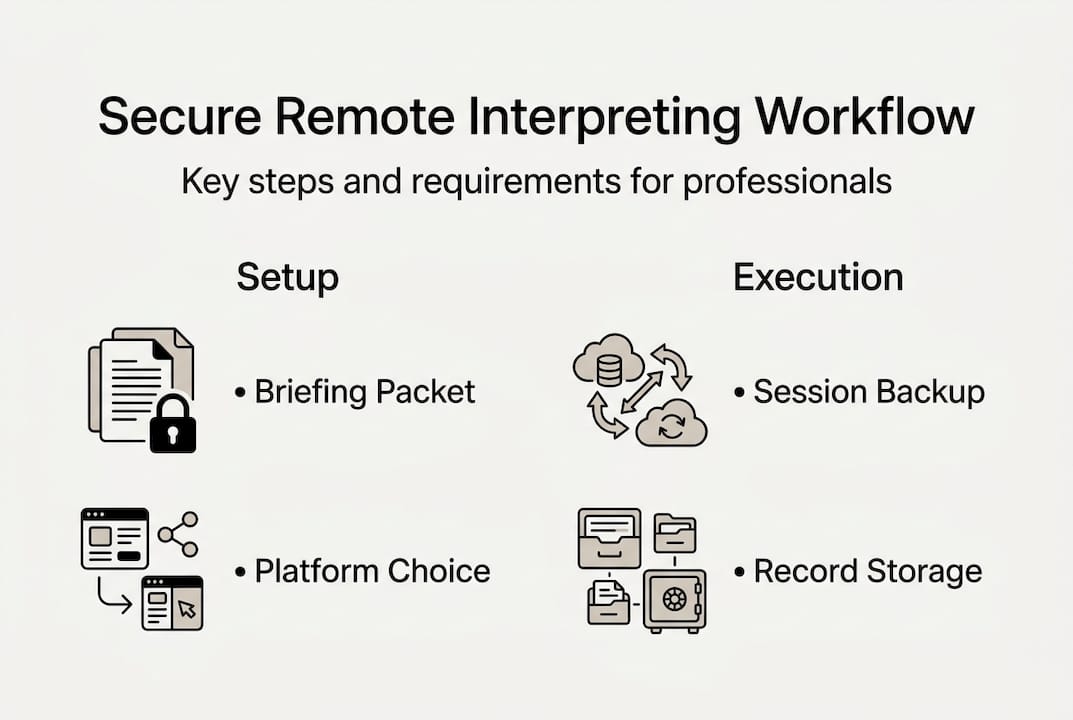
A case study on secure interpretation in enterprise settings demonstrates that organisations with documented post-session protocols experience significantly fewer compliance incidents than those treating record management as informal.
Key post-session actions:
- Secure audit logs immediately. Lock session logs against modification and store them in a compliant, access-controlled environment.
- Execute data retention or deletion. Apply your documented policy without delay. GDPR Article 17 grants data subjects the right to erasure, and delays create liability.
- Review Business Associate Agreements (BAAs). For healthcare sessions, confirm that your interpreting provider has a current BAA in place, as required under HIPAA.
- Obtain participant consent records. Ensure signed consent for any session recording is filed alongside the session documentation.
- Manage data localisation requirements. European clients must confirm that data has not been transferred outside GDPR-compliant jurisdictions without appropriate safeguards.
- Assess and log any incidents. If a security or procedural issue occurred, document it formally and initiate your incident response process.
For professionals involved in medical translation for safety, the stakes of poor record management extend beyond regulatory fines. Incomplete or insecure records can directly affect patient outcomes and legal accountability.
Statistic to note: GDPR fines reached a record €1.6 billion in 2023, with data handling failures among the most cited causes. Post-session compliance is not a formality.
A fresh look: why secure remote interpreting is more than technology
Most guides on secure remote interpreting focus almost exclusively on platform features and regulatory checklists. That framing is useful but incomplete. Technology addresses only the infrastructure layer of risk. The human layer, including interpreter well-being, stakeholder engagement, and real-time decision-making, is where sessions succeed or fail in practice.
Empirical data on AI-assisted interpreting is still sparse. AI interpretation quality pass rates range from just 5% to 83% depending on language pair and context, which means the human/AI mix in interpreting remains an active and unresolved challenge. Organisations that assume AI tools are a compliant, drop-in replacement for qualified human interpreters are taking on risk that their legal or clinical governance frameworks may not support.
The distinction between legal translation vs interpretation is a useful reminder that interpreting is a real-time cognitive and emotional task, not a mechanical conversion of words. Interpreter stress, session complexity, and ambiguous escalation paths are the variables that no platform setting can control.
The organisations that consistently achieve secure, high-quality remote interpreting outcomes are those that invest in interpreter briefing, build genuine contingency protocols, and treat their interpreting partners as skilled professionals rather than interchangeable service components. Compliance is the floor, not the ceiling.
How Glocco supports your secure remote interpreting workflow
If you want to safeguard your multilingual communication processes, specialist support makes a measurable difference. Glocco® has been providing tailored interpretation and translation services to legal, healthcare, and technology clients since 2014, with robust compliance measures and sector-specific expertise built into every engagement.
Our interpretation services for business cover the full range of modalities, from telephone and video remote interpreting to simultaneous interpreting services for high-stakes multilingual events. Every service model is designed with GDPR and HIPAA alignment in mind, supporting your compliance obligations without adding operational friction. Explore the full range of secure interpreting solutions and speak to our team about building a workflow that fits your sector’s specific requirements.
Frequently asked questions
What is the most secure remote interpreting method for sensitive legal or medical scenarios?
The most secure method uses a platform with end-to-end encryption, role-based access control, tamper-proof audit logs, and full alignment with GDPR or HIPAA requirements.
How far in advance should materials be shared for secure remote interpreting?
Best practice is to deliver all relevant materials at least 24 to 48 hours before the session, via an encrypted file-transfer channel rather than standard email.
What edge cases need contingency plans in secure remote interpreting?
Prepare for poor connectivity, overlapping speech, and interpreter fatigue by establishing a telephone bridge backup, clear escalation procedures, and a rotation schedule for interpreters.
Are AI-based interpreting tools secure and reliable?
AI interpreting pass rates range from 5% to 83% depending on context, making AI tools unreliable for high-stakes legal or medical sessions where accuracy and compliance are non-negotiable.
What compliance regulations must be considered for remote interpreting?
European and North American professionals must ensure full GDPR and HIPAA compliance in their remote interpreting workflows, including data localisation, audit trails, and signed Business Associate Agreements where applicable.
Recommended
- Types of interpretation services for European businesses
- What is legal interpreting? Essential guide for EU professionals
- Understanding the role of interpreters in court proceedings
- The role of interpreters in business: boost global reach
- Remote Hiring Step by Step for UK Security Firms | Security Jobs Board


