


Many legal professionals and businesses mistakenly treat legal translation and interpretation as interchangeable terms, yet confusing these distinct disciplines can jeopardise compliance, undermine legal accuracy, and compromise access to justice across Europe. Legal translation transforms written documents with meticulous precision, whilst interpretation delivers real-time spoken communication under intense cognitive pressure. Understanding these differences is essential for selecting the right language services, meeting regulatory obligations, and ensuring that contracts, court proceedings, and cross-border negotiations proceed without error. This guide clarifies the core distinctions, explores regulatory frameworks, and offers practical advice for navigating the complex landscape of legal language services.
Key Takeaways
| Point | Details |
|---|---|
| Distinct Disciplines | Legal translation and interpretation are separate disciplines with different workflows and objectives. |
| Real time interpretation | Interpretation delivers real time spoken communication under intense cognitive pressure without altering meaning. |
| Trained professionals required | European regulations mandate the use of trained professionals for both translation and interpretation to ensure access to justice. |
| AI support with oversight | AI tools assist but human expert oversight remains essential for high stakes tasks. |
Understanding legal translation: scope and methodology
Legal translation involves converting written legal documents from one language to another, requiring meticulous attention to terminology, legal systems, and precision to ensure authenticity and compliance. It is performed by lawyer-linguists who analyse source materials, use standardised terminology, and produce reviewed written outputs. This discipline encompasses contracts, court rulings, legislation, patents, and regulatory filings, all of which demand absolute fidelity to legal meaning and format. Unlike general translation, legal translation bridges not only languages but also distinct legal systems, each with unique concepts, procedural rules, and terminological conventions.
Lawyer-linguists bring dual expertise in law and languages, enabling them to navigate complex legal frameworks and identify equivalent terms that preserve intent and enforceability. They must understand civil law versus common law distinctions, recognise when a term has no direct equivalent, and decide whether to adopt, adapt, or explain legal concepts. This knowledge prevents costly misinterpretations that could invalidate contracts or lead to regulatory penalties. The process allows time for thorough research, consultation with subject matter experts, and iterative revision to achieve the highest accuracy.
Computer-assisted translation (CAT) tools play a significant supporting role by maintaining terminology databases, ensuring consistency across large document sets, and accelerating turnaround times. Translation memories store previously translated segments, reducing redundancy and harmonising language across multiple projects. However, these technologies serve as aids, not replacements, for human judgement. Legal texts often contain ambiguities, cultural nuances, and context-dependent meanings that only experienced professionals can resolve.
Quality assurance in legal translation follows rigorous standards, including ISO 17100, which mandates qualified translators, proofreading, and review stages. Many jurisdictions also require sworn or certified translations for official documents, adding another layer of accountability. When you translate legal documents accurately, you protect your organisation from disputes, regulatory breaches, and reputational damage.
Pro Tip: Always verify that your legal translator holds recognised qualifications in both law and translation, and request samples or references from similar projects to assess their expertise in your specific legal domain.
- Legal translation covers contracts, court judgements, legislation, patents, and compliance documents
- Lawyer-linguists must understand both source and target legal systems to ensure equivalence
- CAT tools and translation memories enhance consistency but require human oversight
- ISO 17100 and sworn translation standards enforce quality and accountability
- Time for research and revision distinguishes translation from interpretation
The practice of legal interpretation: skills and challenges
Legal interpretation is the real-time oral rendition of spoken language in judicial hearings, arbitrations, client meetings, and other legal settings, demanding instant comprehension, memory retention, and flawless delivery without altering meaning. Unlike translation, interpretation occurs under intense cognitive pressure, with no opportunity to consult references or revise output. Interpreters must process complex legal arguments, technical terminology, and rapid speech whilst maintaining neutrality and accuracy. This requires exceptional linguistic skills, deep legal knowledge, and the mental stamina to sustain concentration over extended sessions.

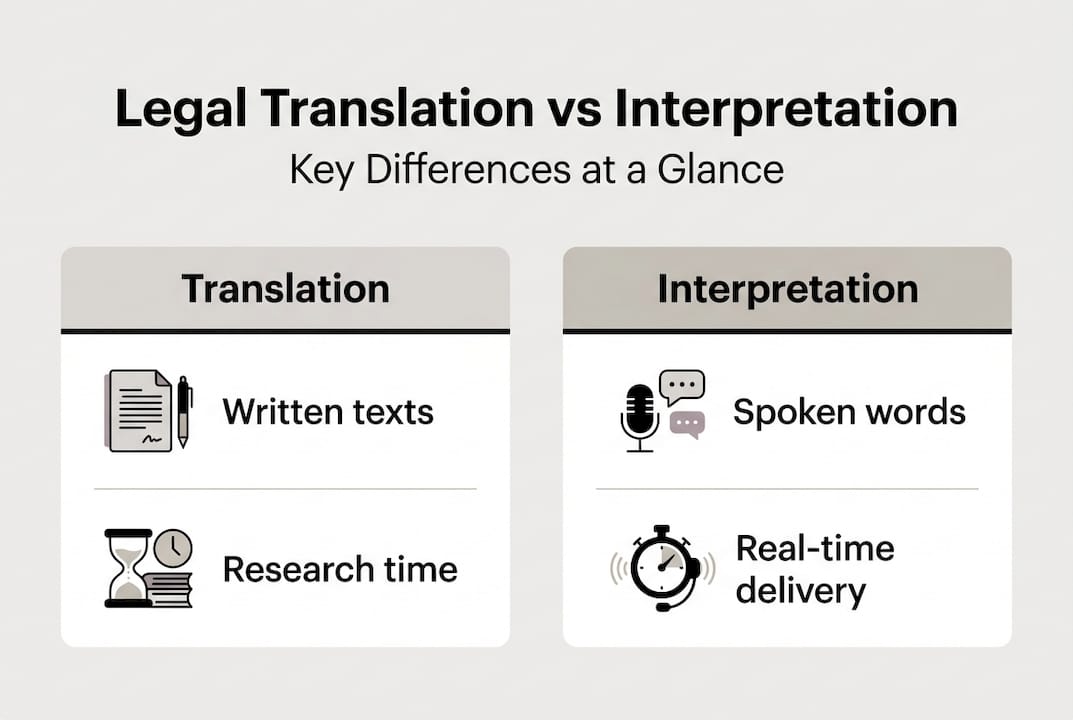
Key methodological differences include translation allowing time for research, revision, and IT tools, whilst interpretation requires instant processing, memory, and note-taking under pressure without altering meaning. Consecutive interpretation involves the speaker pausing after segments, allowing the interpreter to render the message using notes. Simultaneous interpretation occurs in real time, often through headsets in courtrooms or conferences, requiring split-second decision-making. Over-the-phone and video remote interpretation have expanded access to justice, particularly for minority language speakers, but introduce technical challenges such as audio quality and visual cues.
Accredited professional interpreters undergo rigorous training and certification to guarantee competency in legal contexts. Accreditation programmes assess linguistic proficiency, legal terminology, ethical standards, and the ability to manage stress and maintain impartiality. In many European jurisdictions, only accredited interpreters may work in criminal proceedings, ensuring defendants and witnesses understand and are understood. This safeguard is fundamental to fair trial rights under the European Convention on Human Rights.
The role of interpreters in court proceedings extends beyond mere language conversion. Interpreters facilitate communication between judges, lawyers, defendants, and witnesses, often navigating cultural differences and emotional intensity. They must remain invisible, conveying tone and intent without editorialising or influencing outcomes. Ethical codes prohibit interpreters from offering legal advice, advocating for parties, or engaging in conflicts of interest.
Beyond courtrooms, the role of interpreters in business settings includes contract negotiations, due diligence meetings, and compliance interviews, where precision and confidentiality are paramount. Misinterpretation in these contexts can derail deals, expose companies to liability, or breach regulatory obligations.
Pro Tip: When booking an interpreter, confirm their accreditation status, subject matter expertise, and familiarity with the specific legal context, whether criminal, civil, or commercial, to ensure optimal performance.
- Interpretation involves consecutive, simultaneous, and remote modalities, each with distinct demands
- Accreditation ensures interpreters meet professional standards and ethical obligations
- Cognitive skills such as memory, note-taking, and instant processing are essential
- Legal interpreters must remain neutral, accurate, and culturally sensitive
- Fair trial rights depend on access to qualified interpreters in judicial settings
Legal translation and interpretation in the European Union: regulatory overview
In Europe, multilingualism is mandated by Regulation 1/58 and court rules, with lawyer-linguists for translation and accredited interpreters ensuring access to justice across 24 languages. The EU institutions employ thousands of translators and interpreters to maintain legal certainty, protect linguistic diversity, and uphold democratic accountability. Every EU regulation, directive, and court judgement must be available in all official languages, ensuring citizens can understand and challenge laws affecting them.
Regulation 1/58 establishes the linguistic regime for EU institutions, requiring that all documents of general application be translated into every official language. This principle extends to national courts when interpreting EU law, obliging member states to provide translation and interpretation services to safeguard legal rights. Article 42 of the Statute of the Court of Justice of the European Union guarantees the right to use any official language in proceedings, reinforcing the central role of language professionals in European justice.
Directive 2010/64/EU on the right to interpretation and translation in criminal proceedings mandates that suspects and accused persons who do not understand the language of the proceedings receive free interpretation and translation of essential documents. This directive harmonises standards across member states, ensuring that language barriers do not undermine fair trial rights. Member states must maintain registers of qualified interpreters and translators, verify their competence, and monitor quality.
The role of language service providers in EU compliance has grown as businesses navigate cross-border regulations, data protection laws, and public procurement rules. Accurate translation of contracts, privacy policies, and regulatory filings is essential to avoid penalties and legal disputes. Language service providers offer centralised management of multilingual content, ensuring consistency, compliance, and traceability.
Sworn translation in Europe involves officially certified translations recognised by courts and government agencies, often required for birth certificates, marriage licences, diplomas, and corporate documents. Sworn translators are registered with judicial authorities and bear legal responsibility for the accuracy of their work, adding a layer of accountability beyond standard translation services.
| Regulation | Focus | Impact on translation | Impact on interpretation |
|---|---|---|---|
| Regulation 1/58 | EU multilingualism | Mandates translation of all official documents into 24 languages | Requires interpretation in EU institutions and courts |
| Directive 2010/64/EU | Criminal proceedings | Guarantees translation of essential documents for defendants | Ensures free interpretation for suspects who do not speak the court language |
| Article 42 CJEU Statute | Court of Justice proceedings | Allows parties to use any official language, requiring translation | Provides interpretation for hearings and oral arguments |
| EU AI Act | AI governance | Sets standards for AI-assisted translation with human oversight | Limits AI use in high-stakes interpretation without validation |
These regulations enforce clear role distinctions, recognising that translation and interpretation require different skill sets, workflows, and quality controls. Compliance with these frameworks protects legal certainty, safeguards fundamental rights, and ensures that language diversity strengthens rather than hinders European integration.
Emerging trends and practical tips for legal professionals
Empirical benchmarks show frontier large language models outperform specialised machine translation, but human oversight remains essential for accuracy and compliance. AI-assisted translation tools now handle routine legal documents with impressive speed, identifying terminology, suggesting translations, and flagging inconsistencies. However, they struggle with ambiguity, cultural context, and novel legal concepts, making human validation indispensable for high-stakes work. The EU AI Act classifies AI systems used in legal contexts as high-risk, requiring transparency, human oversight, and accountability mechanisms.
Error analysis reveals training challenges with lexical and syntactic errors, highlighting the need for targeted development for jurist-translators. Common pitfalls include mistranslating legal terms of art, failing to adapt to target legal systems, and overlooking procedural nuances. Specialised training programmes now emphasise comparative law, legal drafting, and technology literacy, equipping translator-linguists to meet evolving demands.
AI tools in interpretation remain limited, with automatic speech recognition and real-time translation still prone to errors in legal contexts. The cognitive complexity of simultaneous interpretation, the need for cultural sensitivity, and ethical obligations make human interpreters irreplaceable in courtrooms and negotiations. However, AI can assist with preparation, providing glossaries, background research, and terminology databases that enhance interpreter performance.
Practical tips for legal professionals selecting language services include verifying credentials, requesting subject matter expertise, and establishing clear communication protocols. Always confirm that translators hold recognised qualifications and memberships in professional bodies such as the Chartered Institute of Linguists or national translator associations. For interpreters, check accreditation status with judicial authorities or professional registers.
Using CAT tools and translation memories improves consistency and reduces costs for large-scale projects, but ensure your provider implements robust quality assurance processes. For interpretation, specify the modality required, whether consecutive, simultaneous, or remote, and provide interpreters with case materials, glossaries, and context in advance to optimise accuracy.
What most people miss is the importance of human translators in law, where ethical standards, confidentiality, and accountability cannot be delegated to machines. Legal language professionals are bound by codes of conduct that prohibit conflicts of interest, require impartiality, and mandate confidentiality. These obligations protect clients, uphold justice, and maintain public trust in legal systems.
Exploring AI and machine translation services can reveal opportunities for efficiency gains, but always pair AI tools with expert human review. Hybrid workflows that combine machine translation with post-editing by qualified linguists offer a balanced approach, accelerating turnaround times whilst preserving quality. For contract compliance, AI applications for contracts can automate risk analysis and clause extraction, complementing translation services.
Pro Tip: Build long-term relationships with trusted language service providers who understand your industry, legal context, and quality expectations, ensuring continuity and reducing onboarding time for new projects.
| Aspect | Manual human services | AI-assisted solutions |
|---|---|---|
| Speed | Moderate; depends on document complexity | Fast for routine texts; slower for review |
| Accuracy | High with qualified professionals | Variable; requires human validation |
| Cost | Higher per word; lower error risk | Lower per word; higher post-editing cost |
| Compliance | Meets regulatory standards with accountability | Requires human oversight under EU AI Act |
| Best use case | Contracts, court filings, high-stakes documents | Large-scale routine texts, terminology extraction |
- Verify translator and interpreter credentials through professional bodies and judicial registers
- Provide context, glossaries, and case materials in advance to optimise accuracy
- Use CAT tools and translation memories for consistency in large projects
- Pair AI tools with expert human review to balance speed and quality
- Establish clear communication protocols and confidentiality agreements
- Build long-term partnerships with language service providers for continuity
Connect with expert legal language services
Navigating the complexities of legal translation and interpretation requires trusted partners who combine legal expertise, linguistic precision, and regulatory knowledge. Whether you need to translate legal documents accurately for cross-border transactions, secure interpreting in court proceedings to protect client rights, or explore cutting-edge AI and machine translation services with human oversight, professional language service providers deliver the compliance, accuracy, and responsiveness your organisation demands. Glocco® offers specialised legal language solutions tailored to the unique demands of European legal systems, ensuring your communications meet the highest standards of quality and regulatory compliance. Connect with our team to discuss how we can support your legal language needs with confidence and expertise.
Frequently asked questions
What is the main difference between legal translation and interpretation?
Legal translation is a written process that converts documents such as contracts, court rulings, and legislation from one language to another, allowing time for research, revision, and quality assurance. Interpretation is spoken and occurs in real time during hearings, meetings, or negotiations, requiring instant processing and delivery without the opportunity to revise. Both demand specialised professionals, lawyer-linguists for translation and accredited interpreters for spoken communication, to ensure legal accuracy and compliance with European regulations.
Can AI replace human legal translators and interpreters?
AI assists with routine translation tasks, terminology management, and consistency checks, but cannot fully replace jurist-translators and interpreters due to the complexity, ambiguity, and high stakes inherent in legal language work. Human validation remains essential to resolve context-dependent meanings, adapt to different legal systems, and uphold ethical standards. Under EU AI Act guidelines, AI systems used in legal contexts are classified as high-risk, requiring transparency, accountability, and human oversight to ensure accuracy and protect fundamental rights.
Why are lawyer-linguists crucial for legal translation?
Lawyer-linguists possess dual expertise in law and languages, enabling them to understand legal systems differences, navigate complex terminology, and ensure that translated documents preserve legal intent and enforceability. Their specialised knowledge reduces the risk of errors that could invalidate contracts, trigger regulatory penalties, or lead to costly disputes. By bridging not only languages but also distinct legal traditions, lawyer-linguists ensure precision that general translators cannot achieve, making them indispensable for high-stakes legal work.
What regulatory requirements exist for legal interpretation in EU courts?
Regulation 1/58 and court rules require accredited interpreters to guarantee fair legal proceedings and access to justice across the European Union’s 24 official languages. Directive 2010/64/EU mandates that suspects and accused persons who do not understand the court language receive free interpretation and translation of essential documents in criminal proceedings. Accreditation ensures interpreters meet professional competency standards, adhere to ethical codes, and protect legal rights, with member states maintaining registers of qualified interpreters to monitor quality and compliance. Learn more about EU interpretation regulations and how they safeguard fair trial rights.


