


A cybersecurity policy is not a brochure. It is a document an auditor, a regulator or a court may read word by word. So translate it like one: with a translator who knows the subject, a cybersecurity expert who checks the meaning, and a clear version trail. If your organisation operates in Slovakia, the Slovak text usually matters most. Let’s walk through what to translate, what to watch and how to keep it all tidy.
What counts as a cybersecurity policy document in Slovakia?
More than one file, that’s for sure! Decree of the National Security Authority (NBÚ) No. 227/2025 Coll., in force since 1 September 2025, lists what security documentation contains in § 4(1):
- the approved cybersecurity strategy;
- approved policies for individual areas of cybersecurity management;
- information classification;
- categorisation of networks, information systems and operational technologies;
- risk analysis;
- the documented scope and method of adopting and implementing security measures;
- the latest final cybersecurity audit report;
- other documents required by special regulations.
That is your translation scope in a nutshell. Add the supporting layer too: security standards, procedures, incident response plans, supplier security clauses and staff training material. The decree draws a line between a policy and a standard. A policy sets the direction at management level, with duties, responsibilities, requirements and prohibitions. A standard is a set of rules that applies those requirements consistently in specific situations, as explained by practitioners. Keep that distinction visible in translation. If “policy” and “standard” blur together in the target language, the structure of your whole system blurs with them.
Which language should the final version be in?
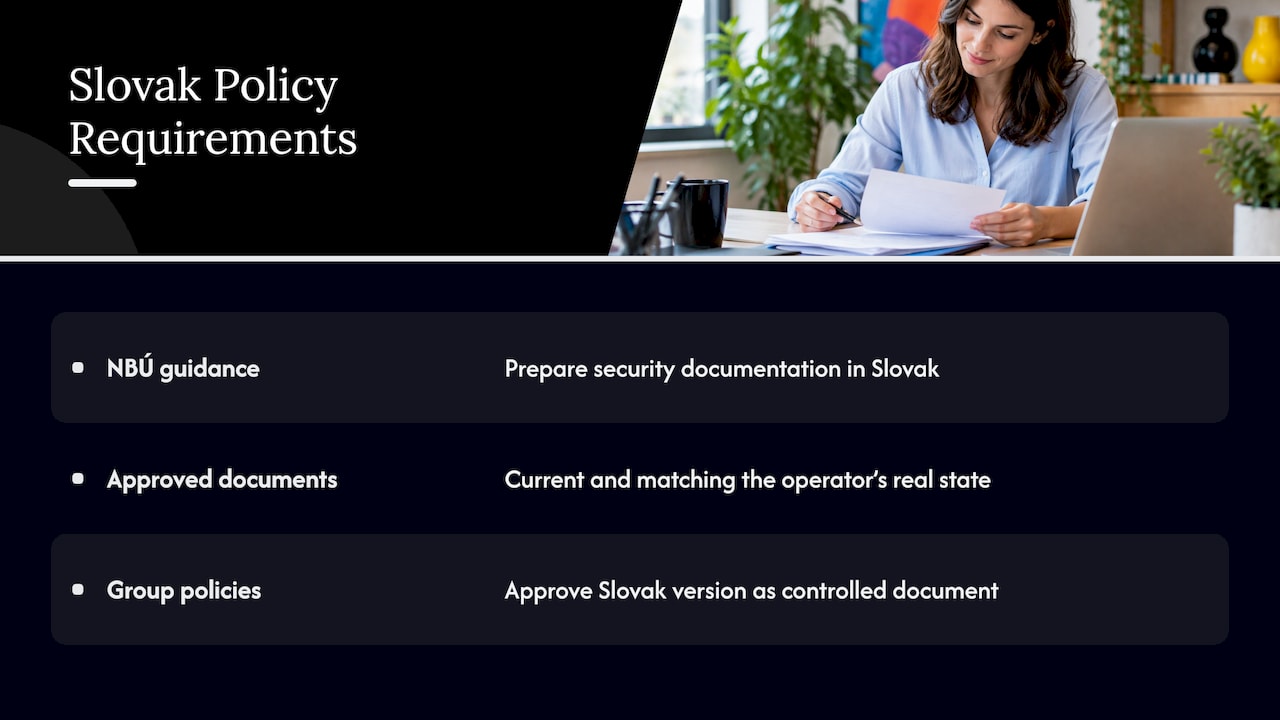
Short answer: for Slovak operators, plan on Slovak. NBÚ guidance says it is desirable for operators of essential services to prepare security documentation in Slovak. Think of the Slovak text as the working version, the one your people, your auditor and the authority will actually use.
The same guidance sits alongside a practical rule from the Cybersecurity Act. Under § 20(6) of Act No. 69/2018 Coll., security measures rest on approved documentation that is current and matches the operator’s real state. A beautiful translation of a policy nobody follows doesn’t help. A translation that differs from the English group policy in a way nobody noticed doesn’t help either.
If your group writes policies in English first, that’s fine. Treat the Slovak version as a controlled document with its own approval, not as a courtesy copy.
Which laws should the translator know about?
Your policies will cite legislation, and the citations have to be right. The NBÚ legislation overview lists the current national framework:
| Instrument | What it covers |
|---|---|
| Act No. 69/2018 Coll. | The Cybersecurity Act |
| Decree 227/2025 Coll. | Security measures |
| Decree 226/2025 Coll. | Reports |
| Decree 493/2022 Coll. | Cybersecurity audit |
| Decree 492/2022 Coll. | Knowledge standards |
| Directive (EU) 2022/2555 | NIS 2 |
| Regulation (EU) 2024/2847 | Cyber Resilience Act |
According to the ICLG report on cybersecurity law in Slovakia, the Cybersecurity Act transposes NIS2 into Slovak law, and EU law takes precedence over national law. Financial entities may also fall under DORA, and products with digital components under the Cyber Resilience Act.
What does that mean for a translator? Two things:
- Cite the exact act, number, year and provision, and check the current version. NBÚ’s own guidance on the Cyber Resilience Act tells readers to use EUR-Lex and check the current text before relying on a provision.
- Use official Slovak titles of EU acts, not a fresh translation of the English name. Don’t invent a Slovak title if one exists in the Official Journal.
Want a deeper look at legal wording? Our guide to translating laws for Slovakia covers what is actually legally valid. For a wider compliance picture on the IT side, these cybersecurity compliance basics are a handy companion.
How do you keep terminology and acronyms consistent?
This is where most policy translations go wrong. Cybersecurity has a lot of near-synonyms, and a policy can’t afford them. “Control”, “measure” and “safeguard” may all be the same word in English and three different concepts in Slovak.
Start from the standards. The Slovak Office of Standards, Metrology and Testing published the official Slovak translation of STN ISO/IEC 27001:2022, and it has the same status as the official versions. If your policies follow ISO 27001, that text is your terminology anchor. Use its Slovak wording instead of improvising.
Then build a glossary before the first page is translated:
- Legal terms: follow the Slovak wording of the Cybersecurity Act and the NBÚ decrees.
- Standard terms: follow the Slovak edition of the standard.
- Acronyms: decide once whether SIEM, SOC, MFA and the like stay in English, get a Slovak expansion on first use, or both. Then stick to it.
- Defined terms: if your English policy defines “Security Incident”, the Slovak definition must say the same thing, every time the term appears.
- Do-not-translate list: product names, tool names, internal system names.
A glossary made upfront costs an hour. One made after an inconsistent audit costs a lot more.
A review process that catches errors
Translation alone is one pair of eyes. A policy needs three kinds of check:
- Translation and editing. A linguist with cybersecurity experience translates, and a second linguist edits against the source.
- Cybersecurity expert review. Someone who knows your environment reads the Slovak text and asks: does this still say what we actually do? Is the responsible role correct? Do the technical terms mean what the standard says?
- Legal review. Someone checks references to the Act, the decrees and EU instruments, and confirms that obligations (“must”, “may”, “is prohibited”) keep their strength.
Why bother with the second and third? Because documentation gets read by auditors. Decree 493/2022 Coll. on cybersecurity audit requires the auditor to review the security documentation and evaluate the security measures, and the self-assessment route includes the same documentation review. If the Slovak policy says something different from your practice, that gap is exactly what they’ll find.
A quick tip on modal verbs: “should” and “must” are not the same, and Slovak (“má”, “musí”, “je povinný”) makes the difference very clear. Agree on a mapping early.
Perspective
We see the same pattern again and again: the policy is excellent in English, and the Slovak version gets treated as an afterthought. That’s backwards! In a regulated setting, the Slovak text is often the one that gets read, signed and audited.
So we put specialist teams on compliance-sensitive content, with subject knowledge and an eye for wording that carries legal weight. We keep terminology in one controlled glossary, and we flag every place where the source is ambiguous before it turns into a Slovak ambiguity. Our approach pairs modern technology with proven localisation practice: tools handle consistency, people handle meaning.
Our advice? Treat translation as part of your compliance process, not a step after it. The earlier your translator sees the policy structure, the fewer surprises later.
glocco®
Sector notes: finance, pharma, defence, tech and e-commerce
The core rules are the same, but the accents differ:
- Finance: ICLG points to DORA as directly applicable EU legislation for financial entities. Your policies may mix NIS2-style and DORA vocabulary, so the glossary needs to cover both.
- Pharma and healthcare: these sit among the sectors listed under the Slovak Cybersecurity Act, according to the NIS Solutions country overview. Policies often overlap with quality and data protection documents, so keep terms aligned across them.
- Defence: document handling and export-control rules add another layer. Our guide to ITAR document translation and the defence software localisation playbook go into it.
- Technology and software: if you ship products with digital components, the Cyber Resilience Act matters. Product-facing text, such as safety notices, should echo your internal policy wording.
- E-commerce: supplier and customer-facing security statements tend to be public. Keep them consistent with the internal policy, word for word where it counts.
One more caution: national guidance may refer to European rules that Member States implement or interpret differently. If you run policies across several countries, don’t assume a Slovak phrase carries over to a neighbouring market unchanged. Responsibility under the Act stays with the company and its directors, so the final wording is yours to approve.
Versions, approvals and updates
Policies live. Laws change, systems change, people change. So the translation needs a life cycle too.
Practitioners note that Decree 227/2025 works with the idea of approved documents, meaning a signature from a specific responsible person. They also recommend that each document carries the approval date, approver’s name and function, version, change history and next review date. Put those fields into the Slovak version as well, not only the English one.
A simple routine:
- Change the source policy and approve it.
- Send only the changed segments for translation, using a translation memory so unchanged text stays identical.
- Run expert and legal review on the changes.
- Get the Slovak version approved and signed by the responsible person.
- Archive both versions with matching version numbers.
When audit or registration dates come up, check the official NBÚ pages for the current cycle instead of relying on a summary. For audit-focused document packs, our piece on audit-ready security protocol translation may help, and our overview of secure translation explains how confidential material should travel during the work.
How glocco® can help
We translate and localise legal, technical and sector-specific content for companies in regulated and international industries, across 76 languages. For policy documents, our HumanLegal service is a natural starting point. Tell us your documents, your sector and your audit timeline, and we’ll shape a workflow around them. Prices are project-based, so we quote after seeing the material.
FAQ
Do we need to translate our cybersecurity policies into Slovak?
If you are an operator of essential services in Slovakia, NBÚ guidance says it is desirable to prepare the security documentation in Slovak. Even where it is not strictly required, a Slovak version helps staff, auditors and the authority. Check your own obligations with your legal adviser.
Who should review a translated policy?
Three people ideally: a linguist who edits the translation, a cybersecurity expert who knows your environment, and a lawyer who checks references to the Act, the decrees and EU acts. Each catches a different kind of error.
Should acronyms like SIEM or MFA be translated?
That depends on your readers, but be consistent. Many organisations keep the English acronym and add a Slovak explanation on first use. Record the decision in your glossary so every document follows it.
How do we keep translated policies up to date?
Tie translation to your change process. When the source policy is updated and approved, translate only the changes, review them, and approve the Slovak version with its own date, version number and approver.
Sources
- Decree 227/2025 Coll. (Zbierka zákonov)
- NBÚ guidance on the language of security documentation
- NBÚ legislation overview
- NBÚ Cyber Resilience Act legal acts and resources
- ICLG: Cybersecurity Laws and Regulations 2026, Slovakia
- STN ISO/IEC 27001:2022, official Slovak translation
- Decree 493/2022 Coll. on cybersecurity audit
- Cyllium: security documentation under Decree 227/2025
- NIS Solutions: NIS2 in Slovakia
- LYNX: NIS 2 in Slovakia and the EU
- Cybersecurity compliance basics


