


Here is the surprising bit: eIDAS does not require you to translate anything. The regulation sets the rules for electronic identification and trust services across the EU. It says nothing like “every signed document must be translated”. The translation requirement comes from somewhere else: Slovak language law, court and authority rules, and the contract itself. This guide shows you where each requirement comes from, so you only translate what you must.
What eIDAS regulates (and what it leaves alone)
Regulation (EU) No 910/2014 covers the mutual recognition of electronic identification between Member States. It also sets out rules for trust services and a legal framework for electronic signatures, seals, time stamps, electronic documents, registered delivery and website authentication. The European Commission describes it as a single framework for eID and trust services across the EU, built to make electronic interactions between businesses in different countries safer and more efficient.
The key point for translation: the regulation expressly does not affect national or Union law on the conclusion and validity of contracts or other form-related legal or procedural obligations. The sources we reviewed state no general duty to translate signatures, certificates or documents just because they fall under eIDAS.
So the question is never “is this an eIDAS document?”. It is “which authority or counterparty will read it, and in which language must they read it?”
The three signature levels in plain words
The legal effect of a signature depends on its level. Under Article 25, an electronic signature cannot be denied legal effect or admissibility in court just because it is electronic or because it is not a qualified signature. A qualified electronic signature (QES) goes further: it has the same legal effect as a handwritten signature.
| Level | What it needs | Legal effect |
|---|---|---|
| Simple | Data in electronic form used to sign | Cannot be rejected only for being electronic |
| Advanced | Uniquely linked to the signatory, identifies them, created under their sole control, detects later changes (Article 26) | Same non-rejection principle, stronger evidence |
| Qualified | Advanced requirements plus a qualified certificate and a qualified creation device | Equivalent to a handwritten signature |
The Commission also notes that the principle of legal effect applies regardless of the technical format of the signature or seal.
Heads-up: none of this changes with the language of the document. A QES on a contract in German is just as qualified as one on a contract in Slovak. The language only matters when someone has to read it.
What a qualified certificate must contain
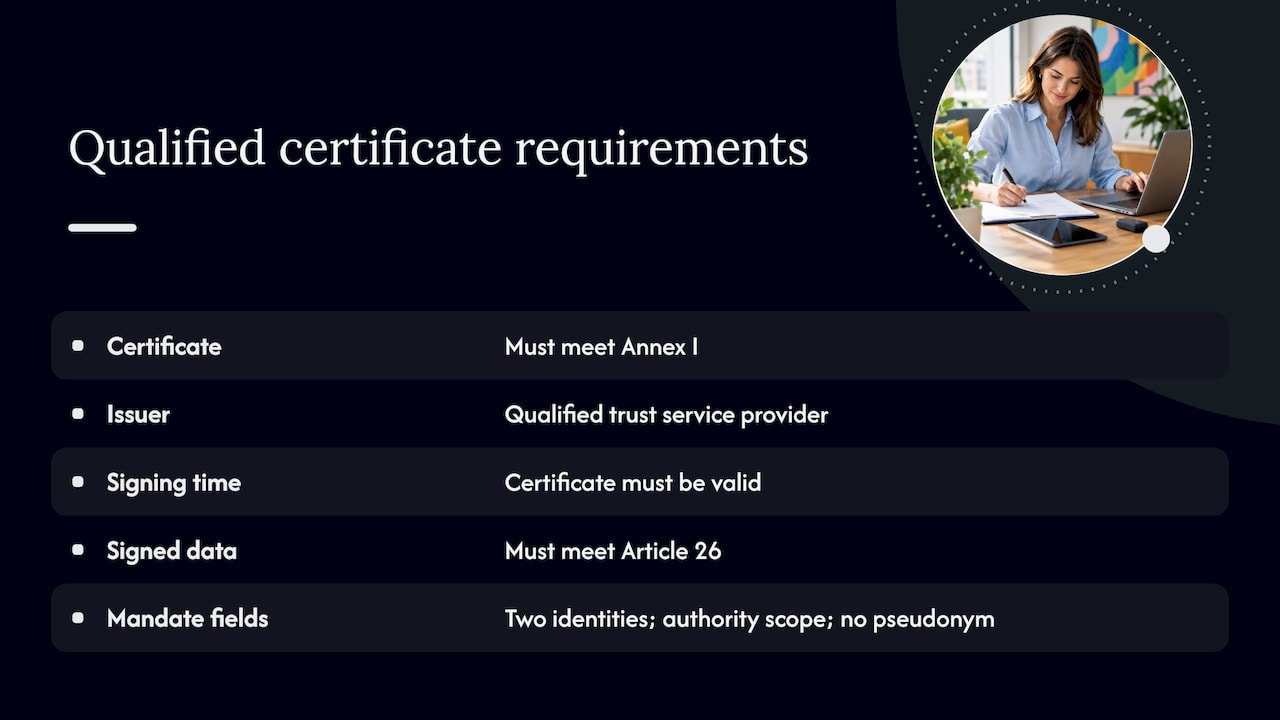
A qualified certificate for electronic signatures has to meet Annex I, and Member States may not impose mandatory requirements beyond Annex I. To validate a QES under Article 32, the certificate must have complied with Annex I and been issued by a qualified trust service provider. It must also have been valid at the time of signing, and the signed data must meet the Article 26 conditions, as the Slovak-language text of the regulation confirms.
Slovakia adds its own wrinkle in Act No. 272/2016 Coll. on trust services. It defines a mandate certificate: a qualified certificate issued to a person acting on behalf of another person or a public authority. It must show the identity of both the mandatary and the principal, plus the scope of authority, and it cannot carry a pseudonym.
Why does this matter for language work? When a Slovak mandate certificate or a validation report goes to a foreign counterparty, the technical fields stay as they are. What gets translated is the explanatory cover: who signed, in what capacity, and what the validation result means.
Cross-border recognition: the limits
Good news for anyone doing business across borders. A qualified signature based on a qualified certificate issued in one Member State must be recognised as a qualified signature in all other Member States (Article 25(3)). The Slovak Ministry of Justice points out that a QES and a qualified time stamp are valid across EU states, in communication between legal entities and with public authorities.
Two limits to remember:
- For public-sector online services, a cross-border user cannot be asked for a signature of a higher security level than qualified (Article 27(3)).
- Recognition of the signature is not recognition of the contract’s form or validity. That stays national. If you sign a cross-border deal, the question of which law governs it is a separate one, and guidance on determining the law applicable to an international contract is a good companion read.
And a question we hear a lot: is an e-signed contract binding at all? In short, yes, within the limits above. For a worked example of how e-signing and legal bindingness play out in practice, see this piece on the legal effect of e-signed agreements.
Where translation requirements really come from in Slovakia
Now the part that actually decides your workload. Under Section 3 of Act No. 270/1995 Coll., public authorities use the state language in official dealings. A natural or legal person does the same unless a law, special regulation or international treaty says otherwise. The same section says authorities and legal entities use the state language in information systems too, with other languages allowed where a special regulation provides.
In practice, translation is triggered by:
- The receiving authority. A Slovak court, registry or office expects Slovak. Our guide to court filings: what to translate and who can sign it goes into the detail.
- The legal text. If you need a statute or regulation rendered, read what is legally valid in translated laws first.
- The contract. Many cross-border agreements name a governing language. That is a business decision, not an eIDAS one.
- Judicial cooperation. A Slovak judicial authority sending a request abroad must, unless a law or treaty says otherwise, arrange translation into the official language of the requested state.
Submitting a translation electronically
Here eIDAS and translation finally meet. The Ministry of Justice says that when a written translation is submitted electronically, each copy should carry a qualified electronic signature and a qualified electronic time stamp. A translation made this way is equivalent to a paper one. The reason: a duplicate of a written translation must be kept for 10 years. The ministry also notes that a qualified time stamp creates a presumption of the accuracy of the date and time and the integrity of the data.
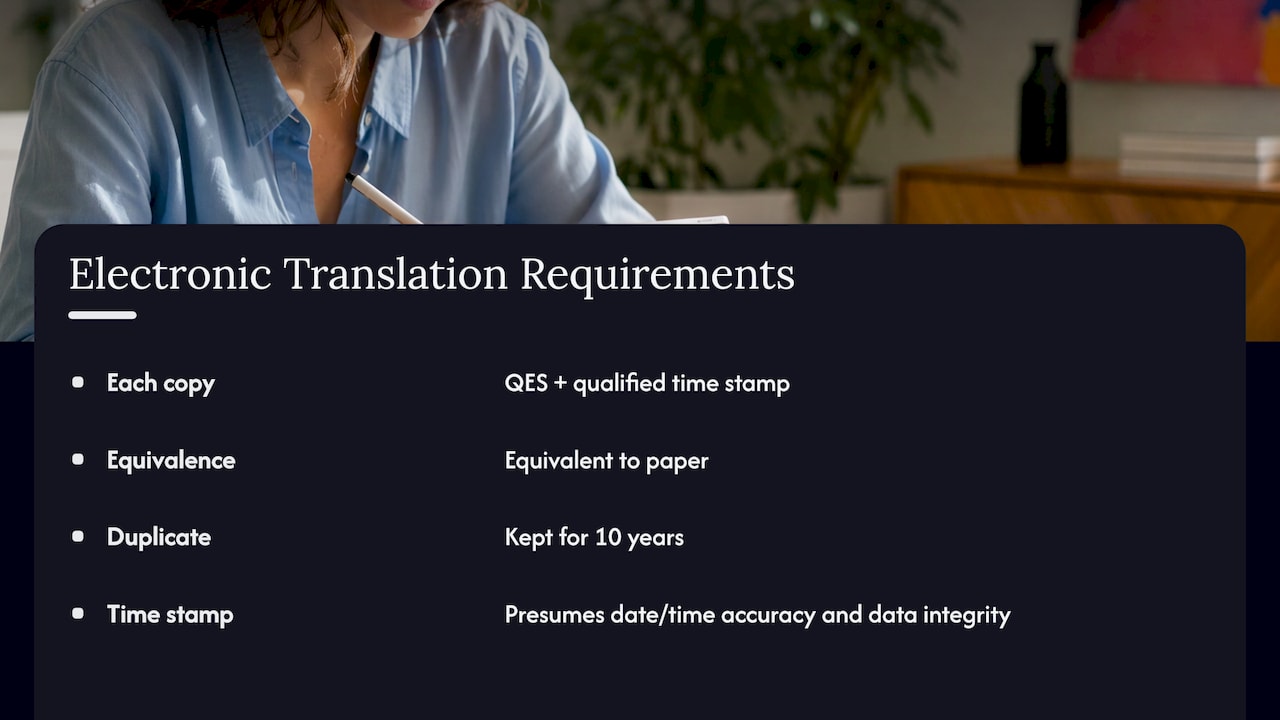
So a signed PDF is not enough on its own. The translator’s QES and the qualified time stamp are what make the file stand up later.
A quick pre-flight checklist
Before you rely on a translated or e-signed document in a Slovak process, check:
- Who is the recipient, and does a rule require Slovak?
- Is the signature qualified, and was the certificate valid at signing?
- Does the translation carry the translator’s QES and a qualified time stamp if filed electronically?
- Does the contract name a governing language and law?
- Is the document sensitive (NDA, regulated)? See our note on NDA translation in Slovakia.
- Do you know the budget? Our legal translation pricing page explains how it is built.
Our perspective
Most eIDAS translation questions we get start with a worry: “Do we have to translate the whole trust chain?” Usually no! The regulation protects the signature, not the language. What needs care is the human layer around it: the contract wording, the signatory’s capacity, the validation note.
That is where we put people first. Our legal workflows pair specialist linguists with careful review, because one misread term in a mandate or a power of attorney can undo a signature’s good work. We combine modern technology with proven localisation practice, so the speed is there and the legal precision stays.
Our advice: map each document to its recipient first, then translate only what that recipient must read. It saves money and avoids surprises.
glocco®
Need a legal translation you can file?
If your documents are heading to a Slovak or EU authority, our HumanLegal service is built for exactly this: contracts, certificates and official papers handled by legal specialists. Want to see how we keep quality tight? Read our tips on legal translation quality in the EU, or tell us about your project at glocco.com.
FAQ
Does eIDAS require me to translate an electronic signature?
No. The regulation sets no general duty to translate signatures, certificates or documents. It leaves national rules on form and validity untouched. Translation is required only when the receiving authority, a law or your contract says so.
Is a qualified electronic signature valid in other EU countries?
Yes. A qualified signature based on a certificate issued in one Member State must be recognised as qualified in all the others (Article 25(3)). The signature is recognised, but the national rules on contract form still apply.
How should a translator file a translation electronically in Slovakia?
The Ministry of Justice recommends that each copy is signed with a qualified electronic signature and carries a qualified electronic time stamp. That makes it equivalent to a paper translation.
Can a document be rejected just because it is electronic?
Not under eIDAS. An electronic signature cannot be denied legal effect or admissibility in court only because it is electronic or not qualified. A qualified signature simply carries the strongest effect.
Sources
- Regulation (EU) No 910/2014 (eIDAS), EUR-Lex
- Regulation (EU) No 910/2014, English consolidated text, EUR-Lex
- Nariadenie (EÚ) č. 910/2014, Slovak text, EUR-Lex
- European Commission: eIDAS, electronic identification and trust services
- European Commission: Q&A on trust services under the European Digital Identity Regulation
- Ministry of Justice of the Slovak Republic: translation submitted electronically
- Section 3 of Act No. 270/1995 Coll.
- Section 58f of Act No. 97/1963 Coll.
- Act No. 272/2016 Coll. on trust services


