


Under the MDR and IVDR you must supply instructions for use in the Member State’s required language, or languages, full stop. Start by checking the European Commission’s language table for every country where your device lands on shelves, then lock each translation into your quality management system with a unique identifier. MDR Article 10 and MDCG guidance back this up, and a proper workflow (ours runs in five stages) keeps you out of trouble.
What the MDR and IVDR require for IFU languages
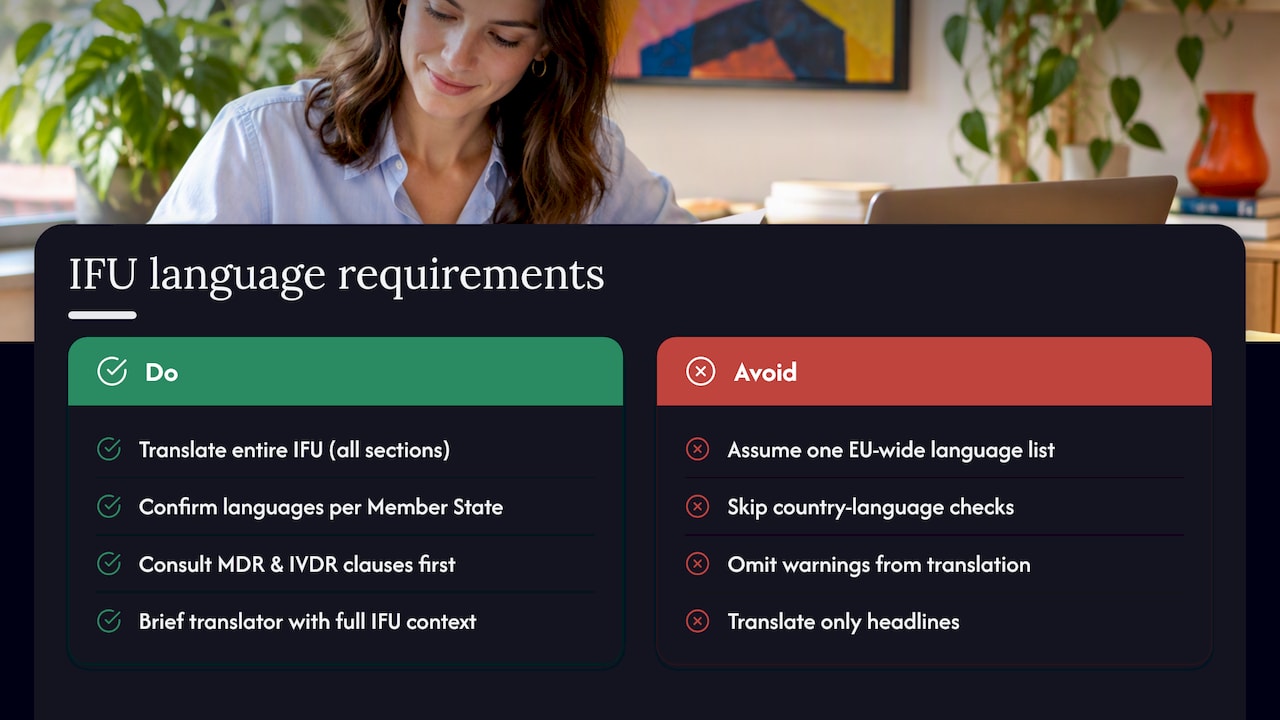
Regulation (EU) 2017/745 sets this out plainly: manufacturers must make the information needed for safe, intended use available in the official language, or languages, decided by whichever Member State the device reaches a user or patient in. That’s Article 10, and the IVDR mirrors it for in vitro diagnostics. It’s not a suggestion.
This covers the whole instructions for use document, not just the headline bits. Indications, contraindications, warnings, storage conditions, cleaning steps, troubleshooting tables, all of it sits inside the scope. Miss a warning in translation and you’ve got a safety problem, not just a paperwork one.
Here’s the bit people trip over: the regulation doesn’t hand you one single EU-wide language list. It tells you to check per country. So before you brief a translator or start formatting a new IFU, go straight to the source texts (both MDR and IVDR link out to the exact clauses) and confirm what’s actually required for the specific Member States on your distribution list. Skipping this step is how projects end up redone twice.
How national language tables shape your IFU requirements
Each Member State decides its own language rules, and the European Commission publishes country tables that lay out what’s expected for labelling, IFUs and GUI elements. No two countries read identically, so treat the table as your starting reference, not background reading.
A pattern worth knowing: some Member States allow English for professional-use devices under specific conditions, which can genuinely cut your translation workload. But “some” and “under conditions” are doing a lot of work in that sentence, so don’t assume it applies to your device without checking.
Practical steps that save you grief later:
- Pull the current country table for every target market before you scope the project.
- Note any conditional acceptance of English and what triggers it (professional-only use, specific device classes).
- Keep a dated screenshot or PDF of the table you consulted, filed against the project.
- When a rule looks ambiguous, get written confirmation from the national competent authority rather than guessing.
A five-stage workflow that keeps IFU translation audit ready
We run every regulated IFU through five stages, and honestly, skipping any one of them is where projects go sideways.
- Source QA and scoping: we check the source IFU for clarity, consistency and completeness before translation even starts, and flag ambiguous phrasing back to you.
- Terminology and translation memory setup: we build (or update) a glossary and TM so your device’s terms stay identical across every language and every future revision.
- Specialist medical translation: a translator with genuine medical device experience does the actual translation, never a generalist.
- Clinical and regulatory review: a subject-matter reviewer checks meaning, not just grammar, and flags anything that reads unclear to a user.
- Final QA, DTP and sign-off: we lay the text back into its packaging or booklet format, run a last proofread against the layout, and issue signed approval files.
Each stage leaves you something concrete: a glossary, a TM export, reviewer comments, a signed sign-off sheet, and final packaging-ready files. That paper trail is what an auditor wants to see.
Pro Tip: Lock your source IFU format and terminology before translation starts. Changing either mid-project is the single biggest cause of rework we see.
Should you translate the GUI, or just explain the icon?
The rule of thumb: anything safe-use-critical gets translated, full stop. If a warning, dosage instruction or troubleshooting step appears on a device screen, that text needs the same language treatment as the printed IFU, as explained in our guide to localize TypeScript language files.
Icons are a different story. A well-chosen, standard symbol can sometimes stand in for text, but only when the IFU itself explains what it means. The European Commission’s guidance treats GUI elements tied to performance or safety the same way it treats IFU text, and MDCG 2018-7 echoes that for UDI-related fields too.
For your documentation, log every screenshot used in the IFU, note which strings were translated and which relied on a standard symbol, and keep that decision trail inside your DTP files so a reviewer can follow your reasoning later.
Keeping your QMS audit ready: traceability for every translated IFU
Every translated IFU is a controlled document, not a one-off file sitting in someone’s inbox. Give it a unique identifier, a revision history, and a clear link back to the master source document, because that’s what an auditor will ask for first.
The must-haves for your technical file:
- A unique document ID and version number for each language variant.
- Signed reviewer approvals for every stage of the workflow.
- Change logs showing what altered between revisions and why.
- Glossary and translation memory exports tied to the project.
- Final approved files in the exact format used for market placement.
A controlled, auditable translation record is one of the most reliable ways to satisfy MDR traceability expectations, and it saves you scrambling when a notified body asks for evidence months after launch.
How long IFU translation takes and what drives the cost
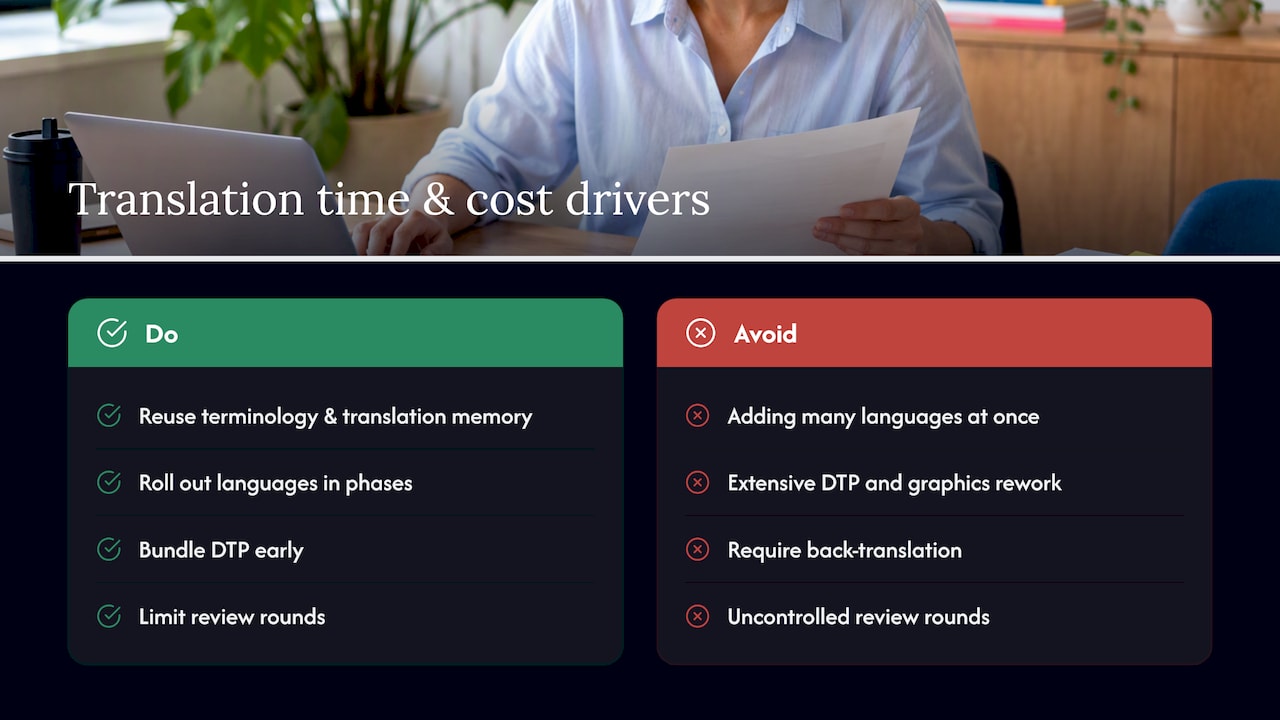
A single-language IFU for a simple device can turn around fairly quickly. Add ten languages, dense graphics and a back-translation requirement, and the timeline stretches considerably, often with regulatory review cycles adding the biggest chunk of time.
The main cost drivers are predictable: how many languages, how much DTP and graphics rework, whether back-translation is required, and how many review rounds your regulatory team needs. The good news? Reusing terminology and translation memory across languages and revisions, plus rolling out languages in phases rather than all at once, cuts both cost and risk without touching compliance.
Your pre-market checklist before the translated IFU goes live
Before anything ships, work through this in order:
- Confirm the exact language requirement for every target Member State and keep dated evidence of the check.
- Complete every workflow artefact (glossary, TM, reviewer sign-off) for each language.
- Run a DTP check against the final packaging or booklet layout.
- Get formal sign-off from your regulatory affairs contact.
- Link the translation record into your QMS against the device’s technical file.
- Check labelling and any EUDAMED or UDI free-text fields align with the translated IFU.
Red flags that tend to trigger regulator queries: missing revision history, an IFU language that doesn’t match the national table, or GUI text left untranslated when it affects safe use. Loop in regulatory affairs, your QA lead and whoever manages your technical file early, not after the translation’s already done.
Why we’d rather slow down than ship a risky shortcut
Speed is tempting, cheap is tempting, but a rushed IFU translation is how warnings get lost in the shuffle. We’ve chosen projects where English GUI text plus a fully localised printed IFU satisfied the national table, because that balance kept safety intact without inflating the budget. When you’re not sure which route fits your device, talk to a specialist before you guess.
How we support regulatory-ready IFU translation
We build IFU translation around the workflow above, not around shortcuts. Our HumanLegal service handles the regulatory and legally sensitive layers of your documentation, while HumanPro covers technical and medical content that needs genuine domain expertise, and HumanAI speeds up large-volume work without cutting the human review step.
Every project gets terminology management, a clear audit trail, and sign-off artefacts you can drop straight into your technical file. If you’d like a compliance-focused quote or a quick audit of your current IFU process, get in touch with our team and we’ll talk you through what fits your device and your target markets.
This article is general information, not a substitute for advice from a qualified doctor. Consult a qualified healthcare professional about your own circumstances before acting on anything here.
FAQ
What languages must an IFU be translated into under the MDR?
The MDR requires IFUs in the official language, or languages, set by each Member State where the device reaches users or patients. You check this per country using the Commission’s language table rather than assuming one list covers the whole EU.
Can we use English instead of the local language for an IFU?
Some Member States allow English for professional-use devices under specific conditions, as noted in the Commission’s language overview. This varies by country and device type, so always confirm the exact conditions before relying on it.
Does GUI text on a medical device need translating too?
Yes, when that text affects safe or intended use, GUI elements follow the same language rules as the printed IFU. MDCG 2018-7 treats safety-linked GUI content similarly to IFU text, particularly around UDI-related fields.
What records do we need to keep for a translated IFU?
Each translated IFU should sit in your QMS as a controlled document with a unique identifier, revision history and signed reviewer approvals. These records, along with glossary and translation memory exports, are what a notified body typically asks for during an audit.
How does glocco® handle regulatory IFU translation projects?
We run translations through a five-stage workflow covering source QA, terminology setup, specialist medical translation, regulatory review and final sign-off, using services such as HumanLegal and HumanPro depending on the content. Every stage leaves an audit trail you can file against your technical documentation.
Sources
- Regulation (EU) 2017/745 (MDR)
- Overview of language requirements for manufacturers of medical devices (European Commission)


