


Right, let’s get straight to it. If you’re producing medical videos, here’s your checklist: synchronised, edited captions, a clean transcript, and if the visuals show something the words alone can’t explain, an audio description too. None of this works without subject-matter expert review and two human checks on every file. Skip that step and you’re not just risking a compliance headache, you’re risking patient safety.
Standards and compliance every producer must meet
Accessibility for medical video isn’t a nice-to-have; understanding web accessibility’s role in boosting inclusion and SEO impact helps ensure your content reaches and serves everyone effectively. It’s a legal and clinical expectation, and the rules are pretty specific.
WCAG 2.2 requires synchronised captions for every prerecorded video. Captions must match the timing of speech, be accurate, and cover the full content, including non-speech cues like alarms or coughing, plus speaker identification when more than one person is talking. Miss any of that and you fail the standard.
In the EU, Directive (EU) 2019/882 sets accessibility obligations for digital products and services, and health content sits squarely inside its scope. Add WHO telehealth guidance recommending short video chunks, captions, transcripts, and audio descriptions wherever visuals carry essential clinical meaning, and you’ve got three separate reasons to get this right.
Here’s why it matters beyond ticking boxes:
- A wrong caption on a dosage instruction isn’t a typo, it’s a clinical risk.
- Missing speaker IDs confuse patients trying to follow multi-clinician consultations.
- Skipping non-speech cues can hide safety-critical audio, like a monitor alarm.
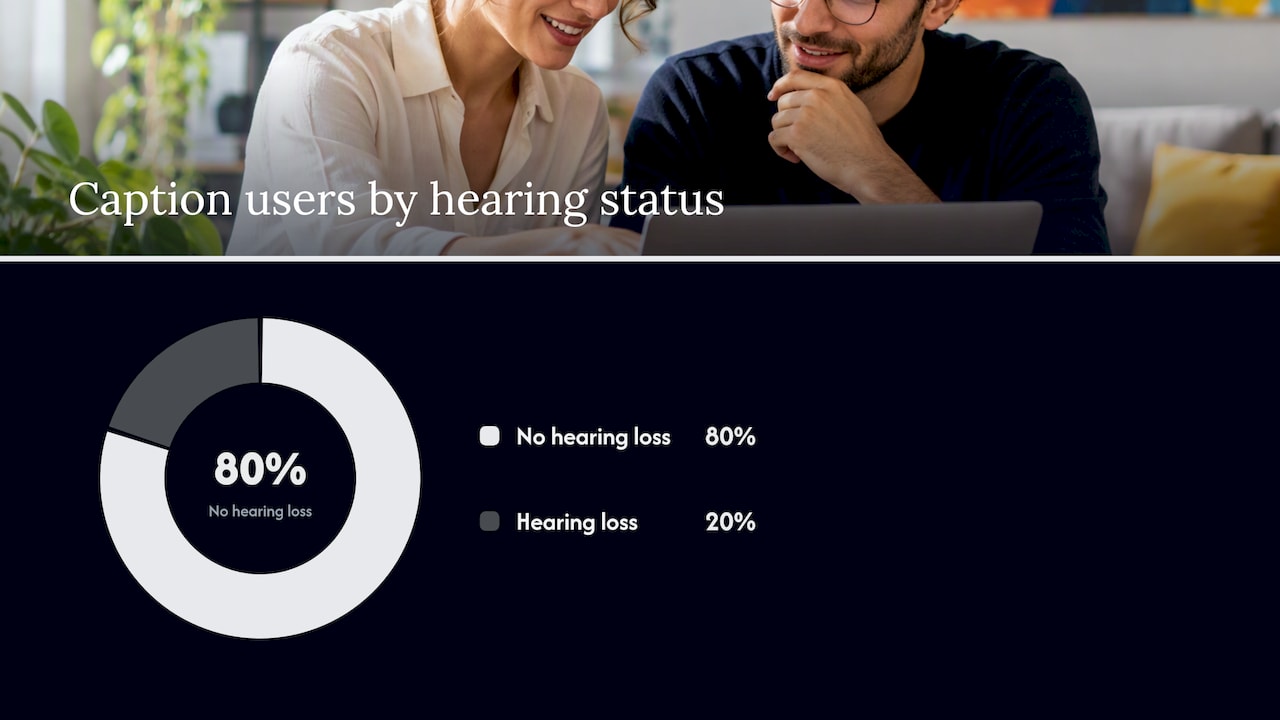
80% of caption users don’t have a hearing disability, which means captions boost comprehension for almost everyone watching, not just those who need them.
How do you turn raw footage into audit-ready captions?
Here’s the workflow that actually works, step by step:
- Plan before you film. Cut unnecessary background music, request scripts or slides in advance, and ask speakers to say their name and role on camera.
- Run an initial ASR pass. Automatic speech recognition gives you a fast verbatim draft, but treat it as a starting point, never a final product.
- Time-code and edit by hand. A human editor checks every line against the audio, fixes errors, and syncs the timing properly.
- Bring in subject-matter experts for translation. Medical terminology needs a specialist, not a generalist, and a maintained glossary keeps terms consistent across every future video.
- Style for readability. Keep lines short, place captions where they don’t block key visuals, and label speakers clearly.
- Package your deliverables. You want an .srt or .vtt file, an editable transcript, a burned-in version if requested, and an audio-described file when the visuals carry information words can’t cover.
Pro Tip: Never publish auto-generated captions straight out of an ASR tool. Always run them past a human editor first, even if the audio sounds clean.
Accessibility guidance from UCSF makes the same point: build captioning into your production schedule from day one, not as an afterthought bolted on after the edit is locked.
Quality assurance, timing and cost drivers
Here’s the bit people get wrong most often: they budget for transcription and translation but forget QA takes real time too.
Practical guidance on medical video production notes that QA and timing adjustments frequently take longer than clients expect, especially with fast-paced surgical or procedural footage where every second of dialogue matters.
What actually drives your cost and timeline:
- Specialist rates. SME-reviewed medical translation costs more than general translation, and it should.
- Turnaround pressure. A 48-hour rush job costs more than a two-week schedule.
- Speaker count. More voices mean more identification work and more QA passes.
- Burn-in versus soft captions. Burned-in captions need a re-render if you spot an error late; soft captions (.srt/.vtt) are easier to fix.
- Multiple languages. Every additional language means another SME review, not just a translation swap.
When you’re comparing quotes, ask for a sample caption on a short clip, a clear list of QA checkpoints, how the vendor handles confidentiality and GDPR, and how many revision rounds are included before you’re charged extra.
Tools, AI and human balance: when to trust the machine
Domain-adapted speech recognition has come a long way, but it’s not the finish line. It’s the first draft.
Use it to speed up transcription, then always follow with human post-editing, particularly on diagnoses, dosages, and drug names. These are exactly the words a generic model gets wrong, and getting them wrong on screen is not a minor slip.
A few practical safeguards worth building in:
- Maintain a glossary of approved medical terms and drug names before transcription starts.
- Set confidence thresholds in your ASR tool and flag anything below the line for mandatory SME review.
- Route every low-confidence segment through a human check, no exceptions.
Pro Tip: If your footage has poor audio, several speakers talking over each other, a fast-paced procedure, or numbers that matter (doses, measurements, timings), skip ASR shortcuts and go straight to human transcription.
Research into biomedical video understanding backs this up. PMC-Vid, a large-scale biomedical captioning dataset, shows that general vision-language models still struggle with specialised medical content. Translation: don’t assume off-the-shelf AI understands your subject matter.
Where does glocco® fit into this workflow?
We’ve been doing this since 2014, and our process maps pretty neatly onto everything above. Our five-step clinical study translation process exists specifically to stop trial documentation and video content getting rejected on compliance grounds, which is a real risk when medical terminology goes wrong.
On the QA side, we run two human reviews to make captions audit ready, which is exactly the safeguard we talked about earlier when covering low-confidence ASR segments. One reviewer checks accuracy against the source, the second checks terminology and clinical sense. That’s the SME layer in action, not a theoretical add-on.
Compliance with HIPAA and patient confidentiality
If your video features real patients, real case footage, or identifiable clinical details, confidentiality isn’t optional; it’s the whole game.

HIPAA governs protected health information in the US, and while it doesn’t apply directly outside that jurisdiction, the underlying principle, that patient identity and clinical detail must stay protected, holds everywhere. In the EU, GDPR does the equivalent job, and any subtitling vendor handling footage with identifiable patients needs a clear data-handling agreement before a single frame gets transcribed.
Practically, that means:
- Footage and transcripts should move through encrypted channels, not email attachments.
- Anyone touching the content, transcriber, translator, SME reviewer, should be under a signed confidentiality agreement.
- Where footage shows real patients, check consent status before it ever reaches a subtitling team.
- Ask your vendor how long they retain files, and when they delete them.
None of this is exotic. It’s the same discipline you’d expect from any handler of sensitive health data, applied to a video file instead of a paper chart. If your vendor can’t answer these questions clearly, that’s your answer about whether to work with them.
Quality assurance metrics and common errors in medical captions
The errors that show up most often in medical video captions aren’t random typos, they’re patterns, and once you know them, you can catch them.
The usual suspects:
- Drug name mangling. Similar-sounding medications get swapped, and spellcheck won’t catch it.
- Dosage and unit slips. “Milligrams” becoming “millilitres”, or a decimal point landing in the wrong place.
- Missing non-speech cues. A monitor alarm or a patient’s cough gets left out, losing clinical context.
- Timing drift. Captions that start a beat late during fast, jargon-heavy dialogue.
- Inconsistent terminology. The same condition named two different ways across one video.
Good QA catches these with a structured check, not a quick read-through. That means a second reviewer working from the source audio, not just proofreading the caption file, and a terminology check against your glossary before sign-off. It’s slower than a single pass, but it’s the difference between a caption file you can publish and one you’ll be reworking after a complaint.
Practical dos and don’ts from a localisation provider
Don’t publish raw ASR output. Don’t let captions block a surgeon’s hands mid-procedure. Don’t skip SME review to save a day.
Do send scripts or slides ahead of filming. Do insist on a glossary before translation starts. Do budget for two human review passes, not one.
We’ve seen trial footage nearly get flagged for a single mistranslated dosage term. One SME catch fixed it before it ever reached a reviewer.
— glocco®
How glocco® can help
Right, here’s where we come in. We provide video subtitling, video translation, and clinical trial translation workflows designed to keep terminology consistent, supported by SME review and multiple human checks.
- Tell us your deliverables: .srt, .vtt, burned-in, or audio-described.
- Tell us your turnaround window, so we can flag if it needs a rush rate.
- Tell us where SME review is non-negotiable (dosages, drug names, procedural steps).
- Tell us how you need confidentiality handled, especially with identifiable patient footage.
Get in touch through our video subtitling services page, or head to our video localisation hub to see the full range of what we do with medical and clinical video content.
This article is general information, not a substitute for advice from a qualified doctor. Consult a qualified healthcare professional about your own circumstances before acting on anything here.
Sources
- Video – Web Guide
- 3 Essential Tips for Creating Accessible, Usable Health Videos
- Directive (EU) 2019/882
- After your event: Captioning and Audio Describing Videos | Disability Resource Center
FAQ
What deliverables should I request for a medical video?
You need synchronised, edited captions, a clean transcript, and an audio-described version when visuals carry clinical meaning the audio doesn’t cover. All of it should pass through SME review and at least two human checks before publication.
Are AI-generated captions accurate enough for medical content?
Domain-adapted speech recognition speeds up the first draft, but it isn’t reliable enough alone for medical content, particularly around drug names, dosages, and numeric detail. Always follow it with a human edit and SME review before publishing.
How long does medical video captioning usually take?
Timing depends on speaker count, footage quality, and how many languages you need, but QA and timing adjustments typically take longer than clients expect, especially for fast-paced procedural content. Build in extra review time rather than assuming a single pass will do.
Does WCAG apply to medical training videos?
Yes. WCAG 2.2 requires synchronised, accurate captions for any prerecorded video, including non-speech cues and speaker identification, and that applies to medical training and patient-facing content alike.
Can glocco® help with clinical trial video translation?
Yes, glocco® runs a five-step clinical study translation process built specifically to keep trial terminology consistent and avoid compliance rejections, paired with two human review passes for audit-ready output.


