


A one-day, two-language conference with booth simultaneous interpreting typically runs from around €1,500 to €4,000, mostly driven by interpreter numbers and equipment. Swap boothed delivery for remote simultaneous interpretation (RSI) and you can strip out most of the equipment costs. The quickest way to nail your budget? Ask your provider for a line-itemised quote before you commit to a format.
Cena tlmočenia konferencia: what actually goes into the number
There’s no single “cena tlmočenia konferencia” (conference interpreting price) because the service isn’t one thing. It’s several different disciplines, each with its own staffing rules and technical demands. Get the type wrong and you’ll either overpay for kit you don’t need or understaff a job that genuinely needs a full team.
Here’s the breakdown:
- Simultaneous interpreting happens in real time, usually from a soundproof booth, with delegates listening through headsets. This is the standard for large, formal, multilingual conferences where speed matters.
- Consecutive interpreting means the speaker pauses and the interpreter delivers the message afterwards. It suits smaller meetings, Q&A sessions, or one-to-one negotiations, no booth required.
- Whispered interpreting (chuchotage) puts the interpreter next to one or two listeners, whispering the translation live. Handy for a small delegation inside a bigger event, but tiring for the interpreter and limited to tiny audiences.
- Relay interpreting kicks in when there’s no direct interpreter for a language pair, so the message passes through a third language first. It adds a layer of cost and, often, a layer of risk.
- Remote simultaneous interpretation (RSI) delivers the same real-time experience as booth work, but interpreters work from a platform rather than a physical booth, cutting your on-site equipment bill.
The format you choose decides your team size and shift pattern, which is where the real cost conversation starts. Our guide to interpretation service types breaks each one down further if you’re still deciding.
What affects price: the cost drivers you’ll see on every quote
Every conference interpreting quote is built from the same handful of variables. Know them, and you can actually compare offers instead of just picking the cheapest number on the page.
- Languages and team size. Simultaneous interpreting needs two interpreters per language pair as a baseline, because sustained focus beyond 20 to 30 minutes genuinely degrades accuracy. Add a language, add a pair.
- Duration, minimum hours, and overtime. Most providers set minimum booking blocks, and Slovak public tenders commonly specify a minimum of one hour within Bratislava, two hours elsewhere in Slovakia, and four hours for assignments abroad.
- Subject complexity. Medical trials, legal proceedings, and pharma content demand specialist interpreters, and that expertise carries a premium over general business interpreting.
- Travel, accommodation, and per diems. Cross-border bookings mean flights, hotels, and daily allowances on top of the interpreting fee itself.
- Equipment, booths, and technicians. Booth rental, console hire, and an on-site AV technician’s day rate all land as separate line items.
- Preparation time. Glossaries, briefing calls, and rehearsal access all take interpreter hours, and that time is usually billed.
Pro Tip: Ask every provider to quote “professional fee,” “technical setup,” “technician day rate,” and “logistics” as separate lines. It’s the fastest way to spot where one quote is cheaper because it’s cutting corners, not because it’s better value.
Typical pricing ranges: three worked examples
Interpreter daily rates aren’t a mystery. The CEB-AIIC memo publishes revised net daily rates for short-term conference interpreters effective from 1 July 2026, with Group I rates including figures such as €653 for certain categories. Those UN-linked rates aren’t what every freelance interpreter charges locally, but they’re the most credible public benchmark going, and local market rates tend to sit below them, especially outside major EU capitals.
Here’s how that plays out across three common scenarios:
- A: One-day, two-language boothed event. Two interpreter pairs, booth hire, console, headsets, and a technician typically cost a few thousand euros, depending on location and equipment supplier.
- B: One-day, two-language RSI event. Same interpreter fees, but no booth, no shipping, no on-site technician travel. Industry analysis shows RSI can meaningfully undercut boothed setups because equipment and AV logistics often double or triple the total cost of a traditional booth job.
- C: Multi-day, multi-language event with travel. Add flights, hotels, per diems, and multiple language pairs across several days, and costs stack quickly into the tens of thousands of euros for larger conferences. Public procurement records show framework contracts for interpreting equipment and support reaching €159,760 across multiple events.
Where organisers most often get caught out? Booth setup hours, shipping costs for equipment, and technician day rates. Those three items rarely appear on the headline quote but show up fast on the final invoice.
Booths, headsets, and RSI: what the standards actually mean for cost
Booths aren’t just a box with a curtain. The European Commission’s technical specifications set detailed, ISO-linked rules covering booth dimensions, ventilation, and console equipment. Meet those specs and you need real floor space, proper power, and enough lead time to build and test everything before doors open.
That’s why boothed setups and RSI carry such different cost shapes:
- Boothed interpretation needs physical booths, shipped or rented equipment, headsets for every delegate, on-site setup hours, and usually a dedicated technician for the day.
- RSI needs a stable internet connection, a licensed platform, and headsets, but skips the booth build entirely, though it adds contingency planning for connection or sound-quality issues that never come up with physical hardware.
- Hybrid setups (some delegates in the room, some joining remotely) combine both cost structures, which is why they’re rarely the cheapest option even when they feel like the flexible one.
The European Commission’s interpreting department also advises venues and architects on compliant room design, and providers who follow those standards tend to quote higher, precisely because compliance checks and certified equipment cost money. Our guide to setting up remote interpreting walks through the technical prerequisites in more detail.
Getting a quote you can actually compare
A useful quote starts with a useful brief. Give every provider the same information and you’ll get quotes that are actually comparable, not just cheaper or more expensive versions of guesswork.
- Send the essentials upfront: exact dates, full schedule, language pairs, speaker list, venue layout, and your AV plan.
- Ask for line items, not one lump sum. You want to see professional fees, equipment, technician rates, and logistics separately.
- Clarify the boring but expensive details: minimum booking hours, overtime triggers, cancellation terms, and whether quoted prices include VAT or are subject to currency conversion.
Then ask every provider these three questions: What’s your minimum booking block? What happens if the event overruns? And what’s included versus billed separately for shipping and setup? The answers reveal hidden costs faster than any price comparison spreadsheet. Venue-side cost factors like staffing and duration follow similar logic to event pricing generally, so the same due diligence applies whether you’re booking interpreters or entertainment.
Beyond interpreting: the fees people forget to budget for
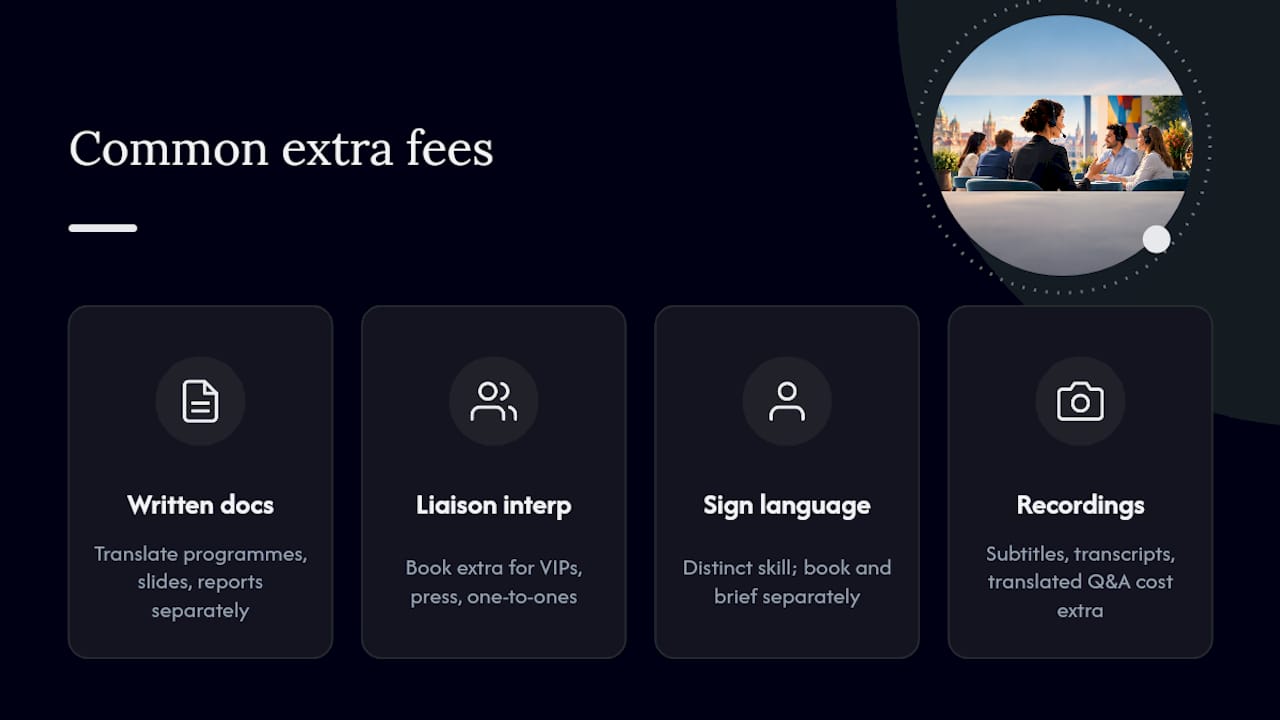
The headline interpreting quote rarely covers everything you’ll actually need. Written materials are the biggest blind spot. If your conference has printed programmes, slide decks, delegate packs, or a post-event report, those need translating separately from the spoken interpreting, and that’s usually a different service line with its own turnaround time and cost.
Liaison interpreting is another one that catches organisers out. If your event includes VIP delegations, press interviews, or one-to-one meetings running alongside the main conference, you’ll likely need a liaison interpreter on top of your booth or RSI team. That’s an additional booking, not something your simultaneous team can absorb between shifts.
Sign language interpreting deserves its own line item too, if accessibility requirements apply. It’s a distinct skill set from spoken-language interpreting and needs to be booked and briefed separately.
Then there’s the paperwork nobody thinks about until it’s due: subtitled recordings of the event, transcripts for compliance purposes, or translated Q&A submissions. Any of these can appear as a client requirement mid-planning, and each one is a separate cost, not a footnote on the interpreting invoice. The smart move is asking your provider upfront what falls outside the core interpreting scope, so nothing lands as a surprise invoice line two weeks before the event.
The glocco® view: preparation beats last-minute panic every time
Here’s what we’ve learned watching organisers budget for conferences: the cheapest quote on paper is rarely the cheapest job in practice. Preparation is the real cost lever nobody talks about. Give interpreters your slides and a glossary two weeks out, and you cut the research time they’d otherwise bill for on the day.
Specialist sectors, clinical trials, legal proceedings, will always carry a premium for the right interpreter. That’s just the market recognising expertise. But a short terminology briefing before the event tends to reduce on-the-day clarifications, which lowers total billed hours even when the day rate itself doesn’t move.
We mix RSI and boothed delivery depending on what the event actually needs, not what’s easiest to sell. That’s the difference between a quote built for your event and one built for our convenience.
— glocco®
Want a straight answer on your conference budget? Ask glocco®
Professional interpreters and technical setups, boothed or RSI, are provided for conferences and hybrid events, with quotes given per event rather than guesses. Quotes break every cost into itemized lines: interpreter fees, equipment, technician time, and prep work, so you know what is included and why.
Quotes typically include advance prep steps like glossary collection and briefing calls clearly laid out alongside pricing. That transparency is the whole point. If your event needs simultaneous interpreting with a team that’s genuinely prepared before day one, get in touch and ask for a tailored quote built around your actual schedule and languages.
Sources
FAQ
How much does conference interpreting cost per day?
A single day of boothed simultaneous interpreting for one language pair typically falls between €1,500 and €4,000, covering two interpreters, equipment, and a technician. RSI setups for the same scenario usually cost less because they skip booth rental and shipping, per industry cost comparisons.
Is RSI cheaper than traditional boothed interpreting?
Yes, generally. RSI removes the booth, console, shipping, and often the on-site technician from your invoice, and analysis shows equipment and AV logistics can double or triple a boothed event’s total cost. You’ll still need a stable connection and licensed platform, so factor that in.
Why do I need two interpreters per language?
Simultaneous interpreting demands intense concentration that research shows can’t be sustained much beyond 20 to 30 minutes without a drop in accuracy. Pairing interpreters lets them rotate and keeps quality consistent for the whole event.
What’s usually missing from a first-draft interpreting quote?
Written material translation, liaison interpreting for side meetings, and technician setup hours are the most commonly forgotten line items. Ask your provider explicitly what falls outside the core interpreting scope before you finalise a budget.
Does glocco® offer conference interpreting?
Yes, glocco® provides simultaneous, consecutive, whispered, relay, and remote simultaneous interpreting for conferences and hybrid events. Current pricing is available on request through a tailored quote rather than a published rate card.


