


Secure translation is defined as the practice of using technical, procedural, and legal controls to protect confidential information throughout the translation process. The industry term for this discipline is “translation security,” and it covers everything from encryption and access controls to compliance with GDPR and ISO 27001. If your business handles contracts, medical records, financial data, or any regulated content, translation security is not optional. It is the difference between a compliant workflow and a very expensive data breach.
What is secure translation and why does it matter?
Secure translation combines encryption, limited data retention, restricted access, and compliance measures to protect sensitive information during the translation process. That definition covers a lot of ground, so let’s break it down.
Think of it this way: you would not hand a confidential contract to a stranger on the street and ask them to translate it. Yet businesses do the digital equivalent every day by pasting sensitive text into free online tools. Secure language transfer means your documents travel through controlled, audited channels where only authorised people can see them.

The shared responsibility model sits at the heart of translation security. Providers secure the infrastructure, but clients must actively configure identity settings, retention policies, and data routing. Client misconfiguration is the most common cause of accidental data exposure. That is a fact worth pinning to your wall.
What are the essential security measures in a secure translation process?
A genuinely secure translation workflow relies on several layers of protection working together. No single measure is enough on its own.
- Encryption in transit and at rest. Transport Layer Security (TLS) protects data moving between systems. Encryption at rest protects files stored on servers. Both are non-negotiable for secure document translation.
- Role-based access control (RBAC) and multi-factor authentication (MFA). Only the people who need to see a document should be able to open it. MFA adds a second verification step, making unauthorised access significantly harder.
- Data minimisation. Send only the data required for the task. Strip out personal identifiers where possible before a document enters the translation workflow.
- Audit trails. Every access event, edit, and download should be logged. Audit trails let you prove compliance and identify breaches quickly.
- Retention policies and automated purging. Data that no longer needs to exist should be deleted automatically. Providers offering zero-retention modes reduce the risk that your content is stored longer than necessary.
- Incident management. A clear response plan for data breaches is a regulatory requirement under GDPR, not a nice-to-have.
Pro Tip: Ask your translation provider for their data retention policy in writing before you share a single file. If they cannot produce one, that tells you everything you need to know.
How do compliance frameworks like GDPR and ISO 27001 shape secure translation?
Regulatory frameworks do not just set rules. They define what “good” looks like for translation security, and they give your legal team something concrete to point at.
GDPR compliance is critical for any business processing European personal data in translation workflows. The regulation requires lawful processing, data minimisation, and the right to deletion. A Data Processing Agreement (DPA) between your business and your translation provider is a GDPR requirement, not a formality.
ISO 27001 certification signals that a provider has a mature information security management system in place. The standard covers access controls, incident management, and audit requirements. Many enterprise clients now demand ISO 27001 as a baseline before signing any translation contract.
Key compliance considerations for businesses include:
- Confirm your provider holds a current ISO 27001 certificate and ask for the scope.
- Sign a DPA that specifies how personal data is processed, stored, and deleted.
- For healthcare content, check whether HIPAA requirements apply to your workflow.
- For financial or SaaS businesses, SOC 2 Type II reports from providers add another layer of assurance.
- Remember that certifications alone do not guarantee security. Ongoing audits and practical implementation matter just as much.
The role of translation in legal compliance extends well beyond language accuracy. Regulatory adherence is baked into every step of a properly managed workflow.
Are free online translation tools safe for business documents?
Short answer: no. Longer answer: absolutely not, and here is why.
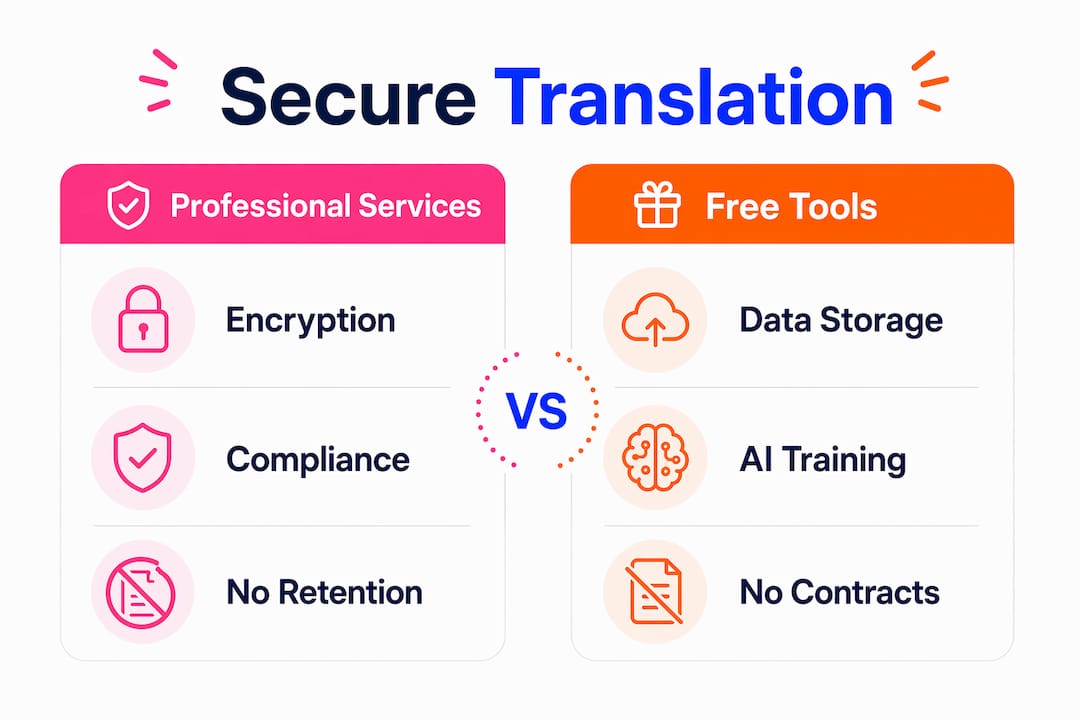
Free online translation tools often use input data to improve their AI models. Many providers’ terms of service allow submitted text to be stored and reused, with no contractual security commitments whatsoever. That means a contract you paste into a free tool could theoretically end up in a training dataset. Not ideal.
| Feature | Secure professional services | Free online tools |
|---|---|---|
| Contractual data protection | Yes, via DPA | Rarely or never |
| Zero-retention options | Available | Not offered |
| Encryption at rest and in transit | Standard | Variable or absent |
| Audit trails | Yes | No |
| Regulatory compliance (GDPR, ISO 27001) | Verified | Not applicable |
| AI training data use | Prohibited by contract | Often permitted by default |
Professional secure language services use zero-retention modes and “no return to AI training” policies. That distinction matters enormously when the content involves personal data, trade secrets, or regulated information.
Pro Tip: Before using any translation tool for business content, read the terms of service. Search for the words “training,” “improve,” and “data.” What you find may surprise you.
Best practices for businesses to ensure translation security
Getting translation security right requires action on your side, not just your provider’s. Here is a practical checklist.
- Vet your provider’s certifications. Request ISO 27001 certificates, SOC 2 reports, and GDPR compliance documentation before onboarding. Do not accept verbal assurances.
- Apply the principle of least privilege. Configure access so that translators and project managers see only the files they need. RBAC settings should be reviewed regularly.
- Use secure file transfer protocols. SFTP and FTPS use encryption to prevent interception during transmission. Email attachments are not a secure transfer method for sensitive documents.
- Limit data before it leaves your systems. Remove unnecessary personal identifiers from documents before translation. Pseudonymisation reduces your exposure if a breach occurs.
- Monitor audit logs. Set up alerts for unusual access patterns. An audit log you never read is just a box-ticking exercise.
- Establish an incident response plan. Know exactly what you will do if a breach occurs. GDPR requires notification to supervisory authorities within 72 hours of discovery.
Working with certified translation professionals who understand both linguistic and data security requirements reduces risk at every stage of the workflow.
Glocco’s perspective on the real challenges of translation security
Here is something most articles on this topic gloss over: the biggest security failures in translation workflows are not caused by hackers. They are caused by well-meaning people who did not configure their settings correctly.
At Glocco, we see this regularly. A client signs up with a provider that has all the right certifications. Then someone on the client’s team sets retention to “indefinite” because they are not sure what the default should be. Or they share a project link with an external reviewer without checking the access permissions. The provider’s infrastructure is fine. The client’s configuration is the problem.
The other misconception worth addressing is end-to-end encryption. True end-to-end encryption, where the provider has zero access to content, is genuinely rare in translation services. What you actually want is user-controlled retention, no AI training data policies, and transparent audit access. Those three things deliver practical protection far more reliably than a marketing claim about encryption.
Translation security in 2026 is also evolving fast. AI-assisted translation raises new questions about where data goes and who can access it. The legal translation trends shaping 2026 show increasing regulatory scrutiny of AI tools in professional workflows. Businesses that get ahead of this now will be in a much stronger position when auditors come knocking.
— glocco®
How Glocco supports secure translation for your business
Glocco has operated as a language services provider since 2014, working with clients across legal, medical, fintech, and engineering sectors where data security is non-negotiable. Glocco’s workflows align with GDPR requirements and ISO 27001 standards, with Data Processing Agreements available as standard for all business clients. You retain control over how your data is handled, and Glocco does not use client content for AI model training. If you are ready to move beyond free tools and ad-hoc workflows, the document translation guide for EU businesses is a practical starting point for understanding what a compliant, secure process looks like in practice.
FAQ
What is secure translation?
Secure translation is the use of encryption, access controls, data retention policies, and compliance measures to protect sensitive information during the translation process. It applies to any business handling confidential, personal, or regulated content.
What is the difference between secure and free translation tools?
Free tools often store input data and use it to train AI models, with no contractual data protection. Secure professional services provide Data Processing Agreements, zero-retention options, and verified compliance with GDPR and ISO 27001.
Is GDPR relevant to translation services?
Yes. Any translation of personal data involving European residents falls under GDPR. Businesses must sign a Data Processing Agreement with their provider and confirm that data minimisation and deletion rights are respected.
What does ISO 27001 mean for a translation provider?
ISO 27001 certification confirms that a provider has a documented information security management system covering access controls, incident management, and audit trails. It is widely regarded as the baseline standard for enterprise translation security.
How do I ensure secure file transfer with my translation provider?
Use SFTP or FTPS protocols for all document transfers. Avoid email attachments for sensitive content, and confirm that your provider supports encrypted transfer as standard rather than as an optional add-on.


