


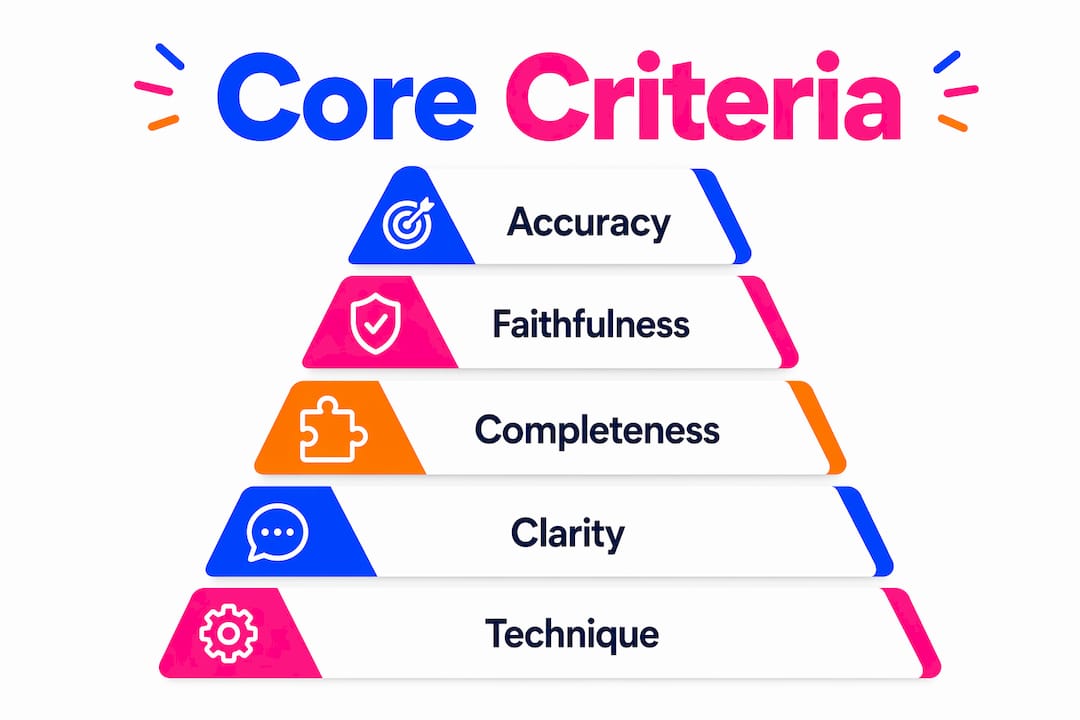
Interpreter performance evaluation is the systematic measurement of interpreting quality using validated frameworks, clear criteria, and a balance of quantitative scoring and qualitative judgement. The industry standard for this process draws on recognised frameworks such as the SEAProTI assessment model, which identifies five core components: accuracy, faithfulness, completeness, clarity, and technique. Knowing how to evaluate interpreter performance properly is not optional for language service managers. It is the difference between a quality assurance programme that holds up under scrutiny and one that falls apart the moment a client complains.
What are the key criteria and metrics to measure interpreter performance?
The SEAProTI framework uses a 100-point scale where a score of 80 or above denotes professional-level competence, classified as C3. Scores below that threshold place an interpreter at the C2 developing level, which signals the need for further training before deployment in high-stakes settings. That single number carries real operational weight.

The five core criteria work together, not in isolation. Here is how each one functions in practice:
| Criterion | What it measures | Example indicator |
|---|---|---|
| Accuracy | Correct transfer of meaning | No factual errors or omissions in legal terminology |
| Faithfulness | Preservation of speaker intent | Tone and register match the source speaker |
| Completeness | Nothing significant left out | All numbers, names, and conditions rendered |
| Clarity | Target-language fluency | No ambiguous phrasing that confuses the listener |
| Technique | Delivery and professional conduct | Appropriate pace, note-taking, and positioning |
Rubric-based scoring systems typically use five performance levels and four scoring criteria, and research shows they deliver moderate-to-high validity when descriptors focus on observable behaviour rather than subjective impressions. “The interpreter spoke clearly” is a subjective impression. “The interpreter maintained a consistent pace of 100–120 words per minute with no unplanned pauses exceeding three seconds” is an observable indicator. The distinction matters enormously for rater consistency.
Pro Tip: Anchor every rubric descriptor to a specific, observable behaviour. If a rater cannot point to something they heard or saw, the descriptor is too vague to be useful.
Which tools and methods support reliable interpreter assessment?
No single tool covers everything. The most reliable assessment programmes combine human expertise with technology, each filling the gaps the other leaves behind.
- Human rater evaluation. Experienced evaluators remain the gold standard for pragmatic and interactional features such as prosody, hesitation patterns, and speaker attitude. These are the qualitative markers that separate a competent interpreter from a truly professional one.
- Analytic rubrics. Rubric-based scoring with multiple levels gives raters a shared reference point. Observable, behaviour-based descriptors promote consistency across raters and sessions.
- AI-assisted linguistic checks. AI tools assess terminology accuracy and grammatical fidelity at scale. They are fast and consistent across large volumes of recorded sessions.
- Multicomponent battery approaches. Combining human and machine-learning scores provides the best differentiation of interpreter skill levels. Cross-lingual embedding models enhance large-scale fidelity checks that human raters alone cannot sustain.
- Portfolio and self-assessment tools. Interpreters submit recorded samples alongside reflective commentary. This method works well for ongoing professional development reviews.
The critical limitation of AI is well established. AI tools cannot fully replace human evaluators because they struggle to assess pragmatic features such as intonation and hesitation. A session that scores well on terminology accuracy can still fail on delivery. Human raters catch that. AI, at present, largely does not.
Pro Tip: Use AI for first-pass screening of recorded sessions, then route flagged or borderline cases to a trained human rater. This keeps costs manageable without sacrificing quality.
How to design and implement an effective evaluation process
A well-designed evaluation programme does not happen by accident. It follows a clear sequence, and skipping steps creates problems that compound over time.
- Define your evaluation goals. Decide whether you are assessing for initial certification, ongoing quality monitoring, or professional development. Each goal requires a different rubric weighting.
- Select or adapt a validated framework. Start with an established model such as the SEAProTI scale. Adapt descriptors to your sector, whether that is legal interpreting, medical, or conference settings.
- Train your raters. Run calibration sessions before any live evaluation. Raters should score the same sample independently, then compare and discuss discrepancies until alignment is reached.
- Pilot test the rubric. Rubrics without validation produce low reliability and limited usefulness. Test on a small cohort first and refine descriptors based on rater feedback.
- Schedule and conduct evaluations. Use a mix of live observation and recorded session review. Vary the task types to capture a representative range of interpreting demands.
- Score, document, and feed back. Record scores against each criterion, note qualitative observations, and deliver structured feedback to the interpreter within an agreed timeframe.
- Review and update the programme. Revisit rubric descriptors annually or after any significant change in service scope.
| Stage | Key output |
|---|---|
| Goal definition | Written evaluation brief |
| Framework selection | Adapted rubric document |
| Rater training | Calibration report |
| Pilot testing | Revised rubric |
| Live evaluation | Scored assessment records |
| Feedback | Individual development plan |
| Programme review | Updated rubric and process notes |
“Reliable interpreter assessment systems rely on pilot-tested analytic rubrics validated against real performance data. Creating rubrics without validation leads to low reliability and limited usefulness.”
The minimum professional qualification for interpreters entering assessment is RQF Level 6, equivalent to a university degree. Knowing this baseline helps managers set appropriate entry thresholds before evaluation even begins.
What common challenges arise when assessing interpreters?
Even well-designed programmes hit obstacles. Knowing what they are in advance means you can plan around them rather than react to them.
- Rater bias. Individual raters favour certain delivery styles or language varieties. Calibration sessions and multiple raters reduce this, but they do not eliminate it entirely. Build in a moderation step for any score that falls near a grade boundary.
- Limited task representativeness. Single-task assessments are insufficient to predict professional interpreting competence. One oral paraphrase exercise tells you very little about how an interpreter performs under sustained consecutive pressure.
- Over-reliance on a single metric. Scoring only accuracy misses technique, clarity, and delivery entirely. The “singular predictor trap” produces misleading pass rates and leaves real quality gaps undetected.
- AI blind spots. Automated tools miss prosodic and interactional features. Using AI output as the sole quality indicator for certified interpreters in high-stakes settings is a governance risk.
- Inconsistent feedback. Interpreters who receive vague or delayed feedback cannot act on it. Feedback must be specific, criterion-referenced, and delivered promptly after the evaluation session.
The fix for most of these problems is the same: use multicomponent testing batteries, train raters rigorously, and never rely on a single data point to make a consequential decision about an interpreter’s professional status.
What Glocco has learned from years of interpreter evaluation
Here is an honest admission: the first time we built an interpreter evaluation process, we over-engineered the rubric and under-invested in rater training. The rubric had twelve criteria. Raters disagreed on half of them because the descriptors were evaluative rather than behavioural. We scrapped it after the pilot and started again with five criteria and observable indicators only. That second version actually worked.
The thing most articles on this topic miss is that the rubric is not the hard part. Rater alignment is. Two experienced evaluators can look at the same session and reach completely different conclusions if they have not calibrated together. We now run calibration sessions before every new evaluation cycle, not just at onboarding. It takes two hours and saves weeks of disputes.
AI has a genuine role in our workflow, but we treat it as a first-pass filter, not a decision-maker. It flags sessions that fall below a linguistic accuracy threshold. A human rater then reviews those sessions and makes the final call. That combination gives us scale without sacrificing the qualitative judgement that clients in legal and medical settings rightly expect. If you are managing remote interpreting at any volume, this hybrid approach is the only one that holds up.
— glocco®
Glocco’s approach to interpreter quality assurance
Glocco has supported language service quality across Europe, the Middle East, North America, and Asia since 2014. Our interpretation services are built around validated assessment frameworks, trained evaluators, and sector-specific quality criteria covering legal, medical, and corporate settings. We work with managers who need more than a score sheet. They need a process that holds up under audit, produces consistent results, and gives interpreters something they can actually act on. If you are building or refining your quality assurance programme, our language services checklist is a practical starting point. For a broader view of how language quality fits into your global operations, the language localisation guide covers the full picture.
FAQ
What is the standard scoring scale for interpreter evaluation?
The SEAProTI framework uses a 100-point scale. A score of 80 or above indicates professional-level competence (C3); below 80 indicates a developing level (C2) requiring further training.
What are the five core criteria for assessing interpreters?
The five core criteria are accuracy, faithfulness, completeness, clarity, and technique. These components appear across the most widely used professional assessment frameworks.
Can AI replace human raters in interpreter performance assessment?
AI tools effectively assess linguistic accuracy and terminology at scale, but they cannot evaluate pragmatic features such as prosody and speaker attitude. Human raters remain necessary for a complete assessment.
How many tasks should an interpreter evaluation include?
Single-task assessments are insufficient to predict professional competence. A multicomponent battery covering different task types and conditions provides a reliable picture of an interpreter’s skill level.
What qualification level should interpreters meet before formal evaluation?
The minimum professional qualification is RQF Level 6, equivalent to a university degree. This baseline combines integrated learning with practical assessment portfolios.


