


Translating legal marketing is defined as the process of adapting law firm content across languages with full cultural and legal accuracy. This is not a job for a dictionary and a prayer. The most effective approach combines transcreation, jurisdiction-specific legal review, and multilingual SEO practices such as hreflang tagging. Law firms that treat this as a box-ticking exercise risk client mistrust, regulatory non-compliance, and wasted marketing spend. This guide to translating legal marketing gives you the practical framework to get it right, whether you are targeting clients in the EU, MENA, North America, or beyond.
What is transcreation and why is it critical for legal marketing?
Transcreation is the process of recreating content so it carries the same meaning, tone, and legal intent in the target language as it does in the original. It goes well beyond word-for-word translation. A literal rendering of “no win, no fee” into Arabic, for example, may confuse rather than reassure a client unfamiliar with that commercial model.
Localisation versus translation is the difference between genuine cultural adaptation and technical word conversion. That gap directly affects how effective your marketing is in diverse markets like MENA or multilingual US communities. A translated tagline that misses the cultural register can make a firm look untrustworthy, even if every word is technically correct.
The risks of skipping transcreation are real:
- Legal misalignment. Contract law terminology varies by jurisdiction. “Solicitor” means something specific in England and Wales but nothing in the United States.
- Commercial failure. Messaging that does not resonate with local client expectations will not convert, regardless of how polished the design is.
- Compliance exposure. Legal advertising rules differ across markets. Content that is compliant in one jurisdiction may breach regulations in another.
Pro Tip: Brief your transcreation team on the target jurisdiction’s advertising standards before they touch a single sentence. Fixing compliance issues after publication costs far more than preventing them.
Which tools, teams, and standards are essential?
The gold standard for translating legal content is a hybrid workflow: AI handles volume and speed, while specialist human linguists handle accuracy and compliance. AI translation alone is insufficient for legal marketing because of the risk of mistranslated jurisdictional terms. A human reviewer with legal expertise catches what the machine misses.

Here is a practical overview of what your workflow needs:
| Component | What it does | Why it matters |
|---|---|---|
| Certified legal translator | Translates and validates legal terminology | Ensures enforceability and regulatory compliance |
| Glossary management | Controls consistent use of approved terms | Reduces terminology drift across languages |
| AI translation engine | Handles first-pass bulk translation | Speeds up volume without replacing human review |
| Hreflang tags | Signals language and region to search engines | Prevents duplicate content and improves multilingual SEO |
| Content management system | Manages multilingual content versions | Keeps localised pages organised and updatable |
| Back translation review | Translates output back to source language | Confirms fidelity and catches meaning errors |
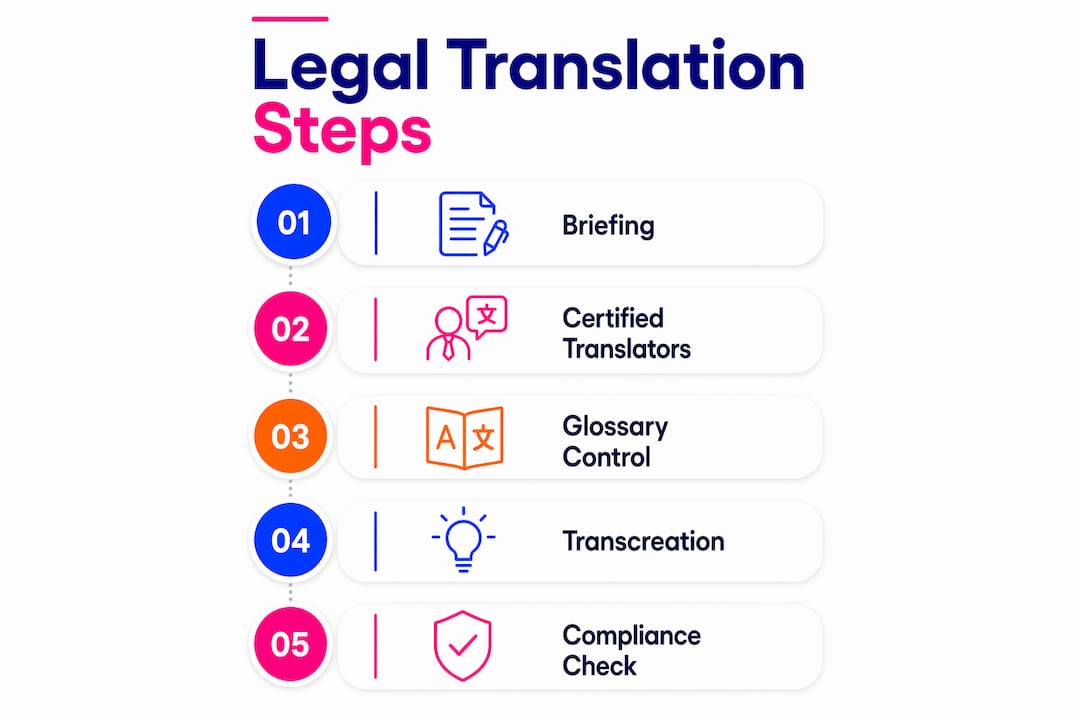
Glossary-controlled translation reduces terminology drift and keeps your multilingual brand consistent across every market you serve. This matters enormously when a client reads your website in French and then receives onboarding documents in English. The terminology must match.
Law firms targeting Singapore or other foreign-owned business markets also need to account for local corporate compliance frameworks. Corporate regulatory requirements vary significantly by jurisdiction, and your marketing must reflect that.
Pro Tip: Build your glossary before translation begins, not after. Retrofitting consistent terminology across a live multilingual site is a painful and expensive process.
How to execute a legal marketing translation process step by step
A clear, repeatable process is what separates firms that do multilingual legal marketing well from those that muddle through. Follow these steps:
-
Define your target markets and languages. Identify which jurisdictions you are entering and which languages those clients actually use. Do not assume that Spanish for Spain works for Latin American clients.
-
Audit your existing marketing content. Catalogue every asset: website pages, brochures, social media profiles, and email templates. Prioritise by client impact and conversion value.
-
Assign certified translators with legal expertise. Certified translations require a signed statement affirming accuracy and translator competence. This is not optional for legal marketing materials that reference services, rights, or fees.
-
Transcreate core messages. Your firm’s value proposition, practice area descriptions, and calls to action all need transcreation, not just translation. Work with your linguist to adapt tone and cultural references for each market.
-
Align with local legal frameworks. Contract law terms, client rights language, and regulatory disclosures must reflect the target jurisdiction. A disclaimer written for English law is not valid in Germany or the UAE.
-
Apply multilingual SEO. Add hreflang tags to every localised page. These tags tell search engines which language and region each page serves, preventing duplicate content penalties and improving visibility.
-
Run back translation and human validation. Translate the output back into the source language independently. Compare it to the original. Discrepancies reveal meaning errors before they reach clients.
-
Obtain legal and compliance sign-off. Have a qualified legal professional in the target jurisdiction review the final content. This step protects the firm from advertising regulation breaches.
-
Publish and monitor. Track engagement metrics by language version. Client behaviour on localised pages tells you whether the content is resonating or needs further adaptation.
What common mistakes should legal marketers avoid?
Most errors in legal marketing translation come down to one of four problems. Knowing them in advance saves you from an expensive fix later.
- Relying solely on AI translation. AI tools are valuable for volume, but they cannot reliably capture jurisdictional legal nuances. Unreviewed AI output in a legal context is a liability, not an asset.
- Treating localisation as optional. Literal translation without localisation produces content that is legally misaligned and commercially ineffective. Arabic marketing that ignores local commercial culture and legal vocabulary will not convert.
- Inconsistent terminology across touchpoints. Inconsistencies between translated marketing and client documents harm retention and referrals. If your website says one thing and your onboarding pack says another, clients notice.
- Skipping certified translation for regulated content. Legal translation errors can result in document rejection, contract disputes, and adverse legal outcomes. That is not a risk worth taking.
“Law firms must guarantee service capacity in the same language used in marketing to prevent client abandonment. Bilingual capability is a high-stakes business development requirement, not a nice-to-have feature.”
The fix for all four mistakes is the same: invest in certified legal linguists, maintain a controlled glossary, and build human review into every stage of your workflow.
What Glocco has learned from legal marketing translation projects
Honestly? The biggest lesson is that legal marketers consistently underestimate how much the human element matters. We have seen firms invest in excellent AI translation tools and then wonder why their French-speaking clients are confused by their fee structures. The tool was fine. The review process was missing.
The hybrid AI-human workflow works because it respects what each does well. AI handles the heavy lifting on volume. Human legal linguists handle the parts where a wrong word costs a client or a case. The collaboration between your legal team, your marketing team, and your language specialists is not a nice extra. It is the process.
Iterative testing matters too. The first localised version of your website is rarely the best one. Client feedback, engagement data, and periodic glossary reviews all sharpen the content over time. Maintaining your brand voice across languages is achievable, but it requires consistent terminology, regular audits, and linguists who understand your firm’s positioning, not just your words.
— glocco®
How Glocco supports legal marketing translation
Glocco has worked with legal teams across Europe, the Middle East, and North America since 2014, combining AI-assisted workflows with specialist human review for every project. The result is consistent, compliant, multilingual legal marketing that holds up under scrutiny in any jurisdiction.
For law firms entering new markets, Glocco provides glossary-controlled translation management, certified legal linguists, and multi-jurisdiction compliance review. Every project follows the legal translation quality standards that protect your firm and your clients. If you want to understand the full scope of quality assurance in legal language work, the guide to back translation practice is a practical next step. Glocco makes the process clear, efficient, and built for firms that cannot afford to get it wrong.
FAQ
What is transcreation in legal marketing?
Transcreation is the adaptation of legal marketing content to preserve meaning, tone, and compliance in a target language and culture. It goes beyond literal translation to ensure the content resonates with local clients and meets local advertising standards.
Why is AI translation alone not enough for legal content?
AI translation cannot reliably handle jurisdictional legal terminology, which varies significantly between markets. A hybrid workflow combining AI with specialist human review is the recognised best practice for legal marketing translation.
What are hreflang tags and why do legal firms need them?
Hreflang tags are HTML attributes that tell search engines which language and region a web page targets. Law firms need them to avoid duplicate content penalties and to ensure localised pages appear in the correct regional search results.
How do certified translators differ from standard translators?
Certified translators provide a signed statement affirming the accuracy of their translation and their competence to produce it. This certification is required for legal documents and marketing materials where enforceability or regulatory compliance is at stake.
What is back translation and when should law firms use it?
Back translation converts a translated document back into the original language independently, then compares it to the source. Law firms should use it as a quality assurance step before publishing any localised legal marketing content.


