


Many legal professionals assume all certified translations meet the same standards, yet translation quality varies dramatically in ways that directly impact regulatory compliance and litigation risk. Understanding what separates adequate from exceptional legal translation has become critical as international business operations expand across jurisdictions with different legal systems. Recent advances in artificial intelligence and specialised evaluation frameworks reveal surprising insights about achieving translation accuracy whilst managing cost and speed pressures. This guide examines the key factors that determine legal translation quality and how compliance managers can secure reliable translations in 2026.
Key takeaways
| Point | Details |
|---|---|
| Translation quality impacts compliance | Poor legal translations create regulatory breaches, litigation exposure, and governance failures in international operations |
| AI advances improve consistency | Frontier models now outperform specialised systems, though human expertise remains essential for accuracy verification |
| Specialised evaluation systems essential | Domain-specific benchmarks like SwiLTra-Judge provide objective quality metrics tailored to legal texts |
| Strategic approach required | Combining expert translators, AI tools, and standardised quality assurance workflows ensures compliance and reduces risk |
Why legal translation quality matters for compliance
Legal translation quality directly determines whether your organisation meets regulatory requirements across jurisdictions. A single mistranslated clause in a contract, compliance policy, or regulatory filing can trigger enforcement actions, financial penalties, or protracted litigation. Compliance managers face particular pressure because legal terminology carries precise meanings that shift dramatically between languages and legal systems.
Poor translations create cascading problems beyond immediate compliance failures. Inaccurate translations of internal policies confuse employees about their obligations, whilst mistranslated customer agreements expose companies to claims of misrepresentation. Regulatory submissions with translation errors delay approvals and damage relationships with authorities. The financial impact extends beyond direct penalties to include remediation costs, reputational damage, and lost business opportunities.
Legal translation in multilingual countries relies heavily on human experts, creating bottlenecks that slow critical business processes. Switzerland exemplifies this challenge, where federal laws must appear in German, French, Italian, and Romansh. The scarcity of qualified legal translators who understand both source and target legal systems creates delays that impact everything from contract negotiations to regulatory compliance timelines.
Quality translation supports business continuity by ensuring legal certainty across markets. When contracts, employment policies, and compliance documentation maintain consistent meaning across languages, organisations operate with confidence. Human translators with legal expertise understand nuances that automated systems miss, such as how legal concepts adapt between common law and civil law jurisdictions.
Pro Tip: Establish translation quality standards before problems arise by defining acceptable error rates for different document types. Critical compliance filings warrant zero-tolerance policies, whilst internal communications may accept minor stylistic variations.
Key quality indicators include:
- Terminological accuracy in legal concepts and institutional references
- Consistency across related documents and previous translations
- Appropriate register and formality matching source text conventions
- Compliance with target jurisdiction’s legal drafting standards
How AI and specialised systems improve legal translation quality
Artificial intelligence has transformed legal translation capabilities through large language models trained on vast multilingual corpora. The SwiLTra-Bench benchmark, comprising 180,000 Swiss legal document pairs across three language combinations, provides rigorous testing of translation quality. This comprehensive dataset includes federal laws, court headnotes, and other legal texts that challenge translation systems with complex terminology and specialised concepts.

Frontier models achieve superior translation performance across Swiss legal documents compared to specialised translation systems. Models like Claude-3.5-Sonnet and GPT-4 demonstrate remarkable accuracy when translating legal texts, outperforming purpose-built translation engines in comprehensive evaluations. These general-purpose models benefit from training on diverse legal content that helps them grasp context and conceptual relationships.
Specialised translation systems excel in narrow domains but struggle with varied legal document types. Whilst dedicated legal translation engines perform well on statutory texts, they underperform on judicial headnotes and administrative documents. This limitation reflects their training on specific document categories rather than broad legal language understanding.
Fine-tuning open SLMs improves quality but still lags behind frontier zero-shot prompted models like Claude-3.5-Sonnet. Organisations investing in custom model development see measurable improvements over baseline open-source models. However, the resource investment required for fine-tuning often exceeds the practical benefit compared to using frontier models with carefully crafted prompts.
The SwiLTra-Judge evaluation system represents a breakthrough in automated quality assessment. This AI-powered judge aligns closely with human expert scoring, providing reliable quality metrics without the cost and delay of manual review. Domain-adapted evaluation proves essential because general translation metrics fail to capture legal-specific accuracy requirements.
| Translation approach | Accuracy level | Best use case | Limitation |
|---|---|---|---|
| Frontier AI models | Highest overall | Complex multi-document projects | Requires prompt engineering expertise |
| Specialised legal systems | High for specific texts | Statutory translation at scale | Narrow domain coverage |
| Fine-tuned open models | Moderate to high | Organisation-specific terminology | Resource-intensive development |
| General translation tools | Variable | Non-critical internal documents | Lacks legal domain knowledge |
Pro Tip: Test multiple AI translation approaches on representative samples before committing to a single system. Quality varies significantly based on language pair, document type, and specific legal domain.
Implementing AI translation requires strategic integration with human expertise. Successful organisations use AI for initial drafts and consistency checking whilst reserving final accuracy verification for qualified legal translators. This hybrid approach balances speed and cost with the precision compliance demands. Sworn translation requirements in many European jurisdictions mandate human translator certification regardless of AI involvement.
Quality assurance workflows benefit from structured localisation processes that incorporate AI capabilities systematically. Organisations achieving the highest translation quality embed AI tools within comprehensive quality frameworks rather than treating them as standalone solutions. The SwiLTra-Bench evaluation methodology provides a model for objective quality measurement that compliance managers can adapt to their specific needs.
Challenges and nuances in legal translation quality assessment
Measuring legal translation quality presents unique difficulties that general translation metrics fail to capture. Legal texts demand absolute terminological precision because single word choices determine rights, obligations, and liabilities. Standard translation evaluation approaches like BLEU scores prove inadequate for legal content where conceptual accuracy matters more than surface-level similarity to reference translations.
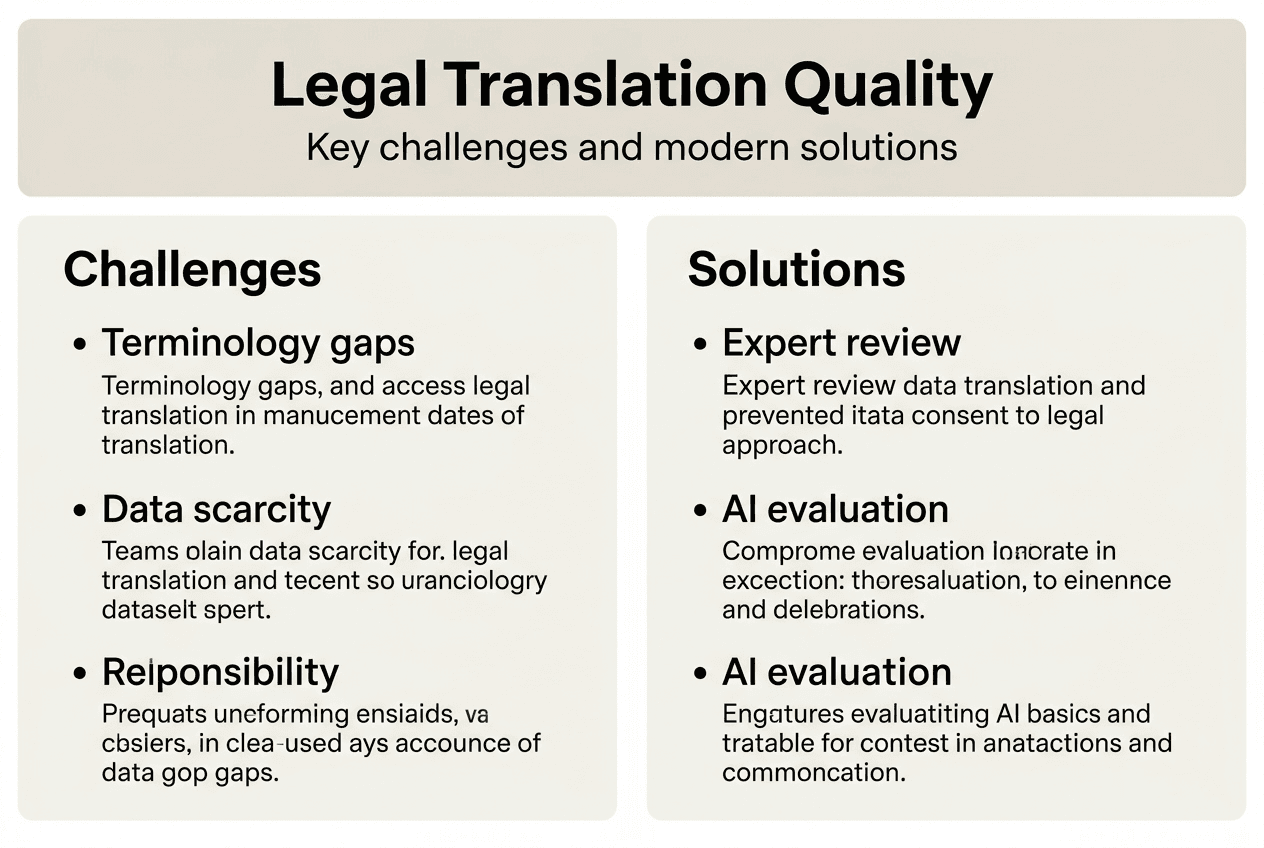
Shortage of high-quality multilingual parallel legal data limits state-of-the-art machine translation system performance. Unlike general domains with abundant training data, legal translation suffers from data scarcity. Confidentiality restrictions prevent sharing most legal documents, whilst publicly available legal texts concentrate in specific document types and language pairs. This data shortage particularly impacts less common language combinations and specialised legal domains.
Human expert assessment remains the gold standard but introduces practical constraints. Qualified legal translators with subject matter expertise command premium rates and limited availability. Manual quality review creates bottlenecks that delay urgent projects and increase costs. Subjectivity in human assessment also introduces variability, as different experts may weight terminology accuracy versus stylistic naturalness differently.
Domain-specific LLM-as-Judge systems are essential for tasks requiring high accuracy and fidelity like legal translation. General-purpose evaluation models lack the specialised knowledge to assess whether translated legal terms carry equivalent meaning in the target jurisdiction. Domain adaptation through training on legal texts and evaluation criteria helps AI judges align with expert human assessment.
Document type variation complicates quality assessment further. Translating federal statutes demands different skills than translating court judgments or regulatory guidance. Laws require formal register and precise terminology mapping, whilst judicial headnotes need conceptual accuracy in summarising legal reasoning. Evaluation frameworks must account for these distinctions rather than applying uniform criteria.
Key assessment challenges include:
- Distinguishing acceptable paraphrasing from meaning-altering changes
- Evaluating appropriateness of legal terminology choices between valid alternatives
- Assessing whether translated text functions effectively in target legal system
- Balancing literal accuracy against natural expression in target language
| Quality dimension | Assessment method | Challenge | Solution approach |
|---|---|---|---|
| Terminological accuracy | Expert review with legal dictionaries | Subjective term selection | Standardised glossaries and precedent databases |
| Conceptual fidelity | Comparative legal analysis | Cross-system concept mapping | Bilingual legal experts with jurisdiction knowledge |
| Functional equivalence | Target text usability testing | Context-dependent effectiveness | User feedback and revision cycles |
| Stylistic appropriateness | Register and formality analysis | Genre convention variations | Style guides and reference corpora |
Automated evaluation systems face particular difficulties with legal translation because errors have asymmetric impact. A mistranslated party name constitutes a critical error, whilst a stylistic infelicity represents a minor quality issue. Weighted scoring systems help but require careful calibration to organisational priorities and risk tolerance.
Compliance managers need evaluation frameworks that distinguish between errors requiring immediate correction and acceptable variations. Language service providers with EU compliance expertise develop quality metrics aligned with regulatory requirements. These frameworks prioritise accuracy dimensions that directly impact legal validity and enforceability.
Ensuring high-quality legal translation in your organisation
Securing reliable legal translation requires strategic planning beyond simply engaging translators when needs arise. Compliance managers who implement systematic quality assurance achieve consistently better outcomes whilst controlling costs. The following approach integrates best practices from organisations successfully managing multilingual legal operations.
-
Select specialist translators with demonstrated legal and multilingual expertise. Review translator qualifications including legal education, translation credentials, and subject matter experience. Verify they understand both source and target legal systems, not just languages. Request work samples in your specific legal domain and assess terminology accuracy.
-
Incorporate AI tools strategically whilst prioritising human review for accuracy verification. Use frontier models like Claude or GPT-4 for initial drafts and consistency checking. Reserve final quality control for qualified human translators who verify conceptual accuracy and legal appropriateness. This hybrid approach delivers speed benefits without compromising reliability.
-
Implement standardised quality evaluation using domain-specific benchmarks adapted from frameworks like SwiLTra-Judge. Develop scoring rubrics that weight critical accuracy dimensions appropriately for different document types. Track quality metrics over time to identify patterns and improvement opportunities.
-
Follow a structured quality assurance workflow with multiple verification steps. Establish clear handoffs between translation, review, and final approval stages. Build in adequate time for thorough quality checks rather than rushing translations to meet arbitrary deadlines.
-
Maintain comprehensive glossaries and style guides ensuring consistency across projects and translators. Document approved terminology for legal concepts, institutional names, and technical terms. Update glossaries regularly as new terms emerge and legal language evolves.
Developing reliable neural machine translation for legal texts boosts governmental efficiency and reduces administrative bottlenecks. Organisations investing in translation infrastructure see compounding returns as quality improves and processes streamline. The initial setup effort pays dividends through faster turnaround times and fewer costly errors.
Pro Tip: Create a translation memory database capturing all approved translations. This repository ensures consistency across related documents and accelerates future projects by leveraging previous work.
Practical implementation steps:
- Audit current translation practices identifying quality gaps and process inefficiencies
- Define quality standards specifying acceptable accuracy levels for document categories
- Establish vendor relationships with qualified legal translation specialists
- Implement technology infrastructure supporting translation memory and terminology management
- Train internal stakeholders on quality requirements and review procedures
- Monitor translation quality through systematic evaluation and feedback loops
Successful organisations treat legal translation as a core compliance capability requiring ongoing investment and attention. Accurate legal document translation becomes a competitive advantage when executed systematically. Companies operating across multiple jurisdictions particularly benefit from standardised approaches that scale efficiently.
Quality assurance extends beyond individual translation projects to encompass the entire multilingual content lifecycle. Regular audits verify that translated policies remain current as source documents evolve. Version control systems track changes and ensure all language versions stay synchronised. Human translator expertise proves invaluable for maintaining quality as legal requirements change.
Discover expert legal translation services to ensure compliance
Navigating complex legal translation requirements demands specialised expertise combining linguistic skill with legal knowledge. Glocco offers comprehensive legal translation solutions designed specifically for compliance-focused organisations operating across international markets. Our approach integrates advanced AI capabilities with experienced human translators who understand both legal systems and business contexts.
We help international businesses maintain regulatory compliance whilst managing translation costs and timelines effectively. Our quality assurance processes incorporate domain-specific evaluation frameworks ensuring accuracy in critical legal documents. Whether you need certified legal document translation, ongoing compliance support, or strategic localisation advice, our team delivers reliable solutions. Discover how expert human translators and proven language services support your global business objectives with confidence.
FAQ
What is the difference between legal translation and regular translation?
Legal translation requires precise terminology reflecting specific legal concepts that often lack direct equivalents between legal systems. Translators must understand both source and target jurisdictions’ legal frameworks to convey accurate meaning. Regular translation focuses primarily on linguistic accuracy without the specialised legal knowledge and consequences associated with legal texts.
How do AI models impact legal translation quality?
Advanced AI models improve translation speed and consistency across large document sets, reducing turnaround times significantly. However, they still require human oversight to verify conceptual accuracy and legal appropriateness in target jurisdictions. Fine-tuning improves AI models’ translation but frontier models still lead in quality for complex legal texts.
What role do specialised evaluation systems play in legal translation?
Specialised evaluation systems provide objective quality metrics tailored specifically to legal text requirements, capturing nuances general translation metrics miss. SwiLTra-Judge aligns closely with human assessments to ensure quality whilst reducing manual review bottlenecks. These systems help organisations maintain consistent standards across translators and projects.
Why does legal translation data scarcity matter?
Limited availability of parallel legal texts constrains machine learning system training, particularly for less common language pairs and specialised domains. Confidentiality restrictions prevent sharing most legal documents publicly, creating data gaps that impact AI model performance. This scarcity means human expertise remains essential for achieving reliable legal translation quality.
How can organisations balance translation cost, speed, and quality?
Implementing hybrid workflows combining AI for initial drafts with human expert review optimises the cost, speed, and quality balance. Prioritise human verification for critical compliance documents whilst accepting AI-only translation for lower-risk internal communications. Building translation memory databases and terminology glossaries improves efficiency over time without compromising accuracy.


