


Operational translation is the systematic process of embedding translation workflows directly into business operations to achieve consistent, timely, and high-quality multilingual communication. Unlike one-off document translation, this approach treats translation as an ongoing function, not an afterthought. It combines AI-powered pipelines, Translation Management Systems (TMS), and human linguist review to meet measurable service-level targets. Glocco works with clients across legal, medical, fintech, and e-commerce sectors who need exactly this: translation that runs like a well-oiled part of the business, not a bottleneck.
What is operational translation and how does it work?
Operational translation is best understood as a production system. It takes content in, processes it through defined stages, and delivers verified translations out, at speed and scale. The industry term you will encounter in technical literature is “machine-assisted translation operationalisation,” but “operational translation” captures the same idea for a business audience.
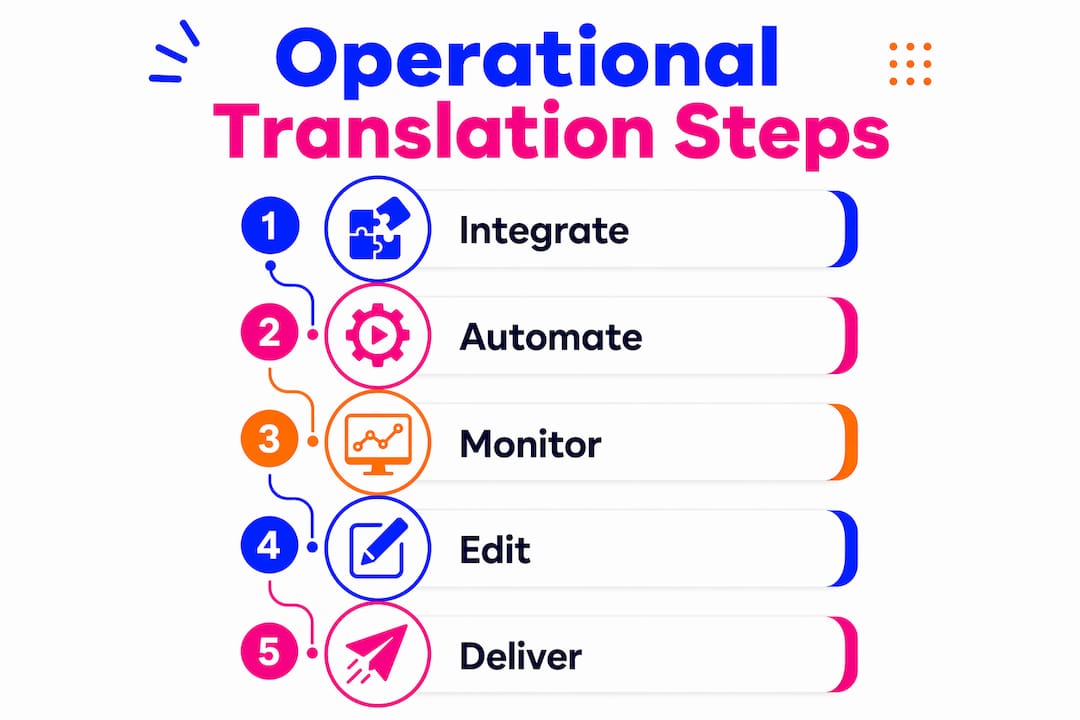
A typical workflow runs like this:
- Content ingestion. Source text enters the pipeline automatically, often triggered by a product update, a new document upload, or a CMS event.
- AI translation. A large language model or neural machine translation engine produces a first-pass translation, often within seconds.
- Automated quality checks. Tools like TMS platforms enforce automatic validation of placeholders, formatting, and glossary terminology. This catches errors before a human ever sees the file.
- Human linguist review. A specialist reviews the output for brand voice, idiom, and domain accuracy. 95% of translations need no significant post-review changes. The remaining 5% typically involve idiomatic expressions or brand tone decisions.
- Delivery and tracking. The verified translation publishes automatically, and operational metrics such as turnaround time and adoption rate are logged.
Large-scale deployments target a 30-minute SLA for 95% of batch translations. That is the difference between translation as a weekly task and translation as a live business capability.
Pro Tip: Do not measure success by BLEU scores alone. Track turnaround time, human edit rates, and end-user satisfaction to get a true picture of operational performance.

Why operational translation matters for global business
The benefits of operational translation are concrete and measurable. Organisations that embed translation into their workflows see faster output, more consistent brand voice, and the ability to scale across markets without proportionally scaling headcount.
Here is what that looks like in practice:
- Speed. Transitioning to AI-powered pipelines can reduce translation latency from days to minutes. For a product team shipping updates weekly, that is a genuine competitive advantage.
- Consistency. Automated glossary enforcement means the same term translates the same way every time, across every market. Brand voice does not drift.
- Scalability. A business entering three new markets does not need to triple its translation team. The pipeline absorbs the volume.
- Compliance. Regulated industries benefit from audit trails, version control, and documented human review steps built directly into the workflow.
- User experience. Customers receive communications in their language, at the right time, with terminology that matches their context.
Operational translation improves efficiency, consistency, and scalability of localisation efforts across global business. That is not a soft benefit. It directly affects customer retention, regulatory standing, and time to market.
What are the main challenges in implementing operational translation?
Getting operational translation right is not trivial. The technology is mature, but the integration work is real. Here are the most common obstacles organisations face:
- Language-specific complexity. Some language pairs have far fewer training resources than others. Performance gaps between, say, English to French and English to Swahili can be significant.
- Model drift and domain mismatch. A model trained on general content may perform poorly on legal contracts or clinical notes. Iterative optimisation by analysing prospective testing results is the only reliable fix.
- Glossary and terminology management. Without a maintained termbase, automated pipelines produce inconsistent output. This is especially damaging in regulated sectors.
- Integration complexity. Connecting a TMS to a CMS, an ERP, and a compliance system requires technical resource. Many organisations underestimate this.
- Balancing automation with oversight. Full automation without human review is a risk. Full human review without automation is too slow. Finding the right balance is the core operational challenge.
Real-world operational metrics like user satisfaction and downstream outcomes provide a fuller picture than technical accuracy scores alone. Tracking these metrics informs where to invest in improvement.
Pro Tip: Build your termbase before you build your pipeline. Glossary alignment is the single highest-leverage investment in translation quality, and it costs far less than fixing inconsistencies after launch.
Operational translation examples across industries
Operational translation looks different depending on the sector. The underlying principles are the same; the implementation details vary considerably.
| Industry | Primary use case | Key quality requirement | Regulatory consideration |
|---|---|---|---|
| Technology | Product UI, app strings, release notes | Speed and placeholder accuracy | GDPR localisation requirements |
| Healthcare | Clinical documents, patient communications | Accuracy and human review | Affordable Care Act mandates human review before release |
| Legal | Contracts, court filings, compliance documents | Terminology precision | Jurisdiction-specific standards |
| E-commerce | Product listings, customer support, marketing | Brand voice and cultural fit | Consumer protection regulations |
| Fintech | Terms and conditions, transaction alerts | Regulatory accuracy | MiFID II, local financial regulations |
The healthcare example is particularly instructive. Healthcare operational translation requires integration with clinical workflows, adherence to regulatory mandates, continuous outcome measurement, and human review to guarantee patient safety. Real-time dashboards track performance against patient and clinical needs, not just translation speed. You can read more about this in Glocco’s guide on medical translation and patient safety.
Legal translation sits at the other end of the spectrum in terms of risk tolerance. A mistranslated clause in a contract can have serious financial and legal consequences. Glocco’s work in legal compliance translation shows how operational workflows must include mandatory human review, version control, and jurisdiction-specific terminology management. For those working across multilingual SEO content at scale, the same operational principles apply: consistency, speed, and quality assurance working together.
Technology companies tend to be the most mature adopters. High-maturity teams embed translation pipelines into product infrastructure, use deterministic guardrails like placeholder protection, and automate evaluation to maintain consistency across multiple languages and services. This is operational translation at its most developed.
Glocco’s take: the metric that most teams get wrong
After working with clients across healthcare, legal, fintech, and e-commerce since 2014, Glocco has seen one pattern repeat itself. Teams invest heavily in AI translation tools and then measure success by the wrong thing. They check BLEU scores, run spot audits, and declare the system working. Then a customer complains about a mistranslated product warning, or a regulator flags an inconsistent term in a filing.
The shift that actually works is measuring translation adoption and downstream impact. Are end users reading the translated content? Are support tickets in that language going down? Are clinical staff using the translated documents, or printing the English version anyway? These questions reveal whether the translation is operationally effective, not just technically accurate.
The other thing Glocco has learned: the human-in-the-loop is not a cost to be minimised. It is the quality signal that keeps the whole system honest. AI handles volume and speed. Human linguists handle nuance, brand voice, and the edge cases that models consistently miss. The organisations that treat these as complementary rather than competing get the best results. Optimising your AI translation process is not about removing humans. It is about putting them where they add the most value.
— glocco®
How Glocco supports operational translation for your business
Glocco combines AI-powered translation pipelines with experienced human linguists to deliver translation that meets real operational standards. Whether you need fast turnaround for product strings, compliant translations for clinical documents, or culturally accurate content for new markets, Glocco builds the workflow around your requirements. The team has delivered AI and human translation services across Europe, the Middle East, North America, and Asia since 2014. If you want to understand how quality assurance works at the output stage, Glocco’s guide on back translation methods is a practical next step. Ready to talk about your operational translation needs? Glocco is.
FAQ
What is the operational translation definition?
Operational translation is the process of integrating translation workflows into business operations as a continuous, managed function. It combines AI translation, automated quality checks, and human linguist review to deliver consistent multilingual output at scale.
How does operational translation differ from literal translation?
Literal translation converts text word for word without regard for context or workflow. Operational translation is a managed process that accounts for brand voice, terminology consistency, regulatory requirements, and measurable service-level targets.
What industries use operational translation most?
Technology, healthcare, legal, e-commerce, and fintech sectors are the primary adopters. Healthcare and legal require the strictest human oversight due to regulatory mandates and the consequences of inaccuracy.
What metrics should you track in an operational translation process?
Track turnaround time, human edit rates, translation adoption rates, and end-user satisfaction. Technical scores like BLEU are useful but do not reflect real-world operational performance on their own.
How does AI fit into an operational translation workflow?
AI handles first-pass translation and automated quality checks, including placeholder validation and glossary enforcement. Human linguists review outputs for brand voice and domain accuracy, with well-run pipelines requiring significant human edits on only a small proportion of translations.


