


Translators in arbitration are neutral facilitators who convert spoken testimony and written documents between languages without altering meaning, legal weight, or intent. Their function is not cosmetic. Institutions including the ICC, LCIA, and ICSID build language provisions directly into their procedural rules because accurate translation determines whether a tribunal can find facts reliably, whether evidence holds up, and whether an award can be enforced across borders. Get the translation wrong, and the entire proceeding is at risk.
How do translators impact accuracy and fairness in arbitration?
The role of translators in arbitration splits into two distinct tracks: oral interpretation during hearings and written translation of documents. Both carry equal weight, and a failure in either track can distort the tribunal’s understanding of the facts.
Oral interpreters handle witness examinations, party submissions, and procedural exchanges in real time. The risk here is what practitioners call semantic drift, where a word or phrase shifts subtly in meaning across languages. Interpretive manipulation during hearings is a documented problem. Arbitrators who do not speak the source language cannot detect subtle shifts without a reliable interpreter in place. That is a structural vulnerability, not a theoretical one.
Written translators handle pleadings, witness statements, contracts, and correspondence. Every translated document is scrutinised against the original by opposing counsel and the tribunal. A mistranslated term in a contract clause can reframe an entire evidentiary argument.
Translators also uphold equality of arms. No party should gain a linguistic advantage over another, and the interpreter is the mechanism that prevents that from happening. This is due process in practice, not in theory.
Best practices that legal teams rely on include:
- Independent interpreters with no affiliation to either party, appointed through the tribunal or an agreed process
- Shared terminology glossaries agreed by both sides before hearings begin, reducing disputes over word choice
- Back-translation spot checks on critical documents, where a second translator renders the translated text back into the original language to verify accuracy
- Audio recording of interpreted hearings to allow post-hearing review if a party raises an objection
Pro Tip: Agree on a bilingual glossary of key technical and legal terms with opposing counsel before the first hearing. It takes an hour to prepare and can prevent days of satellite argument later.
What makes translating arbitration awards so difficult?
Translating an arbitration award is not the same as translating a contract. An award blends complex legal reasoning, factual narratives, and dispositive language into a single document. Each element demands a different register, and the translator must hold all three together without letting one bleed into another.
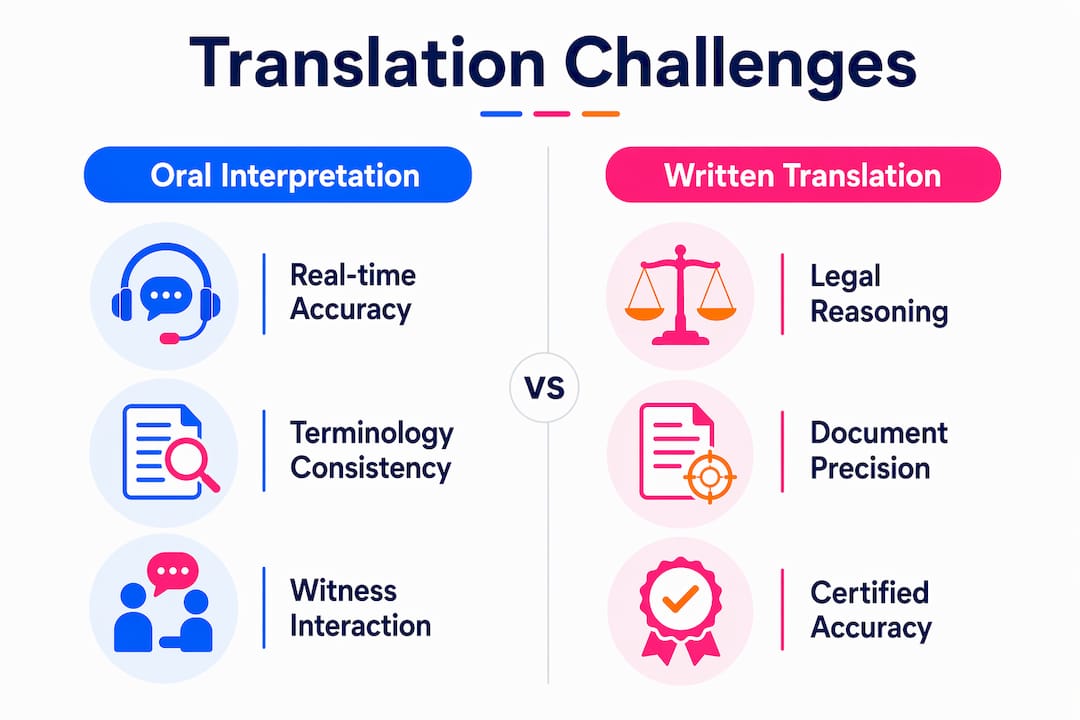
Terminological consistency is the central challenge. The same legal concept must carry the same translated term across pleadings, witness statements, expert reports, and the final award. A single inconsistency gives opposing counsel a foothold to challenge enforceability.
The stakes are highest at the enforcement stage. Mistranslated arbitration awards create procedural challenges and satellite disputes under the New York Convention, the treaty that governs recognition and enforcement of foreign awards in over 170 countries. Courts in the enforcing jurisdiction rely on the translated text. If that text diverges from the original, enforcement can fail.
Practical steps that reduce this risk include:
- Assign the same translation team to the entire proceeding, from the first pleading to the final award
- Build a dedicated translation review phase into the procedural timetable before filing for enforcement
- Certify the final translated award through a recognised certification process accepted in the enforcing jurisdiction
- Conduct a final cross-check between the translated award and the original, focusing on the operative paragraphs
The legal translation vs interpretation distinction matters here too. Written award translation requires different skills from oral interpretation, and conflating the two roles in one appointment is a false economy.
What standards and strategies ensure high-quality legal translation in arbitration?
Quality in arbitration translation is not achieved by hiring any qualified translator. It requires someone who understands the procedural rules of the specific institution governing the case. ICC arbitration, LCIA arbitration, and ICSID proceedings each carry distinct procedural frameworks. A translator who has worked extensively in commercial litigation but never in investor-state arbitration will miss institutional nuances that matter.

| Quality factor | What it means in practice |
|---|---|
| Institutional knowledge | Familiarity with ICC, LCIA, or ICSID procedural rules |
| Subject matter expertise | Prior experience in the relevant sector (construction, finance, energy) |
| Certification | Recognised accreditation accepted in the enforcing jurisdiction |
| Consistency | Same team across all documents and hearings |
| Technology use | CAT tools for terminology consistency, with human review at every stage |
Certified translations prevent delays and non-compliance during both the arbitration and enforcement phases. Certification is not a formality. It is the document’s passport into a foreign court.
Technology assists but does not replace human expertise. Computer-assisted translation tools help maintain terminology consistency across large document sets. They do not exercise legal judgement, and they do not catch the culturally specific implication of a phrase that a trained legal translator would flag immediately. The role of technology in legal translation is to support the human, not substitute for them.
Pro Tip: Ask your translation provider whether they use a translation memory specific to your case. A case-specific memory means every term decision made on day one is automatically applied on day 90.
How do translators manage language barriers in multi-party arbitration?
Multi-party arbitration adds a layer of complexity that single-language proceedings simply do not face. Arbitral tribunals issue procedural orders that define the working language or languages of the proceeding, but those orders also build in flexibility for parties who operate in different legal and linguistic traditions.
The translator in a multilingual arbitration functions as more than a language converter. They mediate between different legal cultures. A concept that exists clearly in civil law may have no direct equivalent in common law, and vice versa. The translator must find the closest functional equivalent and flag where none exists.
Coordination challenges in multi-party cases include:
- Maintaining consistent terminology when multiple translators work on different document sets
- Managing simultaneous interpretation across several language pairs during hearings
- Aligning translated procedural orders with the working language versions to avoid contradictions
- Scheduling translation turnaround times that fit the arbitration’s procedural calendar without creating bottlenecks
The solution is a single point of coordination. Appointing one lead translator or translation provider to oversee all language pairs keeps terminology consistent and prevents the procedural confusion that arises when different teams make independent term decisions. For legal teams seeking practical guidance on legal translation quality controls, the principle is the same: consistency is not accidental, it is managed.
Translators are the silent architects of fair arbitration
Glocco’s view, formed through years of working on legal and arbitration translation projects, is that the translation function is consistently undervalued until something goes wrong. Legal teams budget carefully for counsel fees and expert witnesses. They often treat translation as a procurement afterthought.
That is a mistake with real consequences. Translators are structural pillars of procedural justice, not administrative support. When translation is treated as a commodity, the risk of interpretive error rises, and the arbitrator has no way to detect it. The tribunal depends entirely on the translator’s integrity and competence.
The practical advice is simple: engage your translation provider at the same time you engage your counsel. Build translation review into your procedural timetable from the outset. Insist on institutional knowledge, not just language fluency. And treat the importance of human translators in legal proceedings as a non-negotiable quality standard, not a preference.
The future will bring more AI-assisted translation into arbitration workflows. That is not a threat to quality if human oversight remains central. It is an opportunity to handle larger document volumes with greater consistency, provided the human expert remains in control of every critical decision.
— glocco®
How Glocco supports translation quality in arbitration cases
Glocco has provided specialised legal translation and interpretation services to legal professionals across Europe, the Middle East, and North America since 2014. For arbitration cases, that means subject-matter expertise, institutional knowledge, and certified outputs that hold up at the enforcement stage. Glocco also integrates AI tools for translators to maintain terminology consistency across large document sets, with qualified legal translators reviewing every output. If your next arbitration involves more than one language, the time to engage a specialist is before the first procedural order, not after the first dispute about a translated term.
FAQ
What is the role of translators in arbitration?
Translators in arbitration convert spoken testimony and written documents between languages, ensuring all parties and the tribunal share an accurate, consistent understanding of the facts and legal arguments. They are neutral facilitators, not advocates for either side.
Why does translation accuracy matter for arbitration enforcement?
Mistranslated arbitration awards create procedural challenges under the New York Convention, which governs enforcement in over 170 countries. Courts in the enforcing jurisdiction rely on the translated text, so any divergence from the original can cause enforcement to fail.
What is the difference between a translator and an interpreter in arbitration?
Translators handle written documents such as pleadings, contracts, and awards. Interpreters handle spoken communication during hearings. Both roles require distinct skills, and the differences between them are significant enough that the same professional should not routinely cover both functions in a complex arbitration.
How do institutions like the ICC and LCIA handle translation?
Institutions including the ICC, LCIA, and ICSID embed language and translation provisions directly into their procedural rules. Translators working on these cases must understand those rules to ensure compliance, which is why general legal translation experience is not sufficient on its own.
When should a legal team engage a translator in arbitration?
A legal team should engage a qualified translation provider at the same time as instructing counsel. Building translation review into the procedural timetable from the outset prevents bottlenecks, reduces enforcement risk, and keeps terminology consistent across the entire proceeding.


