


Most legal teams treat translation as the last box to tick before filing. Send the documents off, get them back in another language, done. But that assumption carries real risk. The role of translation in legal compliance is far more strategic than a finishing step. Get the terminology wrong, miss a regulatory nuance, or let inconsistencies creep across language versions, and you are looking at penalties, rejected filings, or worse. This article breaks down how to embed translation into your compliance workflow from the start, what the risks look like in practice, and what 2026’s evolving regulations demand from your team right now.
Translation accuracy in compliance and risk management
Precision in legal translation is not a nice-to-have. It is the difference between a contract that holds and one that does not. Legal terminology is jurisdiction-specific by nature. A term that means one thing under English law may carry an entirely different legal weight under German or French law. When those distinctions get flattened in translation, compliance failures follow.
Consider a cross-border data processing agreement. If “data controller” is mistranslated or inconsistently rendered across language versions, your organisation’s obligations under GDPR become ambiguous. That ambiguity is a liability. Real regulatory penalties have resulted from exactly this kind of terminological drift, not just in data protection but in pharmaceutical submissions, financial disclosures, and employment contracts.
Here is where certified and sworn translations earn their place. Many jurisdictions require them for legal documents submitted to courts, regulators, or government bodies. These formats provide a formal guarantee of accuracy and are often non-negotiable for compliance purposes.
What actually prevents these problems in practice:
- Certified translators with subject-matter expertise in your specific legal domain
- Terminology glossaries that lock in approved translations for key legal terms across all your documents
- Translation memories that ensure consistency whenever a clause or phrase recurs across filings
- Controlled terminology databases that keep legal terms aligned across multi-language versions
Pro Tip: Build your terminology glossary before a major multilingual filing. Waiting until after drafting means you will spend twice the time reconciling inconsistencies across language versions.
Embedding translation into legal workflows
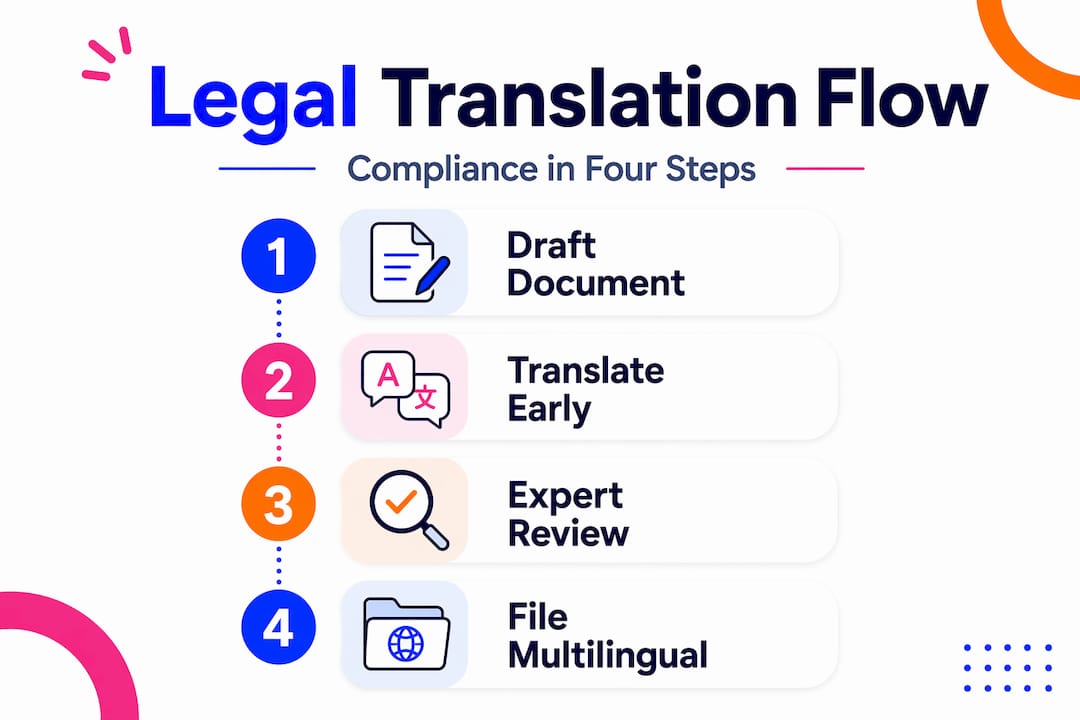
The old model looks like this: drafting finishes, documents go to a translation vendor, everyone waits. The new model, and the one that actually reduces compliance risk, runs translation in parallel with drafting. Legal operations leaders are increasingly treating translation as a core function rather than a downstream service.
Why does timing matter so much? Because regulatory filings rarely happen in isolation. A product approval in the EU might require simultaneous submission in five languages. If translation only starts when drafting ends, your timelines collapse. If terminology decisions get made without the translation team present, you create inconsistencies that take days to fix later.
Here is a practical approach to integrating translation into your legal workflow:
- Appoint a translation lead at project start. This person coordinates between legal drafters and translators from day one, not after the fact.
- Agree on a master document structure. Running translation in parallel with drafting consolidates multiple country-specific versions into a single master document for regulatory approval.
- Establish version control from the outset. Every language version must track to the same source document version. Divergences create compliance gaps.
- Use a centralised translation memory. This is your organisation’s institutional knowledge for how legal terms should be rendered, updated as regulations evolve.
- Plan for amendments. Regulations change. Your translation workflow needs a clear process for pushing updates across all language versions simultaneously.
Pro Tip: When your source document changes, treat it as a translation event, not just an editorial one. Flag every amended clause to your translation team the moment it is revised.
The payoff is measurable. Consistency and coordination in legal translation workflows are as critical as linguistic accuracy. Minor inconsistencies across language versions are a known cause of regulatory compliance failures, and they are almost entirely preventable with the right workflow.

AI translation tools: promise and pitfalls
AI translation has changed the speed equation for legal teams. What used to take weeks can now take hours. But speed without oversight is a compliance trap, and this is one area where the legal sector cannot afford to learn the hard way.
The core issues with AI translation in legal and compliance contexts:
- Accuracy gaps. AI tools still struggle with legal nuance, jurisdiction-specific terminology, and complex sentence structures common in regulatory documents.
- Liability. If an AI-generated translation contains an error that causes a compliance failure, accountability is unclear. Human reviewers are your documented safeguard.
- Data privacy. GDPR and the EU AI Act impose specific obligations on how AI translation tools handle sensitive legal data. Feeding confidential documents into a generic AI tool may itself constitute a compliance breach.
- Audit trails. Translation workflows must capture each step and reviewer to meet regulatory documentation standards. Most off-the-shelf AI tools do not do this automatically.
“AI-assisted translations must be approached cautiously by compliance teams, requiring layered validation to comply with strict legal and data privacy regulations.” — PMC Research on AI translation tools
The practical answer is not to avoid AI. It is to use it with documented human oversight. Human expert review integrated within quality management systems is the current best practice for AI translation in legal contexts. Every AI-generated translation should pass through a qualified legal translator before it touches a regulatory submission. You can find more on balancing these tools in glocco®’s overview of AI translation tools.
Jurisdiction-specific challenges and new regulatory demands
Regulations do not stand still, and neither do their translation obligations. The EU Biotech Act 2026 is a sharp example. It requires clinical trial materials to be submitted in multiple languages with harmonised terminology, and it sets accelerated authorisation timelines that make late-stage translation simply unworkable.
Here is how the demands of evolving regulations compare to traditional translation approaches:
| Traditional approach | Regulatory requirement (e.g. EU Biotech Act 2026) |
|---|---|
| Translate after drafting | Translate alongside drafting |
| Ad hoc terminology decisions | Harmonised, pre-approved terminology |
| Separate language versions | Single master document with version control |
| Translation as a one-off task | Continuous updates with regulatory amendments |
| No formal glossary | Mandatory translation memory usage |
The strategic response is to build your multilingual documentation infrastructure before a regulation goes live, not after. That means creating master documents with translation in mind from the first draft, establishing approved terminology with your translators, and setting up a workflow that can absorb regulatory updates without triggering a full rework. For EU-facing teams, legal translation quality practices are now a direct compliance matter, not a language services preference.
My view: translation is a compliance function, not a language service
I have seen what happens when translation gets treated as a vendor task to be sorted at the end of a project. Missed regulatory deadlines. Terminology inconsistencies that required entire document sets to be resubmitted. Legal teams scrambling to reconcile five language versions that no longer matched the source.
What changed outcomes was not better technology. It was treating translation as part of the legal team’s responsibility from day one. When legal translation is embedded in operations rather than outsourced as an afterthought, compliance consistency follows naturally.
The human factor matters enormously here. Tools and translation memories are only as good as the legal linguists who build and maintain them. The most critical decisions in legal translation, such as how a specific obligation reads under local law, cannot be automated. They require subject-matter expertise and professional judgement.
What legal professionals most often overlook is that how translation affects law is not just about words. It is about whether your legal obligations read the same way in every jurisdiction you operate in.
— glocco®
Work with specialists who understand compliance
If your organisation is managing multilingual legal documents across jurisdictions, glocco® can help you build a translation workflow that holds up under regulatory scrutiny. glocco® works with legal teams and compliance officers to provide certified translations, terminology management, and version-controlled multilingual documentation.
Whether you are preparing for EU regulatory submissions, managing cross-border contracts, or adapting to new legislation in 2026, glocco®’s legal translation specialists bring both linguistic precision and compliance knowledge to every project. Start with the EU document translation guide or explore how to translate legal documents accurately with the right workflow in place. Reducing compliance risk starts with getting the right people involved at the right stage.
FAQ
What is the role of translation in legal compliance?
Translation ensures that legal obligations, regulatory requirements, and contractual terms are accurately communicated across languages and jurisdictions. Mistranslations or inconsistencies in legal documents can lead to compliance failures, penalties, or rejected regulatory filings.
Why does translation accuracy matter for compliance officers?
Translation accuracy in compliance determines whether your legal documents convey the same obligations in every language version. Even minor terminology inconsistencies across multilingual documents can create regulatory gaps or expose your organisation to legal liability.
When should translation be integrated into legal workflows?
Translation should begin alongside document drafting, not after it is complete. Running translation in parallel with drafting, as required by frameworks like the EU Biotech Act 2026, reduces errors, maintains consistency, and meets accelerated regulatory timelines.
What are the main challenges in legal translation?
The main challenges in legal translation include jurisdiction-specific terminology, maintaining consistency across multiple language versions, managing regulatory updates, and ensuring AI translation tools comply with data privacy obligations under GDPR and the EU AI Act.
Do AI translation tools meet legal compliance standards?
AI translation tools can support speed and efficiency but require documented human review to meet legal compliance standards. GDPR and the EU AI Act impose specific obligations on AI data handling, and AI-generated translations alone are not sufficient for regulatory submissions without expert oversight.


