


Most people think machine translation is just Google Translate. It’s not. Machine translation explained properly is a technology category that now sits at the heart of global communication, content localisation, and enterprise workflows across dozens of industries. Understanding what is machine translation, how it works, and where it fits alongside human expertise is no longer a “nice to know” for language professionals. It’s genuinely useful knowledge for anyone operating across borders, whether you’re running an e-commerce store, managing legal documents, or building software for international markets.
How machine translation works
Machine translation has come a long way since the 1950s, when systems tried to convert text using rigid, hand-coded grammatical rules. Those early rule-based systems were brittle. They broke down the moment language got idiomatic, ambiguous, or domain-specific.

The leap forward came with statistical machine translation, which analysed vast bilingual corpora to predict likely translations based on patterns. That was a genuine step up. But the real shift arrived with neural machine translation (NMT). NMT uses deep learning to process entire sentences at once rather than word by word, capturing context in a way earlier systems simply could not.
Today, NMT and large language models dominate enterprise benchmarks. Tools powered by these approaches can produce fluent, near-publication quality output for common language pairs and general content.
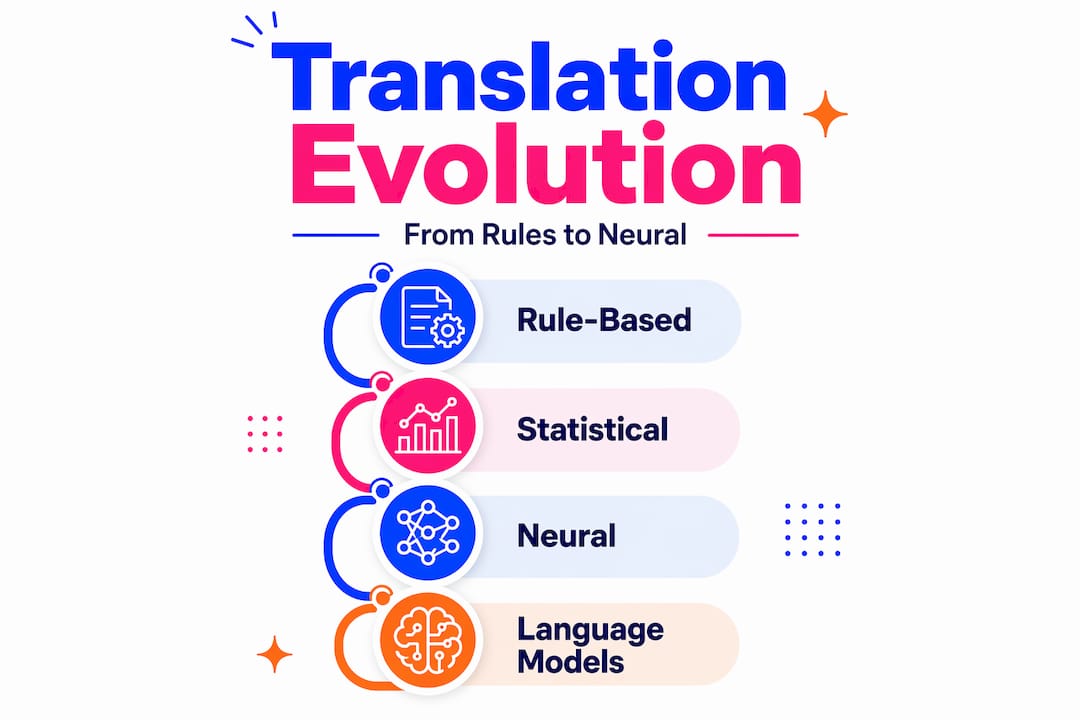
| MT type | Method | Strengths | Limitations |
|---|---|---|---|
| Rule-based (RBMT) | Hand-coded grammar rules | Predictable, good for structured text | Rigid, poor with idioms and ambiguity |
| Statistical (SMT) | Pattern matching from bilingual data | Flexible, scalable | Context often lost at sentence level |
| Neural (NMT) | Deep learning across whole sentences | Fluent output, strong context handling | Can hallucinate plausible but wrong translations |
| Large language models | Transformer-based AI (e.g. GPT family) | Excellent general quality, adaptable | Requires careful prompting and quality control |
Pro Tip: If you’re evaluating MT engines for your business, test them on a representative sample of your own content, not generic benchmarks. Industry-specific terminology behaves very differently from general prose.
Why use machine translation?
The numbers tell the story. The AI translation market is projected to reach $8.93 billion by 2030, growing at a compound annual rate of 24.8%. That’s not a niche trend. That’s a technology category going mainstream at speed.
The core advantages are straightforward.
- Speed. MT can process thousands of words in seconds. A document that would take a human translator a full working day can be available in minutes.
- Cost savings. Raw MT output costs a fraction of full human translation. Even when combined with professional post-editing, organisations routinely report significant savings.
- Scale. MT makes it practical to translate large content volumes that would be unaffordable at full human rates. Think product catalogues, customer support archives, or multilingual knowledge bases.
- Accessibility. MT tools let smaller organisations access multilingual content that once required large translation budgets.
- Real-time communication. Live chat support, instant messaging, and customer service platforms increasingly use MT to offer on-the-spot multilingual dialogue.
The applications span a remarkable range of sectors. E-commerce businesses use MT to localise product listings. Software companies use it to translate user interfaces. Healthcare organisations use it as a first-pass tool for internal documents. Legal teams use it to process high volumes of foreign-language materials before human review.
Pro Tip: MT works best on well-written, consistently formatted source content. Before running anything through an MT engine, review your source text for clarity. Garbage in, garbage out applies here more than almost anywhere else in content production.
Machine translation vs human translation
This is where the conversation gets interesting. MT is not a replacement for human translators. It is, in practice, a different kind of tool that works best alongside them.
The dominant workflow in the industry today is machine translation post-editing (MTPE). A professional translator reviews and corrects MT output rather than translating from scratch. MTPE adoption nearly doubled from 26% to 46% between 2022 and 2024, with organisations reporting cost savings of 30 to 50% compared to human-only translation.
| Workflow | Best suited for | Cost vs human-only | Quality level |
|---|---|---|---|
| Raw MT output | Internal documents, gist translation | Lowest | Variable |
| MT + light post-editing | Internal comms, informational content | 30-40% saving | Good |
| MT + full post-editing (MTPE) | Customer-facing, regulated content | 30-50% saving | Publication quality |
| Full human translation | Legal, medical, creative, high-stakes | Baseline | Highest |
“The most effective MT workflows integrate subject-matter expert review where errors carry the highest cost, balancing efficiency and accuracy at every tier.”
Where MT genuinely falls short is cultural nuance, creative adaptation, and high-stakes regulated content. A contract translated by MT alone may read fluently while containing a materially wrong interpretation of a legal term. A medical leaflet may sound accurate while carrying a dosage ambiguity that a specialist would immediately flag. In those contexts, legal and medical translation demands full human expertise, not a cost shortcut.
Challenges and pitfalls of machine translation
Here’s what catches organisations off guard. MT output often sounds right even when it is wrong. The fluency of modern neural systems can mask errors that are genuinely dangerous in the wrong context.
The most common pitfalls include:
- Hallucinated specifics. MT systems can confidently produce wrong numbers, names, or technical terms while the surrounding text reads perfectly.
- Terminology inconsistency. Without a controlled glossary, the same term may be translated three different ways across a single document.
- UI/UX localisation failures. Software localisation needs human context beyond linguistic accuracy. Text expansion, button labels, and navigation strings all require contextual judgement MT cannot reliably provide.
- Cultural missteps. Phrases that are neutral in one cultural context can be jarring or offensive in another. MT has no cultural instinct.
- Regulatory exposure. AI translation alone carries legal and financial risk in regulated industries. Accountability and governance structures are not optional when compliance is on the line.
The practical response is to tier your content by risk. Internal memos and rough research documents? Raw MT may be perfectly adequate. Marketing copy, customer communications, and anything regulatory? Build human review into the process before publication.
Pro Tip: Audit your translation workflow by content type, not just cost. Ask: “What happens if this translation contains an error?” If the answer involves legal liability, patient safety, or brand reputation, human oversight is not an expense. It’s risk management.
Machine translation and language learning
MT and language learning are often lumped together in conversations about AI. They serve genuinely different purposes. MT excels at immediate signal transfer, getting meaning from A to B quickly. Language learning builds cognitive competence, cultural understanding, and long-term communicative ability through effortful practice.
Research shows that students using MT tools tend to rely on them for simpler tasks, which can reduce motivation and limit the deep language acquisition that comes from working through difficulty. Educators increasingly call for clear guidelines on MT use in educational settings, not to ban it, but to use it deliberately.
Think of MT as accessibility infrastructure. It reduces friction for people who need to communicate across languages right now. It does not build the kind of cultural competence that comes from language learning and MT serving their distinct purposes side by side. The two are complementary, not interchangeable.
Our take: the process matters more than the tool
I’ve worked with clients across fintech, legal, medical, and e-commerce who’ve arrived with the same assumption: “We’ll just run it through an AI tool and that’ll do.” It never quite does.
What I’ve consistently seen is that the quality of a translation project is determined far more by the workflow design around the MT tool than by the tool itself. Which content gets human review? Who is reviewing it? Do they have subject-matter expertise or just language skills? These are the questions that actually determine outcomes.
The AI translation sector is growing fast and genuinely impressive. But impressive fluency is not the same as reliable accuracy. I’ve learned to be more impressed by a well-designed MTPE workflow than by a flashy demo that produces beautiful sentences with quietly wrong facts buried inside them.
My honest advice: embrace MT as a powerful assistant. Use it to process volume, reduce turnaround times, and cut costs on appropriate content. Then be deliberate and protective about where you bring in expert AI translation support. That’s where the real return on investment lives.
— glocco®
How glocco® can help your multilingual workflow
At glocco®, we’ve been combining machine translation technology with specialist human expertise since before MTPE became an industry standard. We don’t just run content through an engine and call it done. We tier content by risk, apply the right level of review, and make sure terminology stays consistent across your materials.
Whether you need document translation for EU markets, precise legal document translation, or a scalable multilingual content workflow for e-commerce or software localisation, glocco® builds the process around your specific needs. The result is quality you can rely on, at a cost that makes sense for your volume. Get in touch and let’s talk about what the right translation workflow looks like for your business.
FAQ
What is machine translation in simple terms?
Machine translation is the automatic conversion of text from one language to another by a computer system, using rules, statistical patterns, or neural AI models to produce translated output without a human translator.
How does machine translation differ from human translation?
Human translation offers cultural nuance, subject-matter judgement, and accountability that MT cannot reliably replicate. Most professional workflows today combine both, using MT for speed and volume, and human review for accuracy and quality.
What are the best uses for machine translation?
MT works well for internal documents, large-volume content, real-time communication, and gist translation. Customer-facing content, legal materials, and medical documents benefit from human post-editing to meet the required quality standard.
Is machine translation accurate enough for legal or medical content?
Not without human review. Legal and medical translation carries regulatory and safety implications where MT errors can have serious consequences. A professional MTPE workflow with specialist reviewers is the appropriate standard for regulated content.
What is machine translation post-editing (MTPE)?
MTPE is the process where a professional translator reviews and corrects MT output. Adoption nearly doubled from 26% to 46% between 2022 and 2024, delivering publication-quality results at 30 to 50% lower cost than full human translation.


