


Most legal professionals assume that handing documents to a translator is no different from handing them to a solicitor. It is not. The role of confidentiality in legal translation is far more complex than a signed NDA and a polite request to “keep it quiet.” Sensitive contracts, litigation files, and compliance records change hands during translation. If that process is not secured properly, the consequences range from GDPR fines to collapsed client relationships. This guide covers the obligations, the risks that technology introduces, and the practical steps that actually work.
Legal and ethical foundations of confidentiality
Confidentiality in legal translation is not just a box to tick on an onboarding form. As foundational translation ethics make clear, it is an ethical principle that governs every decision a translator makes, from which tools they use to how they store files after delivery.
The professional and legal obligations sitting underneath that principle include:
- NDAs and confidentiality agreements: These set out the contractual baseline, specifying what can be shared, stored, and for how long.
- Professional codes of conduct: Bodies such as the Chartered Institute of Linguists require members to maintain strict confidentiality as a condition of membership.
- GDPR and data protection law: Any personal data processed during translation, including names, addresses, or financial details in a contract, falls under GDPR jurisdiction. A breach is not just an embarrassment. It is a regulatory event with real financial consequences.
- Reputational risk: Clients in legal, fintech, and regulated industries will not return to a provider that cannot demonstrate data discipline.
Pro Tip: Always clarify with your translation provider whether their confidentiality agreement covers sub-contractors and freelancers. Many data breaches happen not through the main agency, but through an unsecured third party in their supply chain.
The impact of GDPR on legal translation is significant enough that compliance officers now treat translation workflows as part of their broader data governance reviews. That is exactly where they should sit.
Confidentiality challenges with AI and digital tools
Here is where things get genuinely complicated. Many translation teams have adopted cloud-based AI tools to speed up workflows. The efficiency gains are real. The risks, however, are equally real and often underestimated.

Cloud-based AI platforms may store user inputs and use submitted data to further train their models. When a legal translator pastes a confidentiality clause or a witness statement into such a tool, that text could be retained on servers outside the firm’s control, potentially violating GDPR and certainly violating most client NDAs.
The risks compound quickly:
- Data residency issues: Cloud servers are often located outside the EU, creating cross-border data transfer complications under GDPR Chapter V.
- Model training exposure: Some AI providers explicitly state in their terms that submitted content may be used to improve the model.
- Lack of audit trail: When a document passes through a cloud platform, you often cannot prove where it went or who accessed it.
- Compliance failures with real costs: A €4.2 million GDPR fine was imposed in 2023 due to inappropriate cloud-based AI translation use violating data privacy.
“Confidentiality risks with cloud AI stem from lack of contractual NDAs and data control. Offline AI is now considered essential for legal translation confidentiality compliance.”
The lesson is straightforward. Speed is not worth a regulatory investigation. The role of technology in legal translation workflows must always be evaluated against its data handling practices, not just its output quality.
Best practices for confidential legal translation
Getting this right does not require choosing between speed and security. It requires choosing the right tools and processes. Here is what actually works.
| Approach | Cloud-based AI tools | Offline-first AI tools |
|---|---|---|
| Data leaves the device | Yes, by default | No, processing is local |
| NDA compliance | Often at risk | Maintained |
| GDPR Chapter V risk | High | Minimal |
| Audit trail available | Varies | Yes, via local logs |
| Suitable for legal content | Only with strict vetting | Yes |
Offline-first AI translation software runs solely on local devices, meaning documents never reach a cloud server or a third-party AI trainer. For legal teams handling sensitive files, this architecture satisfies strict NDAs while retaining the speed benefit of AI assistance.
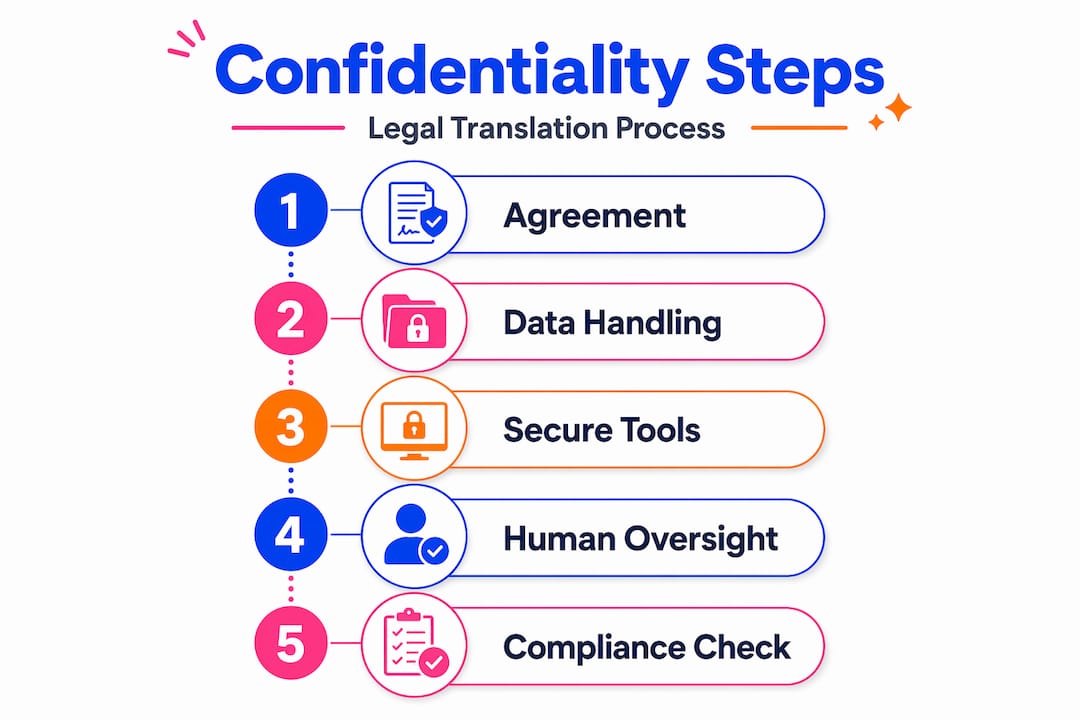
Beyond tool selection, these practices form the backbone of a confidential legal translation process:
- Terminology glossaries and translation memories: Controlled terminology prevents ambiguous language and reduces the risk of misrepresentation in contracts or compliance documents. Consistency is itself a form of data protection.
- Multi-stage validation: Immutable audit trails and event-sourced document workflows allow forensic-level tracking of every change. If a dispute arises, you can prove exactly what was translated, when, and by whom.
- Clear confidentiality clauses in client agreements: Specify which tools may be used, where data is processed, and what happens to files after delivery.
Pro Tip: Ask your translation provider to conduct a Data Protection Impact Assessment (DPIA) before beginning any project involving personal data. Under GDPR Article 35, this is required for high-risk processing. A provider who cannot produce one is a liability.
Good legal document translation depends on accurate language and locked-down processes in equal measure.
How confidentiality supports legal operations
There is a bigger picture here beyond individual documents. Legal translation is now embedded within ongoing legal operations workflows, which means confidentiality is a live, continuous requirement rather than something you address at the start of a project and forget.
| Key area | Confidentiality impact |
|---|---|
| Contract management | Consistent, version-controlled translations prevent contradictions across language versions |
| Compliance documentation | Secure handling protects regulatory filings from unauthorised disclosure |
| Litigation support | Audit trails validate translated evidence and maintain admissibility |
| Cross-border operations | Data governance alignment across jurisdictions reduces exposure |
Document versioning and coordinated terminology across multiple languages help legal teams maintain clarity without inadvertently exposing sensitive drafts. When translation is treated as an integrated workflow function rather than an afterthought, confidentiality becomes easier to manage, not harder. It also produces better documents, because consistency and accuracy travel together.
The importance of skilled human oversight in this context cannot be overstated. Automated tools handle volume; qualified legal translators handle judgement, nuance, and accountability.
My take on what most teams still get wrong
I have worked with legal translation projects across multiple jurisdictions, and the same mistake keeps appearing: teams treat confidentiality as a contractual formality rather than an operational discipline.
Signing an NDA does not protect a document once it has been pasted into a cloud AI tool. I have seen compliance officers who were meticulous about data governance in every other area of their business completely overlook what happened to files during the translation stage. The assumption was that the translator “sorted it.” That assumption is expensive.
What I have found actually works is transparency, specifically, providers who can tell you exactly what happens to your data at each step, which tools process it, and where files are stored. Clear client disclosure about whether translation exposes documents to cloud platforms is now a differentiator in the market. It should be a minimum standard.
The shift to offline AI models is not just a technical preference. It is a commercial argument. Providers who can demonstrate local processing command premium rates, and rightly so, because they are taking on real accountability. If you are a translation manager reading this, that is the conversation to have with your current provider today.
— glocco®
Work with a partner who takes confidentiality seriously
At glocco®, we know that legal translation is not just about the words on the page. It is about the data behind them, the systems that process them, and the professionals accountable for every step. Our legal document translation services are built around confidentiality-first workflows, combining qualified legal translators with processes designed for GDPR compliance and strict NDA environments. Whether you need certified translations, cross-border legal support, or guidance on handling sensitive materials, we are ready to help. Explore our EU business translation guide to see how proper confidentiality standards work in practice.
FAQ
What is the role of confidentiality in legal translation?
Confidentiality in legal translation protects sensitive client data, satisfies GDPR requirements, and maintains the integrity of legal documents throughout the translation process. It operates as both an ethical obligation and a contractual requirement for all parties involved.
Why do cloud AI tools risk legal translation privacy?
Cloud-based AI platforms may store submitted content and use it for model training, which can violate GDPR and breach client NDAs. Offline-first AI tools process data locally, eliminating this exposure entirely.
What should a confidentiality agreement in translation cover?
A confidentiality agreement for translation should specify which tools may be used, where data is processed and stored, sub-contractor obligations, and what happens to files after the project is complete.
How does GDPR affect data protection in legal translation?
GDPR requires that personal data in legal documents is processed lawfully, securely, and only for specified purposes. Translators and providers handling such data must implement appropriate technical and organisational safeguards, including DPIAs for high-risk projects.
How does confidentiality affect legal translation quality?
Strong confidentiality practices, such as controlled terminology and audit trails, directly support accuracy and consistency. When translators work within secure, structured workflows, the quality and legal validity of the output improves alongside the data protection standards.


