


Pharmaceutical content must be localised for the UK to protect patient safety, satisfy MHRA and NHS expectations, and secure market access. That is the short answer. The longer one is that a mistranslated dosage instruction or a culturally tone-deaf patient leaflet can trigger adverse events, stall regulatory approvals, and cost far more to fix than it would have cost to get right from the start.
Here is what that means in practice:
- MHRA compliance: the Medicines and Healthcare products Regulatory Agency requires that patient-facing and HCP-facing materials meet specific language and readability standards before a product can be distributed in Great Britain.
- NHS patient information standards: the NHS sets clear expectations for plain-language, accessible patient materials; content that does not meet these standards risks rejection or costly revision cycles.
- ISO 17100: this international standard for translation services is the baseline quality benchmark buyers should require from any language-services provider.
- Business outcomes: well-executed localisation shortens approval timelines, improves patient adherence, and reduces the regulatory queries that delay launches.
glocco® works with medical and pharmaceutical teams to deliver exactly this, combining medically-qualified reviewers with modern localisation tooling.
Which pharma assets actually need localising?
“Pharma content” covers a wider range of materials than most teams initially budget for. Getting the scope right early prevents nasty surprises mid-project.
Regulatory and clinical documents:
- Patient Information Leaflets (PILs) and Summary of Product Characteristics (SmPC)
- Labelling and packaging copy
- Clinical trial materials: Informed Consent Forms (ICFs), Case Report Forms (CRFs)
- Regulatory submissions and safety reports (including pharmacovigilance documents)
Commercial and HCP-facing materials:
- Promotional and non-promotional marketing copy
- eDetailing and digital sales aids
- HCP training materials and medical education content
- Patient support programmes and adherence tools
Digital and multimedia:
- Website content, patient portals and mobile apps
- Video subtitles, voiceover scripts and eLearning modules
Format matters too. The same core content may need localising across print PDFs, HTML pages, eDetailing platforms, and video. Each format brings its own technical requirements. Some assets, particularly PILs and SmPC documents, require therapeutic SME review and separate regulatory sign-off before they can be published. Local market preferences and communication channels also influence what gets localised and how, so a one-size-fits-all approach to global materials rarely holds up in the UK.
What are the real business and safety benefits?
Localisation has moved from a cost centre to a strategic requirement for global pharma. Here is what that shift looks like in concrete terms.
Patient safety and adherence: local language and culturally appropriate phrasing reduces drug misuse and improves adherence. Patients who understand their medication instructions are more likely to follow them correctly, which directly lowers adverse event rates.
Regulatory efficiency: fewer query cycles with the MHRA means faster approvals and earlier distribution. Content that already meets NHS patient information standards arrives at the review stage in far better shape.
Commercial impact: stronger HCP engagement, higher product uptake, and improved patient outcomes all feed back into brand trust and market share. These are measurable returns, not soft benefits.
Operational savings: translation memory and modular content reuse lower the long-term cost per language significantly. Once a controlled glossary and style guide are in place, repeat updates cost a fraction of the original project.
Statistic callout: improved localisation workflows have been shown to cut localisation errors by 60% in regulated sectors, with faster time-to-publish for compliant assets. This figure is supported by industry case studies.
What UK regulatory rules do you need to know?
The UK’s post-Brexit regulatory framework means you are working with MHRA requirements that now diverge from the EMA in meaningful ways. That is not a minor administrative detail.
- MHRA: governs the approval of medicines and medical devices in Great Britain; all patient-facing and HCP-facing content must align with its guidance on labelling, PILs and promotional materials.
- NHS patient information standards: set readability and accessibility expectations for patient materials distributed through NHS channels; plain English, appropriate reading age and clear layout are all assessed.
- Promotional vs non-promotional content: the distinction matters legally. Promotional materials require pre-approval and carry stricter claims rules; non-promotional content (PILs, SmPCs) follows a different review path. Wording that is acceptable in one category can be non-compliant in the other.
- Staggered approvals: different indications may receive approval at different times, meaning content versions must be carefully version-controlled to reflect only what is currently approved for the UK market.
- Required trust signals: medically-qualified translators, SME clinical review, linguistic validation, and ISO 17100 certification from your language-services provider are not optional extras. They are what the MHRA expects to see in an auditable sign-off trail.
Pro Tip: involve your regulatory and medical reviewers at the content-authoring stage, not after the first draft is complete. Late-stage wording changes following regulatory sign-off are one of the most expensive and time-consuming problems in pharma localisation.
Should you localise early or at the end of the process?
Early. Every time. Localise early and treat it as a design activity, not a final administrative step.

The modular content approach is the practical way to do this. Build a single source of truth, typically the Core Data Sheet or master SmPC, then structure content into reusable blocks stored in a digital asset management (DAM) system. When a block is updated centrally, local versions update consistently rather than diverging into conflicting safety information across markets.
Involving local teams early during content creation means regional regulatory constraints, local epidemiology and market-specific messaging are captured before roll-out, not retrofitted under deadline pressure. For UK launches, that means your localisation partner needs a seat at the table when the master asset is being authored.
Pro Tip: build your controlled glossary and site-specific style guide while the source asset is being created. Translators who work from a pre-approved terminology database preserve clinical intent far more reliably than those working from scratch.
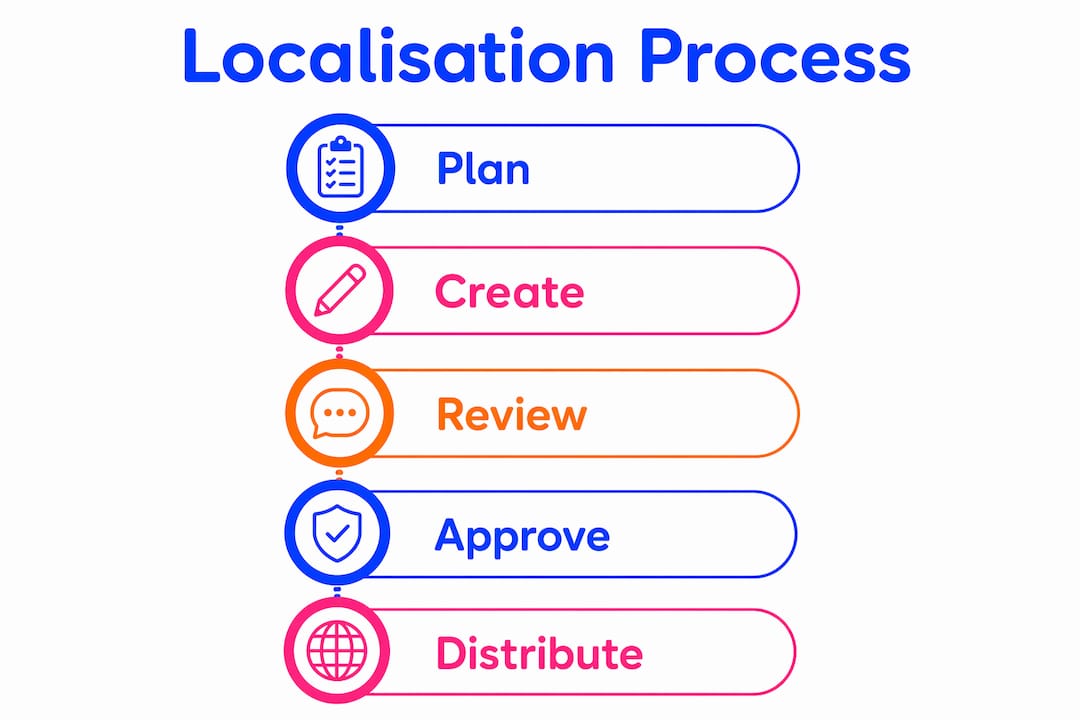
How does a pharma localisation workflow actually run?
A well-structured workflow removes ambiguity and keeps regulated assets on track. Here is the sequence that works.
- Planning: define the full asset list, target audiences (HCP vs patient), regulatory constraints, and required legal sign-offs before a single word is translated.
- Source-of-truth creation: produce the Core Data Sheet, master SmPC/PIL, approved clinical claims, and a controlled glossary or terminology database.
- Modular authoring: write translation-friendly source content (short sentences, no idioms, consistent terminology) and structure assets into reusable blocks.
- Vendor and tooling setup: configure translation memory, CAT tools, DAM integration, and format support for PDF, HTML, eDetailing and video. Content strategy planning at this stage prevents costly rework later.
- Translation and clinical review: forward translation by medically-qualified translators, SME review, and linguistic validation or back-translation where the asset type requires it.
- Technical QA: layout checks, character-set validation, typography, numeric formatting, and format-specific testing (subtitle timing, right-to-left scripts where relevant). A thorough localisation testing process catches errors before they reach regulators.
- Regulatory approval and publishing: MHRA/NHS sign-off and version control for staggered approvals.
- Maintenance: update master assets, push modular changes, and collect local feedback for continuous improvement.
What quality controls should you demand from a vendor?
Quality in pharma localisation is not a checkbox. It is an auditable process with documented evidence at every stage.
- Medically-qualified translators: translators with relevant therapeutic-area expertise, not generalists.
- SME clinical review: a subject-matter expert independent of the translator reviews the output for clinical accuracy.
- Linguistic validation: for patient-reported outcomes and PILs, linguistic validation confirms the translated content is understood as intended by the target population.
- Back-translation: where required by the asset type or regulator, a separate translator renders the target-language version back into English for comparison with the source.
- ISO 17100 certification: the baseline standard for translation services; any provider working on regulated pharma content should hold this.
- Documented sign-off: an auditable trail of who reviewed what, when, and what changes were made. This is what the MHRA expects to see.
- Terminology consistency checks: dose wording, safety statements and numeric formatting must be consistent across every asset version. Medical content localisation requires scientific accuracy and regulatory alignment, not just linguistic fluency.
Pro Tip: ask any prospective vendor for a sample translation of a short regulated document, their documented QA checklist, and a named clinical reviewer with verifiable credentials. If they cannot provide all three, keep looking.
How long does pharma localisation take, and what drives the cost?
Timeline and cost vary considerably by asset type. The table below gives practical reference points.
| Asset type | Typical lead time | Main cost drivers |
|---|---|---|
| PIL / SmPC | 3–6 weeks | SME review, linguistic validation, regulatory sign-off |
| Marketing brochure | 1–2 weeks | Desktop publishing, claims review |
| Clinical trial ICF/CRF | 4–8 weeks | Back-translation, ethics committee review |
| Video (subtitles/voiceover) | 2–4 weeks | Multimedia engineering, lip-sync, timing |
| Regulatory submission | 6 weeks | Volume, SME input, version control |
Translation memory reduces repeat costs substantially. Once a controlled glossary and TM are in place, updates to existing assets can cost a fraction of the original. Modular authoring tools and DAM integration improve scalability further, allowing local visual edits without heavy engineering effort each time.
How do you measure whether localisation is working?
Measuring success turns localisation from a cost line into a demonstrable investment. Build a scorecard around these KPIs.
Safety and compliance KPIs:
- Reduction in MHRA query cycles per submission
- Adverse event reports linked to misinterpretation of patient materials
- Error rate in localised content (pre- and post-workflow improvement)
Commercial KPIs:
- Time-to-market per asset type and language
- HCP engagement metrics for localised digital materials
- Patient adherence rates in markets with localised support content
Operational KPIs:
- Cost per translated word after translation memory reuse
- Turnaround time per asset type
- Volume of content reused from modular blocks vs created from scratch
Methods worth using include A/B testing of patient copy variants, HCP feedback surveys on localised materials, analytics for digital content, and post-launch pharmacovigilance monitoring. Tie each metric back to a business or safety objective so the scorecard has meaning for senior stakeholders, not just the localisation team.
What mistakes do pharma teams make most often?
These are the pitfalls that cause delays, non-compliance, and safety incidents. Most are avoidable.
- Late-stage localisation: starting translation after regulatory sign-off forces wording changes that restart the approval clock.
- No single source of truth: local teams producing their own versions of safety content creates inconsistent, uncontrolled information across markets.
- Machine translation without SME review: MT output for regulated content without clinical review is a compliance risk, full stop.
- Insufficient technical QA: layout breaks, incorrect numeric formatting, and readability failures for low health-literacy audiences are caught only by proper format testing.
- Ignoring local channels and culture: copying global materials verbatim misses local communication preferences, channel habits, and cultural sensitivities that affect uptake and adherence.
glocco®’s perspective on what actually works
The teams that get pharma localisation right share one habit: they treat it as part of product development, not a post-production task. At glocco®, the projects that run most smoothly are the ones where we are involved before the source content is finalised. That means contributing to the glossary, flagging translation-unfriendly phrasing in the master document, and aligning with the regulatory team on sign-off requirements before a single target-language word is written.
The difference this makes to a UK launch timeline is real. When localisation is retrofitted, teams routinely face two or three additional review rounds with the MHRA because the translated content introduces ambiguity the source did not have. When it is built in from the start, those cycles shrink.
What to ask a potential vendor before you commit:
- Can you provide a sample translation of a short regulated document within 48 hours?
- What is your policy on translation memory ownership: does the TM stay with us?
- Who are your clinical reviewers, and can you share their therapeutic-area credentials?
- How do you handle version control for staggered regulatory approvals?
- Are you ISO 17100 certified, and can you share your documented QA checklist?
glocco® can scope your pharma localisation project today
glocco® provides pharma-capable localisation services for UK-based and international pharmaceutical teams: medically-qualified translators, SME clinical review, linguistic validation, back-translation, and full tooling integration including translation memory, CAT tools, and DAM connectivity. Whether you are launching a PIL, localising an SmPC, or migrating to a modular content architecture, the team can scope the project and identify where the commercial benefits of localisation are greatest for your asset mix. Get in touch to request a sample translation, a quote, or a short discovery call with a pharma localisation specialist.
Useful sources and further reading
- MHRA guidance on labelling and patient information
- NHS patient information standards
- Best Practices for International Pharma Content Roll-Out (Certara)
- Top Content Localisation Strategies in Pharma (Viseven)
- Adapting medical content for global audiences (Elion)
- Localisation as a global pharma strategy requirement (Kearney)
- Language localisation workflow: cut errors in regulated sectors (glocco®)
- Localisation testing explained (glocco®)
- Sector-specific localisation for compliance and reach (glocco®)
This article is general information, not regulatory or legal advice. Confirm current MHRA requirements and NHS standards with the relevant primary sources or a qualified regulatory professional for your specific situation.


