


Cross-border language solutions prevent legal, safety, and commercial failure by making multilingual communication auditable, accurate, and accountable. Without them, organisations face rejected evidence, regulatory fines, and patient safety incidents — not because of bad intent, but because unverified translation or ad-hoc interpretation cannot carry legal or ethical accountability. In UK courts, immigration tribunals, clinical trials, and financial disclosures, the question is never just “was it translated?” It is “was it translated accurately, by a qualified professional, with a signed statement and an audit trail?” That distinction is what separates a usable document from an inadmissible one.
Key reasons organisations invest in professional language services:
- Legal admissibility: UK courts expect translated evidence to meet specific attestation standards.
- Regulatory compliance: GDPR, FCA rules, and clinical trial regulations require accurate, auditable multilingual documentation.
- Access to justice: Rights-based contexts (immigration, healthcare consent, social benefits) carry civil-rights obligations.
- Commercial risk: Mistranslated contracts, product disclosures, or financial filings create material liability.
Why getting language wrong in cross-border work is so costly
The consequences of poor multilingual communication are not theoretical. Evidence submitted in a UK court without a signed translator’s statement risks being excluded entirely. A clinical trial consent form rendered by a consumer app rather than a qualified medical translator creates both an ethical breach and a regulatory liability. Regulatory filings with terminology errors can trigger enforcement action or delay market authorisation by months.
Language access in healthcare, justice, and public benefits functions as a civil-rights safeguard, not an optional extra. Relying on bilingual staff or consumer translation apps in these contexts creates legal and ethical exposure that no organisation should accept.
Statistic callout: glocco® internal data shows a 35% reduction in errors in EU compliance communications when professional language service providers are used instead of ad-hoc or machine-only solutions.
The financial case is just as clear. Retroactive correction of a mistranslated regulatory submission costs far more than getting it right first time. Reputational damage from a mishandled multilingual patient interaction or a botched cross-border arbitration can outlast the incident itself.
Pro Tip: Never treat professional language services as a cost to cut in high-stakes work. The false economy of cheap machine-only translation in legal, medical, or regulatory contexts routinely produces costs that dwarf the original saving.
Common consequences of inadequate language provision:
- Evidence rejected or given reduced weight in court proceedings
- Regulatory fines or delayed approvals due to terminology errors in filings
- Patient safety incidents from mistranslated consent or discharge instructions
- Contract disputes arising from ambiguous or inaccurate multilingual terms
- Reputational damage in multilingual markets from culturally tone-deaf communications
What makes cross-border multilingual work so difficult?
Accuracy and legal nuance
Legal language is precise by design. A single mistranslated term in a witness statement, a contract clause, or a regulatory definition can change its legal meaning entirely. Jurisdictional differences compound this: a term that carries a specific legal meaning in English law may have no direct equivalent in French, German, or Arabic legal systems. Translators working in legal contexts need subject-matter expertise, not just linguistic fluency.

Evidence admissibility and certification
UK courts and tribunals do not automatically accept any translated document. Translated evidence typically requires a signed statement from the translator confirming their qualifications and the accuracy of the translation. Without this, opposing counsel can challenge admissibility. For cross-border arbitration, the requirements vary by seat and governing rules, adding another layer of complexity.
Operational fragmentation
Many organisations manage language needs reactively, using multiple uncoordinated vendors, inconsistent glossaries, and no shared translation memory. The result is terminology drift across documents, duplicated effort, and no audit trail. Language Solutions Integrators (LSIs) exist precisely to solve this: they orchestrate AI-enabled multilingual workflows and provide the governance that fragmented vendor relationships cannot.
Cultural and pragmatic risks
Cross-cultural misunderstandings usually stem from implicit cultural assumptions, not bad intent. Silence in a negotiation, indirect feedback, or a different understanding of hierarchy can derail a deal or a hearing without anyone realising why. These risks are not solved by translation alone; they require cultural intelligence built into communication protocols.
Common mistakes to avoid:
- Using family members or untrained bilingual staff as interpreters in legal or medical settings
- Relying on unverified machine translation for court documents, consent forms, or regulatory filings
- Assuming a translated document is admissible without checking attestation requirements
- Ignoring cultural context in multilingual negotiations or client communications
What do “language solutions” actually cover?
The term covers a broader range of services than most procurement teams realise. Here is a working map:
| Service | When to use it | Typical deliverable |
|---|---|---|
| Legal translation | Contracts, court documents, regulatory filings | Translated document + signed translator statement |
| Court and tribunal interpretation | Hearings, depositions, witness interviews | Real-time spoken interpretation (in-person or remote) |
| Certified translation | Immigration, official submissions, notarised documents | Signed certificate of accuracy |
| Localisation | Product content, marketing, software, UX | Culturally adapted target-language content |
| Subtitling and transcription | Video evidence, training materials, hearings | Timed subtitles or verbatim transcript |
| Sworn or notarised translation | Legal proceedings requiring official authentication | Notarised translated document |
| Post-edited machine translation (PEMT) | High-volume, lower-risk content | MT output reviewed and corrected by a human linguist |
| LSI-managed multilingual workflow | Enterprise-scale, multi-language, multi-vendor programmes | Governed workflow with audit trail and QA reports |
| Real-time remote interpreting (RSI) | International meetings, remote hearings, telehealth | Live interpretation via platform or phone |
Operational infrastructure matters as much as the individual services. Translation management systems (TMS), computer-assisted translation (CAT) tools, and translation memory databases reduce cost and improve consistency across large programmes. Quality artefacts — glossaries, QA reports, signed translator statements, and audit logs — are what make language work defensible in regulated contexts.
What practical benefits do organisations actually see?
Investing in professional cross-border language services produces measurable outcomes across risk, operations, and commercial performance.

Risk reduction is the most immediate gain. Fewer admissibility challenges, fewer compliance breaches, and fewer patient safety incidents follow directly from accurate, attested translation and qualified interpretation. The 35% reduction in EU compliance errors recorded in glocco® internal data is a concrete illustration of what professional provision achieves.
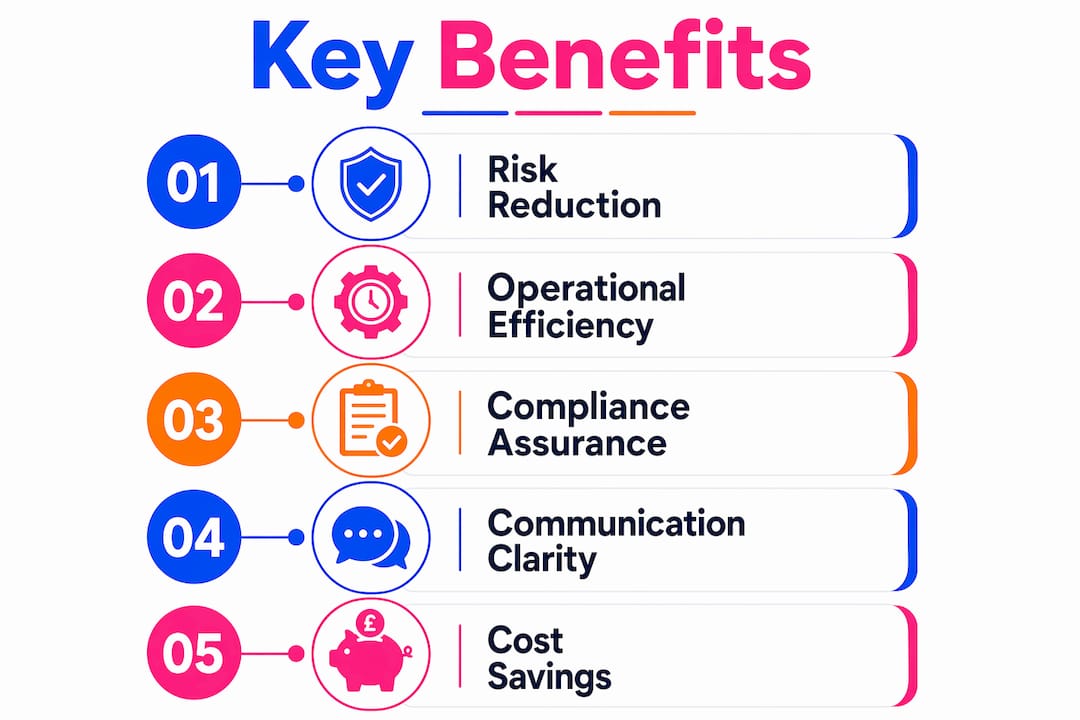
Operational efficiency compounds over time. Translation memory reuse means that repeated legal clauses, standard disclosures, or product descriptions cost less to translate on each subsequent project. Consistent terminology across a document set reduces review time and legal risk simultaneously.
Commercial upside is real too. Localisation treated as infrastructure drives conversion, reduces customer support costs, and shortens time-to-market in new regions. Organisations that build multilingual capability early avoid the exponentially higher cost of retrofitting it later.
Metrics worth tracking:
- Error rate per 1,000 words (pre- and post-professional provision)
- Time to evidence readiness for court or regulatory submission
- Cost per page after translation memory reuse and automation
- Interpreter booking lead time versus required notice period
- Number of admissibility challenges or compliance queries per quarter
When do you actually need specialist language support?
Cross-border litigation and arbitration
Witness statements, expert reports, and documentary evidence submitted in UK proceedings involving foreign-language materials all require qualified translation with attestation. Interpreter support for witnesses or parties who are not fluent in English is a right, not a courtesy. Multilingual legal communication in arbitration adds further complexity: the seat, the governing rules, and the parties’ languages may all differ.
Regulated communications
Clinical trial documentation, regulatory submissions to the MHRA or EMA, financial disclosures under FCA rules, and immigration case files all carry specific language requirements. A mistranslated dosage instruction or an ambiguous financial term is not just an error; it is a regulatory event.
Public-sector and rights-based contexts
Immigration hearings, social benefits assessments, healthcare consent, and education all involve individuals whose rights depend on accurate communication. Using unqualified interpreters or machine translation in these settings creates both ethical and legal exposure for the organisation.
Commercial rollout
Product launches in new markets, multilingual customer support, cross-border procurement, and international contracts all benefit from professional localisation and translation. Cross-border B2B selling requires more than a translated website; it requires culturally adapted messaging, localised legal terms, and consistent brand voice across languages.
Key scenarios at a glance:
- Foreign-language evidence in UK civil or criminal proceedings
- Clinical trial informed consent in multiple languages
- Regulatory filings requiring certified translation (MHRA, FCA, Home Office)
- Immigration and asylum hearings requiring qualified interpreters
- Multilingual financial disclosures and prospectuses
- International arbitration with multi-jurisdictional parties
- Cross-border employment contracts and HR communications
- Multilingual customer support in regulated financial services
How to build language access into your processes
Step 1: Audit your current gaps
Map every workflow where multilingual communication occurs or could occur. Include legal proceedings, regulatory submissions, client communications, HR processes, and product documentation. Identify where you currently rely on unqualified staff, consumer tools, or unverified machine translation.
Step 2: Define use cases and risk tiers
Not all content carries the same risk. A marketing blog post and a witness statement require very different treatment. Classify content by risk level (high: legal, medical, regulatory; medium: commercial contracts, client communications; lower: internal updates, marketing drafts) and assign appropriate service types to each tier.
Step 3: Map stakeholder responsibilities
Legal, procurement, IT, and communications teams all touch language workflows. Assign clear ownership for vendor selection, QA sign-off, and escalation decisions. Without this, high-risk content routinely falls through the gaps.
Step 4: Set KPIs and SLAs
Define what “good” looks like before you procure. Typical SLAs cover turnaround time for certified translations (usually 2–5 working days per standard document), interpreter booking windows (24–48 hours for remote, longer for specialist in-person), and error rate targets.
Step 5: Select vendors against clear criteria
Use the language services checklist as a starting point. Key vendor selection criteria:
- Sector experience in your specific domain (legal, medical, regulatory, financial)
- Auditability: can they provide signed translator statements, QA reports, and audit logs?
- Human-in-the-loop workflows for high-risk content
- Data security and GDPR-compliant handling of sensitive materials
- Certification and attestation capability for court or regulatory use
- Translation memory and terminology management infrastructure
Step 6: Govern QA and escalation
Build review cycles into every high-risk workflow. Translation memory governance, glossary maintenance, and human sign-off for legal or medical content are not optional extras; they are what make the work defensible. Define escalation paths so that any content flagged during QA reaches a qualified reviewer before it leaves the organisation.
Pro Tip: Ask every prospective language service provider for a sample QA report and a redacted audit log from a comparable project. If they cannot produce either, that tells you everything you need to know about their governance.
For detailed vendor selection guidance tailored to EU and UK regulated sectors, glocco® has published a practical framework worth bookmarking.
How technology fits in — and where it must not replace humans
Machine translation (MT) and large language models (LLMs) have genuinely changed the economics of high-volume translation. For lower-risk content — internal communications, first-draft marketing copy, knowledge-base articles — MT with post-editing by a qualified linguist delivers speed and cost efficiency that purely human workflows cannot match.
The boundary matters, though. AI cannot carry legal or ethical accountability in regulated contexts. A court will not accept an MT-generated translation as evidence of accuracy. A regulator will not treat an LLM-produced consent form as meeting its language requirements. The governance model must reflect this.
Technical components of a well-governed language technology stack:
- CAT tools (e.g. SDL Trados, memoQ, Phrase): segment-level translation with memory reuse and consistency checking
- TMS (Translation Management System): workflow orchestration, vendor management, and project tracking
- Translation memory ™: stores previously approved translations for reuse, reducing cost and improving consistency
- Terminology management: controlled glossaries that enforce consistent use of defined terms across all content
- MT engines with post-editing (PEMT): human linguist review of MT output before delivery
- API routing for real-time services: connects live interpretation platforms to booking and quality systems
For a practical overview of AI tools for translation teams, glocco® covers the current landscape in detail.
Pro Tip: Design your escalation triggers before you deploy any MT in a regulated workflow. Define which content types automatically route to a qualified human reviewer — and make that routing mandatory, not advisory. A flag that can be overridden will be.
UK-specific legal and compliance considerations
Admissibility of translated evidence
UK courts assess translated evidence on a case-by-case basis. There is no single statutory form for translator attestation, but common practice requires a signed statement from the translator confirming their qualifications, the source and target languages, and the accuracy of the translation. The Crown Prosecution Service and Ministry of Justice both publish guidance on language provision in criminal proceedings. For civil matters, the Civil Procedure Rules govern how evidence is presented, and parties should seek legal advice on specific requirements.
Certified translations
“Certified translation” in the UK context typically means a translation accompanied by a signed statement from the translator or translation company confirming accuracy. This differs from “sworn” or “notarised” translation required in some other jurisdictions, where a notary public must authenticate the translator’s signature. For UK immigration applications, the Home Office specifies that translations must be certified by a professional translator and include their full name, signature, and contact details. The role of translation in legal compliance is worth understanding in detail before submitting any official documentation.
UK GDPR and data protection
Translated documents often contain personal data. Under UK GDPR (retained post-Brexit as the UK GDPR under the Data Protection Act 2018), organisations must ensure that any third-party processing of personal data — including translation — is governed by a data processing agreement. Cross-border data transfers to translation vendors outside the UK require an appropriate transfer mechanism. Sensitive categories of data (health, legal proceedings, immigration status) attract heightened obligations.
Statistic callout: Multilingual legal support is increasingly cited in UK compliance audits as a gap area, particularly in financial services and healthcare, where regulated communications must meet both accuracy and data protection standards simultaneously.
Practical red flags to watch for:
- A translation vendor that cannot provide a signed translator statement on request
- No data processing agreement offered for sensitive document translation
- MT-only output presented as “certified” without human review
- No glossary or translation memory governance for repeat regulatory filings
This article provides general information, not legal advice. Confirm current requirements with the relevant primary source (Ministry of Justice, Home Office, FCA, MHRA) or a qualified legal professional for your specific situation.
Evidence and benchmarks: what the research shows
The case for professional language services is backed by both sector research and operational data. glocco® internal evidence records a 35% reduction in errors in EU compliance communications when professional language service providers replace ad-hoc or machine-only solutions. That figure reflects real projects across legal, regulatory, and financial content.
Research from Translators Without Borders reinforces the access-to-justice dimension: language inclusion is not a nice-to-have in rights-based contexts; it is the mechanism by which people can exercise their rights at all. In cross-border trade, a study of informal traders at the Chirundu border post between Zambia and Zimbabwe found that a shared language reduced transaction costs, improved access to product information, and decreased fraud — concrete commercial benefits from language alignment.
For a scenario illustration: a UK-based pharmaceutical company preparing a regulatory submission to the EMA for a product approved in three EU member states required certified translations of clinical trial documentation into French, German, and Polish. Using a managed language service provider with sector-specific translators, a governed TMS workflow, and signed attestation for each document, the submission passed first-round review without a language-related query. The same company’s previous submission, handled through an unmanaged mix of freelancers and MT, had generated three rounds of clarification requests, delaying approval by eleven weeks.
The honest view: language access is an organisational decision, not a vendor problem
Most language failures in cross-border litigation and regulated sectors are not caused by bad translators. They are caused by organisations that have not decided to treat language access as a core capability. The decision to use a family member as an interpreter in an immigration hearing, to run a regulatory filing through a consumer MT tool, or to manage ten languages across six uncoordinated vendors is an organisational choice, usually made by default rather than design.
The practical recommendation is this: start with a risk-based audit of your current language workflows. Identify the three highest-risk touchpoints (most likely: court or tribunal proceedings, regulatory submissions, and clinical or healthcare consent). Commission a qualified language service provider to assess those workflows against admissibility, certification, and data protection requirements. Then build outward from there.
Legal, procurement, and IT teams need to be in the same room for this conversation. Language access sits at the intersection of all three, and leaving it to any one function to solve in isolation is how gaps persist.
How glocco® supports cross-border language needs
glocco® works with legal teams, compliance officers, and regulated-sector organisations across Europe, the Middle East, North America, and Asia. The offer is straightforward: professional translation, interpretation, and localisation services with the governance that high-stakes work demands.
What that looks like in practice:
- Audit trails and attestation: every high-risk project includes signed translator statements, QA reports, and a full audit log suitable for court or regulatory submission.
- Human-in-the-loop workflows: MT is used where it adds value; qualified linguists review and sign off all legal, medical, and regulatory content before delivery.
- Certified translations: glocco® provides certified translations for UK courts, the Home Office, the FCA, and other regulatory bodies, with sector-specific terminology management built in.
Projects can be structured as one-off engagements or ongoing agreements for organisations with regular multilingual compliance needs. The right starting point for most teams is a scoped pilot on a live regulatory or legal workflow. To explore document translation for your organisation or to discuss court interpretation requirements, get in touch with the glocco® team directly.
Further reading and primary sources
These are the sources cited in this article, plus primary UK guidance worth bookmarking. Share this list with your legal, compliance, and procurement colleagues.
| Source | Why it is useful |
|---|---|
| glocco®: 35% fewer errors in EU compliance | Operational evidence for the business case |
| MultiLingual: language access cannot be automated away | Rights-based and civil-rights framing for healthcare, justice, and public benefits |
| Slator: why enterprises need Language Solutions Integrators | Governance, AI diffusion, and LSI rationale |
| MultiLingual: multilingual access as global infrastructure | Commercial ROI and LangOps strategy |
| Global Business Culture: communication across international teams | Cultural intelligence and explicit communication protocols |
| Translators Without Borders: translation connects us | Access-to-justice and language inclusion evidence |
| Shared language in cross-border trade (IDEAS/RepEc) | Academic evidence on commercial benefits of shared language |
| glocco®: multilingual legal communication tips | Practical guidance for legal teams |
| glocco®: language services checklist | Procurement quick-start and vendor assessment |
| Workanova: outsourced compliance support | Operational context for managed compliance and back-office integration |
Bookmark this list and circulate it before your next procurement or compliance review. The primary UK sources to add from your own research: Ministry of Justice guidance on court interpreters, Home Office certified translation requirements for immigration, and FCA multilingual disclosure obligations.


