


Budget £15,000 to £50,000 for your first big localisation push into two or three languages, then expect ongoing costs of anywhere from a few hundred pounds a month for a lean scale-up to five figures monthly for an enterprise rolling out across a dozen locales. For continuous product work, retainer or usage-based pricing beats per-word rates almost every time. Glocco builds pricing around exactly this logic.
How much does SaaS localisation actually cost? Breaking down the bill
Here’s the thing nobody tells you upfront: the quote you get is never the number you pay. There are several distinct cost buckets hiding behind that headline rate, and if you don’t know them, you’ll get blindsided at invoice time.
Let’s break them down:
- Translation itself. This is the bit everyone budgets for. Rates vary by language pair, content type, and whether it’s UI strings (short, context-dependent) or documentation (longer, more forgiving).
- TMS or platform fees. Translation management systems often charge separately from your translation vendor, and that duplicate billing can quietly add 20 to 30% to your total spend unless your provider bundles the platform into their service.
- Internationalisation engineering. Someone has to make your codebase capable of handling multiple languages, right-to-left scripts, or variable string lengths before translation even starts.
- Project management and coordination. Someone needs to route strings, chase approvals, and keep translators synced with your sprint calendar.
- QA and localisation testing. Does the German button text still fit? Does the date format break your checkout flow? This step catches it before your customers do.
Then there are the costs nobody puts on an invoice. A blocked release because translations weren’t ready. Developers context-switching to fix a layout bug in Japanese. Inconsistent terminology piling up across features because nobody’s maintaining a glossary. Industry analysis suggests these indirect costs frequently outweigh the raw translation fees themselves, which is exactly why smart teams model total cost of ownership rather than just the translation line item.
Your mileage will vary depending on how mature your codebase already is.
Which pricing model actually fits your release cycle?
Not all pricing models are built for the same kind of work, and picking the wrong one is how teams end up paying twice for the same string.
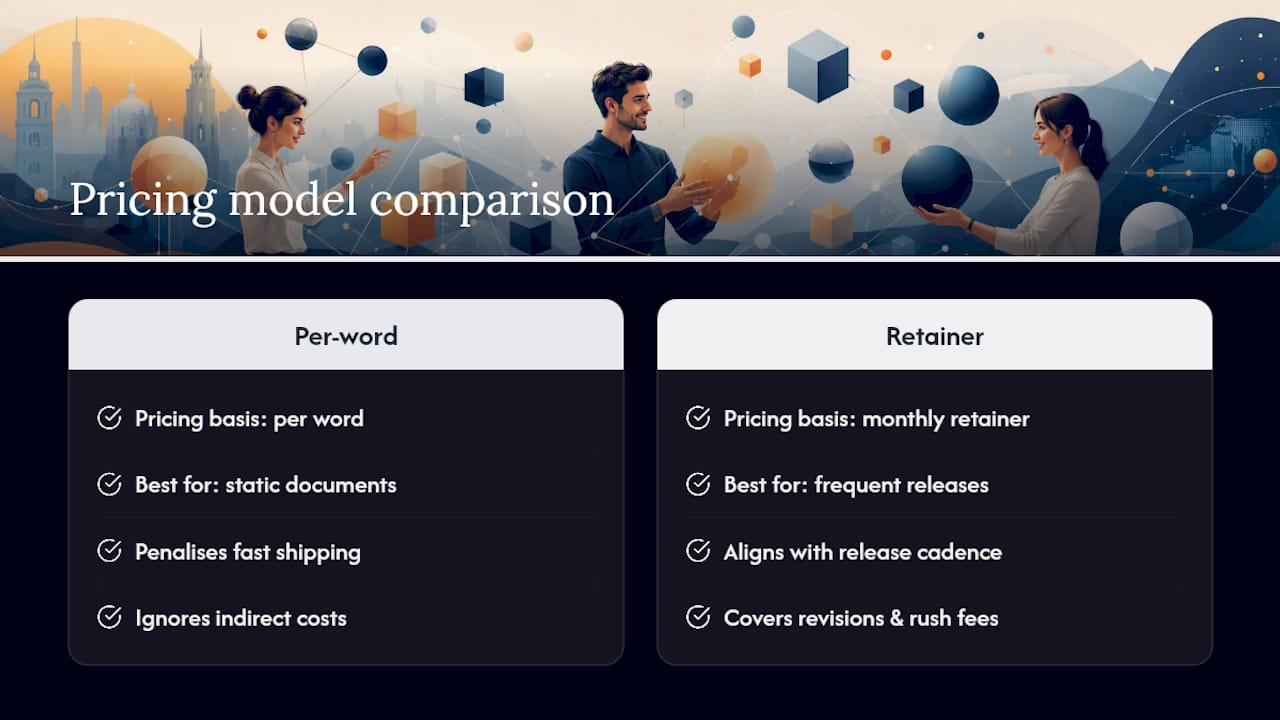
- Per-word pricing. You pay a fixed rate per word translated. Straightforward for one-off documents, but it was designed for static content, not living software. Change three words in a 200-word string and some vendors bill you for the whole string again.
- Per-string pricing. Similar idea, but priced by UI string rather than word count. Slightly better for product teams since it reflects how software content is actually structured, though it still charges per touch.
- Retainer models. You pay a predictable monthly fee that covers a dedicated linguistic team, sprint-aligned delivery, and a set volume of updates. This absorbs the constant churn of agile development without penalising you for shipping fast.
- Usage-based pricing. A newer model that bills based on actions, like API calls or characters processed, rather than raw word counts. It tracks release velocity more closely than word-based billing, though it trades away some of the predictability you get with a flat retainer.
Here’s a quick way to think about it: if you release quarterly and your content barely changes, per-word is fine. If you’re shipping weekly or your product strings are in constant flux, per-word pricing will bleed you dry through repeated micro-charges. Retainer or usage-based models align cost with your actual sprint cadence instead of your vendor’s billing unit.
Pro Tip: Ask any vendor how they charge for a string edit that only changes a variable or a single word. Their answer tells you more about fit than their headline rate ever will.
Realistic budget examples for small, scale-up and enterprise teams
Numbers land better with context, so here are three scenarios you can adapt for your own budget request.
- Small SaaS, first localisation push: one-time internationalisation plus two target languages. Expect the $15,000 to $50,000 range for engineering and initial translation combined, with engineering alone often needing one to two developers for two to three months depending on how tangled your codebase already is.
- Scale-up, five to eight languages, weekly releases: this is retainer territory. Add a monthly TMS subscription, which can range from roughly $144 to $1,245 or more depending on tier, plus a retainer covering translator time and sprint-aligned delivery.
- Enterprise, many locales, compliance-sensitive content: budgets climb here not because translation gets pricier per word, but because QA and PM overhead scales with locale count and regulatory risk. Legal or medical UI copy needs tighter acceptance criteria and more review cycles.
One thing worth flagging: the marginal cost of adding a language rarely scales linearly. Your third language costs less incrementally than your first, because the engineering groundwork and TMS setup are already done. Language number eight, though, might cost more per unit if it needs a right-to-left layout or a completely different QA process.
What do vendors need from you to quote accurately?
Vague requests get vague quotes. If you want numbers you can actually compare across vendors, hand them a proper brief on corporate legal services cost in Asia.
Here’s what to prepare before you reach out:
- String count and type. How many strings, and are they UI labels, error messages, marketing copy, or documentation? Each type prices differently.
- Sample files. Real examples from your codebase, not a hypothetical description.
- Release cadence. Weekly sprints? Monthly? This determines whether retainer pricing even makes sense for you.
- CI/TMS details. What platform are you using, if any, and does it need to integrate with the vendor’s workflow?
- Target locales. Specific languages and regions, not just “European languages.”
- Quality expectations and acceptance criteria. Define what “done” looks like, especially for regulated content.
Once you’ve got that together, ask every vendor to split fixed setup costs from the ongoing retainer and any variable volume charges. This is the single best way to model a launch spike without getting an ugly surprise on next month’s invoice. Also ask about SLAs for continuous delivery. If a vendor can’t commit to a turnaround time for a string batch, that’s a red flag for anyone shipping weekly.
Our language localisation checklist walks through exactly what to gather before sending that first email, and our localisation testing checklist helps you define acceptance criteria properly.
How Glocco prices continuous SaaS localisation
Glocco has been doing this since 2014, working across 76 languages for sectors where getting it wrong isn’t an option: fintech, legal, medical, and software among them. That range matters because a pricing model that works for marketing copy often falls apart for compliance-sensitive UI text.
Most SaaS teams that come to us land on a managed retainer. It covers continuous delivery, sprint-aligned turnaround, and a hybrid workflow that blends AI speed with human review where it counts. The AI does the heavy lifting on volume; humans catch the nuance that machines still miss in regulated or brand-sensitive content.
We won’t pretend a blog post can replace a real quote tailored to your string count and release cadence. What we can say is this: the pricing structure follows the logic laid out above, retainer for cadence, usage-based flexibility where it fits, and transparent line items so you’re never guessing what you’re actually paying for.
Our take: stop budgeting like it’s 2015
The conventional advice, get three per-word quotes and pick the cheapest, is exactly backwards for software. Per-word pricing was built for static documents. Your product isn’t static. It ships weekly, and every quote built on word count alone will punish you for shipping fast.
What actually matters is total cost of ownership: translation, engineering, platform fees, and the QA overhead that keeps your German checkout page from breaking. Teams that only compare headline per-word rates consistently underestimate their real spend, because the indirect costs of delays and context-switching rarely show up on the initial quote.
If there’s one thing to prioritise first, it’s matching your pricing model to your release cadence, not chasing the lowest word rate. A retainer that costs more per month than a per-word quote can still be cheaper over a year once you count the string revisions, the rush fees, and the engineering hours lost to layout fixes nobody budgeted for.
— glocco®
Ready for a proposal that actually matches your release schedule?
Unlike a traditional agency quoting you per word and hoping you don’t ship too often, Glocco builds proposals around how your product actually moves. Tell us your string volume, release cadence, and target locales, and we’ll come back with a breakdown that separates the fixed setup cost from the ongoing retainer or variable component, so you know exactly what changes if you add a language or double your release frequency.
A typical proposal from us includes integration notes for your existing TMS or CI pipeline, an SLA for continuous delivery, and a clear line between one-off engineering work and recurring translation. If your content touches regulated or high-accuracy domains, our guide on document translation for EU businesses is worth a read before you brief us.
Ready to see numbers specific to your product? Get in touch with your string count, sample files, and release cadence, and we’ll turn around a proposal built around how you actually ship.
Sources
- SaaS Localization Pricing | Kobalt Languages
- SaaS Localization Playbook 2026: 0 to 100 Languages | IntlPull
- Localhero
- Localization pricing in 2026: why per-word is dying and what’s replacing it – DEV Community


