


Any translation of an informed consent form submitted to an IRB or ethics committee must be a certified translation backed by an auditable QA workflow. Full stop. Before you accept any quote, check for three things:
- ISO-style process evidence — the vendor can describe a documented translator → reviewer → SME chain
- A signed certification statement per ATA guidance — naming the signer, their qualifications, the document, the language pair, and the date
- SME review attestation — a clinical or research subject-matter expert has signed off on clinical accuracy
No certification page? No reviewer log? Reject the quote and move on.
What must a compliant informed consent translation include?
The deliverable is not just a translated Word document. A compliant preklad informovaného súhlasu is a structured package, and every element has a purpose.
- Certification statement — short or long form, per ATA standards: specifies whether the signer translated or reviewed, lists qualifications, affirms completeness and accuracy, identifies the document and language pair, and carries name, signature, and date.
- QA artefacts — translation memory or glossary used, reviewer tracked changes, SME comments, and a back-translation or reconciliation report when requested.
- Metadata and traceability — versioned file names, a delivery manifest tying each translated page to its source page, and a side-by-side completeness check before submission.
IRBs operationalise regulatory expectations by requesting a certificate or attestation of certified translation precisely because regulations leave verification methods to the board. Your delivery pack is the evidence they reach for first.
Pro Tip: Request the certification page as a standalone PDF separate from the translated document. IRB coordinators often file them separately, and a merged file causes delays.
Who should translate, review, and clinically verify consent forms?
Three distinct roles. Each one matters, and none can cover for a missing other.
- Translator — native target-language competence, documented experience in medical or research translation, and familiarity with certified translation workflows. A general legal translator is not sufficient for a Phase III oncology consent form.
- Independent reviewer — a second linguist who has not seen the source during translation. Their job is to catch omissions, register shifts (clinical language accidentally softened or hardened), and ambiguities. Tracked changes must be included in delivery.
- Clinical SME — a principal investigator, clinical research associate, or medical writer who confirms that clinical accuracy is preserved and that ethical intent — voluntariness, the right to withdraw, risk disclosure — survives the translation. This role is not optional for trial consent forms.
Research published in Clinical Trials found that collaboration between subject-matter experts and linguists produced better conveyance of key ethical concepts than linguist-only workflows, even when those linguists specialised in medical translation. Specialisation alone does not eliminate errors.
Require from every vendor: translator CV or verifier statement, sample translations or references, and written confirmation of sector experience. These are not nice extras — they are the minimum evidence for a role of translators in clinical trials that holds up to audit.
What QA steps should you expect from your translation provider?
The minimum chain for any patient consent translation is:
- Translation by a qualified medical translator
- Independent linguistic review with tracked changes
- Clinical SME review confirming accuracy and ethical fidelity
- Proofreading for formatting, numbering, and signature-block integrity
- Final certification — signed statement, versioned delivery pack
ISO 17100:2015 defines the process and resource requirements that underpin this chain. Critically, it explicitly excludes raw machine translation output plus post-editing from its scope. If a vendor proposes MT+post-edit for a consent form without explicit validation evidence, that is a red flag, not a cost saving.
When to add optional steps: back-translation for high-risk legal sections (withdrawal clauses, liability wording), readability testing for low-literacy populations, and in-country dialectal validation when the target population spans multiple regions.
Each deliverable in the chain proves something specific and adhering to best practices advised in SEO for Medical Professionals – Todd Stager ensures proper labelling and publishing of translated consent materials on trial sites. Reviewer tracked changes demonstrate semantic checks were performed. SME sign-off shows clinical fidelity was verified. The certification page creates accountability. A vendor who cannot supply all three has not completed the workflow.
How do GDPR and data security apply to consent form translation?
Patient data in consent forms is personal data under GDPR. The translation workflow must treat it accordingly. Here is what to require contractually:
- Data processing agreement (DPA) or subcontractor NDA — specifying purpose-limited processing, defined retention periods, and breach notification timelines. This is a legal compliance requirement, not a preference.
- Secure file transfer — SFTP or an encrypted portal, with end-to-end encryption at rest and in transit, and access controls with audit logs.
- PHI minimisation — redact or pseudonymise participant identifiers where possible before sending files. Give explicit instructions about handwritten annotations and stamps.
- Vendor evidence — request a security policy summary, ISO/IEC 27001 certification if available, and examples of secure transfer receipts or access logs.
A vendor who accepts consent form files over unencrypted email without a DPA in place is not a compliant partner, regardless of translation quality.
What does the process look like, and what drives the cost?
A typical end-to-end translation of a single consent form moves through these phases: intake and scope confirmation → glossary and translation memory setup → translation → independent review → SME review → certification and secure delivery.
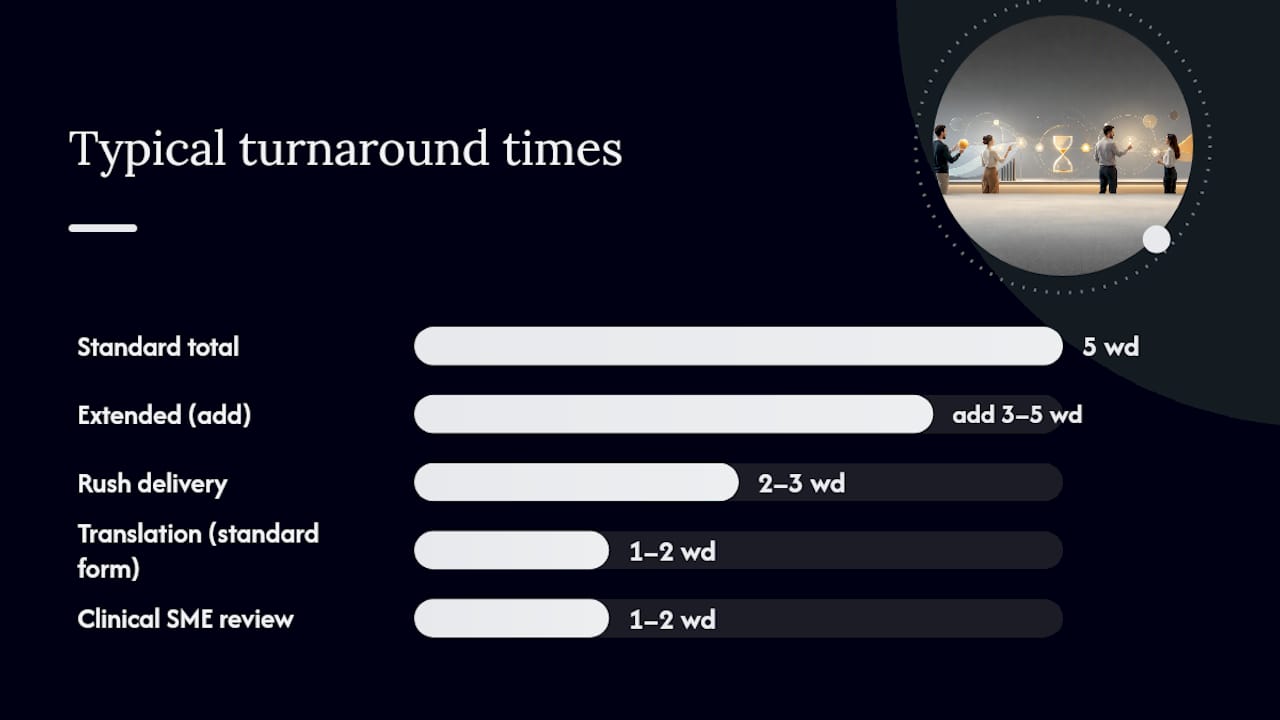
| Phase | Typical duration |
|---|---|
| Intake, scope, glossary setup | 1 working day |
| Translation (standard form) | 1–2 working days |
| Independent linguistic review | 1 working day |
| Clinical SME review | 1–2 working days |
| Certification and delivery | 1 working day |
| Standard total | 5 working days |
| Rush delivery (short form, existing glossary) | 2–3 working days |
| Extended (back-translation or field validation) | Add 3–5 working days |
Primary cost drivers include word count and formatting complexity, SME time, back-translation, rush delivery premiums, certification or notarisation fees, and secure-handling infrastructure. Always request a line-item quote that separates translation, review, SME hours, certification fees, and any rush premium. A bundled single-line quote makes it impossible to compare vendors or negotiate scope.
How to brief your translation provider effectively
A precise brief reduces rework, protects timelines, and gives the vendor no excuse for scope creep. Supply these files and instructions upfront:
- IRB-approved English source document (clean, final version)
- Full relevant protocol excerpts or investigator’s brochure sections
- Approved glossary or preferred translations for key terms
- Target population and dialect notes (region, literacy level, age range)
- Approved reading level and any local legal phrasing required
- Formatting expectations for signature blocks, date fields, and initials
Then confirm the process instructions in writing:
- State the required QA chain explicitly (translation → review → SME → certification)
- Specify whether back-translation is required and for which sections
- Confirm certification format (short or long form, notarisation if needed)
- Set file naming and version control conventions
- Name the point of contact for SME queries and turnaround assumptions
Pro Tip: Use a short email template to open every project. Ask the vendor to confirm: scope, lead linguist name, reviewer name, and proposed certification wording before work begins. This single step catches misaligned expectations before they become delays.
Practical document translation guides consistently list collecting every page that may be submitted as the first step — including back pages, stamps, and annotations — because omissions at briefing stage cause the most common regulatory rejections.
What questions should you ask vendors, and what are the red flags?
Due diligence does not have to be lengthy. These questions cover the critical risks:
- Can you provide a sample certification statement before we award the project?
- Who will be the lead translator, reviewer, and clinical SME? Can we see their CVs?
- Do you maintain a translation memory and glossary for this client and therapeutic area?
- How do you handle PHI in source files? Do you have a DPA template?
- Is your workflow ISO 17100-conformant? Can you provide a QA checklist?
Red flags that indicate unacceptable risk:
- Refusal to provide a signed certification statement
- No independent reviewer — one person translating and self-certifying
- Claims of “native speaker” quality without verifiable credentials or references
- Reliance on raw MT output without explicit validation evidence
- No DPA or NDA offered for files containing patient data
- A single bundled price with no breakdown of translation, review, and SME hours
Before awarding work, request a short test translation of one critical paragraph — the withdrawal clause or a risk disclosure section — plus a reviewer summary. This single practical step reveals more about a vendor’s actual workflow than any questionnaire.
How glocco® delivers compliance-ready consent translations
glocco®’s workflow for informed consent translation follows a documented chain: intake and scope confirmation → glossary and translation memory setup → translation by a medically experienced linguist → independent linguistic review → clinical SME review → signed certification statement → secure delivery.
What you receive in the delivery pack:
- Translated pages with version stamps and a source-to-target manifest
- Reviewer tracked changes and SME attestation notes
- A signed certification statement suitable for IRB and ethics board records
- Secure file transfer with a DPA in place before any files are exchanged
Standards and trust signals glocco® follows and can provide on request:
- ISO 17100-style process conformity
- Certified translation professionals with documented medical and research sector experience
- ATA-style certification statements (short or long form per client requirement)
- GDPR-compliant secure file transfer and data processing agreements
A collaborative SME-plus-linguist workflow is not a premium add-on. Research shows it is the only approach that reliably preserves the ethical intent of a consent form across languages — including voluntariness and the right to withdraw. glocco® builds that collaboration into every consent project as standard, not as an optional extra.
Why glocco® treats consent translations differently
Here is something we have noticed over years of working on compliance-sensitive documents: the riskiest moment in a consent translation is not the difficult medical term. It is the small modal verb — “may”, “might”, “could” — that shifts the meaning of a risk disclosure from definite to speculative, or the passive construction that quietly removes the participant’s agency. Those shifts are invisible to a purely linguistic review. They only surface when a clinical SME reads the text with the participant’s perspective in mind.

That is why glocco® involves clinical SMEs early, not as a final sign-off, but as an active part of the review. And it is why we are happy to share a sample certification page or walk you through our QA log before you commit to anything. No obligation — just transparency.
Ready to get a certified consent translation from glocco®?
glocco® delivers document translation with a full certified workflow: medically experienced translators, independent review, clinical SME sign-off, and a signed certification page ready for IRB submission. Every project includes a DPA, secure file transfer, and a line-item quote so you know exactly what you are paying for.
Need back-translation for a high-risk clause? glocco® handles that too — find out when back-translation is appropriate and how it fits into the consent workflow.
To get started, send glocco® your IRB-approved source document and request a scoped, line-item quote with expected turnaround and explicit certification fees. Contact glocco® at Glocco to request your project intake today.
Sources
- Developing informed consent materials for non-English-speaking participants: An analysis of four professional firm translations from English to Spanish
- Why IRBs Ask for Certified Translations of Informed Consent Forms: Regulation, Guidance, and Practical Reality
- ISO 17100:2015 – Translation services — Requirements for translation services
- What is a Certified Translation? – American Translators Association (ATA)
This article is general information, not a substitute for advice from a qualified doctor. Consult a qualified healthcare professional about your own circumstances before acting on anything here.


