


Cross-cultural teams reliably drive creativity, sharpen market insight, and attract global talent. When led well, they also improve performance and organisational resilience. Meta-analytic research published in the Journal of International Business Studies confirms that cultural diversity produces measurable process gains, particularly in creativity, though net performance effects depend heavily on how teams are designed and managed. Corporate studies from McKinsey and Deloitte reinforce the picture: top-quartile companies on ethnic and gender diversity are more likely to report above-average profitability. The Cultural Intelligence Scale (CQS) gives managers a practical diagnostic to measure whether their teams have the competencies to convert that diversity into results.
The headline benefits, in short:
- Creativity and innovation: diverse perspectives generate more and better ideas, especially on complex or culturally relevant tasks.
- Market insight and talent: teams with native cultural knowledge enter new markets faster and attract a wider pool of skilled people.
- Performance and resilience: when managed deliberately, multicultural teams make better decisions and adapt more readily to disruption.
What are the real benefits of cross-cultural teams?
1. Greater creativity and innovation
Cultural diversity expands the range of mental models a team can draw on. Research reviewed in Emerald Insight shows that culturally diverse innovation teams outperform homogeneous groups on creative tasks, particularly when those tasks tap culturally relevant knowledge and when the team climate is positive. A UK fintech building products for South Asian diaspora communities, for example, generates sharper feature ideas when the product team includes people with lived experience of those markets.
2. Deeper local-market insight
A team member who grew up in a market understands its unwritten rules: what signals trust, what triggers scepticism, what a competitor’s pricing actually means to a local buyer. That knowledge is hard to buy from a consultant and impossible to replicate from a desk in London. UK firms expanding into the Gulf, South-East Asia, or Eastern Europe consistently find that local cultural knowledge shortens the learning curve on market entry and reduces costly missteps.

3. Culturally targeted marketing
Generic campaigns translated word-for-word rarely land. Multicultural teams catch the references that don’t travel, the humour that offends, and the value propositions that need reframing for a different audience. L’Oréal’s multicultural product development teams are credited by Harvard Business Review with materially improving the brand’s success in emerging markets, precisely because cultural competence was built into the product and marketing process rather than bolted on at the end.
4. Stronger talent attraction and retention
Talented people choose employers whose culture reflects their own values and experience. A visibly diverse leadership team signals that progression is genuinely open. For UK organisations competing for multilingual, internationally mobile professionals, this matters. Retention improves too: people stay longer in environments where their cultural background is an asset rather than something to be managed around.
5. A broader skill base and greater adaptability
Different educational systems, professional traditions, and working cultures produce different strengths. A team that includes members trained in German engineering rigour, Japanese process discipline, and British commercial pragmatism has a wider toolkit than any single-culture group. That breadth pays off when conditions change quickly and the team needs to pivot its approach.
6. Better problem-solving and decision-making
Harvard Business Review’s analysis of diverse teams found that the discomfort of working across difference is itself a mechanism for better outcomes. When assumptions can’t go unquestioned, teams process information more carefully. They consider more options, challenge weak reasoning, and arrive at decisions that hold up under scrutiny. Homogeneous teams, by contrast, tend to converge quickly on the first plausible answer.
7. Measurable productivity and performance gains
The McKinsey Diversity Wins report and Deloitte’s inclusive-team research both point to a consistent pattern: companies in the top quartile for ethnic and gender diversity are more likely to achieve above-average profitability. The effect isn’t automatic. It emerges when inclusive practices are in place and when the team’s operating design actively uses the diversity. A cross-cultural team left to self-organise without structure tends to underperform, not outperform.
Pro Tip: Track idea-generation rate and time-to-decision alongside standard output metrics. These leading indicators often show the benefit of cultural diversity before it appears in revenue figures.
8. Multilingual customer support and faster market entry
A team that can serve customers in their own language, without routing every query through a translation layer, responds faster and builds more trust. For UK businesses with customers across Europe, the Middle East, or South Asia, this is a direct commercial advantage. Sector-specific localisation also reduces compliance risk when entering regulated markets, where a mistranslated clause or a culturally misread requirement can be expensive.
9. Personal and professional development
Working alongside people from different backgrounds accelerates learning in ways that training programmes rarely match. Team members develop cultural metacognition, the ability to notice their own assumptions and adapt their communication style, which is one of the most transferable professional skills available. Managers who have led cross-cultural teams consistently report that the experience sharpens their listening, their clarity, and their ability to read a room.
10. Competitive resilience and risk assessment
Monocultural teams tend to share the same blind spots. A team with diverse national and professional backgrounds is more likely to spot geopolitical risk, regulatory shifts, or consumer sentiment changes in markets the leadership team doesn’t personally inhabit. For UK firms navigating post-Brexit trade relationships and expanding into new regions, that breadth of perspective is a genuine strategic asset.
What does the empirical research actually show?
The evidence base for multicultural team advantages is substantial but nuanced. Understanding the nuance is what separates managers who realise the benefits from those who don’t.
The most rigorous synthesis comes from a meta-analysis of 108 primary studies covering 10,632 teams, published in the Journal of International Business Studies. Its headline finding: cultural diversity is not directly related to overall team performance, but it is positively associated with creativity and with task conflict. The net outcome depends on moderators including task complexity, team tenure, and whether the team is co-located or distributed. For complex, knowledge-intensive tasks, the creativity gains tend to outweigh the friction costs. For routine tasks, the equation is less favourable.
A registered-report meta-analysis reinforces this: average linear relationships between diversity and performance are small, but effects are larger for creative or complex tasks and in lower-collectivism cultural contexts. That finding matters for UK managers, because it means the benefit is real but conditional.
On the corporate side, McKinsey’s Diversity Wins and Deloitte’s inclusive-team research consistently show positive associations between diversity and financial performance for top-quartile firms. An umbrella review of diversity research found that most sector-level reviews report positive associations between diversity, innovation, and financial performance, with healthcare studies showing patient outcomes often improve with diverse teams.
The newest evidence addresses remote work specifically. A 2026 Frontiers study found that frequent, predictable use of digital collaboration tools builds empathy and cohesion in multicultural remote teams, and that these relational pathways support inclusive leadership and better cross-cultural communication. The key word is predictable: ad hoc digital interaction doesn’t produce the same effect.
| Outcome | Evidence strength | Key moderator |
|---|---|---|
| Creativity and idea generation | Consistently positive | Task complexity, positive climate |
| Financial performance | Positive for top-quartile firms | Inclusive practices required |
| Task conflict | Consistently elevated early | Team tenure, structured processes |
| Team cohesion | Mixed; lower early, improves over time | Interaction quality, tool use |
| Overall performance | Indirect; context-dependent | Task type, co-location, tenure |
Pro Tip: When reading meta-analyses on diversity and performance, check whether the study distinguishes between creative/complex tasks and routine ones. Most of the positive effects concentrate in the former category.
What frictions should you expect, and how do you manage them?
The benefits of cross-cultural teams don’t arrive automatically. Every manager who has built one knows the early friction is real.
Heightened task conflict. Different assumptions about hierarchy, directness, and decision-making authority produce disagreement. This isn’t always destructive, but it needs to be named and channelled rather than suppressed. Red flag: the same misunderstanding recurring across multiple meetings.
Lower early cohesion. Trust builds more slowly when people don’t share cultural reference points. Teams often underperform in the first few months before the relational foundation is established. Red flag: falling participation in meetings, especially from members who are not in the majority cultural group.
Communication friction. Non-verbal cues, humour, and indirect communication styles don’t travel reliably across cultures. A silence that signals respect in one culture signals disengagement in another. Red flag: repeated requests for clarification on the same type of instruction.
Time-zone strain. Distributed cross-cultural teams carry the additional burden of scheduling across time zones, which concentrates meeting load on some members and fragments deep-work time. Red flag: one group consistently taking early-morning or late-evening calls.
One-size-fits-all processes. Standard onboarding, performance review, and feedback processes often embed the assumptions of the dominant culture. Red flag: disproportionate attrition among members from specific cultural backgrounds.
The mitigation for most of these frictions is cultural metacognition: the active, ongoing practice of noticing your own cultural assumptions and adapting your approach. Atlassian’s research-backed guidance identifies user manuals (personal working-style documents), active listening, and visual communication as practical tools that raise the probability of cross-cultural collaboration converting into creativity and profitability.
Immediate leader actions to reduce early friction:
- Run a structured “user manual” exchange in the first two weeks, where each team member shares their preferred communication style, working hours, and decision-making approach.
- Set explicit norms for meeting participation, including how silence and disagreement are expressed.
- Rotate meeting times so time-zone burden is shared.
- Use visual summaries alongside verbal briefings to reduce language-processing load.
- Schedule a retrospective at 60 days specifically focused on process, not output.
How to unlock the benefits: a practical checklist for UK managers
The HBR analysis of highly effective global teams makes a point most managers underestimate: the decisive factor is not the number of nationalities on the team. It’s the quality of the operating design and the cultural metacognition of the leader.
Step 1: Diagnose cultural intelligence before you start
Use the Cultural Intelligence Scale (CQS) or the Intercultural Development Inventory (IDI) to assess where your team sits on cultural awareness and adaptability. These instruments give you a baseline and a target. Without a baseline, you can’t tell whether your interventions are working.
Diagnostic questions to ask yourself:
- Can each team member describe how their own cultural background shapes their working style?
- Does the team have a shared vocabulary for discussing cultural difference without it becoming personal?
- Are your performance review criteria culturally neutral, or do they reward the communication style of the dominant group?
Step 2: Design the team’s operating rhythms deliberately
- Set predictable interaction patterns. The Frontiers 2026 research shows that frequency and predictability of digital interaction, not just the tools used, drive empathy and cohesion in remote multicultural teams.
- Assign tasks that require cultural knowledge. Diversity benefits are strongest when the task genuinely needs what the diverse members bring. A market-entry sprint for a new region should be led by team members with native knowledge of that market.
- Build in structured reflection. Monthly retrospectives that address how the team is working, not just what it is producing, catch friction before it compounds.
Step 3: Run a market-entry sprint using local insight
A practical workflow for UK teams entering a new market:
- Identify team members with direct cultural knowledge of the target market.
- Brief them to audit the existing product, marketing copy, and customer journey for cultural fit, not just linguistic accuracy.
- Use their findings to brief the localisation and design teams before any translation work begins.
- Test with local users before launch, using document translation and localisation services for any regulated or customer-facing content.
Step 4: Measure what matters
KPIs that capture the value of cultural diversity in practice:
- Idea generation rate: number of distinct ideas surfaced per sprint or project phase.
- Time-to-decision: how long it takes to reach a decision on complex, ambiguous problems.
- Customer NPS by market: whether satisfaction scores differ across the markets your team serves.
- Retention of multilingual hires: a proxy for whether your culture genuinely includes people from different backgrounds.
For teams handling cross-border language requirements, also track error rates in localised content and time-to-market for new-language launches. These metrics make the ROI of cultural and linguistic investment visible to senior stakeholders.
Pro Tip: Set a 90-day review specifically for cultural integration, separate from your standard performance review. Ask: which team members are contributing ideas? Which are staying quiet? Silence in cross-cultural teams is rarely indifference.
glocco®’s perspective on leading cross-cultural teams
Working with cross-border teams since 2014 has taught us one thing above all: the teams that thrive aren’t the ones with the most nationalities. They’re the ones with the clearest operating agreements.
The “user manual” approach, where every team member writes a short document explaining how they work best, sounds almost too simple. But we’ve seen it cut early friction dramatically, especially in remote teams where you don’t have the corridor conversations that fill in the gaps. Pair that with structured onboarding and predictable meeting rhythms, and the diversity stops being a management challenge and starts being the actual point.
The checklist in this article reflects what we’ve seen work across our own multilingual teams and in the organisations we support. Start with the diagnostics. Design the rhythms. Then measure.
How glocco® helps you get the language side right
Cross-cultural teams generate real commercial value, but only when the language and cultural-intelligence infrastructure keeps pace. That’s where glocco® comes in.
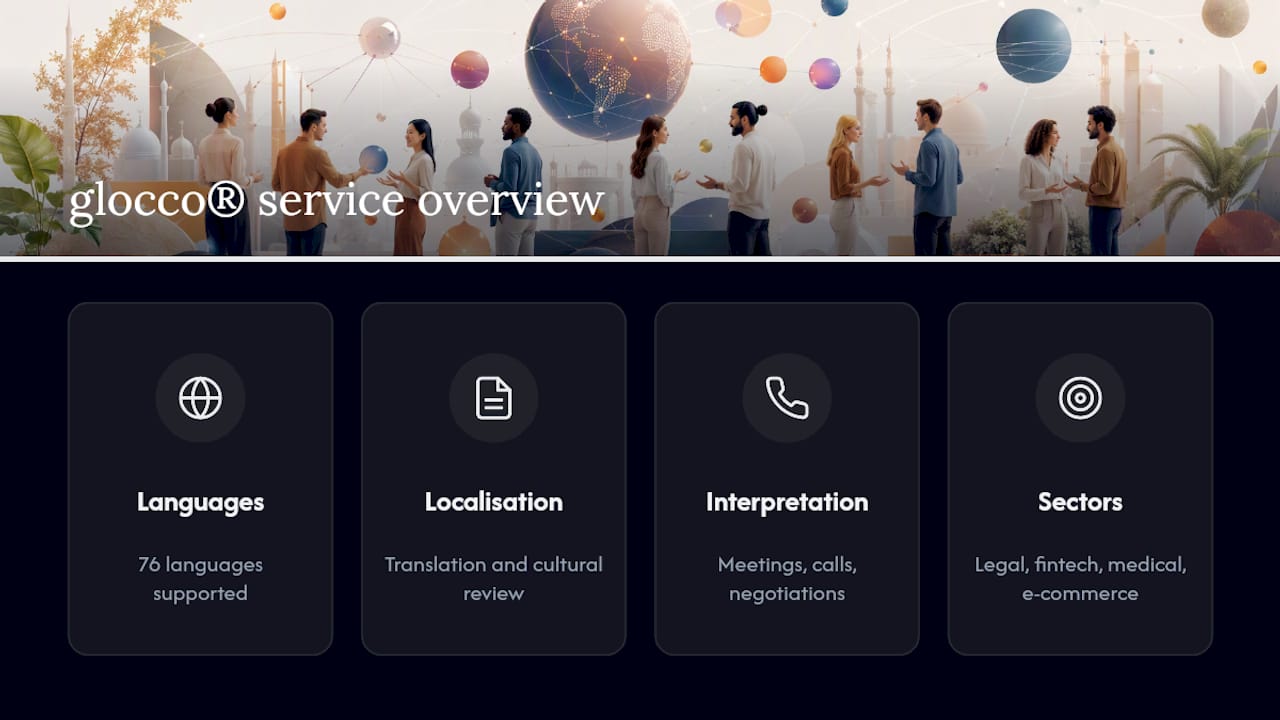
glocco® provides localisation, interpretation, and multilingual support across 76 languages, with sector-specific workflows for legal, fintech, medical, and e-commerce teams. When your cross-cultural team is ready to enter a new market or serve customers in their own language, glocco® handles the translation and cultural review work that makes the difference between a launch that lands and one that misfires.
For managers evaluating when to build versus buy: if the language pair or subject matter is outside your team’s native competence, buying specialist support is almost always faster and cheaper than the cost of a localisation mistake. glocco® also offers interpretation services for multilingual meetings, client calls, and cross-border negotiations, so your team can communicate with confidence from day one.
Get in touch with glocco® to discuss which services fit your team’s current stage.
Sources
- Unraveling the effects of cultural diversity in teams: A retrospective of research on multicultural work groups and an agenda for future research | Journal of International Business Studies
- The impact of digital collaboration tools on inclusive leadership in multicultural teams in the context of global remote work: a psychological perspective on empathy, cohesion, and cross cultural communication
- Cultural diversity drives innovation: empowering teams for success (Emerald Insight)


