


Get this wrong and a regulator can stall your Slovak market entry for weeks. The preklad farmakovigilancia dokumentov (translation of pharmacovigilance documents) that actually matter covers the SmPC, PIL, pack text, DHPCs, and any literature or safety-report attachments tied to an ICSR. Every one of these needs a native Slovak medical translator who understands regulatory formatting, not a generic linguist. Hire a specialist partner and you sidestep the resubmission cycle that eats most PV timelines.
Which pharmacovigilance and regulatory documents require translation?
Not every safety document needs the same treatment, and mixing up the priorities is how teams end up scrambling before a deadline. Here’s what actually lands on a translator’s desk during a typical Centralised Procedure (CP), Mutual Recognition Procedure, Decentralised Procedure (MRP/DCP), or National Authorisation Procedure (NAP) lifecycle.
- SmPC, PIL and pack text: these form the core CTD/eCTD Module 1 content and need a national translation that mirrors the approved English master word for word in meaning, if not in phrasing.
- DHPCs (Direct Healthcare Professional Communications): urgent safety notices that often need turnaround measured in hours, not days, sometimes requiring 24/7 support from your translation partner.
- ICSR literature attachments: case narratives and journal excerpts referenced in Individual Case Safety Reports may need Slovak translation as a follow-up submission rather than at first filing.
- Packaging mock-ups and Braille layout: these aren’t just text swaps. Layout, character counts, and printing checks all need a second look once translated copy goes in.
Miss one of these categories in your brief and you’ll be sending an amended file back through review, which is exactly the kind of delay a specialist workflow is built to avoid.
Regulatory requirements and templates you must follow (QRD, ŠÚKL, EudraVigilance)
Here’s the bit that trips up even experienced regulatory teams: translation isn’t just a language task in pharmacovigilance, it’s a compliance task with its own paperwork. Every national SmPC and PIL has to follow the EMA’s QRD templates, which set the structure, headings, and formatting conventions your translator must replicate exactly.
On top of that, ŠÚKL requires Slovak translations to match national ‘blue-box’ requirements and sets firm submission windows:
- For MRP/DCP procedures, national translations with blue-box content are due within a few calendar days after the EU phase closes.
- For CP procedures, national translations are due shortly after a positive CHMP opinion.
This is the entire window ŠÚKL recommends to submit a compliant national translation after an MRP/DCP EU phase ends, according to ŠÚKL’s own submission guidance. Missing this deadline can cause significant delays.
There’s also ŠÚKL’s detailed guidance on quality translation standards, MP 150, which explicitly rules out machine-only translation for product information and insists on native Slovak speakers with subject-matter knowledge.
And since November 2017, ŠÚKL routes adverse reaction reports directly through EudraVigilance using the E2B(R3) format. That shifts when literature attachments and translations get appended, often as a follow-up rather than at first filing, so your translation workflow needs to sync with your PV team’s case triage timing, not just the submission deadline.
Get any of this wrong and the consequence isn’t a polite email. It’s a rejected submission, a delayed launch, or a national translation that doesn’t match the approved master and has to be redone from scratch.
Translation quality controls and an appropriate pharmacovigilance translation workflow
Good translation in this space isn’t about finding someone fluent in Slovak. It’s about finding someone fluent in Slovak and pharmacovigilance, someone who knows what MedDRA terminology means and why the register in an SmPC (written for clinicians) should read completely differently to a PIL (written for patients). ŠÚKL’s own guidance flags this distinction explicitly: literal, word-for-word translation of technical SmPC content into a PIL just confuses patients.
Here’s the workflow we’d insist on, step by step:
- Build a termbase and glossary from the approved English master before translation starts, not after.
- Produce the first draft with a native Slovak medical translator experienced in regulatory content.
- Route it through subject-matter (pharmacovigilance) review to catch anything a linguist alone would miss.
- Run linguistic and regulatory QA checks in parallel, checking against QRD formatting rules.
- Get final sign-off, then verify packaging mock-ups against the signed-off text before anything goes to print.
Back-translation is worth the extra step for high-risk safety content like DHPCs, where a mistranslation has real clinical consequences. For lower-risk literature attachments, a single bilingual review with SME sign-off is often enough. Getting this distinction right is part of what separates a solid workflow from an expensive one.
Pro Tip: Treat translation as part of your ICSR triage from day one, not a downstream task you bolt on afterwards. It stops you translating the same literature reference twice when multiple reports cite the same article.
Don’t overlook data security either. Safety-critical content needs a full audit trail, from who touched the file to when each version was approved, so you can prove traceability if a regulator asks.
Timelines and cost drivers: plan to avoid last-minute regulatory rushes
Budget and deadline planning go hand in hand here, and most teams underestimate both.
- SmPC and PIL translations typically need several working days once source content is final, more if multiple review rounds are needed.
- DHPCs move faster, often within 24 to 48 hours, because urgent safety notices can’t wait for a standard queue.
- Packaging mock-ups add time on top of text translation, since layout, Braille conformity, and print checks all happen after the words are locked.
- Literature attachments for ICSRs vary widely depending on length and how many articles need translating per case.
Cost tends to track four things: how much SME review time is needed, how complex the formatting or mock-up work is, whether you need 24/7 urgent availability, and how many approval rounds your regulatory team runs before sign-off. If your PV output is steady and unpredictable in timing, a retainer or service-level agreement with a translation partner usually works out cheaper and faster than negotiating a fresh quote every time a DHPC lands on your desk.
Why work with a specialist partner
This is where a generic translation agency and a specialist PV partner stop looking similar. Industry specialists like IQVIA make the point plainly: translation accuracy in pharmacovigilance is a safety and liability issue, not a copywriting task, so you want a partner who understands the full safety lifecycle, not just the language pair.
Glocco brings modern technology and proven regulatory practice together for exactly this kind of work. What that looks like in practice:
- Native Slovak medical translators with pharmacovigilance and regulatory-submission experience.
- Established workflows for medical translation accuracy that protect patient safety at every review stage.
- Experience supporting clinical-trial localisation, where SME reviewers and regulatory formatting matter just as much as they do in PV documents.
- Capacity for rapid-turnaround DHPC work and packaging mock-up verification, the two areas where timelines bite hardest.
What procurement teams keep getting wrong
Three mistakes show up again and again: hiring a general translator who’s never seen a QRD template, trusting raw machine translation on safety-critical text, and commissioning translation only after the regulatory clock has already started ticking. Fix all three by bringing your translation partner in at the triage stage, not the deadline stage. Ask any vendor for proof of native Slovak medical translators, a documented QA process, and references from pharmacovigilance clients before you sign anything.
— glocco®
How glocco® can help you stay ahead of the deadline
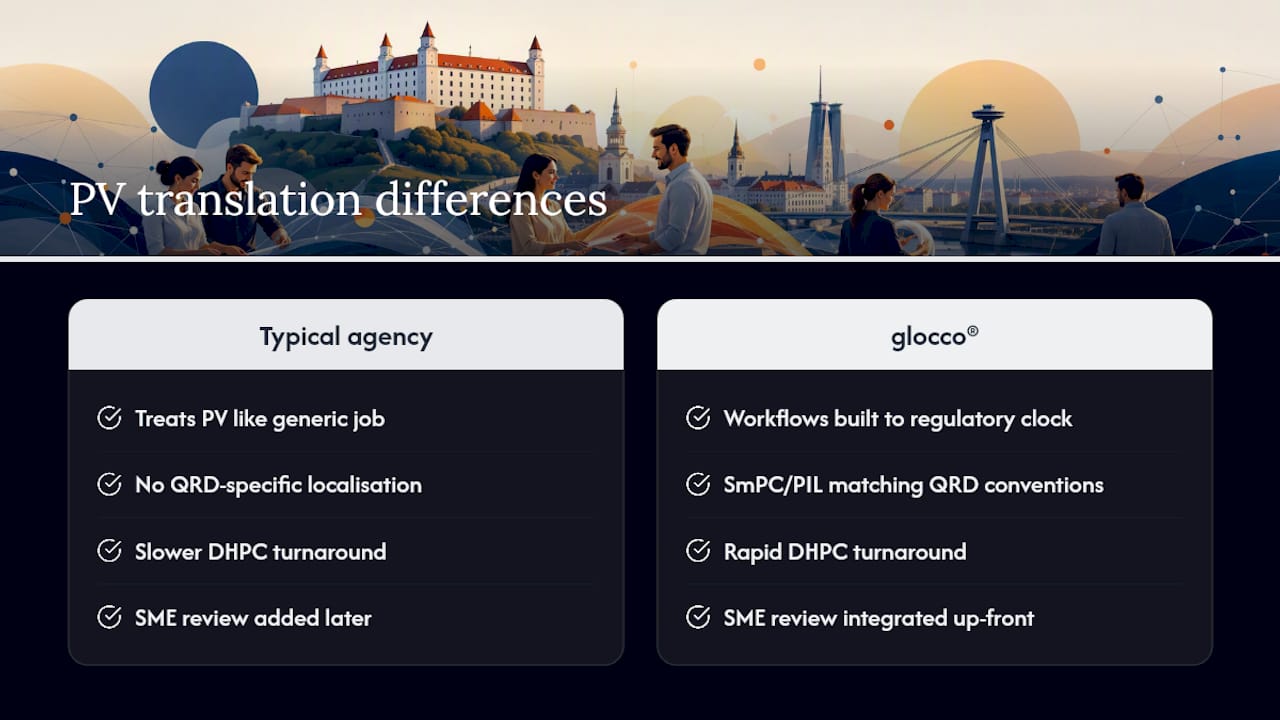
Most agencies treat pharmacovigilance translation like any other document job. Some providers don’t. The best build workflows around the actual regulatory clock, SmPC and PIL localisation that matches QRD conventions, rapid DHPC turnaround when a safety notice can’t wait, packaging mock-up checks, and SME review built into the process rather than bolted on afterwards. That’s the concrete difference: less back-and-forth with your regulatory team, fewer resubmissions, and a translation partner who already knows what ŠÚKL expects.
To get an accurate quote, tell us the document type, the file format, your regulatory deadline, and whether SME review is required. Head over to our document translation guide for EU businesses to see how the process works, or get in touch directly for a compliance readiness check on your next submission.
Sources
- Additional requirements for submission of the dossier in the Slovak Republic (ŠÚKL)
- Language solutions for pharmacovigilance (IQVIA)


