


Any supplier you hire for classified language work must guarantee three things before a single word is translated: appropriate personnel vetting (BPSS, SC, or DV), secure handling aligned to the Government Security Classification Policy, and an auditable chain of custody backed by contractual protections including an NDA, Data Processing Agreement, and Security Aspects Letter (SAL).
Run these three checks immediately:
- ISO 27001 or equivalent: Ask for the certificate number and expiry date. No certificate, no contract.
- Vetting evidence and Official Secrets Act undertakings: Confirm which staff hold BPSS, SC, or DV clearance and that each has signed an Official Secrets Act declaration.
- F1686 / MOD consultation status: For SECRET or above, F1686 approval must be obtained before any substantive exchange of classified material with a third-party linguist.
Statistic callout: Academic research on linguist confidentiality protocols confirms that confidentiality obligations are ongoing commitments that require regular revisiting as projects evolve.
What does the confidentiality process for defence linguists actually look like?
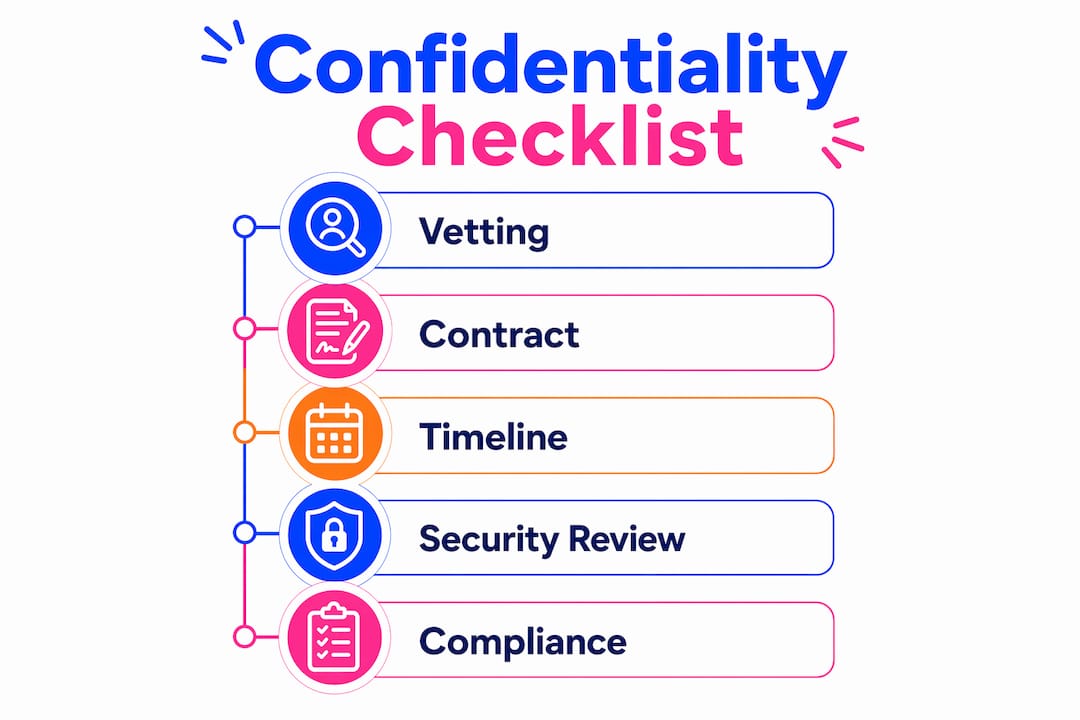
Follow this six-step workflow. Each step has a clear owner and a deliverable.
-
Initial risk and classification assessment. Identify the classification tier (OFFICIAL, OFFICIAL-SENSITIVE, SECRET, TOP SECRET) and apply strict need-to-know principles. Assign a SAL grading at this stage so security obligations are scoped correctly from the outset.
-
Supplier and facility validation. Confirm the supplier holds a Facility Security Clearance (FSC) at the required level. Check ISO 27001 certification and ask for evidence of DEFCON 658 / DEFSTAN 05-138 cyber flow-downs. A secure translation workflow should be documented, not just described verbally.
-
Personnel vetting and paperwork. Every linguist must hold the correct clearance tier (BPSS, SC, or DV) and must have signed an Official Secrets Act undertaking. Where international classified information is involved, PSC applications are managed through NSVS and UKSV. Clearance records must be stored and monitored proactively so renewals never lapse mid-project.
-
Secure handling and technical controls. Encryption in transit and at rest is the baseline. For SECRET+, linguists cannot work remotely and must be on secure MOD premises, accompanied by customer unit or security staff. Controlled devices, isolated work areas, and approved communication channels are non-negotiable at this tier.
-
Delivery, return, and destruction. All classified materials must be returned or destroyed according to the SAL. Chain-of-custody logs must record every transfer, access event, and disposal action. Demand these logs as a contractual deliverable, not an afterthought.
-
Incident escalation and post-job audit. Define escalation contacts, notification timelines, and breach-reporting obligations (UK GDPR Article 33 applies: 72-hour notification to the ICO for personal data breaches). Conduct a post-job audit against the SAL and retain all records.
Pro Tip: Schedule a mid-project security review at the halfway point of any engagement lasting more than four weeks. Clearance status, scope, and classification can all change — catching a gap early costs far less than a post-incident investigation.
UK legal and vetting framework: what you must know
The UK Government Security Classification Policy (GSCP) sets the framework. Every contractor, linguist, and supplier working with HMG information is personally accountable for handling it correctly, regardless of whether it is marked.
Vetting tiers at a glance:
- BPSS (Baseline Personnel Security Standard): Minimum baseline for access to OFFICIAL information. Covers identity, right to work, employment history, and basic criminal record checks.
- SC (Security Check): Required for regular, unsupervised access to SECRET material or occasional access to TOP SECRET. Includes a deeper background investigation.
- DV (Developed Vetting): Required for substantial unsupervised access to TOP SECRET or sensitive intelligence. The most thorough vetting tier, including in-depth interviews.
- PSC (Personnel Security Clearance): Used when accessing international classified information; managed via NSVS and UKSV with strict application and renewal rules.
F1686 and the SAL: F1686 is the formal mechanism by which a prime defence supplier requests MOD permission to subcontract or collaborate on classified work. Skipping it — even for preliminary discussions — can invalidate security compliance entirely. The SAL is the contractual instrument that defines which parts of a contract carry security obligations and keeps classification as low as feasible.
UK GDPR interaction: Where classified workflows involve personal data, UK GDPR applies alongside the GSCP. A Data Processing Agreement must map to UK GDPR obligations, and breach notification timelines must be built into the supplier contract.
| Clearance level | Typical access | Handling constraint |
|---|---|---|
| BPSS | OFFICIAL | Remote working permitted with standard controls |
| SC | OFFICIAL-SENSITIVE / SECRET | Remote permitted on approved systems; need-to-know enforced |
| DV | SECRET / TOP SECRET | Strict need-to-know; on-site for TOP SECRET in most cases |
| DV + F1686 / FSC | SECRET+ (subcontracted) | On MOD premises only; no remote working permitted |
Statistic callout: The GSCP outlines that a compromise of SECRET information carries very serious risks, including threats to individuals and damage to the UK’s security resilience — which is why the Working at SECRET guidance mandates enhanced, proportionate controls above the OFFICIAL baseline.
How do you evaluate a supplier and what should your contract say?
Ask these questions before you shortlist anyone.
Questions to put to every supplier:
- What vetting levels do your linguists currently hold, and can you provide documentary evidence?
- Do you hold a Facility Security Clearance, and at what level?
- Have you obtained, or can you obtain, F1686 approval for this programme?
- Are you ISO 27001 certified? Please provide your certificate reference.
- How do you implement DEFCON 658 cyber requirements and DEFSTAN 05-138 flow-downs?
- Where is data hosted, and is encryption applied in transit and at rest?
- Do you use any offshore subcontractors for SECRET+ work, and if so, what approvals cover them?
Contractual protections to require:
- NDA covering all linguists, project staff, and subcontractors, with explicit reference to the Official Secrets Act.
- Data Processing Agreement mapped to UK GDPR, including sub-processor controls and 72-hour breach notification.
- SAL or security annex defining classification levels, handling constraints, and destruction obligations.
- Chain-of-custody clauses requiring signed transfer logs for every classified asset.
- Audit rights allowing you to inspect logs, vetting records, and incident reports on request.
For confidentiality in legal and compliance-sensitive work, the same contractual rigour applies — a useful reference when drafting your security annex.
Red flags that should stop a procurement in its tracks:
- Vague or verbal-only answers on vetting status.
- No audit logs or inability to produce chain-of-custody records.
- Refusal to sign a SAL or DPA.
- No documented incident response plan with named contacts.
- Unvetted offshore subcontractors proposed for SECRET+ work.
| Evaluation dimension | What good looks like | Red flag |
|---|---|---|
| Vetting / clearance | Documentary evidence of BPSS/SC/DV per linguist | “Our staff are all vetted” with no paperwork |
| Security certification | ISO 27001 certificate, current and in-scope | Expired cert or “in progress” only |
| Technical controls | Encryption in transit & at rest, controlled devices | Shared cloud drives, personal devices |
| Contractual protections | Signed NDA, DPA, SAL, chain-of-custody clauses | Reluctance to sign any security annex |
| Auditability | Timestamped access logs, transfer records | No log capability |
| Incident response | Named contacts, 72-hour notification commitment | “We’ll deal with it if it happens” |
What are the realistic timelines and cost drivers?
Vetting takes time. Budget for it early or it will delay your programme.
- BPSS: Typically two to four weeks, assuming clean employment history and right-to-work documentation.
- SC: Four to twelve weeks via UKSV, depending on complexity and backlog.
- DV: Three to six months, sometimes longer for complex cases.
- F1686 approval: Variable; allow four to eight weeks for MOD consultation on classified subcontracting.
- FSC confirmation and secure platform setup: Two to six weeks depending on existing infrastructure.
The main cost drivers beyond linguist day rates are: vetting administration and renewal monitoring, secure transcription and data-handling infrastructure, specialist reviewer rates for classified content, audit and record-keeping overhead, and any indemnity or insurance requirements tied to the SAL.
To reduce costs without compromising security: batch vetting applications for multiple linguists at the same time, start vetting key staff before contract award, and use a supplier that already holds FSC and ISO 27001 so you are not paying for setup from scratch.
Why confidentiality must be a process, not a single checkbox
The most common mistake buyers make is treating confidentiality as a form to sign at kick-off. Academic research tells a different story.
“Confidentiality expectations may change and ethics frameworks must accommodate evolving project realities — treating informed consent and confidentiality as evolving discussions rather than one-off fixes.”
Ethical practice in participant-centred linguistic research
In practice, this means building change control into your security governance. Classification can shift during a project — a document that starts OFFICIAL may be upgraded to SECRET as the programme develops. A linguist who was cleared for one scope may not be cleared for the revised one.
Good process looks like this:
- Scheduled re-assessments at defined project milestones.
- A documented change control log tied to the SAL.
- Stakeholder dialogue whenever scope, classification, or personnel change.
- Retained records of every decision, approval, and notification.
A practical example: a programme manager on a multilingual defence procurement noticed mid-project that translated briefing materials had been reclassified upward. Because the SAL included a change control clause and the supplier had a documented re-assessment process, the linguist’s clearance was verified, access was restricted, and no breach occurred. Without that process, the reclassification would have gone unnoticed until audit.
glocco®’s view on defence confidentiality
The paperwork matters, but it is not the whole picture. What actually protects classified language work is a supplier culture that treats security as a live obligation, not a compliance box ticked at contract signature.

glocco® has been working with defence and security clients since 2014, and the pattern we see most often is this: buyers focus heavily on vetting at onboarding and then assume the process runs itself. It does not. Clearances expire. Scope changes. New linguists join mid-project. The suppliers who avoid the red flags listed above are the ones who have built re-assessment and change control into their standard workflow, not their exception handling. That is the standard glocco® holds itself to — documented, auditable, and reviewed throughout the engagement, not just at the start. You can see how that plays out in practice in our defence sector case study.
glocco® for defence language projects: what you get
glocco® provides secure translation and interpretation services for defence and security clients across the UK, with documented vetting records, SAL and DPA support, full audit trails, and incident response procedures built into every engagement.
Working with glocco® on a classified programme means you get: vetted linguists with evidenced BPSS/SC clearance, ISO 27001-aligned workflows, chain-of-custody logs as standard deliverables, and a named security contact for escalation. For SECRET+ work, glocco® coordinates MOD consultation and F1686 processes rather than leaving that burden with your procurement team.
Ready to check whether your current supplier meets the standard? Request a security and compliance review from glocco® and get a clear picture of where the gaps are before they become problems.
Useful UK sources and standards to check
Use this list to verify compliance and prepare procurement paperwork.
- ISN 2026/03: F1686 and subcontracting on classified MOD programmes — Start here if your contract involves SECRET or above. Defines F1686 obligations and FSC requirements. Retain the approval as procurement evidence.
- ISN 2026/04: SAL and contractual security conditions — Defines how SALs work, references DEFCON 531 and DEFCON 658, and explains how to keep classification as low as feasible.
- Guidance 1.2: Working at SECRET — Baseline behaviours for users and suppliers handling SECRET material. Consult before drafting handling constraints in your SAL.
- Vetting process for accessing international classified information — PSC applications, renewals, NSVS and UKSV roles. Use when linguists need access to allied-nation classified material.
- Contract specification: cleared linguist requirements — Real MOD contract language on on-site requirements, clearance monitoring, and Official Secrets Act undertakings. Useful as a drafting reference.
- Ethical practice in participant-centred linguistic research (De Gruyter Brill, 2025) — Academic basis for treating confidentiality as a dynamic, dialogic process. Supports the case for change control and ongoing re-assessment in your governance framework.
- Secure transcription and data security guidance — Practical technical commentary on data handling for speech-to-text and transcription workflows relevant to defence audio material.
| Classification | First document to consult | Key action |
|---|---|---|
| OFFICIAL / OFFICIAL-SENSITIVE | GSCP baseline; Guidance 1.2 for SECRET | Confirm BPSS; issue SAL; sign NDA and DPA |
| SECRET | ISN 2026/03; Guidance 1.2 | Obtain F1686; confirm FSC; on-site working only |
| TOP SECRET | ISN 2026/03; DV vetting guidance | DV required; MOD premises; full audit trail mandatory |
Retain copies of all F1686 approvals, FSC confirmations, and signed SALs as procurement evidence. If an audit or incident investigation arises, these are the documents that demonstrate compliance.
This article provides general information on UK defence confidentiality processes and is not legal or security advice. Confirm current requirements with the relevant MOD security authority or a qualified security professional for your specific programme.


