


Many organisations assume that remote interpreting is simply placing a bilingual colleague on a video call. It is not. Remote interpreting is a structured, professional service that requires certified expertise, specialist technology, and deep sector knowledge to deliver accurate, legally and medically sound communication. This guide explains what remote interpreting actually involves, how it is delivered, and why choosing the right provider is critical for businesses operating in legal, healthcare, and commercial environments across Europe.
Key Takeaways
| Point | Details |
|---|---|
| Remote interpreting defined | Remote interpreting is real-time translation delivered via technology, not simply translation over video calls. |
| Sector expertise is critical | Specialised interpreters with legal or medical knowledge are vital for accurate communication in high-stakes settings. |
| Reliability hinges on experts and technology | Successful remote interpreting requires both platform stability and certified interpreters with sector experience. |
| Know the challenges | Expect cognitive demands and technical risks, so always select reputable providers with proven track records. |
Understanding remote interpreting: definition and scope
Remote interpreting refers to the professional delivery of spoken language interpretation services via digital platforms, without the interpreter being physically present at the location of either speaker. It covers a broad range of settings, from international contract negotiations to telemedicine consultations and cross-border court proceedings.
There are four primary modalities used in professional remote interpreting:
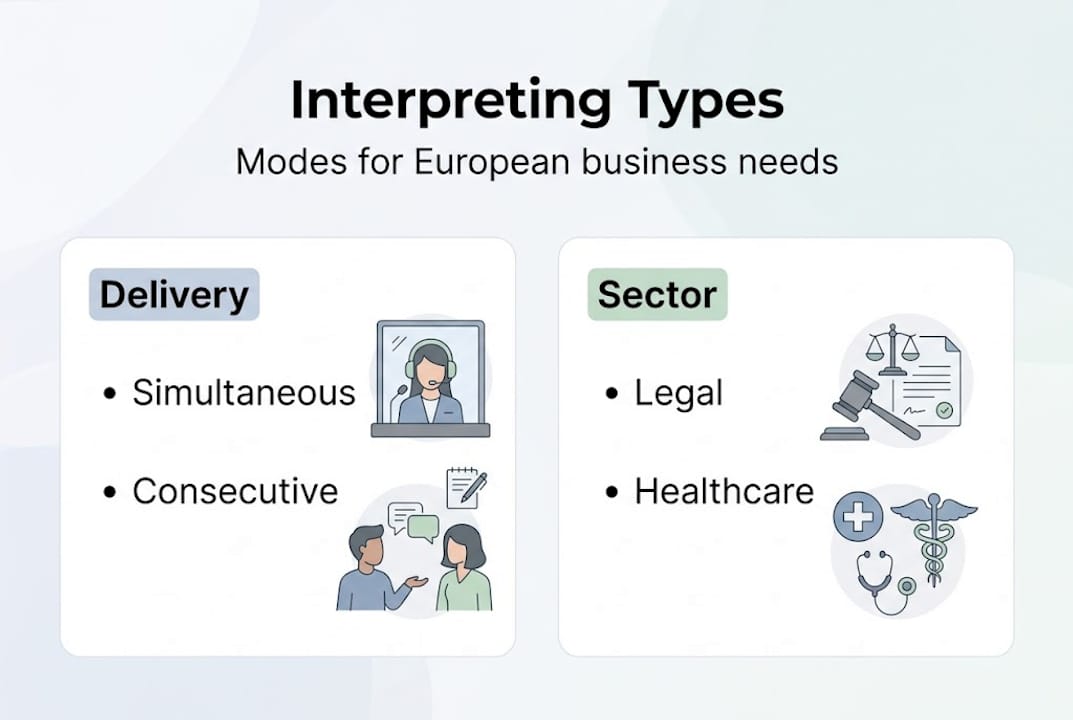
- Simultaneous interpreting: The interpreter renders speech into the target language in real time, with only a few seconds’ delay. This is common in conferences and multilingual business meetings.
- Consecutive interpreting: The speaker pauses to allow the interpreter to render each segment of speech. Widely used in legal depositions and medical assessments.
- Relay interpreting: Used when no interpreter is available for a rare language pair. One interpreter translates into a pivot language, and a second renders that into the final target language.
- Whispering (chuchotage): The interpreter whispers a simultaneous translation to one or two listeners. Useful in commercial site visits or small delegations.
The sectors that rely most heavily on remote interpreting include legal (court hearings, contract reviews, asylum interviews), healthcare (telemedicine, psychiatric assessments, clinical trials), and commercial (mergers and acquisitions, regulatory meetings, multilingual customer support). You can explore the full range of types of interpretation services to understand which modality fits your specific situation.

Research confirms that remote simultaneous interpreting is more cognitively demanding than on-site work, introduces technical challenges, and requires strong sector expertise. This finding matters because it underscores that remote interpreting is not a downgraded version of in-person work. It is a distinct specialism with its own standards and demands. Understanding the interpreters’ business impact helps organisations appreciate why selecting qualified professionals is non-negotiable.
| Modality | Delivery method | Typical sector | Key feature |
|---|---|---|---|
| Simultaneous | Live, real-time | Conferences, EU meetings | Minimal delay |
| Consecutive | Segment by segment | Legal, medical | High accuracy |
| Relay | Via pivot language | Rare language pairs | Extended chain |
| Whispering | Spoken softly | Commercial visits | Intimate settings |
How remote interpreting works: technology and delivery
With the concept clarified, it is vital to understand how remote interpreting is enabled and managed in practice.
The process typically follows these steps:
- Booking and briefing: The client contacts a provider, specifies the language pair, sector, date, and duration. The interpreter receives preparatory materials such as agendas, glossaries, and case documents.
- Platform selection: The session is hosted on a dedicated remote simultaneous interpreting (RSI) platform such as Interprefy, KUDO, or Interactio, rather than a generic video conferencing tool. These platforms are engineered for interpreter switching, audio isolation, and channel management.
- Technical checks: Both the interpreter and the client team run pre-session audio and connectivity tests. Interpreters use professional-grade headsets and operate in quiet, distraction-free environments.
- Live delivery: The interpreter renders speech in the agreed modality. In simultaneous mode, participants select their language channel and receive the interpretation in real time.
- Post-session review: For sensitive sectors, a debrief or quality review may follow, particularly in legal or clinical contexts.
Research notes that audio latency and visual cues represent key challenges in remote settings, alongside sector-specific jargon that can derail interpretation if interpreters are not properly prepared. Using generic video platforms rather than specialist RSI tools amplifies these risks considerably. Businesses should review our secure workflow for remote interpreting to understand how robust data handling and process management protect sensitive communications.
Pro Tip: Always send your interpreter a briefing pack at least 48 hours before the session. Include the meeting agenda, key terminology, speaker names, and any relevant documents. A well-prepared interpreter performs significantly better under the cognitive pressure of live simultaneous delivery.
Benefits and challenges of remote interpreting for European businesses
After learning how the process operates, it helps to weigh the business case’s rewards and obstacles carefully before making a decision.
Benefits:
- Speed and accessibility: Remote interpreting can be arranged at short notice, removing the logistical barriers of travel and venue setup. A legal team in Warsaw can access a certified Mandarin interpreter within hours.
- Global talent pool: You are no longer limited to interpreters who can travel to your location. This is particularly valuable for rare language pairs or highly specialised sectors such as pharmaceutical clinical trials.
- Cost efficiency: Eliminating travel and accommodation expenses for interpreters produces measurable savings, particularly for recurring multilingual meetings or large multinational projects.
- Continuity: Business negotiations, healthcare assessments, and compliance reviews can proceed regardless of geography or unexpected travel disruptions.
Challenges:
- Interpreter fatigue is heightened in remote settings due to reduced visual input and sustained concentration demands.
- Technical failures, including audio dropouts and platform instability, can interrupt critical proceedings.
- Loss of nonverbal context, such as body language and facial expressions, can affect accuracy in emotionally or legally nuanced interactions.
- Data security is a genuine concern, particularly in legal and healthcare contexts subject to GDPR and sector-specific regulations.
“83% of interpreters find remote work more demanding, with specialisation being crucial for handling jargon and cultural nuance in high-stakes environments.”
Consider a commercial example: a European fintech company negotiating a licensing agreement with a Japanese partner used a remote consecutive interpreter rather than a generic online translation tool. The interpreter’s familiarity with financial regulatory terminology prevented a significant misunderstanding around licensing exclusivity clauses. In healthcare, a telemedicine provider serving Arabic-speaking patients in Germany improved patient satisfaction scores measurably by switching from machine translation to certified interpreters in the EU. For legal practitioners, the stakes are even higher. Errors in courtroom or asylum interview interpretation can have life-altering consequences, which is why legal interpreting in Europe is governed by strict professional standards.
| Factor | On-site interpreting | Remote interpreting |
|---|---|---|
| Cost | Higher (travel, venue) | Lower (no travel costs) |
| Availability | Limited by geography | Global talent access |
| Setup time | Longer | Faster |
| Nonverbal cues | Fully available | Reduced |
| Security | Physical control | Requires encrypted platforms |
| Fatigue risk | Moderate | Higher |
Choosing a remote interpreting provider: what matters most
Knowing the benefits and drawbacks, the next practical step is choosing the right service for your organisation’s specific needs.
Not all providers are equal. The market includes highly specialised agencies and generalist platforms. For legal, healthcare, and commercial environments, the distinction is critical. Follow this checklist when evaluating a provider:
- Sector experience: Has the provider delivered interpreting in your specific sector? Ask for case studies or client references from legal, healthcare, or comparable commercial environments.
- Interpreter credentials: Confirm that interpreters hold recognised professional qualifications. In legal contexts, EU and national court accreditation is essential. In medical settings, healthcare interpreting certification matters.
- Platform security: Verify that the provider uses encrypted, GDPR-compliant platforms. Generic consumer video tools are not appropriate for sensitive business or clinical communications.
- Language range: Ensure the provider can cover all languages you require, including less common European languages and non-EU languages used in your markets.
- Technical support: Confirm that real-time technical support is available during sessions, not just before them.
- Briefing process: A credible provider will ask you for preparatory materials before every session. If they do not, treat that as a warning sign.
Established providers recommended for legal, healthcare, and commercial settings share common traits: rigorous interpreter vetting, specialist platform infrastructure, and clear protocols for sector-sensitive contexts. Reviewing the full overview of interpretation service types can help you match your requirement to the most appropriate delivery model before engaging a provider.
Pro Tip: In risk-prone situations such as court proceedings or clinical consultations, always prioritise sector experience over price. The cost of a misinterpreted exchange in a legal or medical context far exceeds any saving made on the service fee.
Why experienced interpreters and robust technology are non-negotiable
There is a persistent misconception in business circles that upgrading to a better platform solves the quality problem in remote interpreting. It does not. Technology creates the conditions for high-quality interpretation. It does not deliver it.
The human element is where outcomes are won or lost. Research shows that remote cognitive demands increase significantly in remote settings, and only sector-specific expertise shields organisations from critical errors. An interpreter unfamiliar with pharmaceutical regulatory language, for example, may select a plausible but legally distinct term, and neither party will notice until the damage is done.
Organisations that treat interpretation as a commodity risk underestimating this exposure. The right approach pairs a robust, secure technology infrastructure with interpreters whose credentials, sector knowledge, and preparation protocols match the seriousness of the communication. For event-scale needs, working with expert interpreters for events demonstrates how skilled professionals elevate every multilingual interaction. People first. Technology in support.
Unlock better multilingual communication for your business
If multilingual success is on your agenda, the right provider makes all the difference. Glocco® has been delivering tailored interpretation and language services to legal, healthcare, and commercial organisations across Europe since 2014. Our vetted interpreters bring sector-specific expertise and work within secure, professionally managed platforms designed for high-stakes communication. Explore our professional interpreting solutions to find the right fit for your needs, or use our language services checklist to evaluate your current multilingual strategy.
Frequently asked questions
What is remote interpreting and how does it differ from traditional interpreting?
Remote interpreting delivers spoken language services via digital platforms without the interpreter being physically present, whereas traditional interpreting requires the interpreter to be on-site with all parties. Both require equivalent professional standards, but remote settings introduce additional technical and cognitive considerations.
What are the main challenges in remote interpreting?
The primary challenges are greater cognitive load on interpreters, audio quality issues such as latency, and the requirement for strong sector-specific knowledge to avoid errors in specialist terminology. These risks are significantly reduced when providers invest in both qualified interpreters and professional-grade platforms.
Which sectors in Europe benefit most from remote interpreting?
Legal, healthcare, and commercial sectors show the highest adoption of remote interpreting across Europe, driven by the need for fast, accurate, multilingual communication in court settings, telemedicine, and international business negotiations.
How should businesses choose a remote interpreting provider?
Prioritise providers with verifiable sector experience, professional interpreter certifications, and technology platforms that meet GDPR and security requirements relevant to your industry. Request references from comparable use cases before committing.


